


This article was automatically translated from the original Turkish version.
Vampire Squid
Scientific Name(s) | Vampyroteuthis infernalis | ||||||||
|---|---|---|---|---|---|---|---|---|---|
Taxonomy | Mollusca > Cephalopoda > Vampyromorpha | ||||||||
Size(s) | Approximately 30 cm | ||||||||
Habitat | Deep sea (600–900 m and deeper) | ||||||||
Diet(s) | Particulate organic matter and microorganisms | ||||||||
Characteristics | no ink sac bioluminescence Eight arms | ||||||||
Evolutionary Position | A distinct lineage between squids and octopuses | ||||||||
Lifespan | Long-lived, slow-growing | ||||||||
Defense | Confusing predators with light production | ||||||||
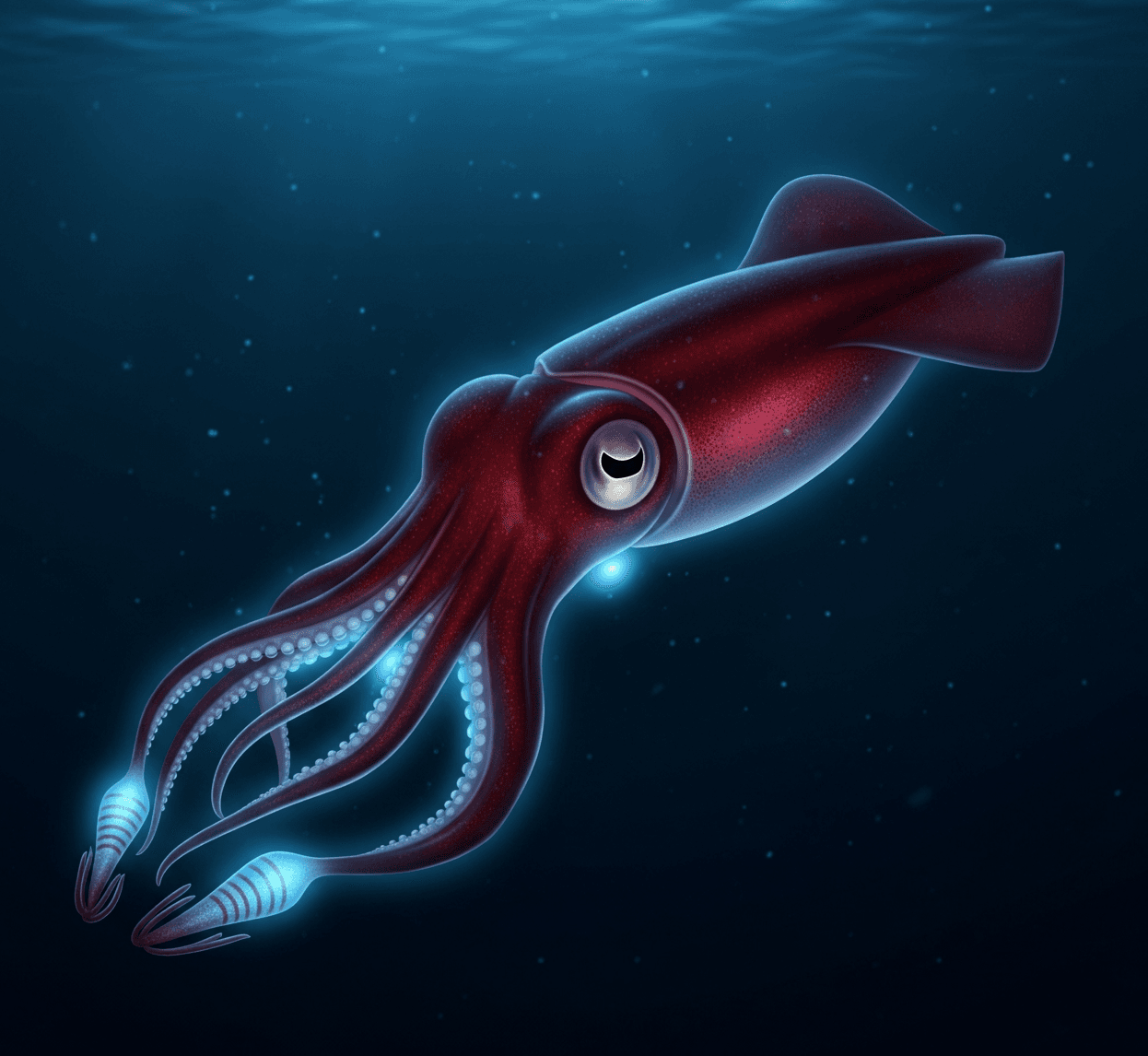
The vampire squid (Vampyroteuthis infernalis) is a rare species distinguished by its unique structure and adaptations among deep-sea cephalopods. This organism thrives in cold, dark, oxygen-poor pelagic environments at depths ranging from 600 to 900 meters and beyond. Taxonomically belonging to the order Vampyromorpha, the vampire squid represents a distinct group that serves as an evolutionary bridge between squids and octopuses. It typically reaches a length of 30 cm and exhibits morphological traits characteristic of both squids and octopuses. The vampire squid’s unique biology, ecology, and defense mechanisms are of significant importance for understanding specialized life forms in deep-sea ecosystems.
Vampire Squid (Generated by Artificial Intelligence)
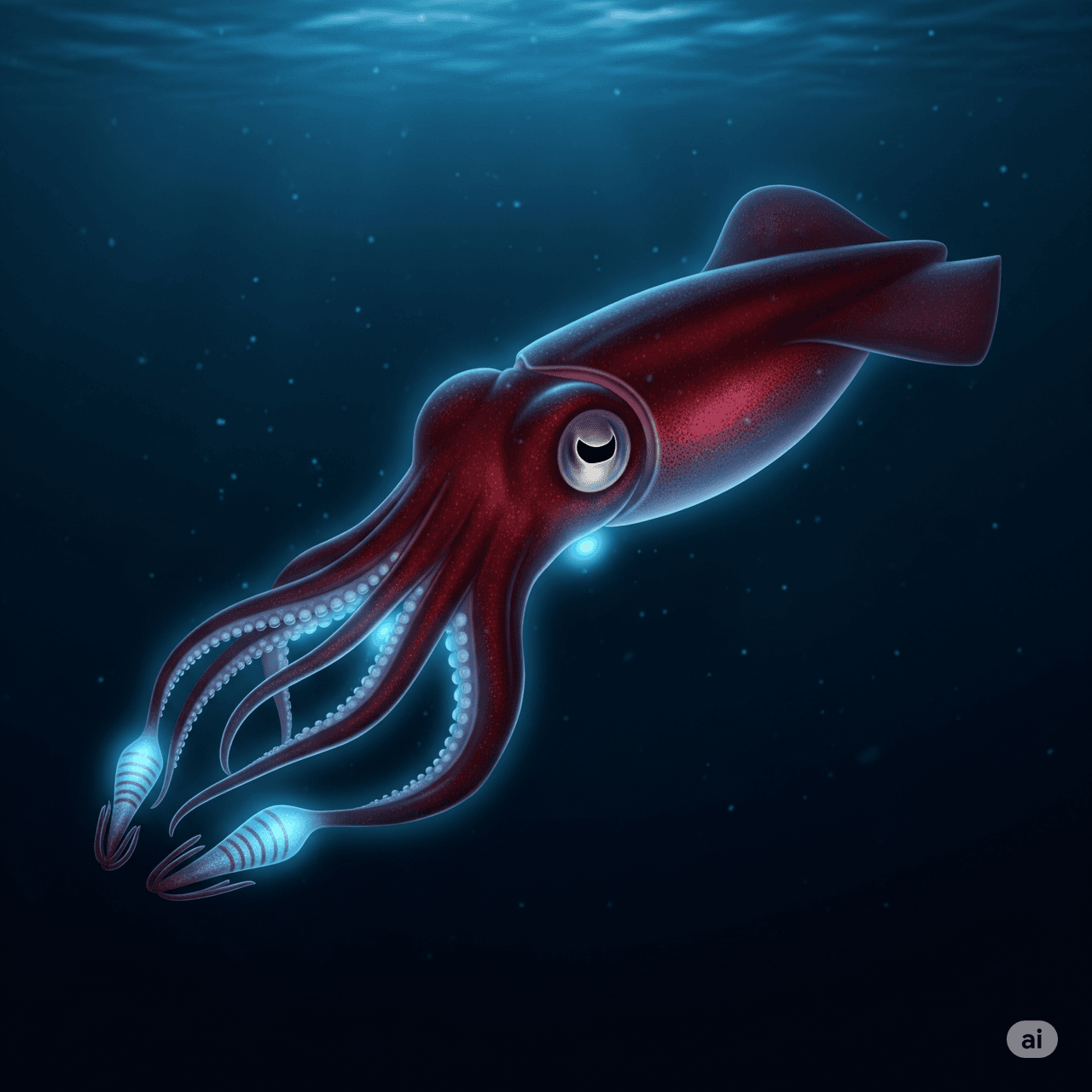
The external appearance of the vampire squid differs from that of other cephalopods. In addition to its eight arms, it possesses filamentous structures between the arms. These structures do not function in hunting or locomotion but play a role in environmental sensing and self-defense. Adapted to the deep-sea environment, this species lacks a traditional ink sac; instead, it has evolved a defensive strategy based on bioluminescence. Light-producing organs located at the tips of its arms flicker in response to environmental conditions, confusing potential predators. The vampire squid’s statocyst is a crucial organ for balance, and detailed morphological analyses have revealed structural differences that distinguish it from other cephalopods.
The vampire squid typically inhabits depths between 600 and 900 meters, though it has been observed descending as deep as 3,000 meters. Oxygen concentrations at these depths are extremely low. The vampire squid distinguishes itself from other cephalopods through its high tolerance for low oxygen levels and has developed survival strategies suited to this environment. As a pelagic species, it survives by swimming through the water column and avoiding predators.
The feeding habits of the vampire squid were previously misunderstood. Although once thought to be carnivorous, later research has shown that it primarily feeds on particulate organic matter such as marine snow and microorganisms. This species collects suspended organic material using its arm filaments and adhesive structures. It can also move with controlled precision using fin-like appendages. Ontogenetic changes in locomotion—employing different swimming patterns at various life stages—enhance the species’ ability to survive in the deep sea.
Although knowledge of the vampire squid’s life cycle remains limited, it is believed to have a slow development and long lifespan, similar to other deep-sea cephalopods. Its reproductive strategies and embryonic development processes have not yet been fully elucidated, but genetic and morphological studies are gradually expanding understanding in this area. The biology of this species provides important insights into the overall functioning of deep-sea ecosystems.
The vampire squid occupies a unique position in the evolutionary history of cephalopods. Recognized as descending from a common ancestor shared with both squids and octopuses, it represents a separate taxonomic group. Morphological and molecular data support its distinct structural characteristics. These features are critically important for understanding the evolutionary diversity of deep-sea life.
Due to its deep-sea habitat, direct human impacts on the vampire squid are limited. However, indirect factors such as marine pollution and climate change may affect its survival. A better understanding of the species’ biological traits will aid in developing strategies to protect deep-sea habitats.
Flusser, V., & Bec, L. (2012a). Vampyroteuthis infernalis. In *Imprensa da Universidade de Coimbra eBooks*. https://doi.org/10.14195/978-989-26-1128-0
Flusser, V., & Bec, L. (2012b). *Vampyroteuthis Infernalis: A Treatise, with a Report by the Institut Scientifique de Recherche Paranaturaliste*. https://philpapers.org/rec/FLUVIA
Robison, B. H., Reisenbichler, K. R., Hunt, J. C., & Haddock, S. H. D. (2003). Light Production by the Arm Tips of the Deep-Sea CephalopodVampyroteuthis Vampyroteuthis infernalis. *Biological Bulletin*, *205*(2), 102–109. https://doi.org/10.2307/1543231
Schwarz, R., Piatkowski, U., Robison, B. H., Laptikhovsky, V. V., & Hoving, H. (2020). Life history traits of the deep-sea pelagic cephalopods Japetella diaphana and Vampyroteuthis infernalis. *Deep Sea Research Part I Oceanographic Research Papers*, *164*, 103365. https://doi.org/10.1016/j.dsr.2020.103365
Seibel, B. A., Thuesen, E. V., & Childress, J. J. (1998). Flight of the Vampire: Ontogenetic Gait-Transition in Vampyroteuthis infernalis (Cephalopoda: Vampyromorpha). *Journal of Experimental Biology*, *201*(16), 2413–2424. https://doi.org/10.1242/jeb.201.16.2413
Stephens, P. R., & Young, J. Z. (1976). The statocyst of Vampyroteuthis infernalis (Mollusca: Cephalopoda). *Journal of Zoology*, *180*(4), 565–588. https://doi.org/10.1111/j.1469-7998.1976.tb04704.x

Vampire Squid
Scientific Name(s) | Vampyroteuthis infernalis | ||||||||
|---|---|---|---|---|---|---|---|---|---|
Taxonomy | Mollusca > Cephalopoda > Vampyromorpha | ||||||||
Size(s) | Approximately 30 cm | ||||||||
Habitat | Deep sea (600–900 m and deeper) | ||||||||
Diet(s) | Particulate organic matter and microorganisms | ||||||||
Characteristics | no ink sac bioluminescence Eight arms | ||||||||
Evolutionary Position | A distinct lineage between squids and octopuses | ||||||||
Lifespan | Long-lived, slow-growing | ||||||||
Defense | Confusing predators with light production | ||||||||
No Discussion Added Yet
Start discussion for "Vampire Squid (Vampyroteuthis infernalis)" article
Morphology and Anatomical Features
Habitat and Ecology
Feeding and Behavior
Reproduction and Life Cycle
Evolutionary Significance and Systematic Position
Conservation Status and Human Impacts