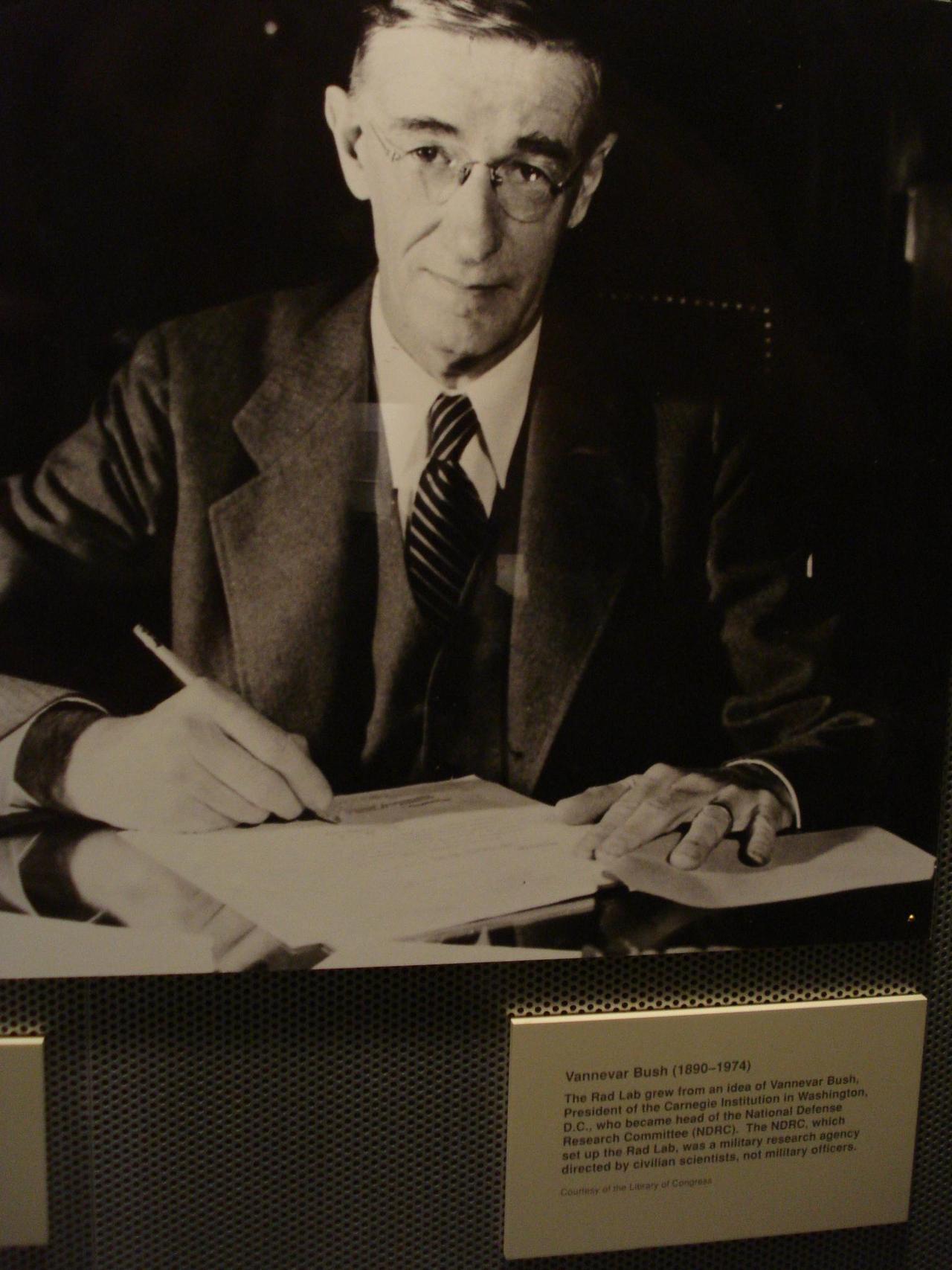
Death | June 30, 1974 | ||||||||
|---|---|---|---|---|---|---|---|---|---|
Birth | March 11, 1890, Everett, Massachusetts, United States of America | ||||||||
Profession(s) | Engineer Science Administrator Academic | ||||||||
Notable Areas of Work | Central organization of scientific research during wartime, development of postwar publicly funded science policies, institutionalization of university-based basic research | ||||||||
Public Offices | Leadership of the National Advisory Committee for Aeronautics, leadership of the Office of Scientific Research and Development | ||||||||
Academic Positions | Faculty and administrative roles at the Massachusetts Institute of Technology, presidency of the Carnegie Institution of Washington | ||||||||
Areas of Expertise | Engineering, Science Policy, Research Management | ||||||||
Vannevar Bush, born in 1890 in the United States, was a scientist and administrator who held roles in engineering, science management, and public policy. Bush combined academic work with public service, playing a key role in organizing scientific research during World War II and in institutionalizing science policy in the postwar period. His contributions are understood within the framework of linking scientific knowledge to public benefit and long-term societal needs.
After completing his engineering education, Vannevar Bush entered academia. His early work focused on applying systematic methods to engineering problems, and while serving as a university faculty member, he also assumed administrative responsibilities. The experience gained during this period shaped his approach to planning and sustaining research activities within university structures.
Massachusetts Institute of Technology, where he held various positions, he worked to strengthen the connection between engineering education and applied research. It became clear during this time that universities should not merely be institutions of teaching but also of knowledge production and societal engagement. Later, as president of the Carnegie Institution of Washington, he took on responsibility for supporting fundamental scientific research and managing long-term research programs.
In the late 1930s, Vannevar Bush served on national committees coordinating science and engineering efforts. In these roles, he participated in planning aviation, defense technologies, and engineering research. This period, during which he directly experienced the relationship between public administration and scientific research, formed the foundation of his later administrative approach.【1】
During World War II, Bush assumed leadership of an institution that coordinated scientific research under a centralized structure. This role involved creating collaboration mechanisms between universities, industrial organizations, and military institutions. Research activities were conducted as large-scale programs with coordination across multiple disciplines.【2】
Under Bush’s leadership during the war, the organization coordinated research in diverse fields such as defense technologies, medical science, and engineering applications. Scientific activities were planned as targeted programs, and universities and the private sector were institutionally integrated into this effort.
This organizational model of scientific research contributed to the widespread adoption of the publicly funded research model. Research activities were carried out through institutional frameworks rather than individual initiatives, and the relationship between scientists and public institutions was formalized within a more structured system.
Near the end of the war, Vannevar Bush prepared a comprehensive policy document addressing the role of scientific research in peacetime. This work emphasized the connection between fundamental scientific research and long-term societal well-being, health, and economic development. It stressed that the continuity of scientific knowledge must be preserved independently of short-term applications.
In this approach, the role of the state was defined not as a direct manager of scientific research but as a supporter providing appropriate funding and working conditions for universities and research institutions. Training young researchers, ensuring the continuity of scientific human capital, and strengthening fundamental research were key components of this framework.
Vannevar Bush’s approach to science policy significantly influenced the development of publicly funded research systems after the war. The expansion of university research infrastructure, the planning of scientific work through long-term programs, and the regular allocation of public resources to research activities are among the outcomes of this process.
A central feature of Bush’s approach was addressing the relationship between the production of scientific knowledge and societal needs at the institutional level. This framework was based on the assumption that scientific research should not be reduced solely to short-term applications.
The National Medal of Science is a national honor awarded in the United States for contributions to science and engineering. Vannevar Bush received this medal for his contributions to organizing scientific research for public benefit, his work in engineering and science policy, and his role in institutionalizing research systems.
National Academy of Sciences of the United States awarded this medal to recognize contributions toward the application of science for public benefit. Bush was honored with this award for his efforts to link scientific knowledge with public policy, develop state-supported research models, and strengthen the connection between science and society.
Membership in the National Academy of Sciences is an academic honor bestowed upon individuals who have made lasting contributions to science and engineering. Vannevar Bush’s membership was recognized for both his work in engineering and his institutional impact on the management of scientific research and science policy.
Akyos, Müfit. “Bilimin Sonsuz Ufuklarının Peşinde 75 Yıl: Vannevar Bush (1890–1974).” *HBT Herkese Bilim Teknoloji Dergisi* 251 (January 15, 2021). Accessed January 12, 2026. https://www.inovasyon.org/images/makaleler/pdf/MA_HBT_Bilim_-_Sonsuz_Ufuklar_MA_15_Ocak_2021.pdf
Amy. “Vannevar Bush.” Flickr. Accessed February 13, 2026. https://www.flickr.com/photos/ultimatelibrarian/3396353063/in/photostream/
Assis, José Luis. “Report Vannevar Bush: Science the Endless Frontiers.” *Journal of Historical Archaeology & Anthropological Sciences* 3, no. 3 (2018): 467–470. Accessed January 12, 2026. https://www.researchgate.net/publication/329940591_Report_vannevar_bush_science_the_endless_frontiers
Bush, Vannevar. *Science, The Endless Frontier: A Report to the President*. Washington, DC: United States Government Printing Office, 1945. (National Science Foundation Reissue). Accessed January 12, 2026. https://nsf-gov-resources.nsf.gov/2023-04/EndlessFrontier75th_w.pdf
Bush, Vannevar. *Science, the Endless Frontier: A Report to the President*. Washington, DC: United States Government Printing Office, 1945. Accessed January 12, 2026. https://www.pi.infn.it/~giorgio/INFN/3M/SciencetheEndlessFrontier.pdf
Bush, Vannevar. “As We May Think.” *Interactions* 3, no. 2 (1996): 35–46. Accessed January 12, 2026. https://doi.org/10.1145/227181.227186
Gross, Daniel P., and Bhaven N. Sampat. *Inventing the Endless Frontier: The Effects of the World War II Research Effort on Post-War Innovation*. Working Paper 20-126. Harvard Business School, 2020. Accessed January 12, 2026. https://www.hbs.edu/ris/Publication%20Files/20-126_0b1ab239-51c4-43ad-9bd8-290bc9caa965.pdf
Issues in Science and Technology. "Episode 10: Creating a ‘High-Minded Enterprise’: Vannevar Bush and Postwar Science Policy." Issues in Science and Technology. March 14, 2022. Accessed January 12, 2026. https://issues.org/episode-10-vannevar-bush-science-policy/
Library of Congress. “Mr. Vannevar Bush, Chief of Scientific Research and Development, Office of Production Management (OPM).” Picryl. Accessed February 13, 2026. https://picryl.com/media/mr-vannevar-bush-chief-of-scientific-research-and-development-office-of-production
Miri, Johnny. “The Fall of Vannevar Bush: The Forgotten War for Control of Science Policy in Postwar America.” *Historical Studies in the Natural Sciences* 51, no. 4 (2021): 507–541. Accessed January 12, 2026. https://doi.org/10.1525/hsns.2021.51.4.507
[1]
Gross, Daniel P., and Bhaven N. Sampat. Inventing the Endless Frontier: The Effects of the World War II Research Effort on Post-War Innovation. Working Paper 20-126. Harvard Business School, 2020. 507–520, Access Date: 12 January 2026. https://www.hbs.edu/ris/Publication%20Files/20-126_0b1ab239-51c4-43ad-9bd8-290bc9caa965.pdf
[2]
Assis, José Luis. “Report Vannevar Bush: Science the Endless Frontiers.” Journal of Historical Archaeology & Anthropological Sciences 3, no. 3 (2018): 467–470. Access Date: 12 January 2026. https://www.researchgate.net/publication/329940591_Report_vannevar_bush_science_the_endless_frontiers

Death | June 30, 1974 | ||||||||
|---|---|---|---|---|---|---|---|---|---|
Birth | March 11, 1890, Everett, Massachusetts, United States of America | ||||||||
Profession(s) | Engineer Science Administrator Academic | ||||||||
Notable Areas of Work | Central organization of scientific research during wartime, development of postwar publicly funded science policies, institutionalization of university-based basic research | ||||||||
Public Offices | Leadership of the National Advisory Committee for Aeronautics, leadership of the Office of Scientific Research and Development | ||||||||
Academic Positions | Faculty and administrative roles at the Massachusetts Institute of Technology, presidency of the Carnegie Institution of Washington | ||||||||
Areas of Expertise | Engineering, Science Policy, Research Management | ||||||||
Education and Academic Career
Public Service and Administrative Roles
Scientific Organization During World War II
Postwar Science Policy Approach
Institutional Impact and Long-Term Outcomes
Awards and Honors
National Medal of Science
Medal for Merit
Membership in the National Academy of Sciences of the United States