


This article was automatically translated from the original Turkish version.
Vantablack
Meaning(s) | Vertically Aligned Nanotube Arrays | ||||||||
|---|---|---|---|---|---|---|---|---|---|
Artistic Property | Artistic usage rights have been acquired by artist Anish Kapoor | ||||||||
Optical Property | Absorbs almost all light falling on its surface | ||||||||
Pigment Condition | Does not contain pigment, has structural color | ||||||||
Light Absorption Rate | 99.96% (visible light) | ||||||||
Material Type | Carbon nanotube based nanomaterial | ||||||||
Area(s) of Use | Astronomy Architecture Art Defense | ||||||||
Vantablack is a material known for its structure composed of carbon nanotubes and its extremely low reflectivity. It derives its name from the initials of the phrase “Vertically Aligned NanoTube Arrays,” which indicates that the material consists of carbon nanotubes aligned vertically at the microscopic scale.
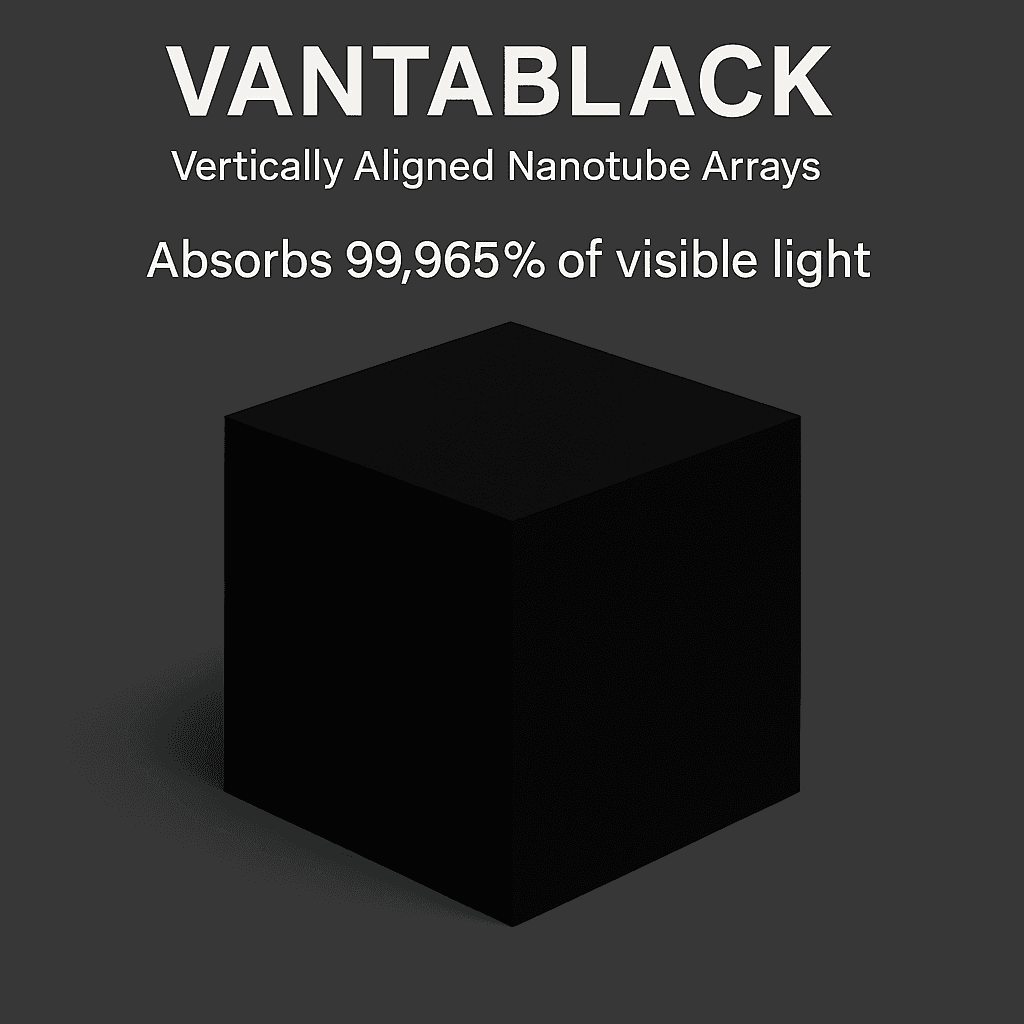
Vantablack can absorb up to 99.965 percent of visible light falling on its surface. Due to this property, it reduces the perception of shape and depth on applied surfaces. Unlike conventional black pigments, Vantablack possesses a specialized surface structure that minimizes reflection to an absolute minimum. In this sense, it is not merely a color but a material with the property of absorbing light.

Visual Representing Vantablack Material (Generated by Artificial Intelligence)
Vantablack is produced by growing carbon nanotubes on specific surfaces using the chemical vapor deposition (CVD) method. During production, the nanotubes are oriented perpendicularly to the surface and measure several micrometers in length and only nanometers in diameter. This arrangement allows incoming light to enter between the nanotubes, undergo multiple reflections, and ultimately be completely absorbed.
Due to this structural characteristic, the material cannot be applied like standard paint. Its application requires specialized equipment and technical expertise. The physical and chemical properties of the substrate play a decisive role in the outcome.
Vantablack exhibits very high light absorption in the visible and near-infrared regions of the electromagnetic spectrum. The majority of incident light is absorbed without reflection, making it suitable for applications requiring minimal reflectivity.
The material is also valuable for its thermal conductivity. The high heat resistance and thermal emission properties of carbon nanotubes enable Vantablack to be used in thermal systems. Because it can absorb infrared radiation, it has been evaluated for use in thermal cameras and sensors to reduce background noise.
Vantablack was developed primarily for use in fields requiring high optical sensitivity. It has been employed in satellite telescopes, optical sensors, laser systems, and thermal imaging devices to minimize reflections. It has also been considered for applications in the defense industry where surfaces with low reflectivity are needed.
The material has occasionally been used in architectural design, art, and industrial product development due to its visual impact. However, application conditions and licensing restrictions limit its widespread use.
The restriction of Vantablack’s artistic use to specific individuals or institutions has sparked debate in public discourse and the art community. In particular, the exclusive rights granted to British artist Anish Kapoor for artistic use of Vantablack have been criticized for limiting accessibility and freedom of artistic expression.
In response to this situation, initiatives have emerged to develop and make publicly available alternative ultra-black pigments with similar optical properties. These discussions have brought ethical considerations regarding ownership and access to scientific discoveries to the forefront.

Visual Representing the Use of Vantablack Material on the Surface of Artist Anish Kapoor’s Sculpture “Cloud Gate” (Generated by Artificial Intelligence)
Vantablack has been researched and applied in specific contexts as a material capable of absorbing light to a high degree and exhibiting extremely low reflectivity, particularly in materials science, optical systems, and specialized design fields. Although its carbon nanotube-based structure imposes technical limitations on its production process, it effectively addresses certain engineering and scientific needs.
Labidi, Aymen. "Vantablack." Nsat (Tunis: National Institute of Applied Science and Technology). Accessed June 4, 2025.
Theocharous, S.P., E. Theocharous, and J.H. Lehman. "The Evaluation of the Performance of Two Pyroelectric Detectors with Vertically Aligned Multi-Walled Carbon Nanotube Coatings." *Infrared Physics & Technology* 55, no. 4 (2012): 299–305. Accessed June 4, 2025. https://www.sciencedirect.com/science/article/abs/pii/S1350449512000291?via%3Dihub
TÜBİTAK Bilim Genç. "Vantablack: Daha Siyahı Yok." Bilim Genç. Accessed June 4, 2025.

Vantablack
Meaning(s) | Vertically Aligned Nanotube Arrays | ||||||||
|---|---|---|---|---|---|---|---|---|---|
Artistic Property | Artistic usage rights have been acquired by artist Anish Kapoor | ||||||||
Optical Property | Absorbs almost all light falling on its surface | ||||||||
Pigment Condition | Does not contain pigment, has structural color | ||||||||
Light Absorption Rate | 99.96% (visible light) | ||||||||
Material Type | Carbon nanotube based nanomaterial | ||||||||
Area(s) of Use | Astronomy Architecture Art Defense | ||||||||
Structure and Production Process
Optical and Thermal Properties
Applications
Social Reactions and Ethical Issues