


This article was automatically translated from the original Turkish version.
Vasa is a warship built for the Swedish Navy in the 17th century. On its maiden voyage on 10 August 1628 in the harbor of Stockholm, it sank after traveling less than a nautical mile (1.85 km). The ship’s hull was raised from the sea in 1961 and, after a long process of conservation and reconstruction, it began to be displayed in 1990 at the Vasa Museum in Stockholm. It is estimated that 98 percent of the hull remains intact, making it the oldest intact wooden ship ever recovered.
The construction of Vasa coincided with Sweden’s rise as a military and political power in Europe under King Gustavus Adolphus II (reigned 1611–1632). During this period, Sweden sought to strengthen its influence in the Baltic region by establishing a professional and enduring army. The king placed particular emphasis on enhancing the navy due to ongoing dynastic conflicts with the Polish–Lithuanian Commonwealth and competition for regional dominance. Vasa was one of the first large, heavily armed ships built as part of this naval expansion program. Sweden had gained independence from the Kalmar Union in 1523 and, initially a resource-limited country, had become militarily stronger by the early 17th century through its natural resources—iron, copper, and timber—and a weapons industry developed with Dutch investment. The fiscal-military reforms implemented under Gustavus Adolphus enabled Sweden to maintain permanent armed forces.
In the early modern period, Sweden established close ties with the rising power of the Dutch Republic. Trade, shared religious and political outlooks, and common adversaries—particularly Denmark’s naval supremacy in the Baltic—brought the two states together. Sweden acquired military technology, weapons production methods, tactics, and shipbuilding knowledge from the Netherlands. Dutch shipwrights, renowned across Europe for their vessels and craftsmanship, were employed in the construction of the Swedish navy. Henrik Hybertsson and Henrik Jacobsson, the shipwrights responsible for Vasa’s design and construction, were both Dutch masters.
In the early 17th century, naval power became a key instrument for achieving state political objectives. Shipbuilding technology evolved as sailing ships transformed into mobile platforms capable of carrying more and larger cannons. Vasa was designed to be among the most powerful warships in Europe at the time, with the specific aim of outmatching other vessels in total broadside weight. The ship was intended to carry a standardized battery of guns, a novel development in naval warfare at the time. Under Gustavus Adolphus, the Swedish navy shifted its doctrine from building numerous small vessels to constructing fewer but larger, heavily armed ships. Vasa was the first ship built under this doctrine.
Vasa was designed and built according to the early modern Dutch shipbuilding tradition, which differed from practices in other European countries by lacking detailed pre-prepared technical drawings or plans. Dutch master shipwrights constructed ships largely by eye, relying on oral design principles and their own experience and judgment. Within this tradition, two main methods existed: the Northern (Amsterdam-based) and Southern (Rotterdam-based) methods. Structural features of Vasa’s hull indicate that it was built using the Northern method.
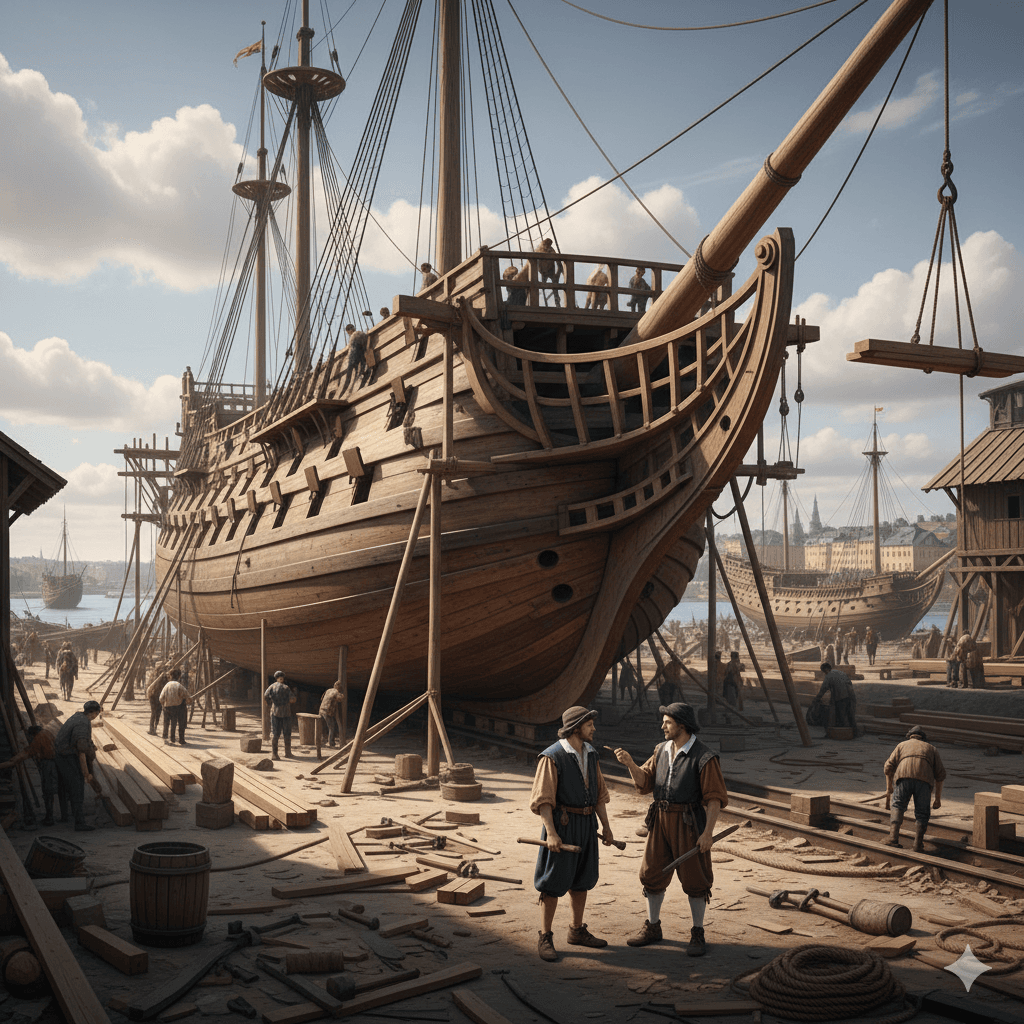
Construction of Vasa on the Keel at the Stockholm Shipyard in the 1620s (Generated by AI)
Construction began with the assembly of the keel, stem, sternpost, and associated structural elements (the keel group). Next, the bottom planks (keel planks) were temporarily fastened together using cleats. At this stage, the cross-sectional shape of the hull was shaped by the shipwright’s eye and tools such as the hel and boeitangen. Once the bottom planking was complete, a single main frame (bend) was placed at the ship’s widest point (hals), and the turn of the bilge planking followed this frame as a guide. After the bilge planking was finished, the temporary cleats were removed and the hull was filled with keel frames and lower futtocks (frame sections). The shape of these frames was determined by the curvature of the existing planking. The frames were attached only to the planking, not to each other. Subsequently, secondary futtocks were installed intermittently, and over them a main ribband, called a scheerstrook, was fastened. The position of this ribband determined the height of the ship’s maximum beam, the sheer line (longitudinal curvature of the deck), and the main deck level. The remaining frames, deck beams, and inner and outer planking were then completed. The ship was typically launched at this stage, with the superstructure finished above water. Archaeological evidence confirming the use of the Northern Method includes the presence of spijkerpennen (small wooden plugs that filled the holes of temporary cleats) and the fact that the frames were not connected to each other.
Design during construction relied on proportions and arithmetic methods. Main dimensions—length, width, and depth—were typically specified in a contract known as a bestek, with other dimensions derived from these. Correspondence regarding the contract negotiations for Vasa survives; however, the ship’s final dimensions differed from those specified. For example, the observed keel length (129 Swedish feet) is shorter than the 136 Swedish feet specified in the contract, consistent with Hybertsson’s written remark that the ship would be “somewhat smaller than specified.” The main width (maximum beam) was measured at the hals. Vasa’s width at this point is 37 Swedish feet 5 inches. According to Henrik Jacobsson, after Hybertsson’s death, he widened the ship by 1 Swedish foot 5 inches, suggesting the original design may have been 36 Swedish feet wide. The ship was designed and built using Swedish feet. Design decisions were largely based on the shipwright’s experience and judgment.
The primary responsibility for the design and construction of the ship lay with the Dutch shipwrights Henrik Hybertsson and his assistant Henrik Jacobsson, who took over after Hybertsson’s death in the spring of 1627. Jacobsson continued as one of Sweden’s leading naval shipwrights after completing Vasa and went on to build other successful warships.
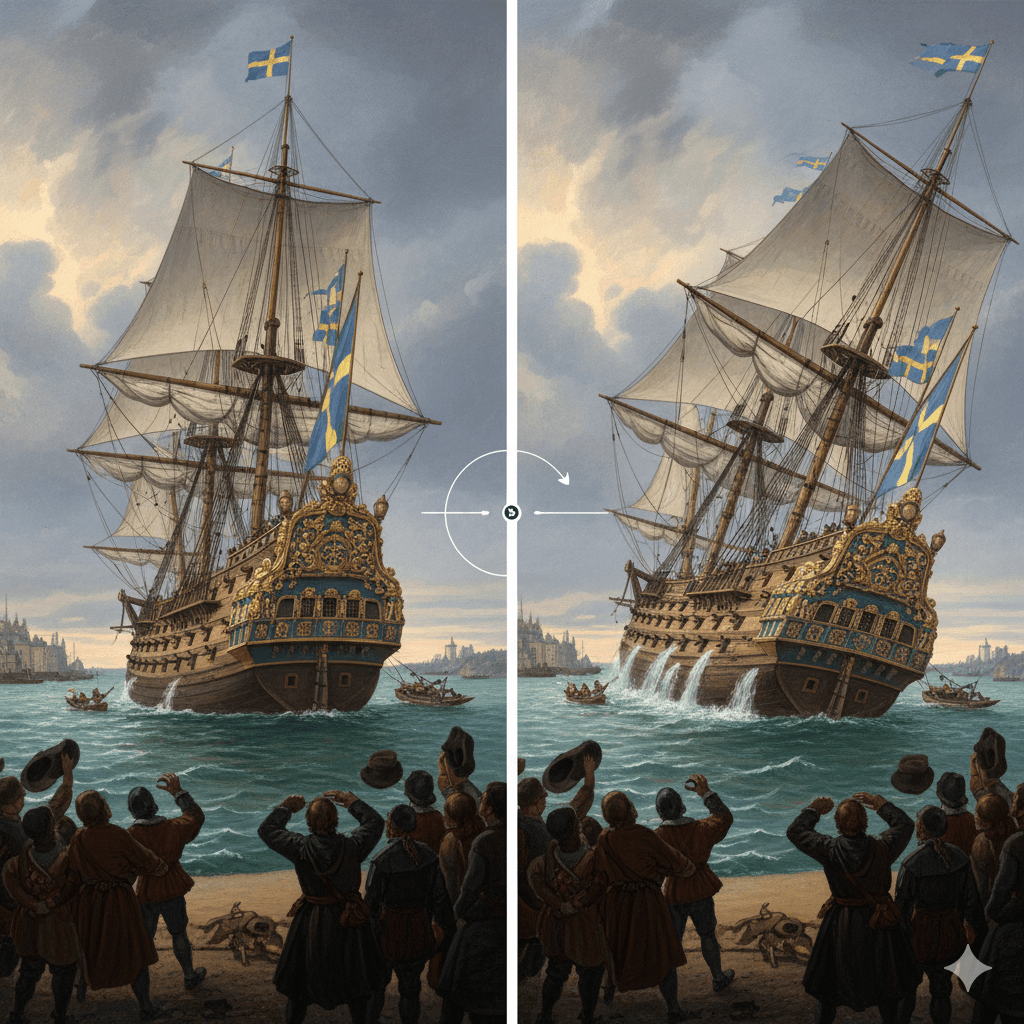
The Grand Maiden Voyage of Vasa and Its Subsequent Dramatic Sinking (Generated by AI)
Vasa sank on the afternoon of 10 August 1628 during its maiden voyage in the harbor of Stockholm. The ship had traveled less than a nautical mile. A sudden gust of wind from the starboard quarter caused the vessel to heel over to port, and water began flooding in through the open lower gunports, leading to its rapid sinking. A stability test conducted shortly before the voyage had failed.
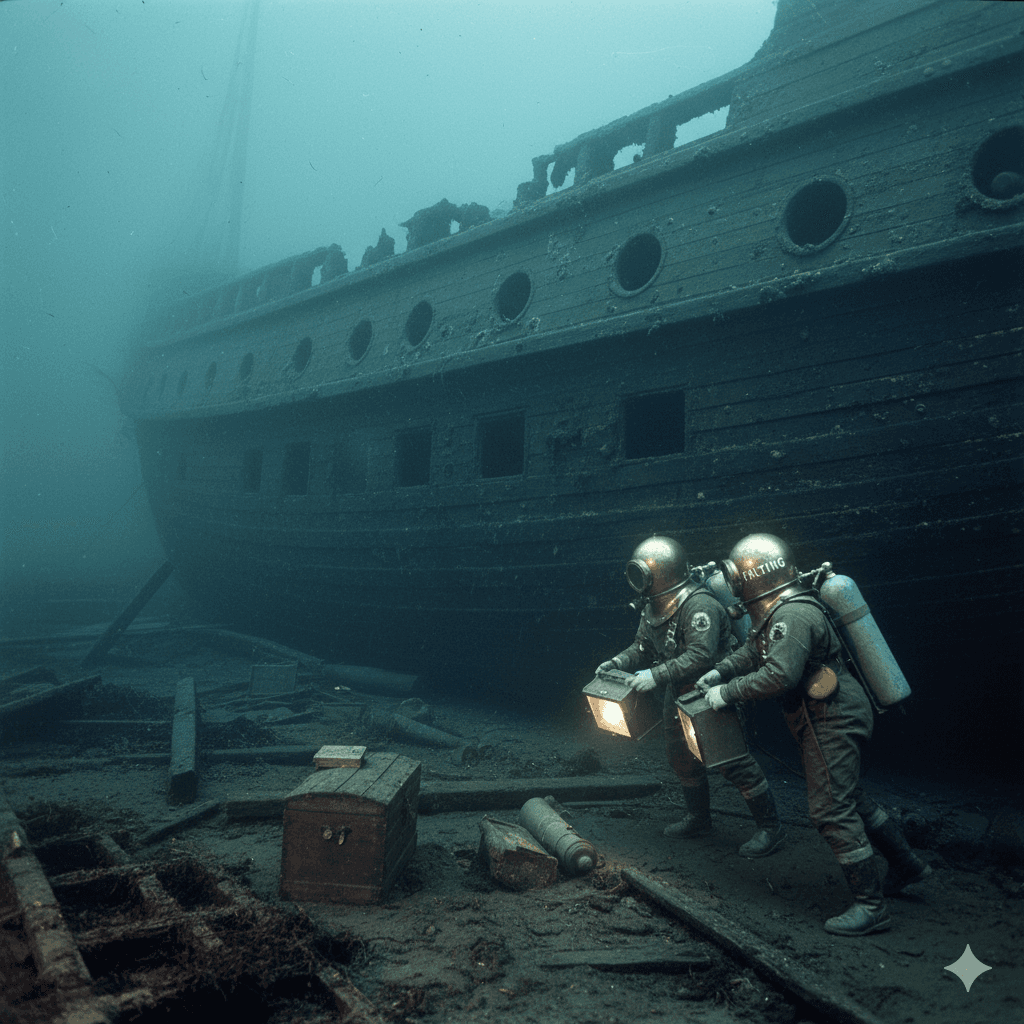
The Hull Being Raised from the Water Using Steel Cables Attached to Pontoons (Generated by AI)
After sinking, the ship’s location was forgotten. It was rediscovered in 1956 by amateur archaeologist Anders Franzén and diver Per Edvin Fälting. Between 1957 and 1961, tunnels were dug beneath the wreck by Swedish Navy divers and steel cables were threaded through them. The first timbers of the wreck surfaced on the morning of 15 January 1961, and by early May the hull was lifted onto a specially constructed pontoon, where it remains today.
Immediately afterward, archaeological excavations began inside the hull. Over five months of work, more than 30,000 artifacts were recovered from the four decks. Polyethylene glycol (PEG) was used for conservation. From 1962, a sprinkler system sprayed PEG onto the interior and exterior of the ship for 17 years, followed by a nine-year controlled drying process. Thousands of wooden fragments, sculptures, and other items that had fallen off the hull underwater were later retrieved in additional dives. Hydraulic jacks were used to restore the hull to a shape close to its original form, and over 5,000 new steel bolts replaced the corroded original iron fastenings.
The hull has undergone structural deformation due to factors including its 333 years underwater, the recovery operation, the PEG conservation process, the drying phase, and the support structure in the museum. It is estimated that the timbers have experienced an average 6 percent tensile stress perpendicular to the grain. Additionally, cracks developed in the sternpost during efforts to restore the ship to its original shape. Human remains were also found during the excavation.
While conservation continued, the ship was opened to the public in 1961 in a temporary structure called the Wasa Shipyard. Construction of the permanent Vasa Museum began in 1987. The ship, still on its pontoon, was moved into the new museum building in November 1988. The museum officially opened in the summer of 1990. The ship is displayed on the same pontoon and steel support cradle used during the recovery operation. The museum attracts over one million visitors annually. Research into the long-term preservation of the ship continues.
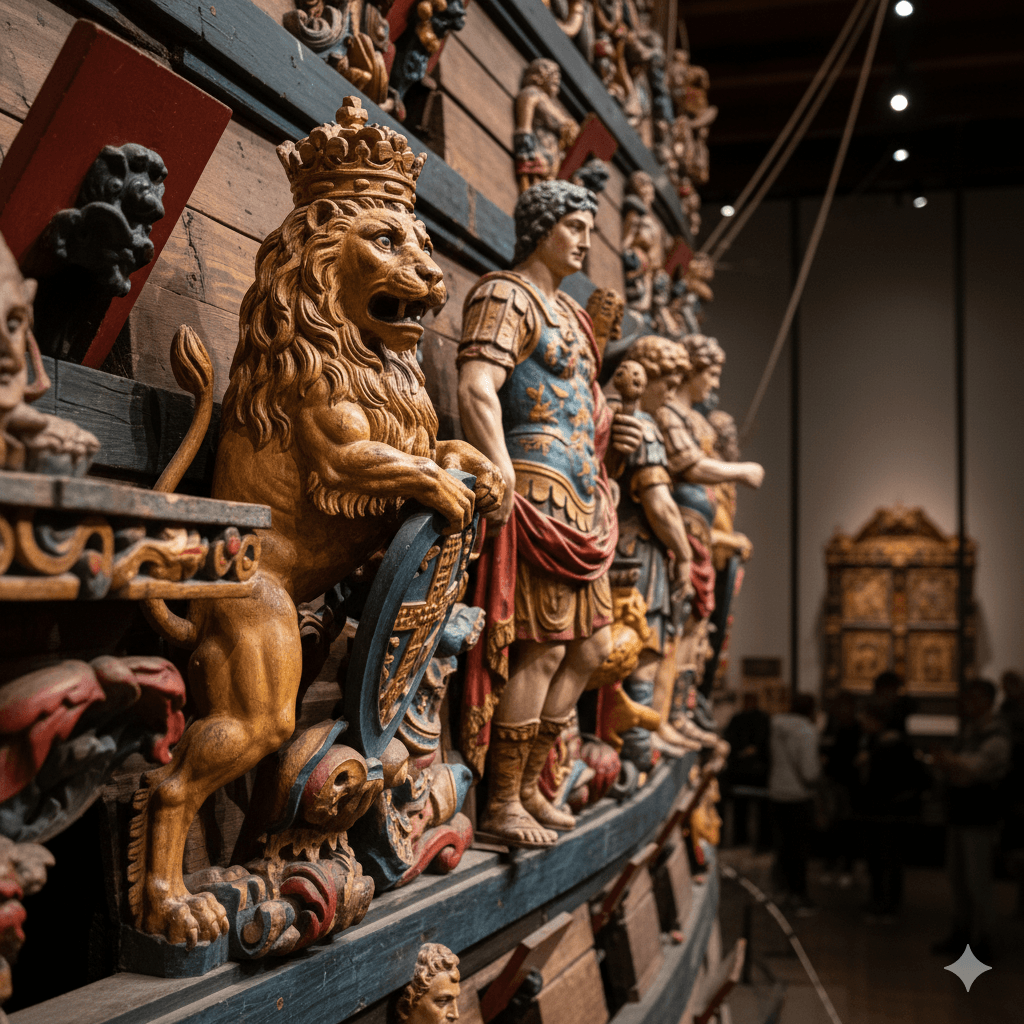
Detailed Close-up of the Wooden Carvings Adorning the Ship, Particularly Those on the Stern (Generated by AI)
Vasa is a vital source for maritime archaeology as the oldest intact wooden ship ever recovered. It provides direct information on the structure, armament, and technology of a 17th-century warship. In particular, it serves as a primary example for studying the Northern Dutch shipbuilding tradition, for which written records are scarce. The rich collection of artifacts recovered from the ship offers data on daily life at sea and on land, material culture, and social structures in the 17th century.
Crespo-Solana, Ana. “Ships Arriving at Ports and Tales of Shipwrecks: Heterotopia and Seafaring, 16th to 18th Centuries.” *Heritage* 8, no. 10 (2025): 411. Accessed October 26, 2025. https://doi.org/10.3390/heritage8100411;
Hocker, Fred, and Per Wendel. “Vasa I: The Archaeology of a Swedish Warship of 1628.” The International Journal of Nautical Archaeology 36, no. 2 (2007): 426–454. Accessed October 26, 2025. https://www.academia.edu/920527/Review_Vasa_I_The_Archaeology_of_a_Swedish_Warship_of_1628
Rose, Kelby James. *The Naval Architecture of Vasa, a 17th-Century Swedish Warship.* PhD thesis, Texas A&M University, 2014. Accessed October 26, 2025. https://oaktrust.library.tamu.edu/handle/1969.1/153363

Historical Context
Sweden in the Early 17th Century
Sweden–Netherlands Relations
European Navies and Shipbuilding
Design and Construction
Dutch Shipbuilding Tradition
Construction Process (Northern Method)
Design Decisions
Persons Responsible for Construction
Sinking
Recovery and Conservation
The Vasa Museum
Archaeological and Historical Significance