


This article was automatically translated from the original Turkish version.
+1 More

Visual Mathematical Literacy
(Generated with Artificial Intelligence)
Visual Mathematical Literacy
Development in Türkiye | Has been included in curricula since 2004 | ||||||||
|---|---|---|---|---|---|---|---|---|---|
Basic Dynamics | Graph, Table, Figure, Symbol | ||||||||
Intersection Areas | Visual Literacy, Mathematical Literacy | ||||||||
Visual mathematical literacy is the ability of an individual to perceive problems encountered in daily life within a visual or spatial framework interpret them mathematically evaluate them and conversely transform mathematical information into visual or spatial forms for use. This concept emerges at the intersection of various literacy types arising in information societies and has been shaped by the integration of common elements between visual literacy and mathematical literacy. The process of concretizing and interpreting the abstract nature of mathematical concepts through graphs tables shapes and symbols constitutes one of the fundamental dynamics of this literacy type.【1】
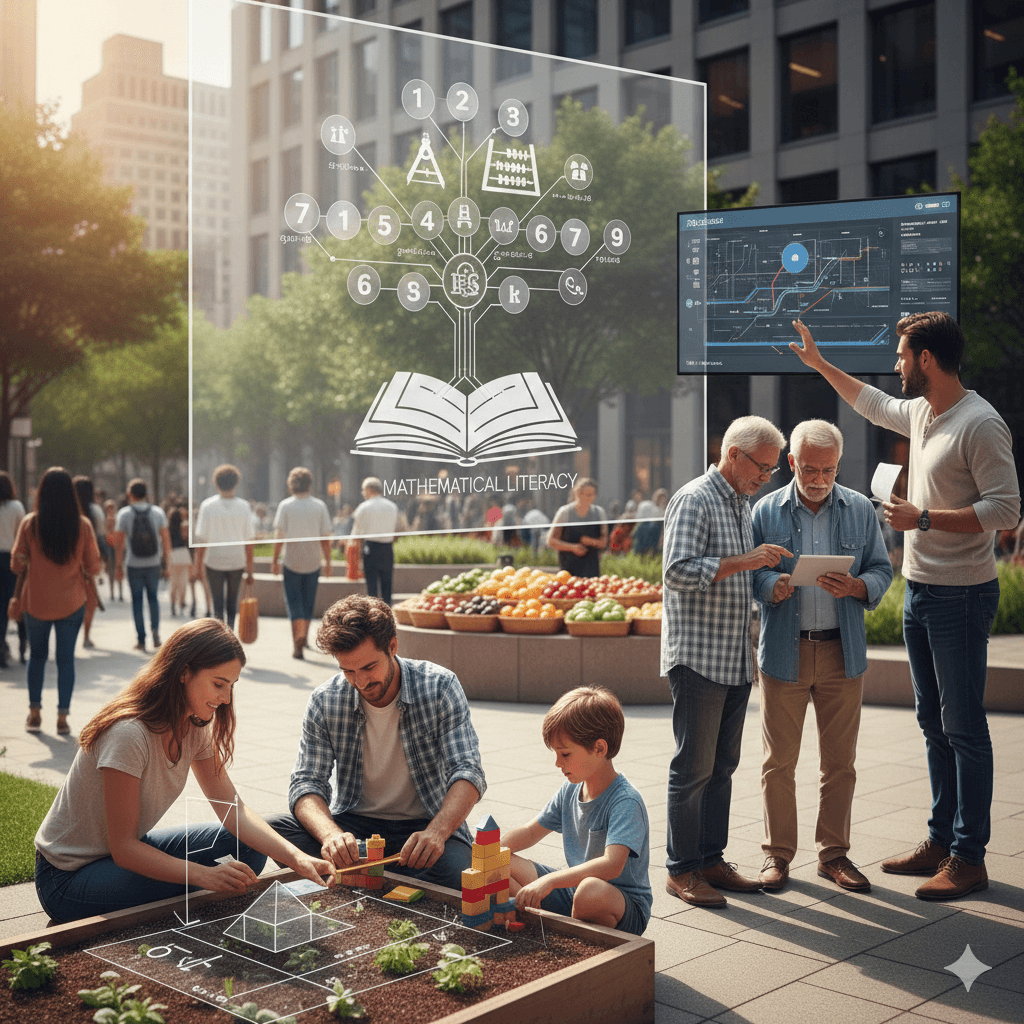
Visual Mathematical Literacy Process
(Generated by Artificial Intelligence)
Visual mathematical literacy is not limited to recognizing geometric shapes but encompasses the processes of visualizing mathematical thinking and translating visual data into mathematical language. This literacy type is based on the individual’s capacity to distinguish natural or artificial objects in their environment establish spatial relationships and integrate these processes with mathematical problem-solving skills. Conceptually it involves coordinating intelligence presentation and mental imagery with verbal visual and symbolic forms to facilitate mathematical communication.
Students’ use of visual strategies in solving mathematical problems or their ability to visualize verbal problems are indicators of this literacy. The definition includes the individual’s mastery of a set of visual shapes and symbols and their capacity to convert visuals into verbal expressions and vice versa.【2】
When examining the historical development of mathematics it is evident that visual elements have always played a significant role in the advancement and transmission of scientific knowledge. From early mathematical knowledge conveyed through drawings and images on cave walls to the works of ancient mathematicians such as Thales Pythagoras and Euclid visual representation has remained central to mathematical thought.
A key milestone in the institutionalization and modernization of this concept was the establishment of the Visual Math Institute in California United States in 1975. This institute aimed to teach university-level subjects such as linear algebra and differential equations using computer-assisted and graphical materials and conducted research on visualizing fields such as chaos theory. In Türkiye visual literacy began to be incorporated into curricula from 2004 onward and academic interest in visual mathematical literacy has increased in subsequent years.【3】
Visual mathematical literacy arises from the interaction of two primary components: visual literacy and mathematical literacy. Visual literacy is the ability to read and interpret information presented in the form of graphs images and tables while mathematical literacy is the capacity of an individual to understand the role of mathematics in the world and to make mathematical judgments. The integration of these two domains enables abstract mathematical ideas to be made "alive and familiar" thereby enhancing comprehension.
When examining the dimensions of this concept three core dimensions emerge based on the Programme for International Student Assessment (PISA) and related academic studies. These are the "content domain" encompassing mathematical concepts such as numbers and geometry the "process" dimension covering thinking and communication processes and the "context" dimension referring to real-world and scientific situations in which mathematical relationships are applied. To be considered visually mathematically literate an individual must not only possess mathematical and geometric knowledge but also demonstrate visual intelligence spatial ability and the capacity to convert between these elements.
In educational processes visual mathematical literacy is regarded as a factor that facilitates learning and enhances retention. Students report that they understand visual problems better than verbal ones due to their visual appeal memorability and ability to capture attention. The use of visuals concretizes abstract information enabling mental processes to occur more rapidly and facilitating easier recall of knowledge.
Visual mathematical literacy holds critical importance particularly in geometry instruction and problem-solving processes. In learning visually oriented topics such as symmetry a parallelism exists between students’ levels of visual literacy and their academic achievement. Furthermore research has identified a significant relationship between visual mathematical literacy self-efficacy and mathematics achievement with self-efficacy acting as a predictor of mathematics performance. Another aspect considered by educators is the relationship between students’ cognitive styles (field-dependent or field-independent) and visual mathematical literacy.
Various scales have been developed in the academic literature to measure visual mathematical literacy. One such instrument is the "Visual Mathematical Literacy Self-Efficacy Scale" designed to assess students’ self-perceptions of their abilities. This scale consists of items grouped under three factors: "content domain" "process" and "context".【4】
Scaling studies have revealed that students’ perceptions of visual mathematical literacy vary according to variables such as gender grade level academic performance teacher attitudes and parental attitudes. Findings generally indicate that female students students in lower grade levels and children of parents with democratic attitudes exhibit higher levels of visual mathematical literacy self-efficacy.
Bekdemir, Mehmet, and Murat Duran. "İlköğretim Öğrencileri İçin Görsel Matematik Okuryazarlığı Öz Yeterlik Algı Ölçeği (GMOYÖYAÖ)'nin Geliştirilmesi." *Ondokuz Mayıs Üniversitesi Eğitim Fakültesi Dergisi* 31, no. 1 (2012): 211–235. Accessed February 20, 2026. https://dergipark.org.tr/tr/download/article-file/187997.
Deveci, Özge, and Çiğdem Aldan Karademir. "Ortaokul Öğrencilerinin Matematik Öz-bildirimleri İle Görsel Matematik Okuryazarlığı Öz-yeterlik Algıları." *Eğitim Kuram ve Uygulama Araştırmaları Dergisi* 4, no. 3 (2018): 33-49. Accessed February 20, 2026. https://dergipark.org.tr/en/download/article-file/602320.
Duran, Murat. "İlköğretim 7. Sınıf Öğrencilerinin Görsel Matematik Okuryazarlığı Hakkındaki Görüşleri." *Mehmet Akif Ersoy Üniversitesi Eğitim Bilimleri Enstitüsü Dergisi* 2, no. 2 (Spring 2013): 38–51. Accessed February 20, 2026. https://dergipark.org.tr/tr/download/article-file/207763.
Durasi, Emre, Gülay Yalim, Kübra Karadeniz, Oğuz Yalçıntuğ, Samet Şahiner, Sinem İnce, Yasin Çetin, Zeynep Şahin, Zülal Kenar, and Özlem Çeziktürk. "Matematik Öğretmen Adaylarında Bilişsel Stil, Görsel Matematik Okuryazarlığı Ve Matematik Başarısı İlişkisinin İncelenmesi: Simetri Örneği." *IBAD Sosyal Bilimler Dergisi*, no. 5 (2019): 587-603. Accessed February 20, 2026. https://dergipark.org.tr/en/download/article-file/824765.
[1]
Özge Deveci and Çiğdem Aldan Karademir "Visual Mathematical Literacy Self-Efficacy Perceptions of Middle School Students in Relation to Their Mathematical Self-Reports" Journal of Educational Theory and Practice Research 4 no. 3 (2018): 45 accessed 20 February 2026https://dergipark.org.tr/en/download/article-file/602320.
[2]
Murat Duran "Elementary School Seventh Grade Students’ Opinions on Visual Mathematical Literacy" Mehmet Akif Ersoy University Journal of Educational Sciences 2 no. 2 (Spring 2013): 40 accessed 20 February 2026https://dergipark.org.tr/tr/download/article-file/207763.
[3]
Emre Durasi et al. "Examining the Relationship Between Cognitive Style Visual Mathematical Literacy and Mathematics Achievement in Mathematics Teacher Candidates: The Case of Symmetry" IBAD Journal of Social Sciences no. 5 (2019): 593 accessed 20 February 2026https://dergipark.org.tr/en/download/article-file/824765.
[4]
Mehmet Bekdemir and Murat Duran "Development of the Visual Mathematical Literacy Self-Efficacy Scale (VMLSES) for Elementary School Students" Ondokuz Mayıs University Journal of Faculty of Education 31 no. 1 (2012): 10 accessed 20 February 2026,https://dergipark.org.tr/tr/download/article-file/187997.
Visual Mathematical Literacy
(Generated with Artificial Intelligence)
Visual Mathematical Literacy
Development in Türkiye | Has been included in curricula since 2004 | ||||||||
|---|---|---|---|---|---|---|---|---|---|
Basic Dynamics | Graph, Table, Figure, Symbol | ||||||||
Intersection Areas | Visual Literacy, Mathematical Literacy | ||||||||
No Discussion Added Yet
Start discussion for "Visual Mathematical Literacy" article
Conceptual Framework
Historical Development
Components and Dimensions
Role in Education and Instruction
Measurement and Assessment