



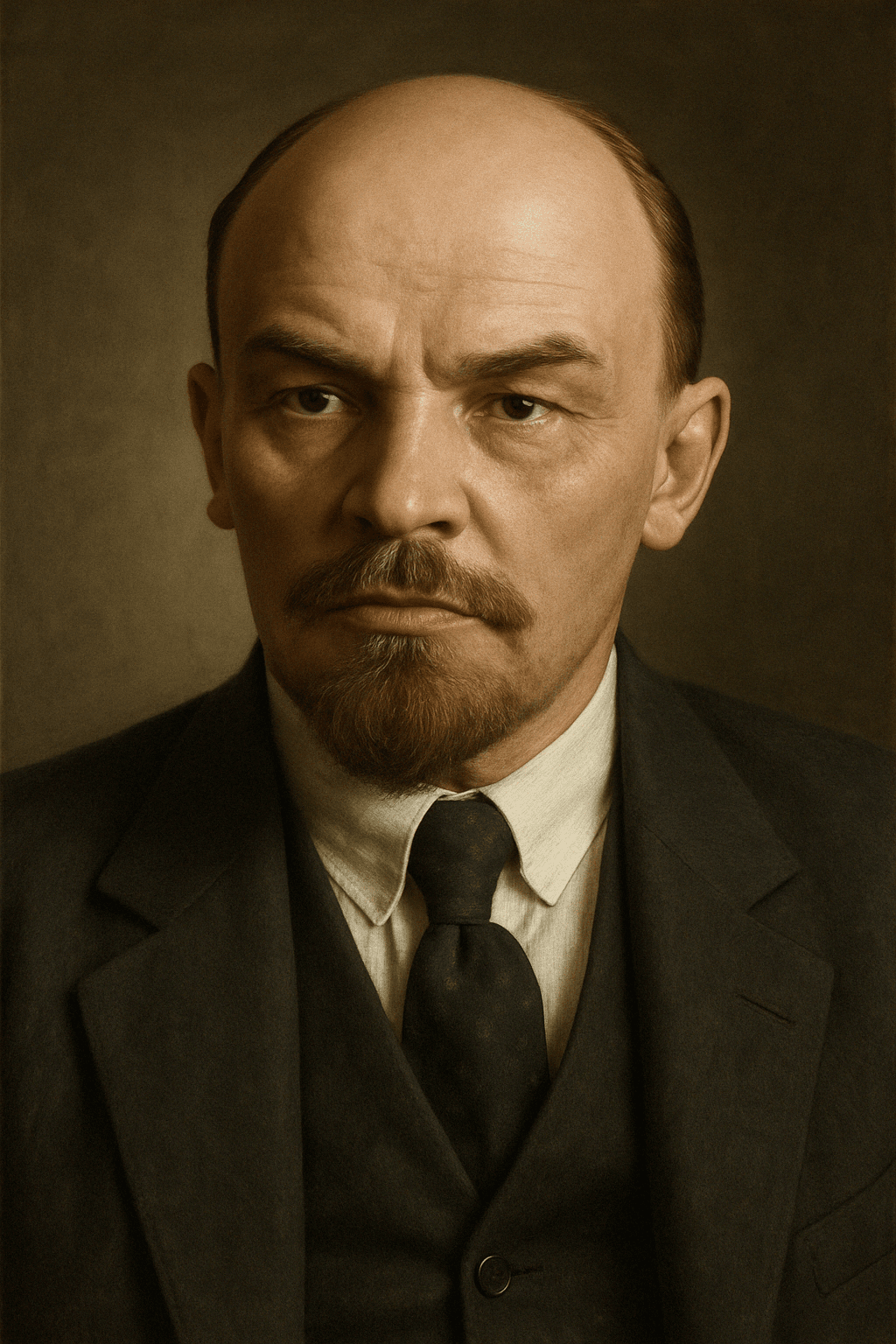
Birth | 22 April 1870 | ||||||||
|---|---|---|---|---|---|---|---|---|---|
Death | 21 January 1924 | ||||||||
School Attended | Saint Petersburg State University | ||||||||
Offices Held | Chairman of the Council of Labor and Defense of the Russian SFSR, Chairman of the Council of Labor and Defense of the USSR, Chairman of the Council of People's Commissars of the USSR | ||||||||
Political Parties Active In | Union for the Struggle for the Liberation of the Working Class (1895–1898) Russian Social Democratic Workers' Party (1898–1912) Russian Social-Democratic Workers' Party (Bolsheviks) (1912–1918) Russian Communist Party (Bolsheviks) (1918–1924) | ||||||||
Vladimir Lenin (born Vladimir Ilyich Ulyanov, Complete) was born on 22 April 1870 in the city of Simbirsk, within the Russian Empire. His father, Ilya Nikolayevich Ulyanov, was an educational inspector. His mother, Maria Aleksandrovna, came from a cultured and noble family. Lenin’s early life was shaken by the execution of his brother Aleksandr in 1887 for his involvement in a plot to assassinate Tsar Alexander III. This event laid the groundwork for his engagement with radical ideas.
While studying law at Kazan University, Lenin was expelled for his political activities. He later graduated from Petersburg University as a free student. He encountered Marxist thought at an early age and adopted the materialist conception of history after being influenced by the writings of Georgi Plekhanov.
In 1895, Lenin united Marxist worker groups to form the Union for the Liberation of the Working Class. He was arrested the same year and exiled to Siberia. After his release, he moved to Europe and published his influential work What Is to Be Done? in 1902. In this work, he advocated for a tightly organized group of professional revolutionaries.
At the second congress of the Russian Social Democratic Labour Party (RSDLP) in 1903, the faction led by Lenin adopted the name “Bolshevik” (majority). The opposing faction, led by Julius Martov, became known as the “Menshevik” (minority). This division became a pivotal turning point in the future course of the Russian revolution movement.

People Commemorate Lenin on the Anniversary of His Birth (Anadolu Agency)
Lenin’s 1902 work What Is to Be Done? is regarded as a foundational tactical document of revolutionary struggle. In it, Lenin argued that the working class could not develop political revolutionary consciousness on its own; such consciousness could only be introduced through a professional vanguard party. This approach led to the split within the Russian Social Democratic Labour Party (RSDLP) into Bolsheviks (majority) and Mensheviks (minority) in 1903.
Lenin’s concept of party organization was centralized, disciplined, and hierarchical. He championed the principle of “democratic centralism” within the party: there was freedom of discussion, but once a decision was made, strict implementation was mandatory.
The 1905 Revolution provided Lenin with an opportunity to test his theoretical principles. The first workers’ councils, known as soviets, emerged during this period. Lenin viewed these structures as essential organs for the working class to seize power. However, the revolution failed. Although the Tsarist regime temporarily conceded reforms, its repressive policies soon intensified. Lenin continued to live in exile in Switzerland and various other European countries.
Lenin’s April Theses, presented upon his return from exile in 1917, were decisive for the revolutionary program. With slogans such as “All Power to the Soviets!” and “End to the Imperialist War!”, he adopted a radical stance against the Provisional Government. His goals included transferring land to the peasants, placing factories under worker control, nationalizing banks, and dismantling the bourgeoisie state structure. On the night of 7 November 1917, the Bolsheviks launched the uprising, overthrowing the Provisional Government in Petrograd. The soviets formally assumed power.
The first Soviet government, the Sovnarkom, established under Lenin’s leadership, enacted radical decrees in rapid succession:
The Decree on Land abolished private landownership, and peasant committees redistributed land.
The Decree on Peace offered unconditional peace to all warring parties.
The Decree on Workers’ Control granted workers the right to participate in factory management.
Secularization of education and the nationalization of church property were implemented.
Reforms included granting women the right to divorce, maternity leave, and equal fee. The soviets became one of the first regimes in the world to grant women the right to vote and stand for election.
To secure Bolshevik power, Lenin signed a separate peace treaty with Germany. Under the Treaty of Brest-Litovsk, the Soviets were forced to cede vast territories (Poland, the Baltic states, Ukraine) to Germany. This situation sparked intense debates within the party, particularly among left communists. Trotsky initially opposed the agreement as well. However, Lenin interpreted it as a “step backward” to preserve the revolution for a larger future upheaval.
From 1918 onward, the Bolsheviks fought against the White Army, composed of former Tsarist officers, Mensheviks, socialist revolutionaries, and supported by foreign powers. During the civil war, Lenin oversaw the creation of the “Red Army.” Trotsky served as its military commissar. The CHEKA (Soviet secret police) was extensively used to suppress opposition groups. The policy of war communism was implemented: all means of production were fully nationalized, food requisitioning was enforced, and all industry were placed under centralized command. These harsh measures led to famine and widespread discontent.
The Kronstadt Uprising and peasant revolts in rural areas forced Lenin to reconsider existing policies.
In 1921, the NEP was introduced. Limited private ownership and market trade were partially restored. The state retained control over heavy industry, but a limited return to the market occurred. This policy signaled signs of economic recovery. The NEP is recognized as the only major economic policy in which Lenin felt compelled to take an ideological step backward.
In the final years of his life, Lenin waged a fierce struggle against bureaucratization within the Bolshevik Party and the Soviet state apparatus. In a text written at the end of 1922 and known as his “Testament,” he recommended that Stalin be removed from the post of General Secretary. During the same period, he attempted to form an alliance with Trotsky to combat Great Russian chauvinism and bureaucracy.
However, March the third stroke he suffered in 1923 prevented Lenin from continuing his political activities. He died on 21 January 1924 at the age of 53. His death dramatically altered the balance of power within the Bolshevik Party; Trotsky became isolated, Stalin rapidly gained strength, and the Bolshevik line gradually took the form of a centralized dictatorship.
Lenin established the Soviet Union, the first state in history founded on socialist principles, through the October Revolution of 1917. This created a significant rupture in the capitalist world, demonstrating that an alternative social model was possible. Thus, socialist ideas moved beyond the confines of intellectual circles and became a practical reality at the state level.
Lenin adapted Marx’s ideas to the conditions of his time, developing a doctrine known as Marxism-Leninism original.
This doctrine included contributions such as the centralized party model, proletariat dictatorship, and the theory of imperialism. Leninism became the foundational ideological basis for communist movements in many countries throughout the 20th century, including China, Cuba, Vietnam, East and Europe.
Founded in 1919 under Lenin’s leadership, the Communist International (Comintern) was an international organization that coordinated communist parties world worldwide. Through this structure, communist ideas were spread to numerous countries. Anti-colonial struggles and anti-imperialist movements were supported through this network.
Lenin’s theory of imperialism provided an ideological foundation for anti-imperialist struggles, particularly in Africa, Asia and Latin America. Leaders such as Mao Zedong, Ho Chi Minh, and Fidel Castro drew inspiration from Lenin’s views. Many independence movements took Lenin’s anti-colonial approach as a guide.
Lenin’s socialist revolution, together with the rise of the Soviet Union, transformed into a systemic rivalry with capitalism West. This situation formed the basis of the global polarization known as the Cold War after the Second World War Cold War. The capitalist bloc led by the United States USA and the socialist bloc led by the Soviet Union engaged in competition at ideological, political, and military levels.
Lenin’s leadership contributed to the strengthening of working-class movements worldwide. He indirectly influenced the spread of democratic demands such as unionization, social rights, and the right to strike. The rise of social democracy in Western Europe was largely an effort to provide an alternative to the Soviet system.
Lenin’s vanguard party concept was adopted as an organizational model by many revolutionary and radical left groups. Disciplined, centralized, and ideologically cohesive party structures became standard across global left-wing movements throughout the 20th century.
Lenin’s writings were debated in universities and academic circles throughout the 20th century in the fields of political science, economics, and history. Works such as The State and Revolution, What Is to Be Done?, Imperialism continue to hold relevance in discussions of political philosophy and theories of power importance. Lenin’s emphasis on “revolution,” “leadership,” and “practice” has inspired contemporary political strategy theories.
During Lenin’s era, women in the Soviet Union were granted the right to vote and stand for election, and divorce laws were reformed. These practices were far ahead of those in many countries and provided an indirect foundation for movements advocating gender equality.
Lenin’s concept of a “temporary dictatorship” was misused by some leaders. Practices such as the fusion of party and state and the suppression of opposition provided ideological justification for totalitarian regimes.
Carr, Edward Hallett. Bolşevik Devrimi 1917–1923. Cilt I. Çev. Orhan Suda. İstanbul: Metis Yayınları, 1989.
Service, Robert. Lenin: A Biography. Cambridge: Harvard University Press, 2000.
Topsakal, İlyas. “Bolşevik İhtilali.” *TÜBİTAK Ansiklopedi.* Bilim ve Toplum Başkanlığı, Popüler Bilim Yayınları. https://ansiklopedi.tubitak.gov.tr/ansiklopedi/bolsevik_ihtilali.
Troçki, Lev. Lenin: Politik Biyografi. Çev. Orhan Koçak. İstanbul: Belge Yayınları, 1991.

Birth | 22 April 1870 | ||||||||
|---|---|---|---|---|---|---|---|---|---|
Death | 21 January 1924 | ||||||||
School Attended | Saint Petersburg State University | ||||||||
Offices Held | Chairman of the Council of Labor and Defense of the Russian SFSR, Chairman of the Council of Labor and Defense of the USSR, Chairman of the Council of People's Commissars of the USSR | ||||||||
Political Parties Active In | Union for the Struggle for the Liberation of the Working Class (1895–1898) Russian Social Democratic Workers' Party (1898–1912) Russian Social-Democratic Workers' Party (Bolsheviks) (1912–1918) Russian Communist Party (Bolsheviks) (1918–1924) | ||||||||
Revolutionary Activities and Exile Years
Vladimir Lenin’s Major Achievements (1902–1924)
Pioneering Party Theory and Revolutionary Organization (1902–1905)
The 1905 Revolution and the Proletarian Alliance
The April Theses and the November Revolution
The Council of People’s Commissars and Early Reforms
The Treaty of Brest-Litovsk (1918)
Civil War and Red Terror (1918–1921)
New Economic Policy (NEP) (1921–1924)
Lenin’s Opposition to Bureaucratization
Vladimir Lenin’s Impact on the World
Establishment of the First Socialist State
The Transformation of Marxism: Marxism-Leninism
Establishment of the Communist International (Third International)
Laying the Foundations of the Cold War
Contribution to the Political Consciousness of the Working and Laboring Classes
Enduring Influence on Political Organization and Party Model
Intellectual and Academic Impact
Role in Women’s Rights and Social Transformation
Model for Authoritarian Regimes Seeking Legitimacy