

This article was automatically translated from the original Turkish version.
+1 More
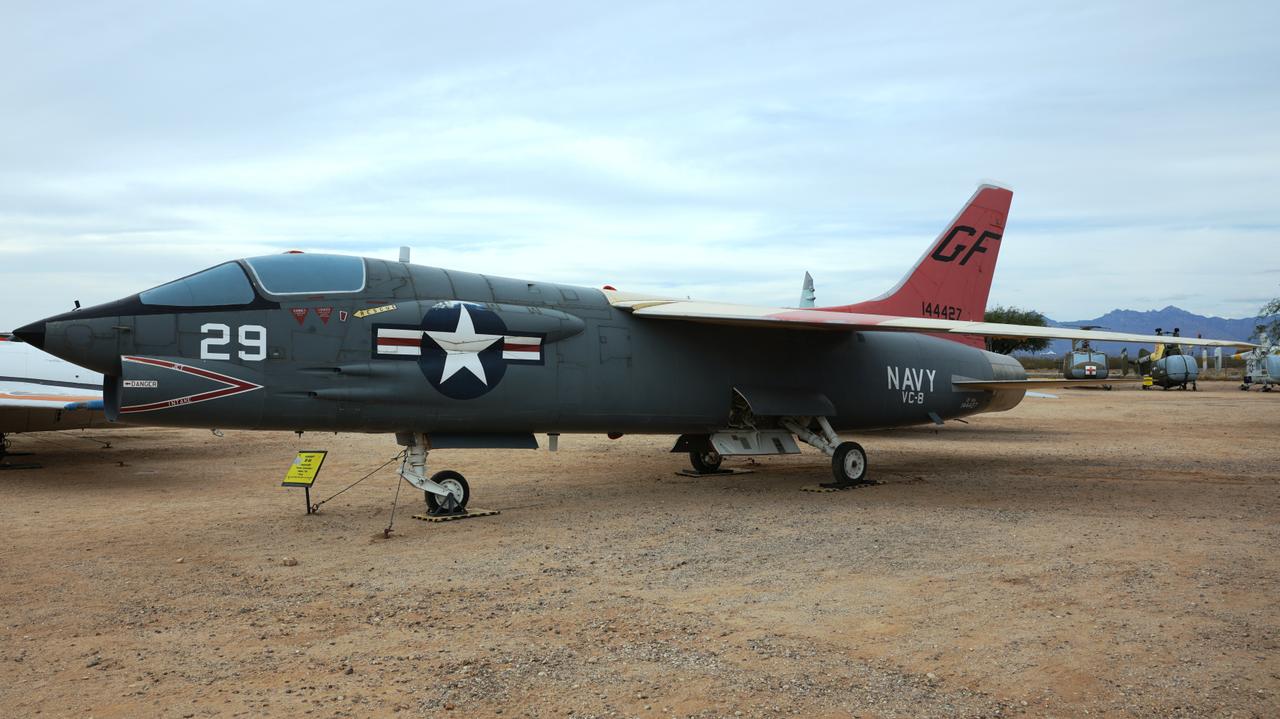
The Vought F-8 Crusader (originally designated F8U) is a single-engine, carrier-based supersonic air superiority fighter developed by Chance Vought in the 1950s for the United States Navy. Designed in response to a 1952 Navy requirement for an interceptor capable of reaching Mach 1.2 and climbing at 25,000 feet per minute, the aircraft broke the sound barrier on its first flight on 25 March 1955, setting a technical milestone for operational carrier-based aircraft. Known in aviation literature as the "Last of the Gunfighters," it was the final American fighter to carry guns as its primary armament—four 20 mm Colt Mk 12 cannons—and achieved a 19% air-to-air victory rate against MiG aircraft during the Vietnam War through its low-altitude maneuverability.【1】
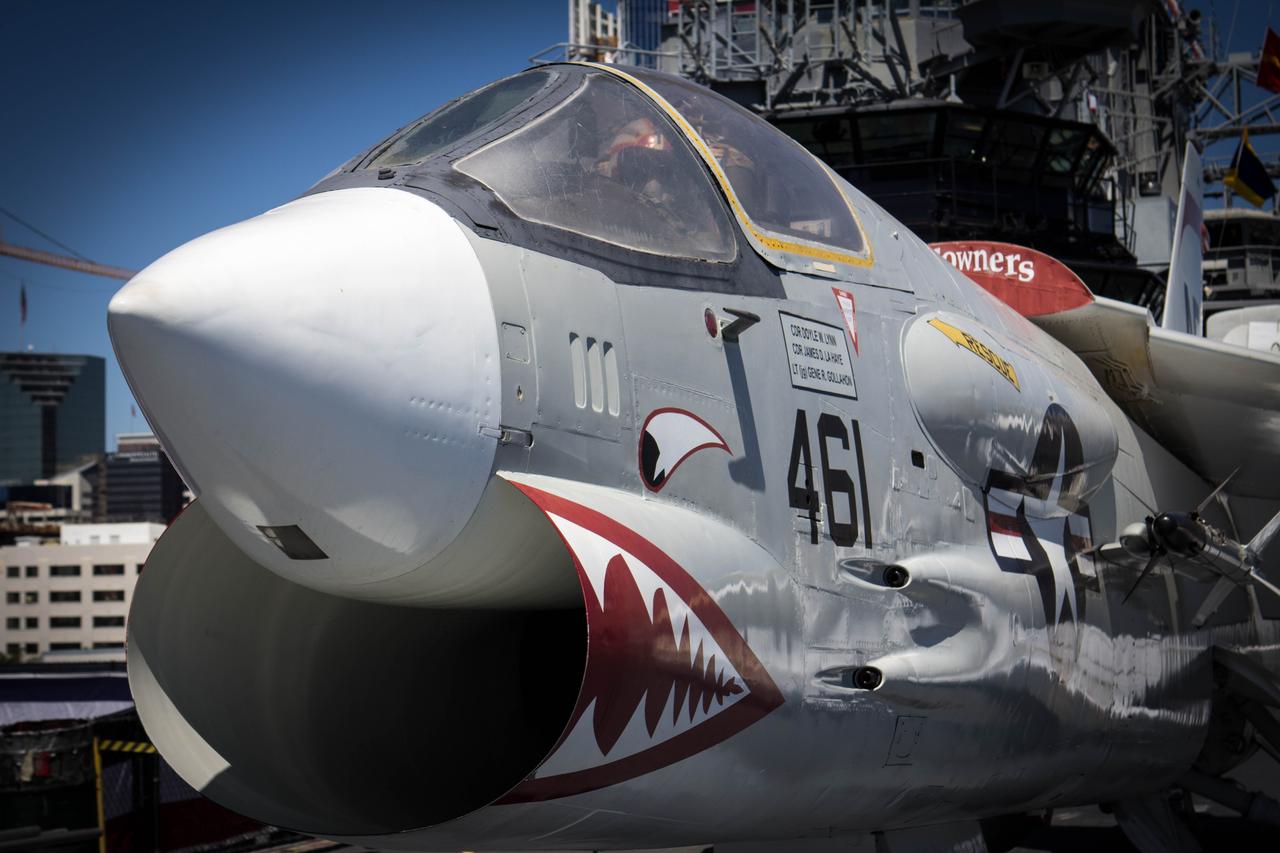
Vought F-8 Crusader (Clark)
The aircraft’s most distinctive design feature is its variable-incidence wing system. This mechanism allows the wing structure to pivot independently of the fuselage up to 7 degrees upward, maintaining a level fuselage attitude during carrier approach and landing phases, thereby preserving the pilot’s forward visibility. Its aerodynamic fuselage was shaped according to the area rule principles, and it incorporated titanium—a then-advanced material—to achieve weight savings and structural strength. A total of 1,261 units were produced across numerous variants from F-8A to F-8J. The platform served with the U.S. Navy and Marine Corps from the late 1950s until the end of the 1980s, and with the French Navy in its modernized F-8E(FN) variant until 1999.【2】
Development of the Vought F-8 Crusader began in September 1952 in response to a U.S. Navy requirement for a new supersonic carrier-based fighter. The Navy specified that the aircraft must achieve Mach 1.2, climb at 25,000 feet per minute, and maintain a landing speed below 100 mph (160 km/h). Led by John Russell Clark, the Vought design team won the competition with the V-383 design, which maximized internal fuel capacity while minimizing aerodynamic drag. In June 1953, the company received an official order for three XF8U-1 prototypes.【3】
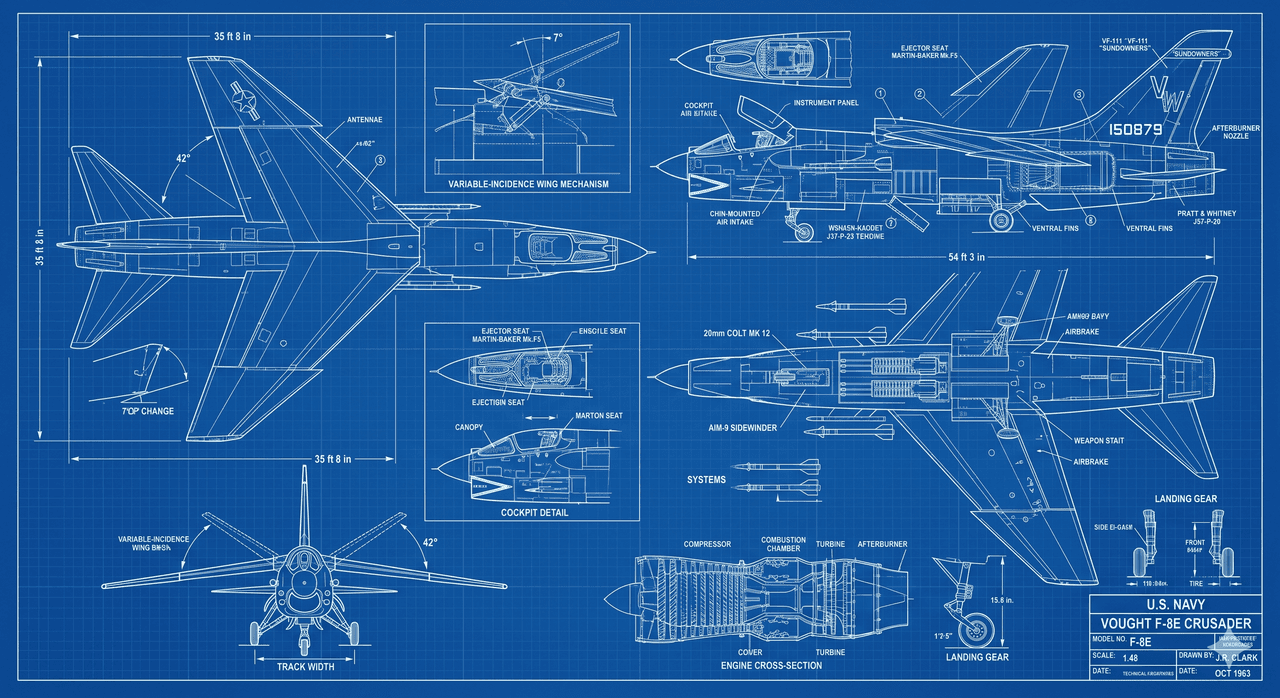
Vought F-8 Crusader Technical Drawing (Generated by AI)
The most significant technical innovation during development was the variable-incidence wing mechanism. This system allowed the wing to pivot up to 7° independently of the fuselage, maintaining a level attitude during low-speed carrier approaches. This design eliminated the high nose-angle (high alpha) problem that obstructed the pilot’s view of the carrier deck and reduced landing speeds to safe limits. The first prototype, XF8U-1, became the first operational jet aircraft to exceed the speed of sound on its maiden flight on 25 March 1955 at Edwards Air Force Base.【4】
The F-8’s fuselage architecture features a narrowed midsection based on the area rule to reduce shock wave effects at high speeds. Extensive use of titanium alloy in the rear fuselage and primary structural components enhanced durability while controlling weight. The Pratt & Whitney J57 afterburning turbojet engine was selected for development, enabling speeds exceeding 1,000 mph (1,600 km/h). On 21 August 1956, test flights achieved a speed of 1,015 mph, setting a new U.S. national speed record and confirming the aircraft’s operational viability.【5】
The Vought F-8 Crusader is powered by a single afterburning Pratt & Whitney J57 turbojet engine. The initial operational variant, the F-8A, used the J57-P-12 engine, while the more advanced F-8E series transitioned to the J57-P-20 (or P-20A). The J57-P-20 generates 10,700 lbf (47.6 kN) of dry thrust and 18,000 lbf (80.1 kN) with afterburner. This thrust capability enabled supersonic performance and a maximum speed of approximately Mach 1.86 (1,225 mph or 1,972 km/h) at 35,000 feet.【6】
The aircraft’s performance specifications were optimized for carrier operations requiring high acceleration and climb rates. The F-8 Crusader achieves an initial rate of climb between 19,000 and 23,300 feet per minute at sea level with afterburner.
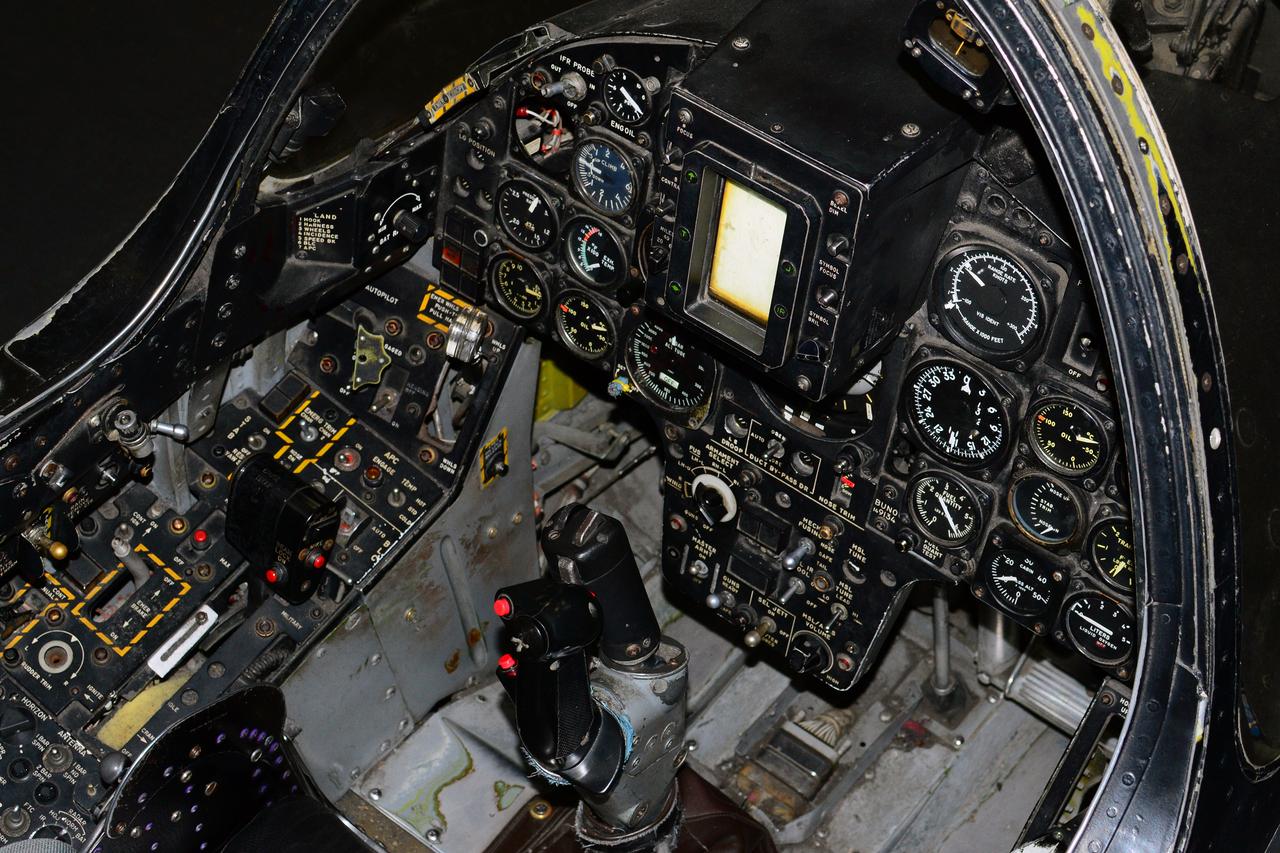
F-8 Crusader Cockpit (Ian Abbott)
The service ceiling is rated at 58,000 feet (17,700 meters), supporting its effectiveness in high-altitude interception roles. Thanks to the aerodynamic advantages of the variable-incidence wing, the stall speed is maintained at approximately 125 mph (201 km/h), enabling safe approaches to narrow carrier decks.【7】
Operational range and fuel capacity are supported by internal tanks and external refueling capability. The F-8H variant has a total internal fuel capacity of 1,348 gallons (JP-5 fuel). The combat radius is approximately 450 miles (724 km), depending on weapon load, while the ferry range exceeds 1,400 miles with external fuel tanks. Cruise speed typically ranges between 495 and 570 mph (797–917 km/h), depending on altitude and configuration.【8】
The Vought F-8 Crusader earned the title "Last of the Gunfighters" in aviation literature because it was the final American fighter to carry guns as its primary armament: four 20 mm Colt Mk 12 automatic cannons mounted on the fuselage sides. Each cannon had a 125-round ammunition box, providing a combined rate of fire of approximately 1,000 rounds per second. However, operational records from the Vietnam War indicate that the cannons frequently jammed due to feed system failures under high-G maneuvers, leading pilots to rely more heavily on missile systems for air-to-air victories.
The missile inventory consists of up to four AIM-9 Sidewinder infrared-guided air-to-air missiles mounted on "Y"-shaped launch rails on either side of the fuselage. Early models featured a retractable rocket pod under the fuselage carrying 32 unguided 2.75-inch (70 mm) "Mighty Mouse" FFAR rockets, but this system was removed in later variants (F-8E and beyond) due to aerodynamic instability and operational inefficiency.【9】
French Navy F-8E(FN) Crusader operations on Clemenceau (Aviation videos archives)
In terms of avionics, the F-8 was equipped with advanced radar and fire control systems for its era. Early models used the AN/APG-30 ranging radar, while the F-8E variant introduced the more capable Magnavox AN/APQ-94 all-weather radar. This system enabled pilots to detect airborne targets at distances of up to 20 miles (32 km) and guide Sidewinder missiles to them. Additionally, the AN/AAS-15 infrared search and track (IRST) unit mounted above the nose radar provided a passive sensor capability to track targets by their heat signature when radar use was compromised or required to remain silent.【10】
For strike missions, the F-8E model was fitted with two underwing multi-purpose pylons, granting it a payload capacity exceeding 4,000 pounds (1,814 kg). These stations could carry AGM-12 Bullpup air-to-surface missiles, Mk 80 series general-purpose bombs, and Zuni rockets. For navigation and communication, the aircraft was equipped with an AN/ARN-21 TACAN (Tactical Air Navigation System), an AN/ARC-27 UHF radio, and IFF (Identification Friend or Foe) transponders. The cockpit instrumentation included a flight director and an automatic power control (APC) system to assist pilots in executing carrier-controlled approach (ACLS) maneuvers.【11】
The Vought F-8 Crusader entered U.S. Navy service in 1957 and conducted its first operational missions during the 1962 Cuban Missile Crisis. The unarmed reconnaissance variant, the RF-8A, participated in the "Blue Moon" operation, flying low-altitude photographic missions over Soviet missile sites in Cuba. These flights, conducted by Navy and Marine Corps pilots, provided critical photographic evidence used in the diplomatic resolution of the crisis. Although exposed to anti-aircraft fire, the aircraft’s high speed and maneuverability enabled all missions to be completed without operational losses.
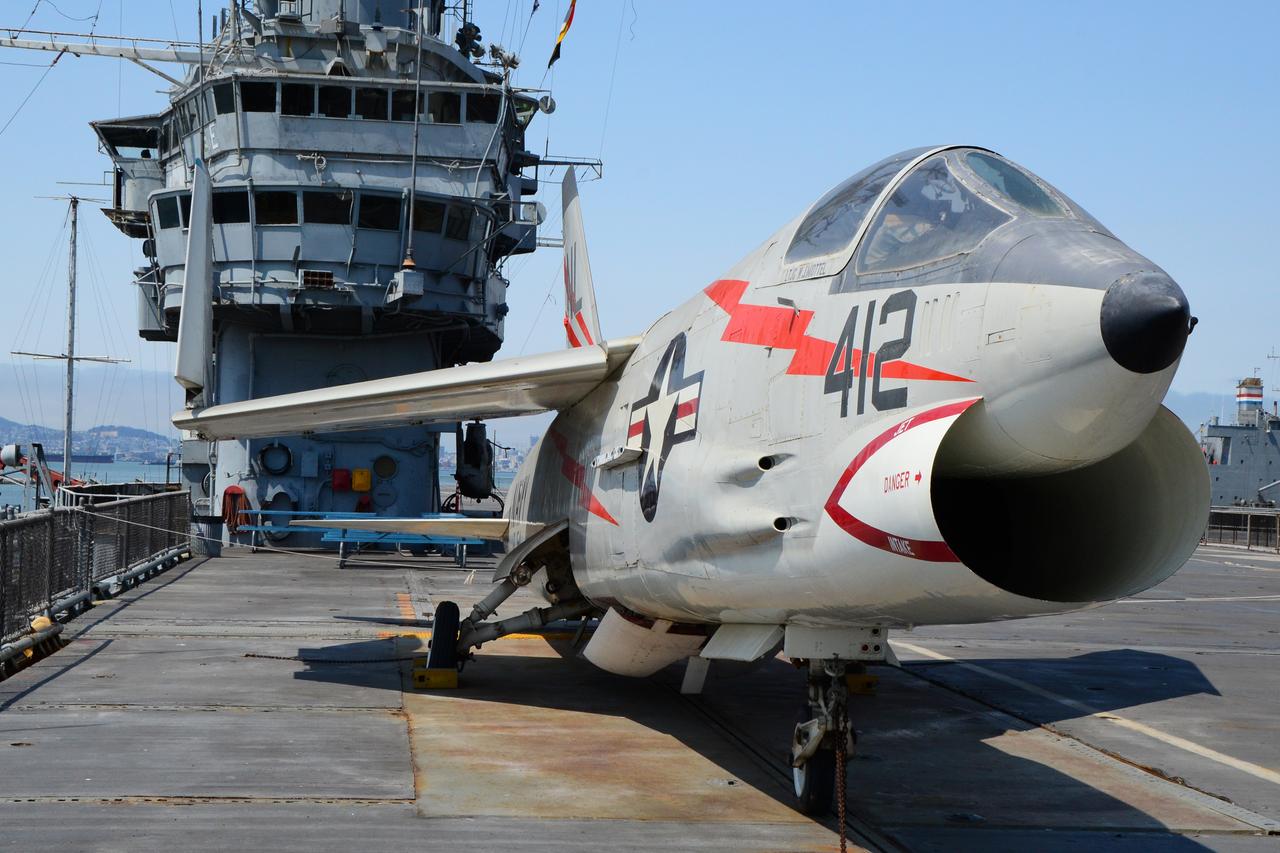
F8U-1 (F-8A) Crusader (Ian Abbott)
From the mid-1960s onward, the platform was extensively deployed in Southeast Asian conflicts for air superiority and escort missions. According to U.S. Navy records, F-8 pilots downed a total of 19 North Vietnamese MiG aircraft between 1966 and 1968, achieving the highest kill ratio of any American fighter in service at the time. Sixteen of these victories were achieved with AIM-9 Sidewinder missiles and three with the 20 mm Colt Mk 12 cannons. However, due to its vulnerability to anti-aircraft fire during low-altitude strike missions, a total of 166 Crusaders were lost to operational causes.【12】
The French Navy (Aéronautique Navale) expanded the aircraft’s international operational history by acquiring 42 F-8E(FN) variants in 1964. Deployed aboard the Clemenceau and Foch aircraft carriers, French Crusaders performed air patrols in various overseas operations, including in Djibouti, Lebanon, and the Persian Gulf (including Operation Blue Helmet). Unlike the U.S. Navy, France modernized the aircraft’s air superiority capabilities and kept it in active service until 1999. The Philippine Air Force operated 35 second-hand F-8H aircraft acquired in 1977 as a land-based interceptor until the end of the 1980s.
The Vought F-8 Crusader was developed into numerous variants to meet evolving operational needs and technological advances. The first production model, the F8U-1 (renamed F-8A after 1962), entered service in 1956 and 318 units were built. The subsequent F-8B (F8U-1E) variant was equipped with the AN/APS-67 radar, enabling limited all-weather operations. The F-8C (F8U-2), which first flew in 1958, featured the more powerful J57-P-16 engine and ventral fins to improve stability at high speeds, raising the maximum speed to Mach 1.7.
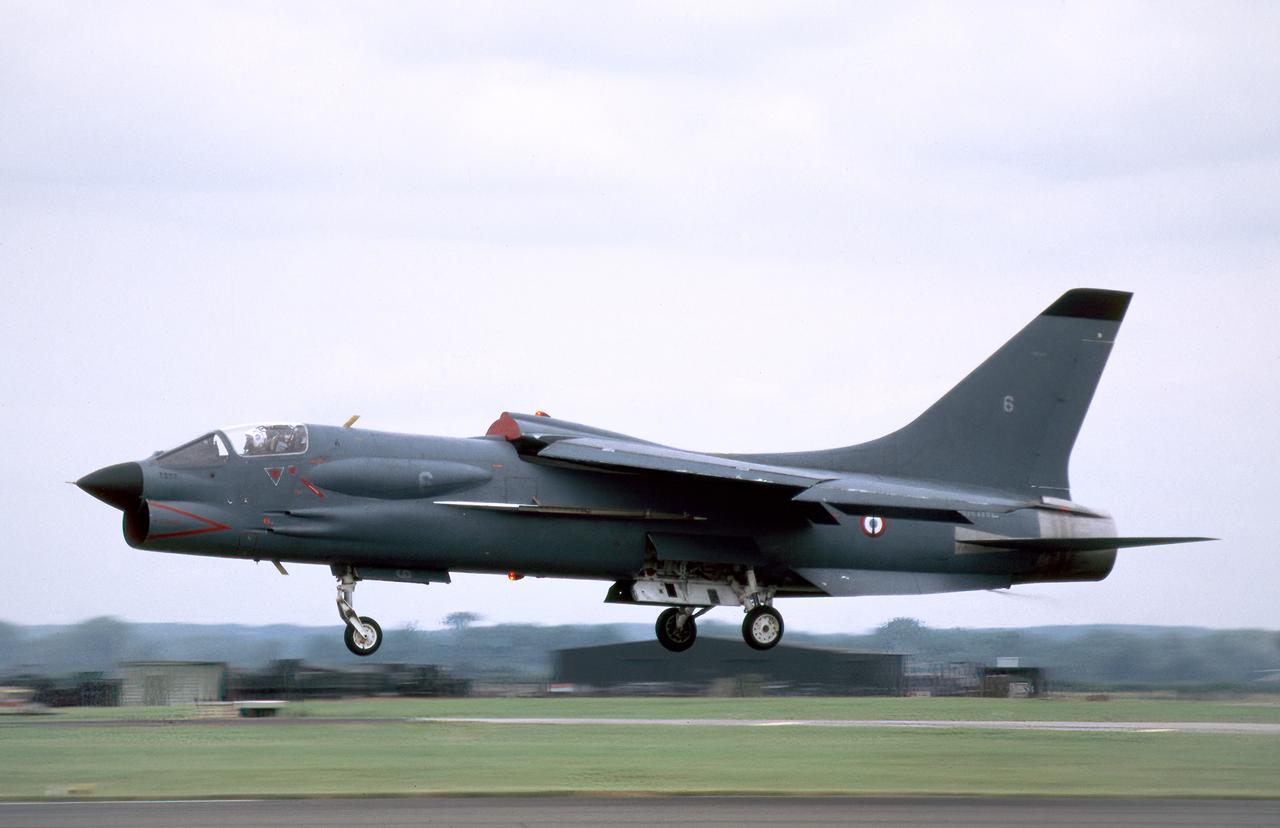
F-8E (FN) France (Rob Schleiffert)
The most comprehensive fighter variant in the development lineage was the F-8E (F8U-2NE). This model was fitted with the AN/APQ-94 all-weather radar and two underwing pylons to increase ordnance capacity. With a payload exceeding 4,000 pounds, the F-8E evolved from a pure fighter into an effective strike aircraft. The F-8E(FN), produced specifically for the French Navy, incorporated aerodynamic modifications such as larger flaps and a 7° wing incidence mechanism to accommodate the shorter flight decks of French carriers.【13】
The unarmed reconnaissance variants, RF-8A and RF-8G, were created by replacing the nose-mounted cannons and radar with five high-resolution cameras. The RF-8G, in particular, was the product of a modernization program that included structural reinforcements to extend airframe life and upgraded avionics. In the late 1960s, a "remanufacturing" program upgraded existing F-8D and F-8E airframes to F-8H and F-8J standards respectively. These upgrades included strengthening the wing structure, improving landing gear durability, and integrating boundary layer control systems.【14】
The Vought F-8 Crusader left a strategic legacy in aviation engineering history through its innovative design solutions and technological firsts for carrier operations. Its key engineering achievement—the variable-incidence wing—demonstrated that a supersonic fighter could land safely on carriers without sacrificing high-speed performance. This design success earned Chance Vought the prestigious Collier Trophy from the National Aeronautic Association in 1956. Data gathered during the F-8’s development laid the foundation for subsequent generations of variable-geometry wing technology and high-performance naval aviation platforms.
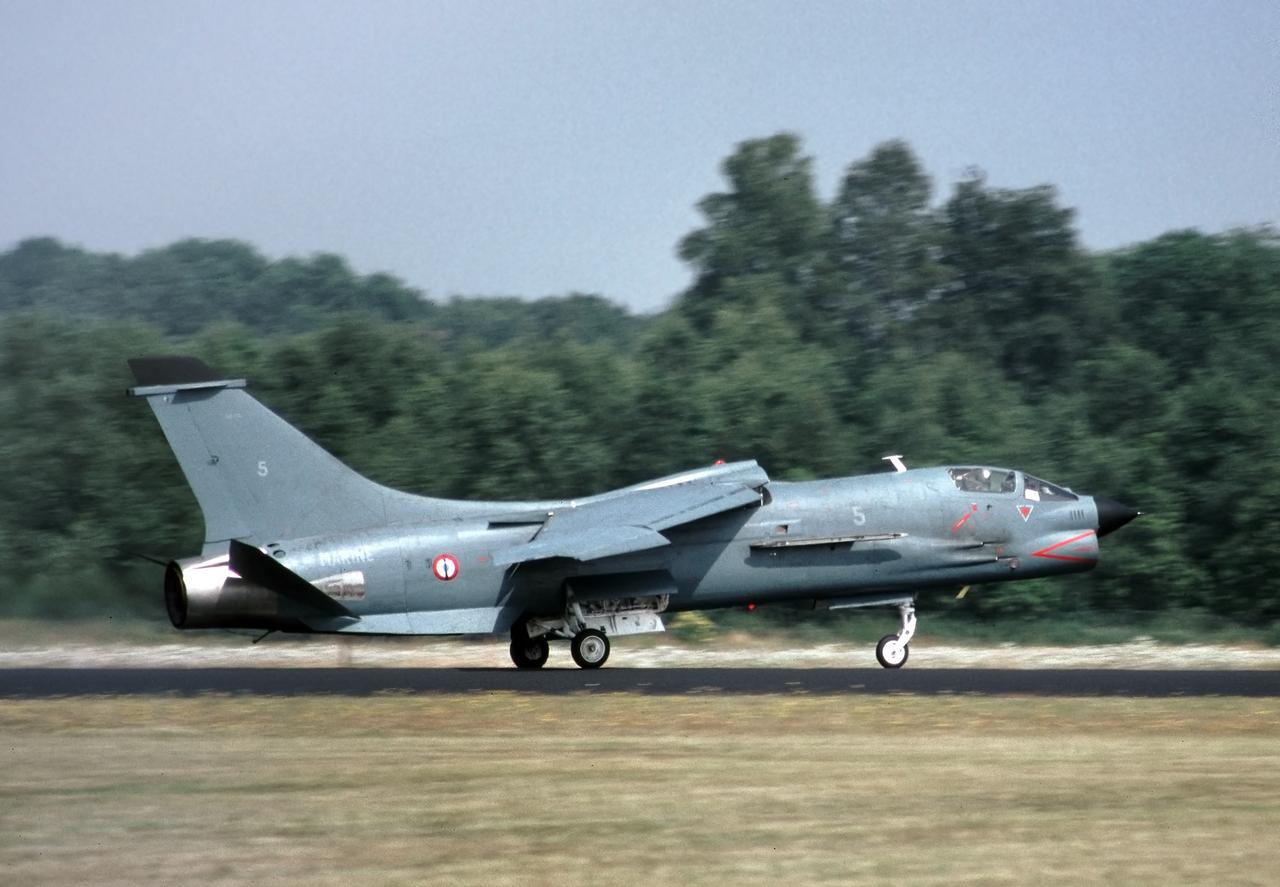
F-8P Crusader (Rob Schleiffert)
The platform’s operational legacy became synonymous with the designation "Last of the Gunfighters," representing the final era in which cannon armament remained central to air combat. However, Vietnam War data revealed a shift in air-to-air engagement tactics, paralleling the maturation of missile technology (AIM-9 Sidewinder). The F-8 also provided a model for successfully converting a fighter into an effective reconnaissance platform (RF-8 variants); the intelligence gathered during missions such as the Cuban Missile Crisis directly influenced military reconnaissance doctrine.【15】
The F-8 Crusader also served as an experimental laboratory in the development of digital flight control systems. In 1972, NASA modified an F-8C aircraft as part of its Digital Fly-By-Wire (DFBW) program, making it the first aircraft in the world to be flown entirely by digital systems. Data from this test platform formed the foundation for the flight control systems of the F-16 Fighting Falcon, the F/A-18 Hornet, and even the Space Shuttle.【16】
Abbott, Ian. F-8 Crusader Cockpit. December 12, 2015. Flickr. Accessed May 4, 2026. https://www.flickr.com/photos/ian_e_abbott/23492646864/.
Abbott, Ian. F8U-1 (F-8A) Crusader, 143703. August 23, 2016. Flickr. Accessed May 4, 2026. https://www.flickr.com/photos/ian_e_abbott/29386857765/
Aviation videos archives. USMC F-8B and US Navy RF-8A Crusaders operations on USS Shangri-La (CVA-38). YouTube. Accessed May 4, 2026. https://www.youtube.com/watch?v=pX3XBbFavGE
Comstedt, Johnny. Vought V-383 F8U-1 / F-8A / DF-8F Crusader 144427 in Tucson. October 17, 2017. Flickr. Accessed May 4, 2026. https://www.flickr.com/photos/johnnyflight/33443227638/.
F-8 Crusader." Naval History and Heritage Command. Accessed May 4, 2026. https://www.history.navy.mil/content/history/museums/nnam/explore/collections/aircraft/f/f-8-crusader.html
F-8 Crusader." USS Midway Museum. Accessed May 4, 2026. https://www.midway.org/visit/aircraft-gallery/f-8-crusader.
F-8 Digital Fly-By-Wire." NASA Armstrong Flight Research Center. Accessed May 4, 2026. https://www.nasa.gov/centers/armstrong/news/FactSheets/FS-024-DFRC.html.
Hisgett, Tony. Vought F-8 Crusader. September 9, 2014. Flickr. Accessed May 4, 2026. https://www.flickr.com/photos/hisgett/15406968847/.
Photos By Clark. F-8 Crusader. June 9, 2017. Flickr. Accessed May 4, 2026. https://www.flickr.com/photos/photos_by_clark/35676158581/
Rob Schleiffert. F-8E (FN) France. December 2, 2022. Flickr. Accessed May 4, 2026. https://www.flickr.com/photos/109661044@N07/52545242506/.
Rob Schleiffert. F-8P Crusader. September 24, 2024. Flickr. Accessed May 4, 2026. https://www.flickr.com/photos/109661044@N07/54036629530/
Vought F-8 Crusader." Aerospaceweb.org. Accessed May 4, 2026. https://aerospaceweb.org/aircraft/fighter/f8/.
Vought F8U-1 'Crusader.' Planes of Fame Air Museum. Accessed May 4, 2026. https://planesoffame.org/aircraft/plane-F8U-1.
Vought/LTV DF-8F (F8U-1, F-8A) Crusader." Pima Air & Space Museum. Accessed May 4, 2026. https://pimaair.org/designation/f-8a/.
[1]
"F-8 Crusader," Naval History and Heritage Command, Access Date: 4 May 2026,https://www.history.navy.mil/content/history/museums/nnam/explore/collections/aircraft/f/f-8-crusader.html.
[2]
"Vought F-8 Crusader," Aerospaceweb.org, Access Date: 4 May 2026,https://aerospaceweb.org/aircraft/fighter/f8/.
[3]
"F-8 Crusader," Naval History and Heritage Command, Access Date: 4 May 2026,https://www.history.navy.mil/content/history/museums/nnam/explore/collections/aircraft/f/f-8-crusader.html.
[4]
"Vought F-8 Crusader," Aerospaceweb.org, Access Date: 4 May 2026,https://aerospaceweb.org/aircraft/fighter/f8/.
[5]
"Vought F8U-1 'Crusader'," Planes of Fame Air Museum, Access Date: 4 May 2026,https://planesoffame.org/aircraft/plane-F8U-1.
[6]
"F-8 Crusader," USS Midway Museum, Access Date: 4 May 2026,https://www.midway.org/visit/aircraft-gallery/f-8-crusader.
[7]
"Vought F8U-1 'Crusader'," Planes of Fame Air Museum, Access Date: 4 May 2026,https://planesoffame.org/aircraft/plane-F8U-1
[8]
"Vought F-8 Crusader," Aerospaceweb.org, Access Date: 4 May 2026,https://aerospaceweb.org/aircraft/fighter/f8/.
[9]
"Vought F8U-1 'Crusader'," Planes of Fame Air Museum, Access Date: 4 May 2026,https://planesoffame.org/aircraft/plane-F8U-1.
[10]
"F-8 Crusader," Naval History and Heritage Command, Access Date: 4 May 2026,https://www.history.navy.mil/content/history/museums/nnam/explore/collections/aircraft/f/f-8-crusader.html.
[11]
"F-8 Crusader," Naval History and Heritage Command, Access Date: 4 May 2026,https://www.history.navy.mil/content/history/museums/nnam/explore/collections/aircraft/f/f-8-crusader.html.
[12]
"Vought F-8 Crusader," Aerospaceweb.org, Access Date: 4 May 2026,https://aerospaceweb.org/aircraft/fighter/f8/.
[13]
"Vought F8U-1 'Crusader'," Planes of Fame Air Museum, Access Date: 4 May 2026,https://planesoffame.org/aircraft/plane-F8U-1.
[14]
"F-8 Crusader," USS Midway Museum, Access Date: 4 May 2026,https://www.midway.org/visit/aircraft-gallery/f-8-crusader.
[15]
"Vought F-8 Crusader," Aerospaceweb.org, Access Date: 4 May 2026,https://aerospaceweb.org/aircraft/fighter/f8/.
[16]
"F-8 Crusader," USS Midway Museum, Access Date: 4 May 2026,https://www.midway.org/visit/aircraft-gallery/f-8-crusader.

No Discussion Added Yet
Start discussion for "Vought F-8 Crusader" article
Design and Development
Propulsion System and Performance Data
Weapons Systems and Avionics
Operational History
Variants and Modifications
Sector Legacy