

This article was automatically translated from the original Turkish version.
+2 More
Protection Status | Death Valley National Park | ||||||||
|---|---|---|---|---|---|---|---|---|---|
Movement Mechanism | and Wind Thin Ice Layer Combined Effect of Water | ||||||||
Location | USA California Death Valley | ||||||||
Scientific Importance | Desert Surface Processes | ||||||||
Movement Speed | Up to Several Meters per Minute | ||||||||
Heaviest Rock | Approximately 320 kg | ||||||||
Formation Type | Geomorphological Surface Process | ||||||||
Area of Occurrence | Racetrack Playa (Dry Lake Bed) | ||||||||
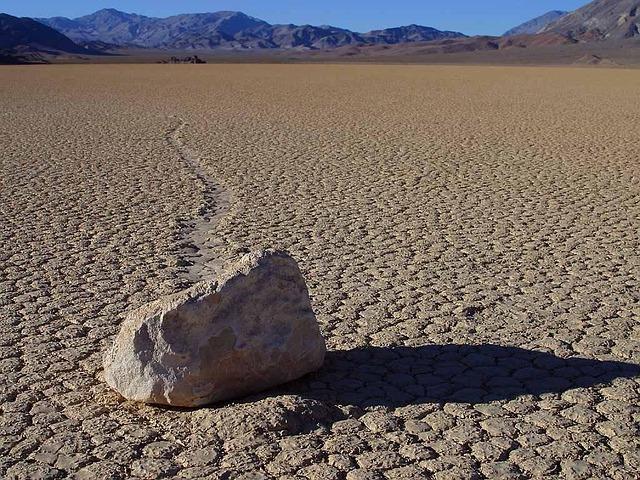
Moving Rocks are rock blocks observed on Racetrack Playa within the boundaries of Death Valley National Park in the state of California, United States of America. These rocks, typically composed of dolomitic material and occasionally quartz monzonite, move across the wet and flat playa surface leaving trails behind. The shape and length of these trails are not directly related to the size or shape of the rocks but are largely influenced by surface water saturation, local wind conditions, and surrounding topography. Since the rocks move without being directly observed, studies have been conducted through their trails and long-term field observations have mapped their patterns.

Moving Rocks (Flickr)
Moving Rocks are located within the boundaries of Death Valley in the United States of America, on the expansive desert basin known as Racetrack Playa. The region has an arid climate with low precipitation and high evaporation rates; for most of the year the surface is dry and covered with cracked clay layers. The substrate consists of fine-grained clay and silt deposits, with seasonal short-lived water accumulations. The surrounding mountainous and rugged terrain transports minerals and sediments via erosion to this flat area. Topographic and geological features directly influence the movement of the rock blocks and the orientation of their trails, thereby providing the essential natural conditions for observing motion and trail formation.
The moving rocks observed on Racetrack Playa vary in size and shape, with volumes ranging from large pebbles to medium-sized blocks up to 320 kg.【1】 A GPS-based mapping study conducted in 1996 recorded trails of 162 rocks, of which 132 were selected for analysis. No significant correlation was found between the base area or dimensions of the rocks and trail length; for example, the correlation coefficient between rock volume and trail length was only r = 0.04. Similarly, the relationship between the contact area of the rock base with the playa and trail length was not statistically significant (r = 0.05). Trails ranged from the shortest at 1.6 m (Mary Ann) to the longest at 880.7 m (Diane), with an average trail length of 211.7 m. Trail accuracy, defined as the ratio of total trail length to the straight-line distance between start and end points, varied from a minimum of 0.19 (Claudia) to a maximum of 1.00 (Agnes). Trail morphology differed according to rock shape: rounded rocks left more sinuous trails, while blocky rocks followed straighter paths. These data indicate that rock movement is not solely dependent on physical dimensions or mass.【2】
Trail formation is directly related to local terrain and surface conditions. The playa surface is covered with hard, dried sedimant polygons composed of 24% fine sand, 41% silt, and 35% clay.【3】 Trails form only when the surface is wet and slippery; their shapes are preserved with slightly raised edges and resemble “fossil waves.” Trail orientation analysis reveals a predominant north-northeast direction in most trails, consistent with the dominant wind direction in the region. For instance, in a visual field analysis of 12 representative rocks, an inverse relationship was observed between trail orientation and the aspect (slope direction) of surrounding terrain; a quadrant with high pixel density correlated with low trail orientation values, and this finding was statistically significant at the 95% confidence level in t-test analyses. Trail length and accuracy vary depending on the starting location of the rocks, with trails along the eastern edge being both longer and straighter; this is explained by microtopographic effects resulting from local wind channels and limited water sources on the playa that partially wet the surface.【4】

Moving Rocks (Flickr)
The movement of Moving Rocks is explained by the complex interaction of surface properties, wind conditions, and topographic micro-features. The area where rocks move is concentrated mostly in the southeast portion of the playa, which offers a relatively flat surface; when a thin layer of water or moist surface forms here, rocks become more responsive to wind due to reduced friction. The local wind regime is the most important factor determining the direction and form of rock trails; Racetrack Playa is exposed to variable and sometimes vortical wind flows channeled by surrounding natural topography. These air currents enable rocks to follow both straight and meandering paths. Additionally, the topographic structure around the playa alters wind speed and direction in micro-regions where rocks move, contributing to trail diversity. Contrary to earlier ice-sheet hypotheses, ice is not a necessary condition for rock movement; moist ground and directed winds are sufficient to allow rocks to move in specific directions and leave characteristic trails. Thus, the formation mechanism of moving rocks is based on the combined interactions of local wind conditions, surface moisture, and surrounding topography.
Research into the movement of Moving Rocks has been limited by the field’s harsh conditions and the unobserved nature of rock motion, restricting early methods to traditional approaches. Until the mid-20th century, studies were confined to manually measuring a small number of rocks; for example, Kirk, Sharp, and Carey mapped trails of only 12 to 30 rocks without comprehensively explaining their sampling criteria or methodological details. These limitations created significant gaps in understanding the rocks’ movement mechanism. The characteristic features of trails—length, accuracy, sinuosity, and starting points—could not be fully determined using traditional mapping techniques, and the influence of surface conditions on rock movement was inadequately assessed.【5】
In studies conducted in 1996, Global Positioning System (GPS) technology enabled comprehensive mapping of the area. Using Trimble Pro-XL receivers and TDC1 data loggers, the positions of 162 rocks and their trails were recorded with approximately 30 cm precision. Trails were digitally traced in 50 cm segments to obtain detailed directional and length data. Field data were analyzed to examine relationships between the physical properties of the rocks and trail parameters. Additionally, terrain topography and visibility analyses were used to evaluate the microtopographic and wind conditions affecting each rock at the start of its movement. These methods provided significantly higher accuracy and scope than previous studies in understanding rock movement mechanisms and trail formation.【6】
The trails of Moving Rocks on Racetrack Playa vary despite forming on a flat surface, due to environmental conditions. Trails exhibit diverse morphologies because the surface varies in moisture content and plasticity. Some trails are straight and directly reflect the direction of rock movement, while others are sinuous and irregular; this can be explained by local topography directing wind flows. Field observations show that the starting locations and trails of rocks are shaped independently of the rocks’ physical characteristics. Trails are sensitive to microtopographic obstacles and changes in wind direction encountered during movement, regardless of the rock’s shape or size.

Moving Rocks (Flickr)
Different densities and orientations of trails have been observed in various regions of the playa. Particularly along the eastern edge, trails are longer and straighter, consistent with the surface being more frequently wet and smooth. In the central and western areas, trails are shorter, more sinuous, and irregular, which can be linked to variable wind flows and the heterogeneous morphology of the surface. Observations indicate that rock movements cannot be explained by a single mechanism; rather, trails result from the combined effects of surface conditions, microtopography, and wind interactions. These general findings demonstrate that the movement of Moving Rocks is closely tied to environmental factors and that the heterogeneous natural structure of the playa plays a decisive role in shaping the trails.【7】
Moving Rocks draw attention as a product of natural geomorphological processes and illustrate the interaction between surface morphology and climatic conditions. These rocks and their trails reveal the physical effects of environmental changes and provide insight into how landforms are shaped by hydraulic and wind forces. The isolated and inaccessible nature of the area allows the rocks to remain preserved and their trails to remain observable over long periods. Their movement and the trails they leave behind offer tangible evidence of landscape dynamics and environmental variability. Beyond their importance as a key natural reference point in geomorphology, Moving Rocks occupy a position as both a natural and cultural heritage element in the relationship between the natural environment and human perception.
Fulmer, David P. "Sliding Stones, Death Valley." Flickr. Accessed March 14, 2026. https://www.flickr.com/photos/daveynin/26726524352/
Fulmer, David P. "Stone race." Flickr. Accessed March 14, 2026. https://www.flickr.com/photos/daveynin/26195001514/
Fulmer, David P. "The rock had a shadow." Flickr. Accessed March 14, 2026. https://www.flickr.com/photos/daveynin/26547729240/
Fulmer, David P. "Turning the slide path." Flickr. Accessed March 14, 2026. https://www.flickr.com/photos/daveynin/26706921372/in/photostream/
Messina, Paula, and Phil Stoffer. "Terrain analysis of the Racetrack Basin and the sliding rocks of Death Valley." *Geomorphology* 35, no. 3–4 (2000): 253–265. Accessed March 14, 2026. https://www.sciencedirect.com/science/article/pii/S0169555X00000428
National Park Service. "Death Valley’s Moving Rocks." National Park Service, March 22, 2018. Accessed March 14, 2026. https://www.nps.gov/articles/deva-moving-rocks.htm
National Park Service. "The Racetrack." Death Valley National Park. September 29, 2021. Accessed March 14, 2026. https://www.nps.gov/deva/planyourvisit/the-racetrack.htm
Norris, Richard D., James M. Norris, Ralph D. Lorenz, Jib Ray, and Brian Jackson. "Sliding Rocks on Racetrack Playa, Death Valley National Park: First Observation of Rocks in Motion." *PLOS ONE* 9, no. 8 (2014): 1–11. Accessed March 14, 2026. https://journals.plos.org/plosone/article?id=10.1371/journal.pone.0105948
PDPhotos. "Yürüyüş Kayaları, Taşlar, Ölüm Vadisi görseli." Pixabay. Accessed March 14, 2026. https://pixabay.com/tr/photos/y%c3%bcr%c3%bcy%c3%bc%c5%9f-kayalar%c4%b1-ta%c5%9flar-%c3%b6l%c3%bcm-vadisi-3712/
Scripps News. "Mystery Solved: “Sailing Stones” of Death Valley Seen in Action for the First Time." Scripps Institution of Oceanography. August 27, 2014. Accessed March 14, 2026. https://scripps.ucsd.edu/news/mystery-solved-sailing-stones-death-valley-seen-action-first-time
[1]
Paula Messina and Phil Stoffer, “Terrain Analysis of the Racetrack Basin and the Sliding Rocks of Death Valley,” Geomorphology 35, no. 3–4 (2000): 255, Last Access: 14 March 2026, https://www.sciencedirect.com/science/article/pii/S0169555X00000428
[2]
A.e., p. 257-258
[3]
A.e., p. 254
[4]
A.e., p. 263-264
[5]
A.e., p. 255
[6]
A.e., p. 256-257
[7]
A.e., p. 256-257


Protection Status | Death Valley National Park | ||||||||
|---|---|---|---|---|---|---|---|---|---|
Movement Mechanism | and Wind Thin Ice Layer Combined Effect of Water | ||||||||
Location | USA California Death Valley | ||||||||
Scientific Importance | Desert Surface Processes | ||||||||
Movement Speed | Up to Several Meters per Minute | ||||||||
Heaviest Rock | Approximately 320 kg | ||||||||
Formation Type | Geomorphological Surface Process | ||||||||
Area of Occurrence | Racetrack Playa (Dry Lake Bed) | ||||||||
Geographic Location and Natural Environment
Rock Movement and Trail Formation
Formation Mechanisms
Research and Measurement Methods
Observations and General Findings
Cultural Significance