


This article was automatically translated from the original Turkish version.
+1 More
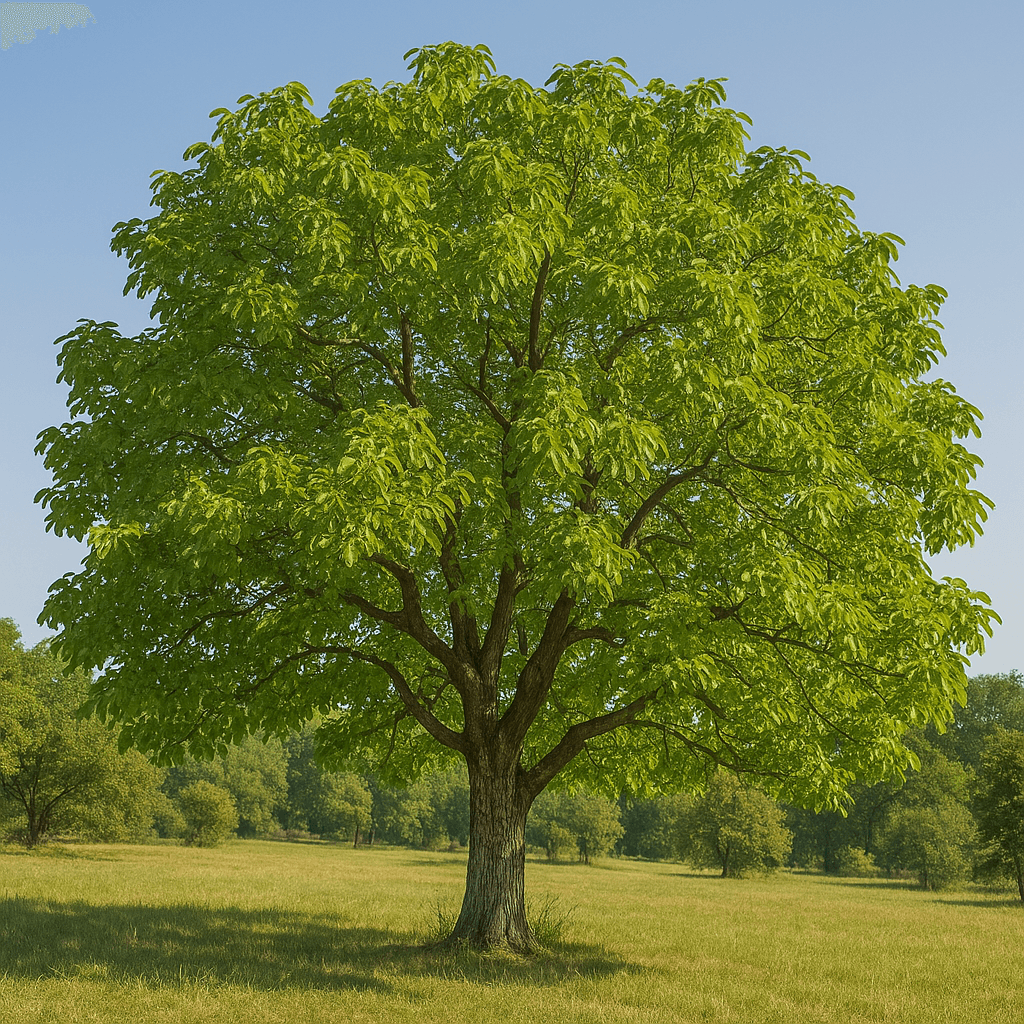
Walnut Tree
Family | Juglandaceae | ||||||||
|---|---|---|---|---|---|---|---|---|---|
Genus | Juglans | ||||||||
Tree Height | 25–40 metres | ||||||||
Root | Deep taproot system, can extend down to 3–5 metres | ||||||||
Leaf | Compound leaves, with 7–9 leaflets, arranged oppositely | ||||||||
Flower | Monoecious; male and female flowers open on the same tree at different times (dikogamy) | ||||||||
Pollination | Occurs by wind (anemophily) | ||||||||
The walnut tree (Juglans regia L.) is a deciduous, long-lived tree species belonging to the Juglandaceae family, characterized by a deep taproot system and a height that can reach 25–40 meters. It is an ecologically and economically significant plant due to its wide distribution, compound leaves, and nutritious fruit.
Walnut belongs to the Juglandaceae (walnut family) and the genus Juglans, with Juglans regia L. being the most widely cultivated species. The genus Juglans comprises 18 species, among which J. nigra (black walnut), J. hindsii (Hinds’ walnut), J. cinerea (butternut), J. mandshurica (Manchurian walnut), and J. californica are notable. The walnut tree is distinguished by its height of up to 25–40 meters and a taproot system that can extend to depths of 3–5 meters. Its leaves are compound, with large, oval leaflets that have smooth margins. These leaves typically consist of 7–9 leaflets arranged alternately along a central axis on short petioles. Male flowers develop in catkin-like structures on lateral branches, while female flowers form at the tips of shoots. The plant is monoecious, with male and female flowers occurring on the same individual but in different locations. Pollination is primarily wind-driven (anemophilous), and dichogamy is common among walnut species.
Juglans regia exhibits a broad distribution across temperate regions, including Southeastern Europe, Central Asia, and North America. It can be cultivated at elevations up to 2000 meters above sea level and requires 800–1800 chilling hours, giving it wide ecological tolerance. Excessive summer heat may cause scorching of the green husk and leaves, and shriveling of the nuts. Spring frosts represent a major limiting factor in walnut cultivation.
Walnut trees form symbiotic relationships primarily with arbuscular mycorrhizal (AM) fungi. This association is most intense in the finer, younger root tips (first- and second-order branched roots). The fibrous roots of walnut depend on AM fungi for nutrient uptake. The fungi supply the plant with carbon compounds, while in return they facilitate the absorption of minerals such as phosphorus and nitrogen. This symbiotic structure positively influences the adaptation and development of walnut seedlings in the field.

Walnut fruit contains 55–77% oil, 15–30% protein, and 5–15% carbohydrates. It also provides vitamins A, B1, B2, B6, and C, as well as minerals including calcium, phosphorus, magnesium, iron, sodium, and potassium. The walnut leaf and green husk, which are by-products of agricultural production, are rich in phenolic acids (ellagic, gallic, ferulic, chlorogenic, etc.), flavonoids (myricetin, rutin), triterpenic acids, juglone, organic acids, and terpenoid derivatives. Phenolic compounds such as juglone are particularly abundant in the leaves. Juglone is a secondary metabolite noted for its antimicrobial, antifungal, anti-inflammatory, and anticancer properties.
The walnut leaf and green husk contain compounds that support a wide range of biological activities, including antioxidant, antimicrobial, anti-inflammatory, anti-ulcer, antidiabetic, antihistaminic, and hepatoprotective effects. These components hold potential for use in functional foods, nutraceutical product development, and the production of natural food additives.
In 2019, global walnut production reached approximately 4.5 million tons. China led production with a 56.1% share, followed by the United States and Iran. Türkiye ranked fourth with approximately 5% of global production. In 2020, walnut cultivation area in Türkiye reached about 142,000 hectares, with a production volume of 287,000 tons. The provinces of Bursa, Mersin, and Kahramanmaraş were among the highest-producing regions. Walnuts are exported globally both in-shell and shelled. Türkiye imports significant quantities of shelled walnuts from countries such as Ukraine, Iran, and China. As of 2020, Türkiye’s total walnut exports amounted to 3,551 tons, while imports reached approximately 62,000 tons.
ER, Ercan. *Cevizin Bitkisel Özellikleri.* Presentation, 1st Regional Group Meeting, 2023, Karabük, June 13, 2023. Accessed July 21, 2025. https://arastirma.tarimorman.gov.tr/ktae/Belgeler/BGT/1-Cevizin_Bitkisel_Ozellikleri.pdf.
Mortier, Emma, Olivier Lamotte, Fabrice Martin-Laurent, and Ghislaine Recorbet. “Forty Years of Study on Interactions between Walnut Tree and Arbuscular Mycorrhizal Fungi: A Review.” *Agronomy for Sustainable Development* 40, no. 43 (2020). Accessed July 21, 2025. https://doi.org/10.1007/s13593-020-00647-y.
Salık, Mehmet Ali, and Songül Çakmakçı. “Ceviz (Juglans regia L.) Yaprağı ve Yeşil Kabuğu: Fonksiyonel Özellikleri, Sağlığa Yararları ve Gıdalarda Kullanım Potansiyeli.” *Akademik Gıda* 21, no. 1 (2023): 90–100. Accessed July 21, 2025. https://doi.org/10.24323/akademik-gida.1274040.
Türkiye Ziraat Odaları Birliği (TZOB), Tarımsal Ekonomi ve Politika Geliştirme Enstitüsü (TEPGE). *Ceviz, Haziran 2021, Tarım Ürünleri Piyasa Raporu.* Ankara: TZOB TEPGE, 2021. Accessed July 21, 2025. https://arastirma.tarimorman.gov.tr/tepge/Belgeler/PDF%20Tar%C4%B1m%20%C3%9Cr%C3%BCnleri%20Piyasalar%C4%B1/2021-Haziran%20Tar%C4%B1m%20%C3%9Cr%C3%BCnleri%20Raporu/Ceviz,%20Haziran-2021,%20Tar%C4%B1m%20%C3%9Cr%C3%BCnleri%20Piyasa%20Raporu,%20TEPGE.pdf.
Özuğur, Zafer. “Bilecikli Arıcı Asırlık Ceviz Ağacında Bal Üretiyor.” Anadolu Ajansı, August 16, 2020. Accessed July 21, 2025. https://www.aa.com.tr/tr/yasam/bilecikli-arici-asirlik-ceviz-agacinda-bal-uretiyor/1927152.

Walnut Tree
Family | Juglandaceae | ||||||||
|---|---|---|---|---|---|---|---|---|---|
Genus | Juglans | ||||||||
Tree Height | 25–40 metres | ||||||||
Root | Deep taproot system, can extend down to 3–5 metres | ||||||||
Leaf | Compound leaves, with 7–9 leaflets, arranged oppositely | ||||||||
Flower | Monoecious; male and female flowers open on the same tree at different times (dikogamy) | ||||||||
Pollination | Occurs by wind (anemophily) | ||||||||
No Discussion Added Yet
Start discussion for "Walnut Tree (Juglans regia L.)" article
Taxonomic Classification and Botanical Characteristics
Distribution and Ecological Suitability
Root Systems and Mycorrhizal Relationships
Chemical and Bioactive Composition
Functional and Nutraceutical Potential
Agricultural and Economic Importance