


This article was automatically translated from the original Turkish version.
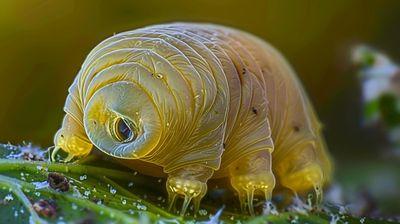
Tardigrade
World | Eukaryota | ||||||||
|---|---|---|---|---|---|---|---|---|---|
Lower World | Eumetazoa | ||||||||
Common Names | Sea Anemone, Algal Pigment | ||||||||
Discovery | 1773 | ||||||||
Tardigrada (commonly known as water bears or moss piglets) are small invertebrate animals found in marine, freshwater, and terrestrial habitats worldwide. They typically measure between 0.1 and 1 mm in length and consist of a head segment and four body segments, each bearing a pair of clawed legs. Terrestrial tardigrades require a thin film of water to remain active.
The phylum Tardigrada has a controversial and complex taxonomy. Traditionally it is divided into three classes:
Heterotardigrada are united by the presence of a lateral cirrus, while Eutardigrada are distinguished by the morphology of their buccopharyngeal apparatus. The validity of the class Mesotardigrada is disputed, as it is based on a single specimen that has since been lost. Recent molecular studies suggest that Apochela, previously considered an order within Eutardigrada, should be reclassified as a new class, Apotardigrada, and that Parachela should become the new Eutardigrada class. This reclassification is based on claw morphology, but debates continue regarding whether phylogenetic branch length data should be used to define taxonomic hierarchies. Approximately 80 percent of described tardigrade species are found in terrestrial ecosystems and are predominantly members of the class Eutardigrada.

Tardigrade visualized using colorized electron microscopy (American Scientist)
Tardigrades occur in various soil types and under plant cover in terrestrial ecosystems. They occupy different trophic levels as herbivores, omnivores, predators, and sometimes microbivores (microbe feeders). Their diet includes fungi, algae, rotifers, nematodes, detrital particles, and even macrofauna; algae and nematodes are particularly important food sources. Tardigrades also serve as prey for other micro- and macrofauna, highlighting their ecological importance and complexity within biological food webs. They contribute to nutrient cycling by breaking down other microorganisms and releasing nutrients back into the environment.
Their distribution is influenced by various abiotic and biotic factors. Average annual temperature (MAT) has been identified as the most significant factor affecting tardigrade presence; relative abundance decreases as MAT increases. Tardigrades are thought to prefer or be well adapted to cooler environments. Other important abiotic factors include soil pH, total nitrogen (TN), and mean annual precipitation (MAP). A large-scale study in Australia observed that tardigrades are predominantly found in coastal soils, with the genus Eremobiotus being the most dominant. Structural equation modeling has revealed that bacterial, fungal, protist, algal, and nematode communities also play a critical role in shaping tardigrade distribution. Different tardigrade genera (e.g., Eremobiotus, Minibiotus, Paramacrobiotus) exhibit distinct responses to specific environmental factors (pH, MAP, ammonium, MAT) and to other organism groups (algae, protists, fungi, bacteria).
Tardigrades are renowned for their remarkable resistance to extreme conditions, largely due to their ability to enter a state called anhydrobiosis, in which they tolerate nearly complete water loss and become metabolically inactive. In this state, they can survive a wide range of physical extremes that are lethal to most organisms, including extreme temperatures (from approximately -273°C to 100°C), high pressure (7.5 GPa), immersion in organic solvents, high doses of radiation (ionizing and UV), and even the vacuum of space. Experiments conducted during the FOTON-M3 mission in September 2007 demonstrated that dried specimens of Richtersius coronifer and Milnesium tardigradum survived exposure to the vacuum of space. Although the combined effects of space vacuum and solar radiation significantly reduced survival rates, some M. tardigradum specimens survived even under these conditions. This constitutes the first recorded instance of an animal surviving simultaneous exposure to the vacuum of space and solar/galactic radiation.
The molecular mechanisms underlying tardigrades’ extraordinary resilience are actively being investigated. Key findings include:
Tardigrade research has traditionally relied on morphological identification and microscopic analysis. However, these methods are time-consuming and require specialized expertise. In recent years, molecular techniques such as environmental DNA (eDNA) metabarcoding and 18S/28S rRNA gene sequencing have been increasingly used, particularly in large-scale distribution and community structure studies. Nevertheless, the effectiveness of molecular methods is limited by gaps in existing genetic databases; many tardigrade species have not yet been sequenced or are misclassified in databases. Therefore, the combined use of morphological and molecular approaches is emphasized as essential for future tardigrade ecology research.
Chavez, Carolina, Grisel Cruz-Becerra, Jia Fei, George A. Kassavetis, and James T. Kadonaga. 2019. “The Tardigrade Damage Suppressor Protein Binds to Nucleosomes and Protects DNA From Hydroxyl Radicals.” *eLife* 8 (October). https://doi.org/10.7554/elife.47682.
Fleming, James F., and Kazuharu Arakawa. 2021. “Systematics of Tardigrada: A Reanalysis of Tardigrade Taxonomy With Specific Reference to Guil Et Al. (2019).” *Zoologica Scripta* 50 (3): 376–82. https://doi.org/10.1111/zsc.12476.
Hashimoto, Takuma, Daiki D. Horikawa, Yuki Saito, Hirokazu Kuwahara, Hiroko Kozuka-Hata, Tadasu Shin-I, Yohei Minakuchi, et al. 2016. “Extremotolerant Tardigrade Genome and Improved Radiotolerance of Human Cultured Cells by Tardigrade-unique Protein.” *Nature Communications* 7 (1). https://doi.org/10.1038/ncomms12808.
He, Zi-Yang, Hang-Wei Hu, Bao-Anh Thi Nguyen, Qing-Lin Chen, Anthony Weatherley, Michael Nash, Li Bi, Keren Wu, and Ji-Zheng He. 2024. “Distribution of Soil Tardigrades as Revealed by Molecular Identification Across a Large-scale Area of Australia.” *Soil Biology and Biochemistry* 196 (June): 109506. https://doi.org/10.1016/j.soilbio.2024.109506.
Persson, Dennis, Kenneth A. Halberg, Aslak Jørgensen, Claudia Ricci, Nadja Møbjerg, and Reinhardt M. Kristensen. 2011. “Extreme Stress Tolerance in Tardigrades: Surviving Space Conditions in Low Earth Orbit.” *Journal of Zoological Systematics & Evolutionary Research* 49 (s1): 90–97. https://doi.org/10.1111/j.1439-0469.2010.00605.x.

Tardigrade
World | Eukaryota | ||||||||
|---|---|---|---|---|---|---|---|---|---|
Lower World | Eumetazoa | ||||||||
Common Names | Sea Anemone, Algal Pigment | ||||||||
Discovery | 1773 | ||||||||
No Discussion Added Yet
Start discussion for "Water Bear (Tardigrada)" article
Taxonomy and Systematics
Ecology and Distribution
Resistance to Extreme Conditions (Extremotolerance)
Molecular Mechanisms of Resistance
Research Methods