

This article was automatically translated from the original Turkish version.

An earthquake, a pandemic, or a flood is in itself merely a movement of nature. These movements gain meaning within the framework of human-made systems, and what we call a disaster is in fact far more related to humans than to nature. How societies are organized, who they protect and who they leave vulnerable, what inequalities they contain—these determine how a disaster takes shape. Thus, disasters are natural, but the disasters themselves and their consequences are never natural.
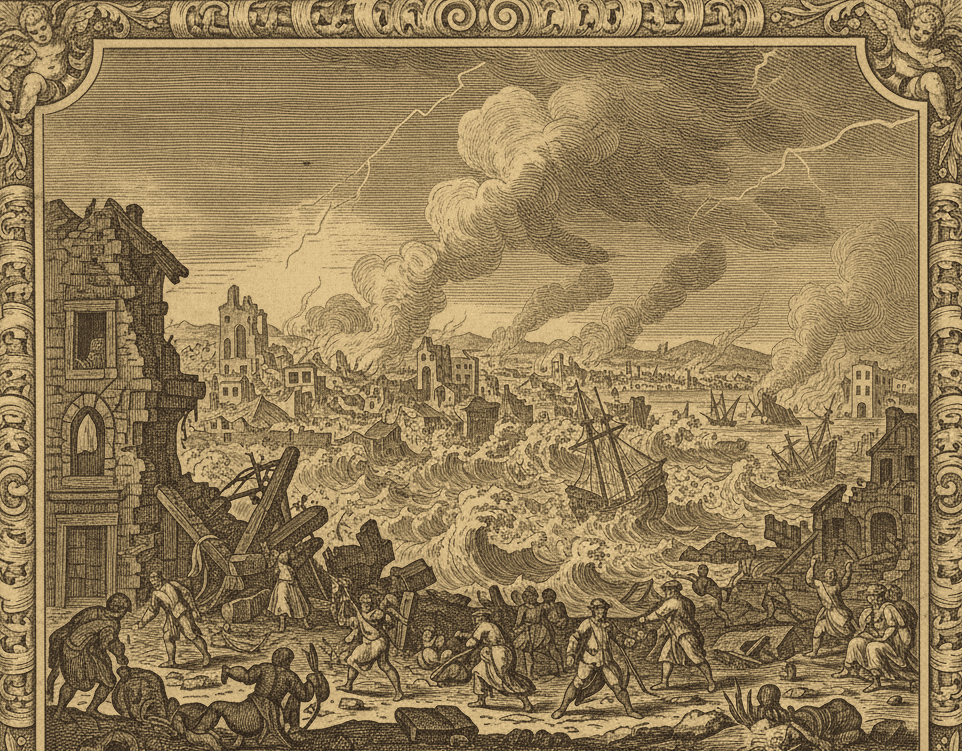
A representative image of the Lisbon earthquake. (Image generated by artificial intelligence.)
This distinction may seem obvious to us today, but one of the first to articulate it so clearly was Jean-Jacques Rousseau. The great earthquake that struck Lisbon in 1755 fundamentally shook Europe’s belief systems and intellectual world. Tens of thousands died; the city was completely consumed by fire. The poor, the priests, and the nobility all lost their lives. Across Europe at the time, everyone began asking the same question: “Why did God allow this?”
At the time, the prevailing belief was that disasters were God’s way of punishing humanity. This idea must sound familiar, does it not? The Church claimed the Lisbon earthquake was the result of human sin, but the scale of destruction was so immense that this explanation satisfied no one. After all, priests had died too, and churches had collapsed. If this was punishment, then for whom? Against whom had God become angry?
It was precisely at this point that Rousseau approached the event from a radically different perspective. While everyone questioned God’s justice, he began questioning humanity itself. He did not only ask why the disaster occurred, but what it meant. In describing the destruction in Lisbon, he examined how people had built their cities and how wealth had been distributed. According to him, if the city’s layout had been more balanced and if everyone had lived in homes of equal quality, the losses would have been far fewer. The earthquake in Lisbon affected everyone, of course, but the poor suffered the most. Aid reached the nobility first, not the poor. The funeral of the priest, not the pauper, was sought after.
For Rousseau, which people were destroyed, which were protected, and which recovered more quickly by a natural event was directly tied to the class structure of society. In other words, disaster was, in a sense, a mirror of social inequality.
Today, in modern sociology, Rousseau’s approach is known as “vulnerability.” It is impossible to truly explain a disaster without understanding which groups within a society are most vulnerable. The same earthquake produces different outcomes for different classes. Rousseau had recognized this centuries ago. Nature does not treat everyone equally, because society does not offer everyone equal opportunities.
To Rousseau, even labeling an event as a “disaster” was a class-based choice. The Lisbon earthquake entered Europe’s public agenda because the areas destroyed were those inhabited by nobles, priests, and merchants. Had only the poor perished, the event would have been dismissed as a “natural catastrophe” and forgotten.
Centuries have passed, but Rousseau’s insight remains valid today. For example, the COVID-19 pandemic is one of its most immediate illustrations. The pandemic affected everyone, but not equally. Some people could work from home; white-collar workers could remain safely indoors. Meanwhile, blue-collar workers, supermarket employees, factory laborers, and healthcare providers faced risk every day. The virus could infect anyone, but not everyone had equal means of protection. The vulnerability Rousseau described remained decisive even 250 years later.
A similar dynamic occurred in the Kahramanmaraş earthquakes. The same magnitude of shaking affected millions, but the outcomes were not the same for everyone. Some buildings remained standing; others collapsed within seconds. Aid reached some areas immediately, while others waited for days. The same earthquake affected Türkiye differently than it did Syria. Women, children, the elderly, and people with disabilities became the most vulnerable groups.
This is exactly what Rousseau meant. Natural events expose the injustices hidden within societies. Whether it is an earthquake, a pandemic, or a flood, pre-existing inequalities in society grow larger through disasters, and suppressed vulnerabilities come to light. We often speak of the disaster itself, but not of the system that creates it. Yet that is the real issue.
Today we frequently hear the term “resilient cities,” but a society’s resilience cannot be measured solely by the strength of its buildings. True resilience is tied to the fair distribution of resources, social policies, and a system in which everyone is equally protected. The same magnitude of earthquake produces different outcomes in an unequal society. Poor neighborhoods suffer more destruction, women are rescued later, babies are stolen, and migrants’ tents are placed farther away. None of these disparities originate in nature; all are human-made.
As Rousseau said centuries ago, how societies are organized, who is deemed worthy of protection, and who can be forgotten—these determine the scale of a disaster. What makes a disaster a disaster is not how much the ground shook or how widely the virus spread. It is who survived, who was cared for, and who was able to rebuild. And the force that creates this difference is humanity itself.
Alexander, David. “Models of Social Vulnerability to Disasters.” *RCCS Annual Review* 4, no. 4 (2012). Centro de Estudos Sociais da Universidade de Coimbra. Accessed November 11, 2025. https://doi.org/10.4000/rccsar.412
Dynes, Russell R. "The Dialogue Between Voltaire and Rousseau on the Lisbon Earthquake: The Emergence of a Social Science View." *Preliminary Paper No. 293. Disaster Research Center*, University of Delaware, 1999. Accessed November 11, 2025. https://udspace.udel.edu/server/api/core/bitstreams/34022716-7977-40e2-9f4d-8b3d6d6b4bff/content