


This article was automatically translated from the original Turkish version.
February 6, 2023 Kahramanmaraş Earthquakes
History | 2023-02-06 | ||||||||
|---|---|---|---|---|---|---|---|---|---|
Time | 04:17 (Mw 7.7) - 13:24 (Mw 7.6) | ||||||||
Epicenter | Kahramanmaraş (Pazarcık and Elbistan) | ||||||||
Loss of Life | 50,000+ | ||||||||
Number of Injured | 100,000+ | ||||||||
Affected Population | 14 million | ||||||||
Destroyed/Severely Damaged Building | 300,000+ | ||||||||
Fault Line | East Anatolian Fault Line | ||||||||
6 February 2023 earthquakes centered in Kahramanmaraş in southeastern Türkiye have been recorded as one of the largest and most destructive seismic events in the country’s history. Two main shocks with magnitudes of 7.7 and 7.6 on the moment magnitude (Mw) scale occurred along the East Anatolian Fault Zone, causing extensive damage across a wide geographic area.

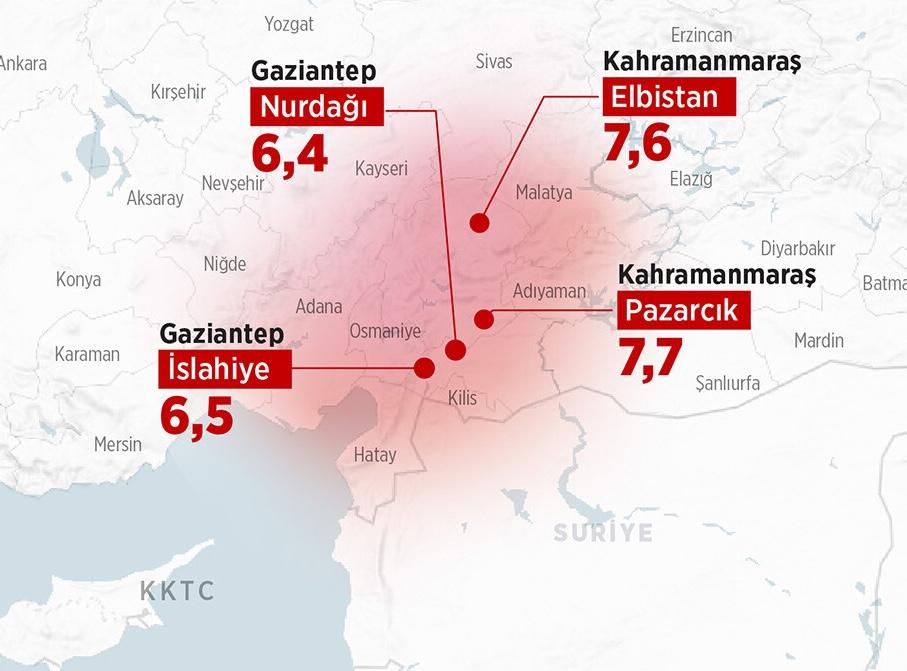
2023 Kahramanmaraş Earthquakes map - Anadolu Ajansı
The first earthquake occurred at 04:17 on 6 February 2023, centered in Pazarcık district of Kahramanmaraş, with a magnitude of 7.7. On the same day at 13:24, a second major earthquake of magnitude 7.6 struck centered in Elbistan district of Kahramanmaraş. Thousands of aftershocks were recorded during and after the interval between these two major events.
The earthquakes caused widespread destruction in 11 provinces of Türkiye and were felt in surrounding regions. Kahramanmaraş, Hatay, Adıyaman, Malatya, Gaziantep, Osmaniye, Kilis, Diyarbakır, Şanlıurfa, Elazığ and Adana were directly affected, with approximately 14 million people impacted directly by the earthquakes. The tremors were also felt in neighboring countries including Syria, Lebanon, Cyprus and Iraq, with casualties and damage reported in Syria as well.
The earthquakes resulted in massive infrastructure and building damage, disruptions to transportation networks, and outages in energy and communication systems. Search and rescue and humanitarian aid operations were launched across the region. Under the Türkiye Disaster Intervention Plan (TAMP), a Level 4 disaster state was declared and an international aid appeal was issued.
The 6 February 2023 Kahramanmaraş earthquakes occurred along the East Anatolian Fault Zone (EAFZ), triggering extensive surface ruptures and widespread damage. In addition to the two main shocks, thousands of aftershocks were recorded in the region, and significant changes were observed in the Earth’s crust.
The first main shock occurred at 04:17 on 6 February 2023, centered in Pazarcık district of Kahramanmaraş. This earthquake, with a moment magnitude (Mw) of 7.7, occurred at a depth of approximately 8.6 km. Its epicentral coordinates were calculated as 37.236°N, 37.057°E.
The second major shock occurred at 13:24 on the same day, centered in Elbistan district of Kahramanmaraş. This second earthquake, with a magnitude of Mw 7.6, was recorded at a depth of 7 km, with epicentral coordinates of 38.089°N, 37.239°E.
The EAFZ, together with the North Anatolian Fault Zone (NAFZ), is one of Türkiye’s primary tectonic boundaries and is actively active due to compression between the Arabian Plate and the Anatolian Plate.
During the 6 February earthquakes, surface ruptures up to 290 km in length developed along different segments of the East Anatolian Fault. The earthquakes caused major displacements particularly along the following fault segments:
Pazarcık Segment: This segment, which formed the rupture line of the first earthquake, generated a 82 km long fault.
Çardak Fault: This segment, ruptured by the second earthquake centered in Elbistan, produced a 85 km long surface rupture.
Erkenek, Gölbaşı and Amanos Segments: These segments produced ruptures of varying lengths during the earthquakes, with displacements ranging from 3 to 6.5 meters.
Field surveys after the earthquakes revealed extensive surface displacements along highways, railways and agricultural lands, with horizontal displacements reaching up to 3–4 meters in some areas.
Numerous aftershocks occurred in the region following the main shocks. During the first week after the earthquake, at least 200 aftershocks with magnitudes of Mw 5.0 or higher were recorded, and thousands of aftershocks were documented within the first month. Between 6 February 2023 and 5 February 2024, the 11 affected cities experienced approximately 57,000 tremors.

Number of earthquakes between 6 February 2023 and 5 February 2024 - Anadolu Ajansı
The 6 February 2023 Kahramanmaraş earthquakes caused extensive destruction across a wide geographic area, resulting in thousands of fatalities, severe building damage and infrastructure collapses. Heavy damage occurred in the 11 directly affected provinces, rendering many structures unusable.
According to official figures, 53,537 people lost their lives, 107,213 were injured, and many others went missing. The death toll increased further as additional bodies were recovered during debris clearance operations.
Fatality rates were particularly high in the affected regions, especially in Hatay, Kahramanmaraş, Adıyaman, Gaziantep, Malatya and Osmaniye. Approximately 14 million people in the region were directly affected by the earthquake, of whom over 3.5 million were evacuated.
A total of 311,440 buildings were identified as severely damaged or destroyed. 810,902 independent units (residential and commercial) became unusable.
In the earthquake zone, particularly:
Multi-story reinforced concrete apartment buildings were completely collapsed or severely damaged. Industrial facilities and factories suffered major damage. Public buildings (hospitals, schools, administrative structures) sustained serious structural damage. Traditional stone and adobe houses in rural areas were entirely destroyed. The provinces with the highest structural damage were, in order, Hatay, Kahramanmaraş, Malatya and Adıyaman.
The earthquakes severely impacted transportation and infrastructure, causing major damage to roads, railways, airports, energy lines, communication networks and water supply systems. Major deformations occurred on main transportation routes, with some roads completely collapsed or fractured. In provinces such as Hatay and Gaziantep, railway lines were damaged, and train services were suspended due to displacement and destruction of tracks. At Hatay Airport, cracks on the runway temporarily halted flights, and the airport’s inoperability caused delays in logistical support.
The electricity and natural gas infrastructure also suffered major damage. Prolonged power outages occurred in Hatay, Kahramanmaraş and Adıyaman due to destruction of power lines, while gas pipeline leaks created additional safety hazards. Communication infrastructure was severely affected; numerous base stations and fiber optical lines were damaged, leading to prolonged disruptions in telephone and internet services. Cracks and breaks occurred in water supply and sewage systems, resulting in drinking water shortages in some areas, while damage to the sewage system created a public health threat.
The earthquakes also caused severe damage to the region’s historical and cultural heritage. Among the structures that were destroyed or severely damaged are:
A total of more than 3,900 cultural heritage structures were assessed, with some completely destroyed and a large portion requiring restoration. Following the earthquakes, some historical mosques, churches and caravanserais became unusable, and artifacts in museums were damaged or relocated to safe areas. A cost of 56.3 billion TL was estimated for the restoration of cultural structures.

Restoration work on Habib-i Neccar Mosque damaged by the earthquakes, February 2025 - Anadolu Ajansı
Following the 6 February 2023 Kahramanmaraş earthquakes, a large-scale disaster response and relief effort was launched across Türkiye. Under the Türkiye Disaster Intervention Plan (TAMP), emergency management systems were activated, and national and international rescue teams were deployed to the affected areas. Government institutions, civil society organizations, volunteers and military units worked in coordinated fashion to carry out search and rescue, shelter and humanitarian aid operations.
Due to the scale and destructive impact of the earthquake, a “Level 4 Disaster” was declared under the Türkiye Disaster Intervention Plan (TAMP), which is defined as the highest level of emergency response, triggering international aid requests.
Immediately after the earthquake, crisis management centers were established under the coordination of AFAD, initiating a rapid response in the affected regions. Search and rescue teams from across the country were rapidly dispatched to locate survivors trapped under debris. Government agencies, local administrations, civil society organizations and volunteers were mobilized to create a broad support network. Additional security forces were deployed to ensure safety and maintain order in disaster zones, and measures were taken to ensure the safe conduct of search and rescue operations. To enable effective management of the emergency response, a state of emergency (OHAL) was declared in the earthquake zone, accelerating logistical flows and coordination to ensure uninterrupted relief and rescue efforts.
AFAD organized search and rescue operations from the moment of the earthquake and provided logistical support to field teams. The Turkish Red Crescent delivered hot meals, drinking water, blankets and essential supplies through mobile kitchens and emergency shelter services.
Civil society organizations and volunteers supported search and rescue efforts, provided humanitarian aid and offered psychosocial support. AKUT, İHH, Ahbap and other civil society organizations actively operated in the earthquake zone.
Medical teams, including the National Medical Rescue Team (UMKE) and 112 Emergency Service personnel, provided emergency medical care and established field hospitals to deliver healthcare services.
Immediately after the earthquake, search and rescue teams from across Türkiye were rapidly deployed to the disaster zones. Intensive efforts were made within the first 72 hours to reach people trapped under debris.
A total of more than 650,000 personnel were actively engaged in the field, including 35,250 search and rescue staff, of whom 11,488 were international teams. Search and rescue operations were conducted at 26,032 debris sites across an area of 120,000 km².
AFAD, the Gendarmerie Search and Rescue (JAK), Police Search and Rescue (PAK), AKUT, fire departments and international rescue teams coordinated efforts to carry out debris removal and rescue operations.
Following the earthquake, aid offers were received from 93 countries, with over 90 countries providing search and rescue teams, humanitarian assistance and technical support.
Under international aid, more than 11,000 foreign search and rescue experts were dispatched to the region. Countries such as the United Kingdom, Germany, Azerbaijan, the United States, Japan, Qatar, Spain and Greece sent search and rescue teams. Within Türkiye, the “One Heart” campaign was launched, raising financial support for the earthquake zone through donations.
To rapidly deliver aid to the disaster zone, air, land and sea routes were effectively utilized, with large-scale logistical operations conducted. The Air Force, Army, Navy and Coast Guard Command deployed a total of 141 helicopters and 182 aircraft to transport relief supplies, deploy rescue teams and evacuate the injured. A total of 20,000 vehicles and heavy machinery were dispatched to support debris removal and infrastructure repair. Twenty-three vessels under the Navy were deployed to deliver humanitarian supplies and conduct evacuation operations. Turkish Airlines (THY) conducted 13,701 flights, evacuating over two million earthquake victims and facilitating the arrival of humanitarian and rescue teams. The Navy vessels TCG Bayraktar and TCG Sancaktar were equipped as floating hospitals and played a critical role in treating and evacuating the injured.
To meet the urgent shelter needs after the earthquake, tent cities and container cities were rapidly established, and large-scale shelter, nutrition and healthcare services were provided to disaster victims. Following the temporary shelter phase, long-term reconstruction plans were initiated through state-supported projects and housing construction programs led by TOKİ.

Tent city established by AFAD in Hayat district, 8 February 2023 - Anadolu Ajansı
Following the earthquake, a total of 645,000 tents were erected across 350 tent city areas, providing temporary shelter for approximately 2.5 million disaster victims. Additionally, 220,000 containers were constructed across 428 container city areas, providing housing and various social services for 707,000 earthquake victims. In temporary shelter areas, nutrition, healthcare and education services were provided to meet basic needs. Under the coordination of the Turkish Red Crescent and AFAD, daily hot meal distributions were carried out, health centers were established, and educational spaces were created for children.
As part of the long-term reconstruction process, state-supported housing projects were rapidly implemented, and new housing initiatives were launched by relevant institutions, led by TOKİ. The reconstruction aimed to build earthquake-resistant structures, strengthen urban infrastructure and create sustainable living environments. Under joint projects by TOKİ and Emlak Konut GYO, a total of 452,983 independent units—including 358,859 homes, 31,307 commercial units and 62,817 village houses—are planned to be delivered to their rightful owners by the end of the year.
To enhance disaster management and ensure coordination in the affected areas, a state of emergency (OHAL) was declared and various legal measures were implemented. The OHAL declared on 8 February 2023 applied to the 11 affected provinces and established the necessary legal framework to accelerate emergency response, ensure safety, regulate debris removal and facilitate the effective delivery of aid. Under OHAL, investigations were initiated into construction and building inspection procedures, and special regulations were enacted regarding shelter, healthcare, education and economic support.
Extensive legal investigations were conducted to identify those responsible for buildings destroyed in the earthquake, and legal proceedings were initiated against contractors, building inspection firms and public officials. Within judicial processes, the responsibilities of contractors, engineers and building inspection companies found to have used defective construction practices were examined, and criminal penalties were applied for offenses including negligent homicide, causing construction violations and dereliction of duty. Administrative investigations were also launched against public officials found responsible for permitting unauthorized or unmonitored construction.
Following the earthquake, various legal reforms were enacted in the fields of disaster management, urban planning and building inspection, and new regulations came into effect. Urban planning codes were revised to create more resilient cities, building inspection procedures were tightened, and construction criteria in high-risk areas were redefined.
AFAD. *Kahramanmaraş Depremi Arazi Ön Raporu.* February 28, 2023. Accessed February 6, 2025.
AFAD. *Kahramanmaraş Depremi Raporu.* June 2, 2023. Accessed February 6, 2025.
Anadolu Ajansı. "Asrın Felaketinin İkinci Yılı." Anadolu Ajansı, 2025. Accessed February 6, 2025.
Anadolu Ajansı. "Deprem Bölgesindeki Konut ve İş Yerleri Yıl Sonuna Kadar Hak Sahiplerine Teslim Edilecek." Anadolu Ajansı, 2025. Accessed February 6, 2025.
Anadolu Ajansı. "Strateji ve Bütçe Başkanlığı’nın Raporu: Depremlerin Yol Açtığı Kayıp ve Hasarı Ortaya Koydu." Anadolu Ajansı, 2023. Accessed February 6, 2025.
Ağın Gözükızıl, C., and S. Tezcan. "Afetler: 06 Şubat 2023 Kahramanmaraş Depremi." Kent Akademisi 16, Türkiye Cumhuriyetinin 100. Yılı Özel Sayısı (2023): 97–114. Accessed February 6, 2025.
Bloomberg HT. "Depremlerin Maliyeti Açıklandı." Bloomberg HT, 2023. Accessed February 6, 2025.
Kızılay Akademi. "Türkiye’nin Afetler Tarihinde Bir Milat Olarak 6 Şubat Depremleri." Kızılay Yıllık Raporu, 2023. Accessed February 6, 2025.
Okuyaz, Selda, and Cennet Şevval Balcı. "Bir Belge Işığında Osmanlı’dan Günümüze Doğal Afetlerde Deniz Araçlarının Kullanımı." Mersin Üniversitesi Tıp Fakültesi Lokman Hekim Tıp Tarihi ve Folklorik Tıp Dergisi 13, no. 3 (September 2023): 621-34. Accessed February 6, 2025.
SETA Vakfı. "Verilerle 6 Şubat Depremleri ve Özellikleri." SETA Strateji Araştırmaları, 2023. Accessed February 6, 2025.
T.B.M.M. "6 Şubat Depremleri ile İlgili Genel Kurul Görüşmeleri." Türkiye Büyük Millet Meclisi, 2023. Accessed February 6, 2025.
T.C. Strategy and Budget Presidency. "2023 Kahramanmaraş andHatay Depremleri Report." March 2023. Accessed February 6, 2025.
T.C. İletişim Başkanlığı. *Asrın Felaketi Raporu.* 2023. Accessed February 6, 2025.
T.C. İletişim Başkanlığı. *İhya ve İnşa: 6 Şubat Kahramanmaraş Depremleri Sonrası Türkiye'nin Yeniden Yapılanma Süreci.* 2023. Accessed February 6, 2025.
Turk Tabipleri Birliği. "6 Şubat Depremleri: 1. Ay Değerlendirme Raporu." 2023. Accessed February 6, 2025.
Özgür Yayınları. *Depremlerin Sosyal ve Ekonomik Etkileri.* 2023. Accessed February 6, 2025.


February 6, 2023 Kahramanmaraş Earthquakes
History | 2023-02-06 | ||||||||
|---|---|---|---|---|---|---|---|---|---|
Time | 04:17 (Mw 7.7) - 13:24 (Mw 7.6) | ||||||||
Epicenter | Kahramanmaraş (Pazarcık and Elbistan) | ||||||||
Loss of Life | 50,000+ | ||||||||
Number of Injured | 100,000+ | ||||||||
Affected Population | 14 million | ||||||||
Destroyed/Severely Damaged Building | 300,000+ | ||||||||
Fault Line | East Anatolian Fault Line | ||||||||
No Discussion Added Yet
Start discussion for "February 6, 2023 Kahramanmaraş Earthquakes" article
Seismological and Geological Characteristics
Magnitudes, Depths and Epicentral Coordinates of the Earthquakes
Fault Lines and Surface Ruptures
Aftershocks and Secondary Seismic Events
Damage and Losses
Fatalities, Injured and Missing Persons
Collapsed and Severely Damaged Buildings
Damage to Infrastructure, Transportation and Public Services
Condition of Cultural and Historical Structures
Post-Earthquake Response and Relief Operations
Measures Taken Under the Türkiye Disaster Intervention Plan (TAMP)
Operations of AFAD, the Red Crescent, Civil Society Organizations and Volunteers
Deployment and Operations of Search and Rescue Teams
National and International Aid Mobilization
Support from Military and Civil Air, Land and Sea Transport Vehicles
Temporary Shelter and Reconstruction Process
Disaster Management and Legal Processes