


This article was automatically translated from the original Turkish version.
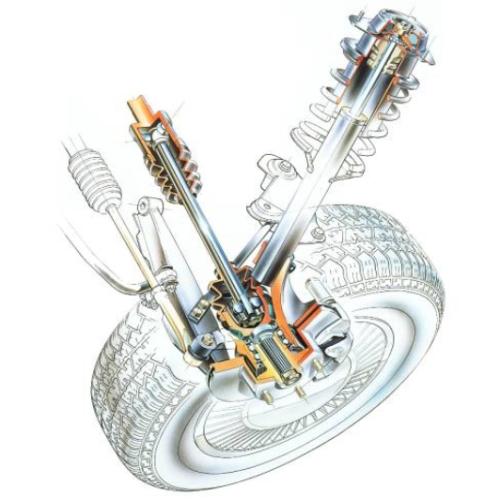
Wheel Rim
Structure(s) | Flanged Housing + Integrated Bearing + Sensor Socket | ||||||||
|---|---|---|---|---|---|---|---|---|---|
Connection Points | Wheel Rim, Axle, Brake Disk, Swing Arm | ||||||||
Function(s) | Carrying the Wheel and Connecting to the Swivel Axle | ||||||||
Integrated Feature | ABS Sensor, Speed Sensor | ||||||||
The wheel hub is the central component that transmits rotational force from the vehicle’s differential output shaft to the wheel while also supporting the wheel bearing. These connection points work in integration with the vehicle’s suspension system to ensure both power transmission and stable handling.
The hub features bearings pressed onto the shaft and hub spindles. The internal bearings enable a frictionless connection between the wheel and the housing, even as the shaft rotates. This design plays a critical role in the vehicle’s straight-line stability and cornering performance.
The rim is fixed to the hub flange using rivets or bolts. This connection supports various wheel sizes and types.
Lug bolts are threaded fasteners that secure the rim firmly to the hub. This connection system, tightened by lug nuts, ensures the wheel rotates without lateral movement or misalignment.
The bearings inside the hub enable smooth and quiet wheel rotation. At the same time, hub seals protect the internal components from external contaminants such as dust and moisture.
During regular maintenance, the hub grease, lug bolt torque, seal condition, and fastener integrity must be inspected.
Millî Eğitim Bakanlığı (MEGEP). *Hareket İletim Sistemleri*. Ankara: MEB Yayınları, 2013. Accessed June 17, 2025. https://megep.meb.gov.tr/mte_program_modul/moduller_pdf/Hareket%20%C4%B0letim%20Sistemleri.pdf.
Millî Eğitim Bakanlığı (MEGEP). *Periyodik Bakım Talimatı 2*. Ankara: MEB Yayınları, 2011. Accessed June 17, 2025. https://megep.meb.gov.tr/mte_program_modul/moduller_pdf/Periyodik%20Bak%C4%B1m%20Talimat%C4%B1%202.pdf.
Millî Eğitim Bakanlığı (MEGEP). *Ön Düzen ve Tekerlekler*. Ankara: MEB Yayınları, 2012. Accessed June 17, 2025. https://megep.meb.gov.tr/mte_program_modul/moduller_pdf/%C3%96n%20D%C3%BCzen%20Ve%20Tekerlekler.pdf.

Wheel Rim
Structure(s) | Flanged Housing + Integrated Bearing + Sensor Socket | ||||||||
|---|---|---|---|---|---|---|---|---|---|
Connection Points | Wheel Rim, Axle, Brake Disk, Swing Arm | ||||||||
Function(s) | Carrying the Wheel and Connecting to the Swivel Axle | ||||||||
Integrated Feature | ABS Sensor, Speed Sensor | ||||||||
Structure and Function of the Hub
Connection Points and Components
Wheel Rim Connection
Hub Spindles and Lug Bolts
Bearings and Seals
Failure Indicators and Maintenance