This article was automatically translated from the original Turkish version.
Scientific Name(s) | Branta leucopsis | ||||||||
|---|---|---|---|---|---|---|---|---|---|
Family | Anatidae (Geese) | ||||||||
Genus | Branta | ||||||||
Dimension(s) | 55–70 cm | ||||||||
Wingspan | 130–145 cm | ||||||||
Breeding Areas | Russian Arctic Coasts Svalbard Greenland | ||||||||
Conservation Status | Least Concern | ||||||||
White-cheeked Goose (Branta leucopsis) is a bird species belonging to the family Anatidae, recognized by its distinctive black-and-white plumage. The species is particularly identifiable by the prominent white patch on its face. This goose breeds in Arctic regions and winters along the coasts of Western Europe, making it a notable species in terms of migration ecology and habitat preferences.
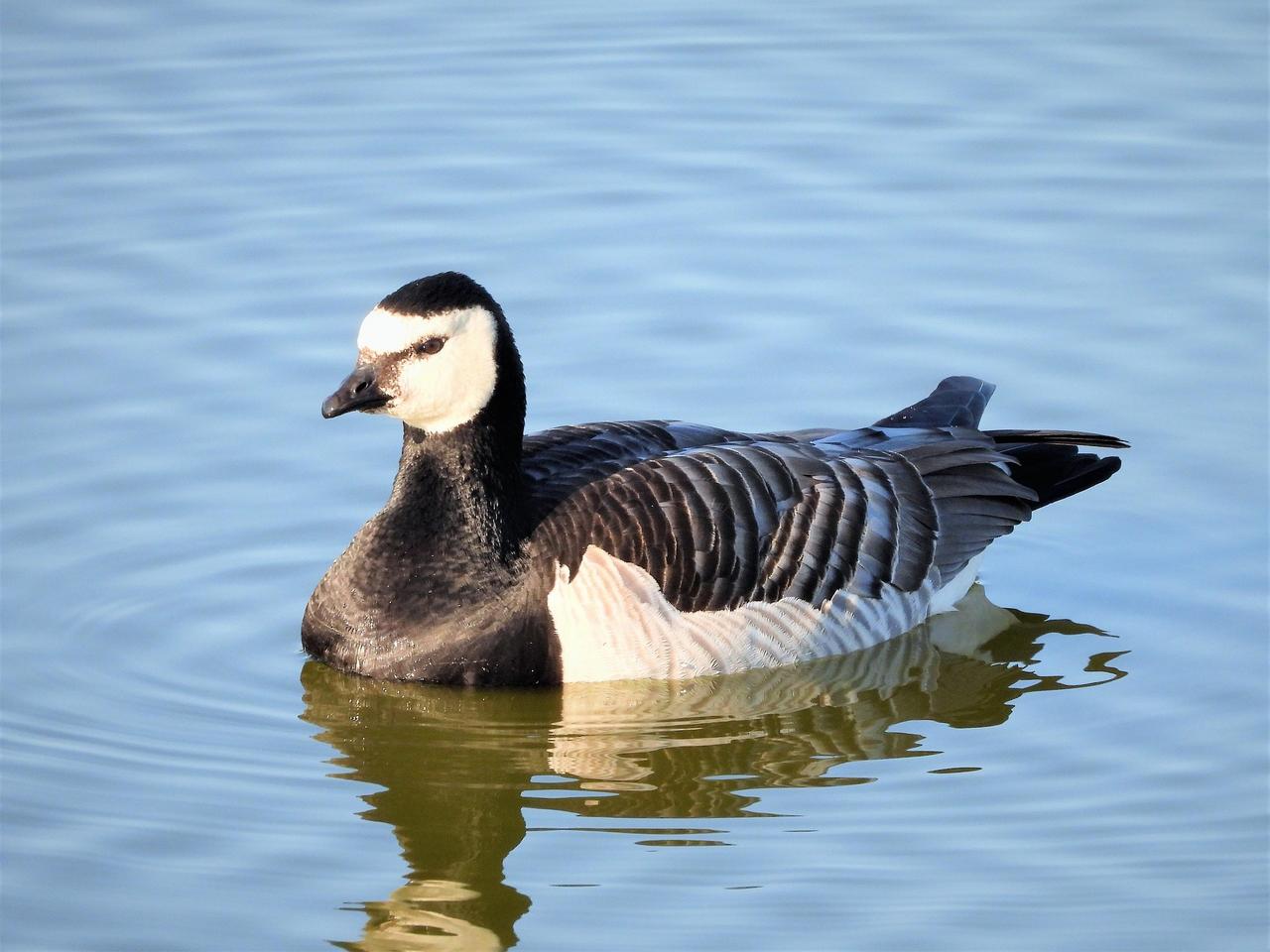
The white-cheeked goose belongs to the genus Branta and, like other members of this genus, has a plumage dominated by black, white, and gray tones. The head and neck are black, while the cheeks and forehead are white. This white facial pattern is the most distinctive identifying feature of the species. The body is gray, the belly is white, and the wing coverts display black and gray stripes. Its average length ranges from 55 to 70 cm, with a wingspan of 130 to 145 cm.

White-cheeked Goose (Branta leucopsis)
The breeding grounds of the white-cheeked goose are concentrated in three main regions: Greenland, Svalbard, and the Arctic coasts of Russia. During the breeding season, it prefers coastal tundra areas. In winter, the species migrates to Western Europe, where it forms large populations in the British Isles, the Netherlands, Germany, and Denmark. Wintering habitats include coastal grasslands, wet meadows, agricultural fields, and lowland areas along the seacoast.
As a long-distance migrant, the white-cheeked goose breeds in polar regions during summer and moves to milder western regions in winter. During spring migration, the selection of stopover and feeding sites is sensitive to climatic conditions and human-induced land use changes. Research has shown that migration routes have shifted due to climate change and agricultural activities. This demonstrates a direct relationship between the species’ migratory ecology and environmental factors.
The breeding season is limited to the Arctic summer. Nests are typically built on coastal cliffs or islands in locations that offer protection from predators. Females lay one clutch per year, consisting of 4 to 6 eggs. The incubation period lasts approximately 24 to 26 days. Chicks begin feeding independently shortly after hatching and are protected by their parents until the migration period.
The white-cheeked goose is a herbivorous species. In breeding areas, it feeds on tundra vegetation, mosses, and short grasses. In wintering areas, it utilizes grasslands in agricultural fields and residual crops left after harvest. Consequently, there is a close relationship between agricultural activities and the species’ wintering success.
Globally, the white-cheeked goose is not considered threatened; it is classified as “Least Concern” by the IUCN. However, the species is affected by habitat loss due to climate change and alterations in land use. In particular, the transformation of stopover sites used during spring migration, driven by agricultural pressures and changing climatic conditions, poses a risk to population dynamics.
Biological Conservation 86, no. 3 (December 1998): 339–346. Accessed August 22, 2025. https://www.sciencedirect.com/science/article/abs/pii/S0006320798000299.
Birds of the World. "Barnacle Goose." Cornell Lab of Ornithology. Accessed August 22, 2025. https://birdsoftheworld.org/bow/species/bargoo/cur/introduction.
Prop, Jouke and Jeffrey M. Black and Paul Shimmings. "The spring range of barnacle geese Branta leucopsis in relation to changes in land management and climate."
Sabine_999. "Barnacle goose, Birds, Animals image." Pixabay. Accessed August 22, 2025. https://pixabay.com/tr/photos/barnacle-kaz-ku%C5%9Flar-hayvanlar-5741778/
eBird. "Barnacle Goose (Branta leucopsis)." Cornell Lab of Ornithology. Accessed August 22, 2025. https://ebird.org/species/bargoo?siteLanguage=tr.
pevank01. "Barnacle kaz, Su kuşu, Kaz görseli." Pixabay. Accessed August 22, 2025. https://pixabay.com/tr/photos/barnacle-kaz-su-ku%C5%9Fu-kaz-kazlar-5267333/
Özkan, Korhan. “Ak Yanaklı Kaz.” TÜBİTAK Ansiklopedi. Accessed August 22, 2025. https://ansiklopedi.tubitak.gov.tr/kutup/ansiklopedi/ak-yanakli-kaz.

Scientific Name(s) | Branta leucopsis | ||||||||
|---|---|---|---|---|---|---|---|---|---|
Family | Anatidae (Geese) | ||||||||
Genus | Branta | ||||||||
Dimension(s) | 55–70 cm | ||||||||
Wingspan | 130–145 cm | ||||||||
Breeding Areas | Russian Arctic Coasts Svalbard Greenland | ||||||||
Conservation Status | Least Concern | ||||||||
No Discussion Added Yet
Start discussion for "White-cheeked Goose (Branta leucopsis)" article
Taxonomy and Morphological Characteristics
Distribution and Habitat
Migratory Dynamics
Reproductive Biology
Feeding Habits
Conservation and Threats