


This article was automatically translated from the original Turkish version.
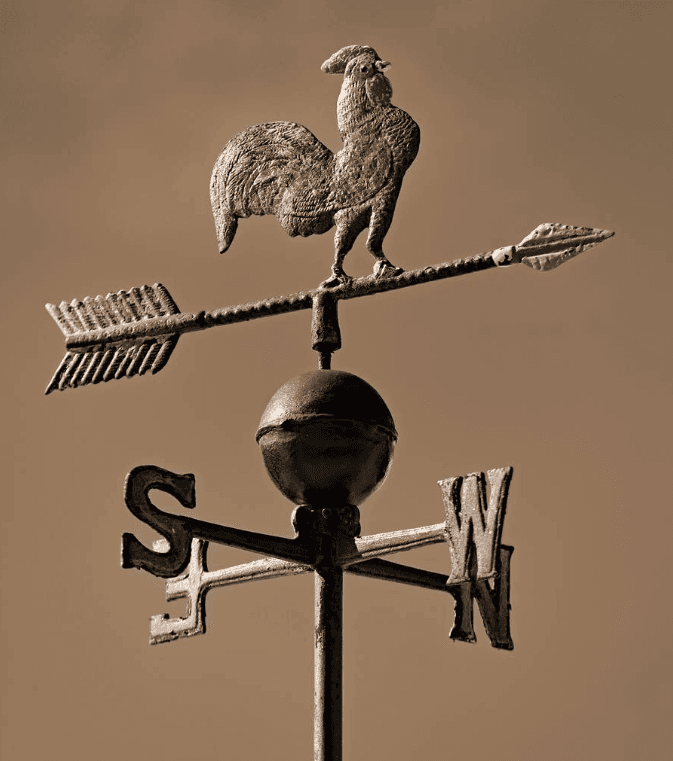
Name(s) | Rüzgâr Gülü | ||||||||
|---|---|---|---|---|---|---|---|---|---|
English Name | Wind Vane / Weather Vane | ||||||||
Application Area(s) | Agriculture and Aviation Fields Educational Experiment Sets Meteorology Stations Weather Observations | ||||||||
Direction Indicator | W (West) — Batı E (East) — Doğu S (South) — Güney N (North) — Kuzey | ||||||||
A wind vane is a meteorological instrument used to determine the direction of the wind. Traditionally, it has a mechanical design and rotates when the wind blows, indicating the direction from which the wind is coming. Modern versions are equipped with digital sensors and can be integrated into computer systems. Wind vanes are commonly used in weather stations, educational settings, and wind energy research.
A wind vane consists of a lightweight body that can rotate around an axis. This body is aerodynamically designed to be unbalanced so that the wind strikes its largest surface. When the wind blows, the front end of the device turns away from the wind direction while the tail aligns with it, thus indicating the wind’s origin. It is typically used in conjunction with the four cardinal directions (north, south, east, west) and intermediate directions (northeast, etc.).
Principle of Operation of a Wind Vane (World Book)
The earliest instruments used to determine wind direction date back to antiquity. One of the oldest examples is the Horologion, also known as the Wind Tower, built in the 1st century AD in Athens by Andronicus. This octagonal tower features reliefs on each face representing a different wind direction. At its summit was a bronze figure of Triton that rotated with the wind. This figure is regarded as one of the earliest mechanical wind vanes.
However, wind vanes were not only used in the Western world but also in China during early periods. Chinese sources, particularly from the Tang Dynasty (618–907), mention wind indicators used in observation towers. These devices were often decorated in the shape of birds or dragons and made from bronze or wood.
In the medieval Islamic world, certain instruments developed for astronomical and meteorological observations were also used to determine wind direction. In particular, the works of Al-Biruni draw attention to observations of atmospheric movements.
In Europe, wind vanes began to appear on the tops of church towers from the 9th century onward. By the 17th century, more precise and measurable versions were developed and began to be used for scientific purposes.
Today, wind vanes are used alongside instruments such as anemometers in meteorological stations to measure both wind direction and speed. Thanks to digital sensors, data can be transmitted to computer systems and long-term records can be maintained. These devices are also frequently found at test stations established to assess wind energy potential.
Cartwright, Mark. “Tower of the Winds.” *World History Encyclopedia*. Accessed May 11, 2025. https://www.worldhistory.org/article/1044/tower-of-the-winds/?.
Chen, Joseph Cheng-yih. Science and Technology in Chinese Civilisation: Proceedings of the Workshop Held at the University of California. Singapore: World Scientific, 1987.
National Geographic Society. “Anemometer.” National Geographic Education Resources. Accessed May 11, 2025. https://education.nationalgeographic.org/resource/anemometer/.
Sparavigna, Amelia Carolina. "The Science of al-Biruni." Department of Applied Science and Technology, Politecnico di Torino, Italy. Accessed May 11, 2025.
World Book. "What Is a Weather Vane?" YouTube video. Accessed May 11, 2025. https://www.youtube.com/watch?v=-rQc4uYnBe8.

Name(s) | Rüzgâr Gülü | ||||||||
|---|---|---|---|---|---|---|---|---|---|
English Name | Wind Vane / Weather Vane | ||||||||
Application Area(s) | Agriculture and Aviation Fields Educational Experiment Sets Meteorology Stations Weather Observations | ||||||||
Direction Indicator | W (West) — Batı E (East) — Doğu S (South) — Güney N (North) — Kuzey | ||||||||
Structure and Principle of Operation
History
Modern Usage and Technology