This article was automatically translated from the original Turkish version.
+2 More
Type(s) | Unmanned aerial vehicle | ||||||||
|---|---|---|---|---|---|---|---|---|---|
Origin(s) | United States of America | ||||||||
Manufacturer(s) | Shield AI | ||||||||
Status | Prototype (In Testing Phase) | ||||||||
Primary User | United States of America | ||||||||
Wingspan | 12 m | ||||||||
Fuselage Length | 8 m | ||||||||
Maximum Range | ≈ 3 700 km | ||||||||
Service Ceiling | ~15 000 m | ||||||||
Intended Takeoff/landing | Vertical takeoff and landing | ||||||||
X-BAT is a conceptual combat aircraft platform (English: Collaborative Combat Aircraft, CCA) developed by the U.S. defense technology company Shield AI, featuring autonomy (no pilot required) and vertical takeoff and landing (VTOL) capabilities.
Before initiating the X-BAT project, Shield AI was known for the V-BAT, a VTOL-capable reconnaissance and strike unmanned aerial vehicle. X-BAT was developed to elevate the performance and mission scope of this platform to a level approaching that of a manned combat jet. The new system aims to create an autonomous combat platform capable of longer ranges, jet propulsion, and multi-role missions.
Shield AI defines X-BAT as "an air power solution that combines vertical takeoff capability, long range, multi-role mission flexibility, and high levels of autonomy." The aircraft operates in integration with Shield AI’s proprietary artificial intelligence pilot system, named “Hivemind.” The X-BAT concept was publicly unveiled on 21–22 October 2025.
X-BAT is designed to eliminate dependence on runways and fixed bases in modern combat environments. Unlike conventional aircraft, its VTOL capability enables operations from ships, mountainous terrain, or temporary forward bases. This offers a strategic advantage, particularly in high-intensity conflict zones where traditional air bases are vulnerable.
The aircraft is equipped with Shield AI’s “Hivemind” artificial intelligence pilot system. This system enables flight continuation in GPS-denied or communication-degraded environments, target identification, route planning, and coordinated missions with other aircraft. X-BAT is designed to operate both in coordination with manned aircraft and in fully autonomous missions.
One of the platform’s key objectives is to reduce operational costs. Shield AI aims for X-BAT to achieve a lower cost-per-effect ratio compared to fifth-generation fighter aircraft, with significantly reduced operating and maintenance expenses.
The design of X-BAT does not limit it to air-to-air or air-to-ground missions alone. The aircraft is multi-role, capable of performing a wide range of tasks including electronic warfare (EW), intelligence-surveillance-reconnaissance (ISR), and close air support. In this regard, X-BAT exemplifies the emerging paradigm of modular, mission-focused autonomous combat systems.

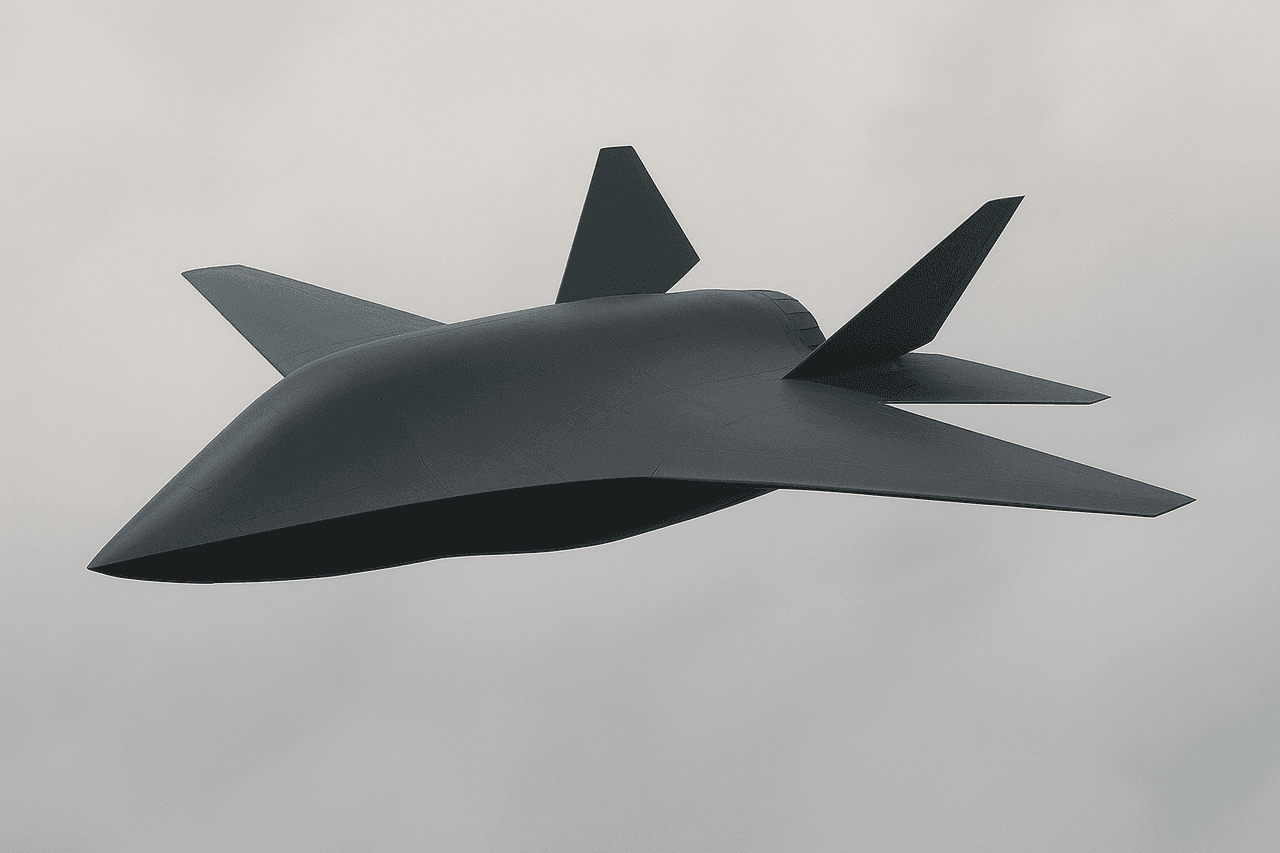
X-BAT Model First Revealed by Shield AI (Shield AI)
The wingspan of X-BAT is approximately 39 feet (about 12 meters), and its fuselage length is about 26 feet (approximately 8 meters). The aircraft is designed to achieve a range exceeding 2,000 nautical miles (about 3,700 kilometers). Its service ceiling is targeted to exceed 50,000 feet (approximately 15,000 meters). Maneuverability is expected to allow load factors exceeding 4 g.
The propulsion system is planned to consist of a turbine engine comparable to those used in F-16-class aircraft, equipped with an afterburner and vectoring thrust nozzle. This configuration aims to provide flexible control in both vertical takeoff and landing modes and high-speed horizontal flight regimes.
The weapons carriage system includes an internal weapons bay and external hardpoints for optional use. This allows the aircraft to carry ordnance internally for missions requiring low radar visibility, or to augment range and payload capacity with external stores during less critical operations.
The takeoff and landing method is based on the vertical takeoff and landing (VTOL) principle. The structural design is expected to resemble a tail-sitter configuration, where the aircraft rests on its tail during vertical operations. This arrangement is intended to eliminate dependence on runways or aircraft carriers, enabling operations from remote or temporary deployment sites.【1】

Expected Tailless Operational Design of X-BAT (Generated with Artificial Intelligence Assistance)
Shield AI has indicated that the first vertical takeoff and landing (VTOL) tests are scheduled for late 2026. Full flight testing and operational validation are targeted for completion by 2028. Production and field deployment are planned for subsequent years.
Rogoway, Tyler, and Joseph Trevithick. “The Rise of X-BAT.” *The War Zone*, October 22, 2025. Accessed November 3, 2025. https://www.twz.com/air/the-rise-of-x-bat.
Shield AI. "X-BAT." Shield AI, 2025. Accessed November 3, 2025. https://shield.ai/x-bat/.
Shield AI. “Unveiling X-BAT: Launch Keynotes.” Shield AI, October 23, 2025. Accessed November 3, 2025. https://www.youtube.com/watch?v=BEer2MXTAcU&t=657s.
Szondy, David. “X-BAT: Shield AI’s Jet-Like Combat Drone Concept.” New Atlas, October 24, 2025. Accessed November 3, 2025. https://newatlas.com/military/x-bat-combat-drone-shield-ai/.
Wolfe, Frank. “Flight Debut for Shield AI X-BAT Could Come Next Fall.” *Avionics International*, October 30, 2025. Accessed November 3, 2025. https://www.aviationtoday.com/2025/10/30/flight-debut-for-shield-ai-x-bat-could-come-next-fall/.
[1]
Bu başlık içinde yer alan bilgiler kamuya açıklanmış konsept verilerinden ve resmi tanıtım materyallerinden derlenmiştir. Değerler, operasyonel üretim varyantlarında değişiklik gösterebilir.

Type(s) | Unmanned aerial vehicle | ||||||||
|---|---|---|---|---|---|---|---|---|---|
Origin(s) | United States of America | ||||||||
Manufacturer(s) | Shield AI | ||||||||
Status | Prototype (In Testing Phase) | ||||||||
Primary User | United States of America | ||||||||
Wingspan | 12 m | ||||||||
Fuselage Length | 8 m | ||||||||
Maximum Range | ≈ 3 700 km | ||||||||
Service Ceiling | ~15 000 m | ||||||||
Intended Takeoff/landing | Vertical takeoff and landing | ||||||||
Development History and Purpose
Concept and Operational Philosophy
Technical Specifications (Planned / Disclosed)
Planned Timeline and Phases