

This article was automatically translated from the original Turkish version.
+2 More
Name(s) | Yakovlev Yak-9 | ||||||||
|---|---|---|---|---|---|---|---|---|---|
Category | Fighter Aircraft | ||||||||
Origin(s) | Soviet Union (Yakovlev) | ||||||||
Engine(s) | 1 x Klimov VK-105PF-2 piston engine | ||||||||
First Flight(s) | 28 September 1942 | ||||||||
Crew | 1 | ||||||||
Length(s) | 8.5 m | ||||||||
Wingspan | 9.8 m | ||||||||
Maximum Speed | 590 km/h | ||||||||
Maximum Takeoff Weight | 3400 kg | ||||||||
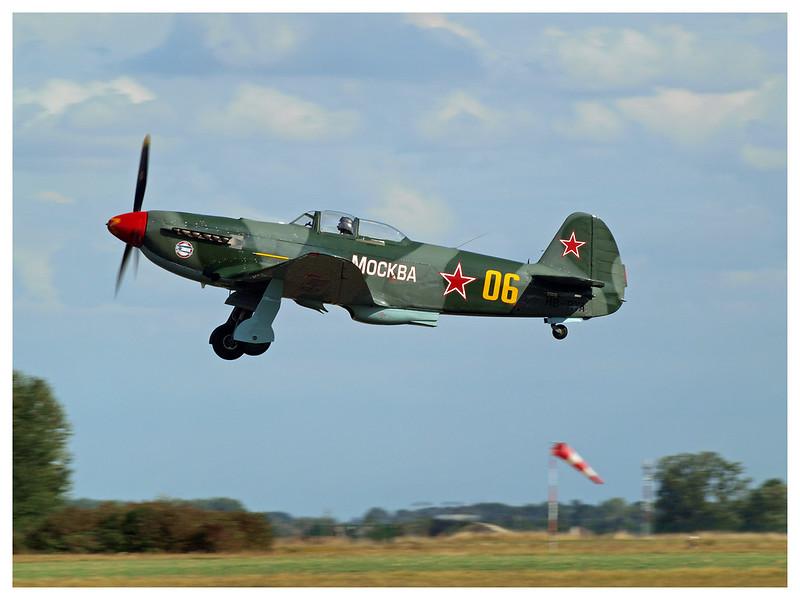
Yakovlev Yak-9 is a single-engine, single-seat, multirole fighter aircraft developed by the Alexander Sergeevich Yakovlev Design Bureau in the Soviet Union. As a lightened and improved derivative of the Yak-7, the Yak-9 became the mainstay of the Soviet Air Forces (VVS) on the Eastern Front from late 1942 onward. The aircraft holds the distinction of being the most produced Soviet fighter of all time; a total of 16,769 units were manufactured between 1942 and 1948, including 14,579 produced during the war years.

Yakovlev Yak-9 (Flickr)
Although the Yak-9’s design was based on the fuselage of its predecessor, the Yak-7, it differed significantly through structural lightening and aerodynamic improvements.
Yakovlev Yak-9 (Dark Skies)
The Yak-9 is generally recognized for its superior maneuverability and high power-to-weight ratio at low altitudes.

Yakovlev Yak-9 (Pavel Vanka)
The Yak-9’s versatile design enabled the production of numerous specialized variants to meet evolving front-line requirements during World War II.
The Yak-9 entered combat in late 1942 during the Battle of Stalingrad and played a central role in regaining Soviet air superiority in critical battles such as the 1943 Battle of Kursk, where it confronted German Bf 109G and Fw 190 fighters.
270862. "Yakovlev Yak-9." Flickr. Accessed October 20, 2025. https://www.flickr.com/photos/131561895@N06/43562076470
Airpages.ru. "Yakovlev Yak-9 Fighter." Accessed October 20, 2025. http://airpages.ru/eng/ru/yak9.shtml
Classic Wings. "Yak 9." Accessed October 20, 2025. https://classicwings.nl/yak-9/
Dark Skies. "The Most Important Fighter of WW2?" YouTube. Accessed October 20, 2025. https://www.youtube.com/watch?v=DH8-GJqyJwo
Elhassan, Khalid. "Dogfights: Top 10 Fighter Planes of World War II." *History Collection*. Accessed October 20, 2025. https://historycollection.com/dogfights-top-10-fighter-planes-world-war-ii/9/
IL-2 Sturmovik. "Yak-9 ser.1." Accessed October 20, 2025. https://il2sturmovik.com/museum/fighters/yak-9-ser1/
National Air and Space Museum. "Junkers Jumo 210 D, Inverted V-12 Engine." Accessed October 20, 2025. https://airandspace.si.edu/collection-objects/junkers-jumo-210-d-inverted-v-12-engine/nasm_A19670103000
Patrascu, Daniel. "Yakovlev Yak-9s Helped Push the Nazis Out of Russia, Red Fighters Still Stun." *Autoevolution*. Accessed October 20, 2025. https://www.autoevolution.com/news/yakovlev-yak-9s-helped-push-the-nazis-out-of-russia-red-fighters-still-stun-151863.html
Pavel Vanka. "Yakovlev Yak-9." Flickr. Accessed October 20, 2025. https://www.flickr.com/photos/pavelvanka/17215821451/in/photolist-hR4up-29nr2DY-seizVM-rhxNdX-2b2YrPC-aqCtpU-2kXz2aD-2kXpYav-2gWVDNi-2TRaCx-2gWUSz6-2gWUSSv-GVT9NY-5zywWH-2jkkFwX-28HiR8U-dSeuJ2-oSUPB2-coBz1J-ezAWiA-ezAZrd-ezxVG4-ezxYK4-H85SwY-2xQrB-cBzuCj-6QkL3G-271jna2-2hGfBaf-6QgHup-aoCn3S-2hGcZ67
Pilot's Post. "Yakovlev Yak-9- The Most Produced Soviet Fighter Of All Time." Accessed October 20, 2025. https://pilotspost.co.za/PsPpyarn1677
Selman, Jay. "Yak-9 Represents a Rare Breed Among Warbirds." *FLYING Magazine*. Accessed October 20, 2025. https://www.flyingmag.com/yak-9-represents-a-rare-breed-among-warbirds/
Weichert, Brandon J. "The Soviet Union's Yak-9K Fighter Was Too Powerful for Its Own Design." *National Interest*. Accessed October 20, 2025. https://nationalinterest.org/blog/buzz/soviet-unions-yak-9k-fighter-too-powerful-bw-080925
yak9.nl. "Geschiedenis." Accessed October 20, 2025. https://yak9-nl.webnode.nl/het-vliegtuig2/geschiedenis/

Name(s) | Yakovlev Yak-9 | ||||||||
|---|---|---|---|---|---|---|---|---|---|
Category | Fighter Aircraft | ||||||||
Origin(s) | Soviet Union (Yakovlev) | ||||||||
Engine(s) | 1 x Klimov VK-105PF-2 piston engine | ||||||||
First Flight(s) | 28 September 1942 | ||||||||
Crew | 1 | ||||||||
Length(s) | 8.5 m | ||||||||
Wingspan | 9.8 m | ||||||||
Maximum Speed | 590 km/h | ||||||||
Maximum Takeoff Weight | 3400 kg | ||||||||
Development and Structural Features
Technical Specifications and Performance
Variants and Specialized Roles
Operational History and Combat Effectiveness