


This article was automatically translated from the original Turkish version.
+1 More
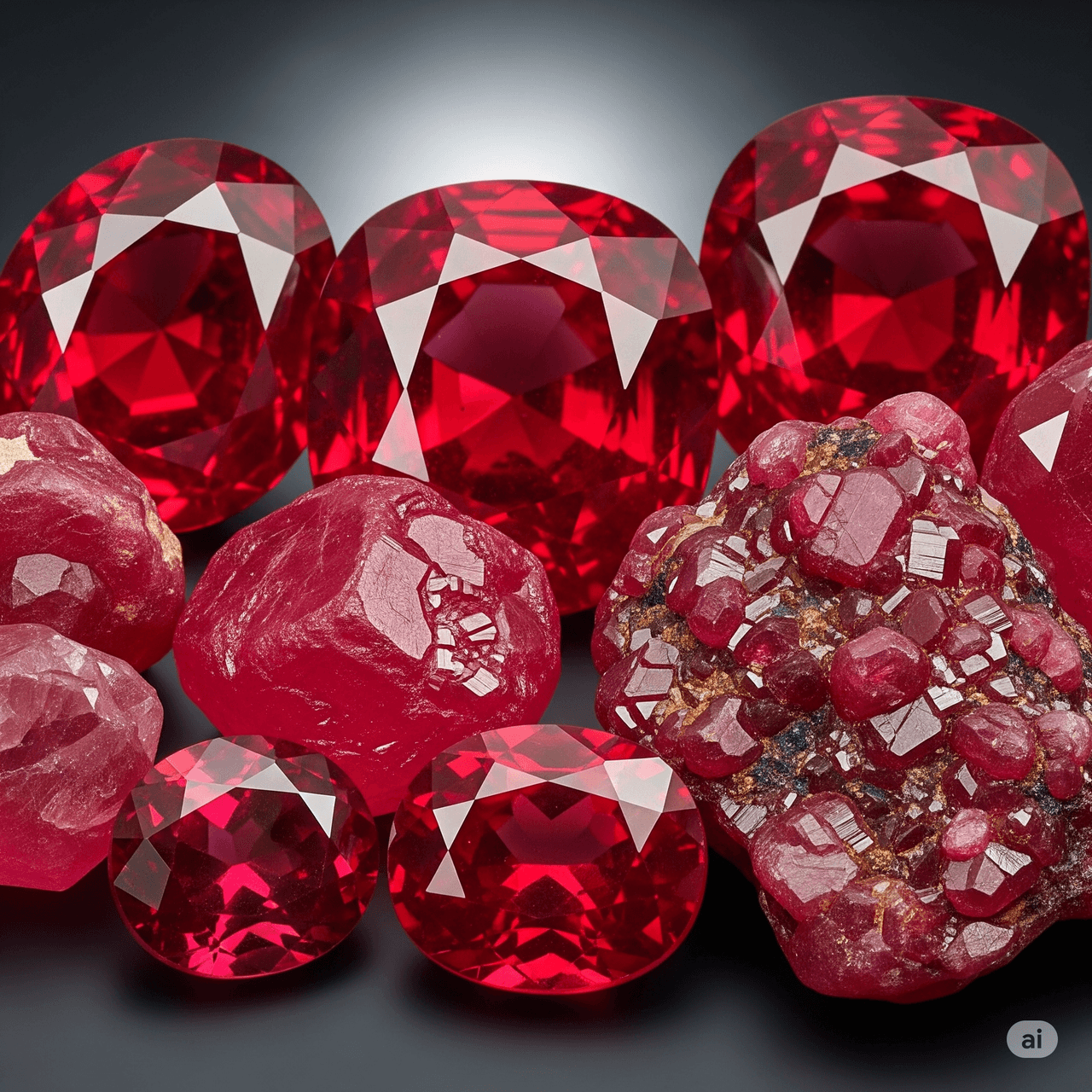
Yakut Stone
Chemical Formula | Al₂O₃ (chromium-doped) | ||||||||
|---|---|---|---|---|---|---|---|---|---|
Crystal System | Trigonal | ||||||||
Hardness (Mohs) | 9 | ||||||||
Density | 3.99–4.00 g/cm³ | ||||||||
Refractive Index | 1.76–1.77 | ||||||||
Color | Red (tones may vary depending on chromium concentration) | ||||||||
Main Deposits | Greenland Vietnam Thailand Mozambique Myanmar | ||||||||
Cultural Significance | Purity Protection Courage | ||||||||
Ruby is a precious gemstone belonging mineralogically to the corundum group and characterized by its red color. This mineral, with the chemical formula Al₂O₃, acquires its distinctive red hue due to the presence of chromium. With a hardness of 9 on the Mohs scale, it is one of the hardest natural minerals after diamond. Throughout history, ruby has been valued in various cultures for both its aesthetic appeal and symbolic meanings.
Ruby is the red variety of corundum, and its color is due to the presence of chromium ions (Cr³⁺) within its crystal structure. The substitution of chromium within the aluminum oxide (Al₂O₃) lattice determines the stone’s red tones. An increase in chromium concentration results in deeper and more saturated red hues. Additionally, trace elements such as iron (Fe) and titanium (Ti) can influence the color variations.
Ruby crystallizes in the trigonal system and is commonly found in prismatic or tabular crystal forms. Rubies sometimes contain needle-like inclusions of rutile; these inclusions can produce optical effects on the stone’s surface such as “cat’s eye” or “star” phenomena.
Rubies typically form in two main geological environments: metamorphic and magmatic. In metamorphic settings, rubies found within marble form under conditions of high temperature and pressure. Such deposits are common in regions including Myanmar (Mogok area), Vietnam, and Nepal. In magmatic environments, rubies occur within basaltic rocks, particularly in Thailand and Cambodia.
Ruby formation generally occurs in aluminous but silica-poor environments, which favor the crystallization of corundum. Additionally, metasomatic processes driven by hydrothermal fluids can contribute to ruby formation. These processes have been observed in ruby deposits in regions such as Greenland and Mozambique.

An English depiction of the ruby formation process. (Generated by artificial intelligence.)
Ruby has been regarded as a precious and sacred stone in many cultures throughout history. In ancient India, it was known as “ratnaraj,” meaning “king of precious stones.” In Hindu mythology, it was believed that offering a ruby to the god Krishna would grant the owner imperial status in rebirth. Rubies were also traded along the Silk Road as valuable stones in China as early as the 200s BCE.
In medieval Europe, ruby was symbolically associated with nobility, courage, and protection. It was frequently used in royal jewelry and carried by warriors who believed it would bring victory. The Bible mentions ruby four times, associating it with virtues such as beauty and wisdom.
Today, ruby retains high prestige among precious stones. Particularly valuable are those with deep red tones known as “pigeon’s blood,” which are rare and highly sought after. Such rubies are typically mined from the Mogok region of Myanmar.

Use of ruby in jewelry. (Generated by artificial intelligence.)
Pardieu, Vincent. "Ruby Deposits: A Review and Geological Classification." Academia.edu, 2020. Accessed May 22, 2025. https://www.academia.edu/47163002/Ruby_Deposits_A_Review_and_Geological_Classification
Parke, Aaron C., Saeseaw, Sudarat, Renfro, Nathan D., Sun, Ziyin, and McClure, Shane F. "Geographic Origin Determination of Ruby." GIA, 2019. Accessed May 22, 2025. https://www.gia.edu/doc/WN19-ruby-geographic-origin-determination.pdf
Sutherland, Frederick Lin. Zaw, Khin. Mineralogy and Geochemistry of Ruby. MDPI Books, 2020. Accessed May 22, 2025. https://www.mdpi.com/books/reprint/3177-mineralogy-and-geochemistry-of-ruby

Yakut Stone
Chemical Formula | Al₂O₃ (chromium-doped) | ||||||||
|---|---|---|---|---|---|---|---|---|---|
Crystal System | Trigonal | ||||||||
Hardness (Mohs) | 9 | ||||||||
Density | 3.99–4.00 g/cm³ | ||||||||
Refractive Index | 1.76–1.77 | ||||||||
Color | Red (tones may vary depending on chromium concentration) | ||||||||
Main Deposits | Greenland Vietnam Thailand Mozambique Myanmar | ||||||||
Cultural Significance | Purity Protection Courage | ||||||||
Mineralogical Properties and Geochemical Structure
Geological Formation and Deposit Types
Cultural and Historical Significance