

This article was automatically translated from the original Turkish version.
Registration Number | 1525 | ||||||||
|---|---|---|---|---|---|---|---|---|---|
Registration Date | 23.01.2024 | ||||||||
Application Number | C2020/138 | ||||||||
Application Date | 23.06.2020 | ||||||||
Name of the Geographical Indication | Yalova Chestnut Honey | ||||||||
Product / Product Group(s) | Flower Honey / Honey | ||||||||
Type of Geographical Indication | Geographical Indication | ||||||||
Applicant/Registrant(s) | Yalova Province Beekeepers Union | ||||||||
Geographical Boundary | Yalova Province | ||||||||
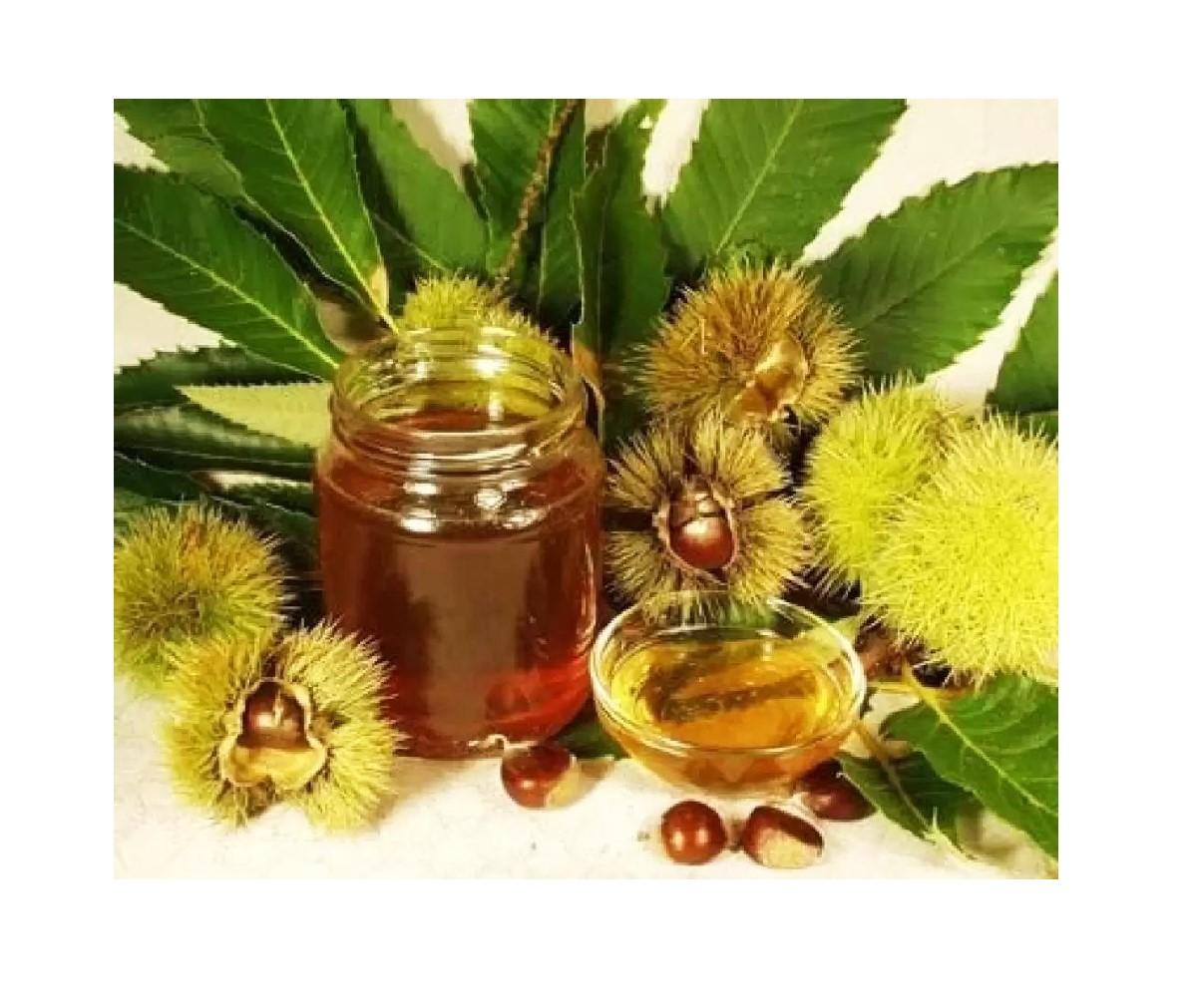
Yalova Chestnut Honey is a floral honey produced in beehives located within 600 meters of chestnut forests in Yalova Province, Türkiye. It is obtained from Caucasian honeybees (Apis mellifera caucasia), Anatolian honeybees (Apis mellifera anatolica) and their hybrids. The pollen composition of this honey contains at least 74% chestnut (Castanea sativa) pollen along with linden (Tilia spp.), thyme (Thymus spp.), aster family (Asteraceae) and rose family (Rosaceae) pollen.

Yalova Chestnut Honey (AA)
The vegetation of Yalova Province consists of maquis and forests. The steep southern slopes are densely covered by forest cover. The majority of these forests belong to the Black Sea coastal range flora, while a portion consists of Mediterranean flora species. Chestnut trees are the primary source for honey production; linden, thyme, aster family and rose family plants serve as pollen sources contributing to the honey’s composition.
Yalova Chestnut Honey is distinguished from other chestnut honeys by its pollen composition and chemical properties. It contains at least 74% chestnut pollen and also includes linden, thyme, aster family and rose family pollen. The product’s composition meets the following criteria: moisture content not exceeding 20%, total fructose and glucose content of at least 62 g per 100 g, fructose/glucose ratio between 1.10 and 1.40, free acidity not exceeding 45 meq/kg, electrical conductivity of at least 0.8 mS/cm, diastase number of at least 8, HMF value not exceeding 40 mg/kg, and proline content of at least 540 mg/kg.
Caucasian honeybees, Anatolian honeybees and their hybrids are kept in Langstroth-type hives for honey production. The bees spend the winter months in warmer regions and are relocated to chestnut forests within the boundaries of Yalova Province during April and May. Hives are placed either within the forests or no more than 600 meters away. Honeycombs are harvested between 15 and 30 June, filtered and purified of foreign substances. The honey is stored for up to two years at temperatures not exceeding 25 °C in appropriate packaging.
The honey is presented with the label “Yalova Chestnut Honey” and the official certification mark on the product or its packaging. Due to the presence of linden pollen, it is suitable for use as a breakfast honey.
Yalova Chestnut Honey is an important agricultural product in Yalova Province, with annual production ranging between 300 and 350 tons. Geographical indication registration enhances product recognition and supports commercial use.
Monitoring is carried out by a three-member inspection body coordinated by the Yalova Province Beekeepers Union, in collaboration with the Yalova Provincial Directorate of Agriculture and Forestry and the Yalova Chamber of Commerce and Industry. At least two inspections per year are conducted, covering hive placement, bee breed, compliance with production methods, pollen content and use of the certification mark. Chemical and physical properties of the product are also tested when necessary.
Anadolu Ajansı. 2024. “Ihlamur Aromasıyla Yumuşak Tada Sahip Yalova Kestane Balı Coğrafi İşaret Olarak Tescil Edildi.” Accessed August 18, 2025. https://www.aa.com.tr/tr/yasam/ihlamur-aromasiyla-yumusak-tada-sahip-yalova-kestane-bali-cografi-isaret-olarak-tescil-edildi-/3118183.
Turk Patent and Trademark Office. "Yalova Kestane Balı." Accessed August 18, 2025. https://ci.turkpatent.gov.tr/Files/GeographicalSigns/a5a88fc3-950e-4bd6-80a5-a5dc76e5513d.pdf.
Yalova Directorate of Agriculture and Forestry. "Yalova Kestane Balı Coğrafi İşaret Tescili Aldı." Yalova Directorate of Agriculture and Forestry. Accessed August 18, 2025. https://yalova.tarimorman.gov.tr/Haber/897.

Registration Number | 1525 | ||||||||
|---|---|---|---|---|---|---|---|---|---|
Registration Date | 23.01.2024 | ||||||||
Application Number | C2020/138 | ||||||||
Application Date | 23.06.2020 | ||||||||
Name of the Geographical Indication | Yalova Chestnut Honey | ||||||||
Product / Product Group(s) | Flower Honey / Honey | ||||||||
Type of Geographical Indication | Geographical Indication | ||||||||
Applicant/Registrant(s) | Yalova Province Beekeepers Union | ||||||||
Geographical Boundary | Yalova Province | ||||||||
No Discussion Added Yet
Start discussion for "Yalova Chestnut Honey" article
Botanical and Ecological Characteristics
Distinguishing Characteristics
Production Method
Usage
Economic and Cultural Significance
Monitoring