
This article was automatically translated from the original Turkish version.
+2 More
Location | Istanbul Türkiye | ||||||||
|---|---|---|---|---|---|---|---|---|---|
Year of Establishment | 1992 | ||||||||
Building | 1958; Paul Schmitthener, 2017 renewal | ||||||||
Yapı Kredi Museum is a private museum established within Yapı Kredi Bank and operational since 1992 in Istanbul. The museum’s collections primarily consist of numismatic and ethnographic artifacts, and also include works related to painting, sculpture, photography, archaeology, and culture.

Yapı Kredi Museum (Anadolu Agency)
Yapı Kredi was founded in 1944 by Kâzım Taşkent. Taşkent established a department within the bank called the “Culture and Art Advisory Office” to promote cultural and artistic activities, appointing Vedat Nedim Tör to lead it. Cultural figures such as İbrahim Hakkı Konyalı and Şevket Rado also served in this department. From 1953 onward, Yapı Kredi began building its collection in line with these initiatives.
The museum building was constructed in 1958 by Paul Schmitthener. It opened in 1992 as a private museum under the authority of the Ministry of Culture. The museum was closed in 2014 for renovation and reopened in 2017 following restoration work carried out by Teğet Mimarlık. In 2021, it resumed operations with a renewed exhibition layout on International Museum Day. The museum is open seven days a week and admission is free.
The museum building has five floors. The ground floor houses books published by Yapı Kredi Yayınları, while the mezzanine contains reading areas. The first floor displays the coin collection, and the second and third floors house art galleries. The fourth floor hosts various events such as theater performances, lectures, performances, and film screenings. The top floor contains a library with approximately 80,000 books.
The numismatic section, which forms the core of the museum’s collection, includes over 55,000 artifacts such as coins, medals, and insignia. The majority of the collection consists of coins from Islamic states. It also includes coins from Ancient Greece, Rome, and the early Republican period. The collection covers a broad geographical area including Athens, Pergamon, Rome, Istanbul, the Arabian Peninsula, and Spain. The coins provide historical information spanning approximately 2,600 years within a chronological framework. In the current exhibition, 250 selected coins made of electrum, gold, silver, and copper are displayed to visitors.
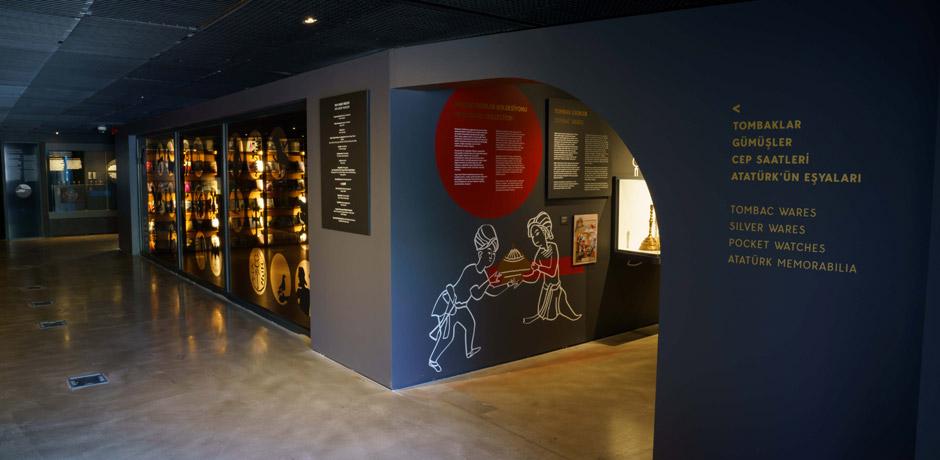
The ethnography section contains over a thousand artifacts related to Turkish-Islamic culture, dated from the 16th century onward. The collection includes tombaks, silver objects, textiles, prayer beads, clocks, and shadow puppet representations. Tombaks, which are copper objects gilded with gold, were used in both civilian and military contexts in the Ottoman Empire from the 16th century. Silver objects are represented across a wide range, from decorative items to kitchen utensils.
Clocks hold a significant place in the museum’s collection. The majority of the displayed timepieces were manufactured in Europe and brought to Ottoman territories. These clocks reflect not only the widespread adoption of timekeeping devices in Ottoman society but also the technological developments of the period.
The museum features a dedicated section displaying personal belongings of Mustafa Kemal Atatürk. Among the items on display are a pocket watch presented to Atatürk by Kâzım Taşkent, a musical cigarette box gifted by the King of Jordan, and letters handwritten by Atatürk to his mother, his brother, and Falih Rıfkı Atay.
In addition to its exhibitions, the museum hosts a wide range of cultural activities. Events include film screenings, literary meetings, photography exhibitions, and reading and drama programs for children. Theater performances and lecture series are also part of the museum’s program. The museum is open seven days a week and offers free admission.
Anadolu Ajansı. “Tombak: Altından Süzülen Zarafet Sergisi.” Accessed August 16, 2025. https://www.aa.com.tr/tr/pg/foto-galeri/tombak-altindan-suzulen-zarafet-sergisi/13
Anadolu Ajansı. “Yapı Kredi, 75 yıllık tarihini 'Sanal Müze'yle sergiliyor.” Anadolu Ajansı İş Dünyası Haberleri. Accessed August 16, 2025. https://www.aa.com.tr/tr/isdunyasi/finans/yapi-kredi-75-yillik-tarihini-sanal-muzeyle-sergiliyor/655019
Karahan, Günay. “Yapı Kredi Müzesi.” Türkiye Turizm Ansiklopedisi. Accessed August 16, 2025. https://turkiyeturizmansiklopedisi.com/yapi-kredi-muzesi
Yapı Kredi Kültür Sanat Yayıncılık. “Yapı Kredi Müzesi.” Yapı Kredi Kültür Sanat Web Sitesi. Accessed August 16, 2025. https://sanat.ykykultur.com.tr/muze/yapi-kredi-muzesi
Yapı Kredi. "Müze." Kültür ve Sanat, Yapı Kredi Resmî Web Sitesi. Accessed August 16, 2025. https://www.yapikredi.com.tr/yapi-kredi-hakkinda/kultur-ve-sanat/muze
Location | Istanbul Türkiye | ||||||||
|---|---|---|---|---|---|---|---|---|---|
Year of Establishment | 1992 | ||||||||
Building | 1958; Paul Schmitthener, 2017 renewal | ||||||||
History
Building and Layout
Collections
Numismatic Collection
Ethnographic Collection
Clock Collection
Special Atatürk Section
Activities and Services