This article was automatically translated from the original Turkish version.
+2 More
Coordinate(s) | Approximately 2.5 km North of Küçükçekmece Lake | ||||||||
|---|---|---|---|---|---|---|---|---|---|
Site Status | First Degree Archaeological and Natural Site Area (2001) | ||||||||
Period(s) | Lower Paleolithic – Byzantine | ||||||||
Significance | One of the Oldest Settlement Sites in Türkiye and Europe | ||||||||
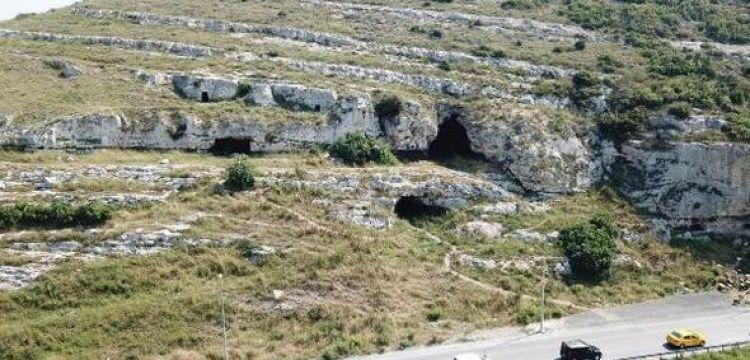
Yarımburgaz Cave is a natural cave located approximately 2.5 km north of Küçükçekmece Lake, in the northern part of Altınşehir Neighborhood, Başakşehir District, Istanbul. The cave exhibits continuous evidence of use from prehistoric times through the Byzantine period and is one of Turkey’s most significant cultural heritage sites, both archaeologically and geologically. It is regarded as one of the earliest human settlements in Europe.
Yarımburgaz Cave has been formed by karstic processes within limestone (calcite) deposits dating to the Middle Eocene period. It consists of two main sections:
The cave lies within the Altınşehir Formation and is situated in a geologically rich environment. The Sazlıdere River (known in antiquity as Bathynias) flowing nearby, along with surrounding freshwater and saline springs, contributed to the cave’s long-term selection as a habitation site.
Excavations have revealed a layered cultural deposit spanning from the Lower Paleolithic to the Byzantine period. The stratigraphic layers can be chronologically ordered as follows:
Numerous animal remains have been recovered from the cave, particularly in the Lower and Middle Pleistocene layers:
Yarımburgaz Cave is a key site for documenting climatic changes and the geological evolution of the Marmara Basin over the last four glacial-interglacial cycles. Distinct climatic phases—including cold-dry and warm-wet periods—are recorded in the cave’s sedimentary deposits. In this regard, Yarımburgaz Cave is regarded as one of Türkiye’s most important geoarchaeological laboratories.
Arsebük, Güven, F. Clark Howell, and Mihriban Özbaşaran. "Yarımburgaz 1990." *XIII. Kazı Sonuçları Toplantısı I. 1988–1990*. Accessed July 9, 2025. http://www.kulturvarliklari.gov.tr/sempozyum_pdf/kazilar/13_kazi_1.pdf.
Arsebük, Güven. “Pleistosen Arkeolojisi ile İlgili Son Çalışmalara 1997 Gözüyle Özet Bir Bakış: Yarımburgaz Mağarası.” *TÜBA-AR*, no. 1 (1998): 9–26. Accessed July 9, 2025. https://dergipark.org.tr/tr/pub/tubaar/issue/61830/925376.
Aydıngün, Şengül G. "Yarımburgaz Mağarası’nda Son Durum." Arkeoloji ve Sanat, p. 152 (2016): 217–230. Accessed July 9, 2025. https://d1wqtxts1xzle7.cloudfront.net/52461823/yarimburgaz_magarasinda_son_durum-libre.pdf.
Küçükçekmece Municipality. *Küçükçekmece Kültür Varlıkları Envanteri*. Istanbul: Küçükçekmece Belediyesi Yayınları, 2022. Accessed July 9, 2025. https://kucukcekmece.istanbul/Content/dosya/31990/kckvenvanteriweb-51491-2988854.pdf.
T.C.Başakşehir Kaymakamlığı Governorship. "Yarımburgaz Mağaraları." Accessed July 18, 2025. http://www.basaksehir.gov.tr/yarimburgaz-magarasi-09-04-2012

Coordinate(s) | Approximately 2.5 km North of Küçükçekmece Lake | ||||||||
|---|---|---|---|---|---|---|---|---|---|
Site Status | First Degree Archaeological and Natural Site Area (2001) | ||||||||
Period(s) | Lower Paleolithic – Byzantine | ||||||||
Significance | One of the Oldest Settlement Sites in Türkiye and Europe | ||||||||
Physical Structure and Geological Features
History of Research
Archaeological Findings and Stratigraphy
Paleontological and Archaeozoological Data
Cultural and Religious Use
Geoarchaeological and Climatic Significance
Protection and Threats