

This article was automatically translated from the original Turkish version.
Yedikule Gazhane is a historical gas production facility constructed during the Ottoman period to meet Istanbul’s lighting needs and is now recognized as one of the city’s most important industrial heritage sites. Built in the late 19th century, this structure stands as a symbol of modernization in Istanbul’s daily life.

Yedikule Gazhane (Istanbul Tourism Platform)
In the Ottoman Empire, gas production centers were referred to as “gazhane” or “gaz fabrikası.” After cities in Europe began to be illuminated with town gas, this technology was introduced to Ottoman territories; gas usage in Istanbul began in the 1850s with the construction of the Dolmabahçe Gazhane.
The construction of Yedikule Gazhane was planned to introduce modern urban lighting to Istanbul’s “suriçi” area, which corresponds to today’s Fatih district. Following feasibility studies conducted by the Municipality, the Yedikule neighborhood was selected as the most suitable location due to its proximity to the sea. The ability to transport necessary construction materials and coal by sea, along with the area’s low population density, influenced this decision.
Construction of the gazhane began in 1873 and, after prolonged delays, was completed and opened for service in 1880 under the order of Sultan Abdülhamid II. This facility, built by the Municipality, was the first gas plant established in Istanbul for public purposes.
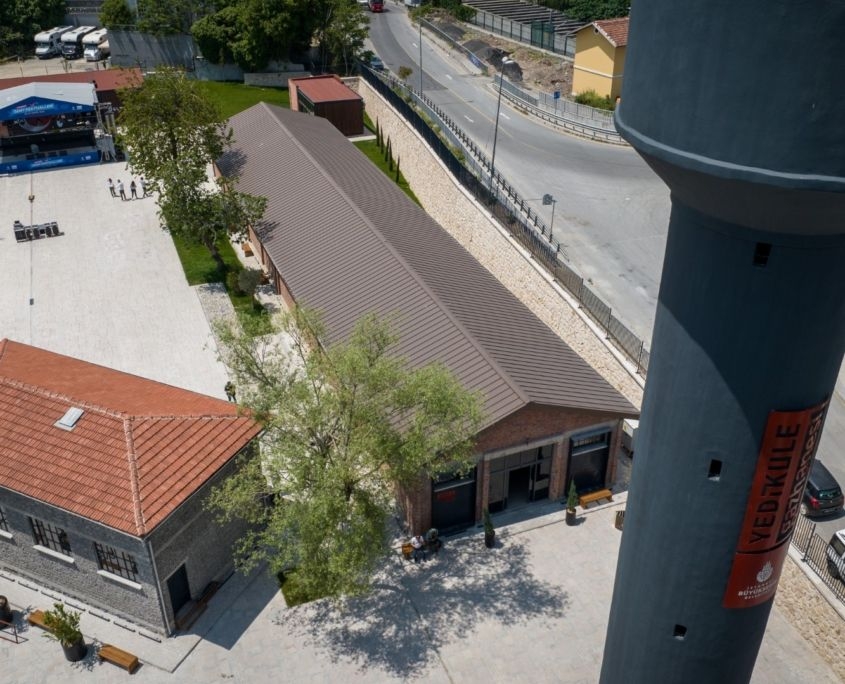
Yedikule Gazhane is a complex comprising coal gas production blocks, tar separators, cranes, boilers, storage units, administrative buildings, and gasometers. According to historical documents and maps, the complex included multiple elements such as Block-1, Block-2, a small house, a washing and crushing building, a water tower, a cooling unit, and office structures.
Initially, production was planned to supply gas to only 400 lamps, with further goals to distribute the gas via pipelines to central areas such as Langa, Bahçekapısı, Beyazıt, and Şehzadebaşı. Excess gas produced was utilized in government offices, residential buildings, and train stations.
In 1887, the Municipality leased the gazhane to Hasan Tahsin Efendi for 40 years. In 1888, he transferred this right to a company named “İstanbul Şirket-i Tenviriye-i Osmaniye,” marking the beginning of private operation. In 1926, the gazhane was acquired by the Üsküdar-Kadıköy Gas Company, which operated the Kadıköy Gazhane, ushering in a new operational phase. In 1945, it was transferred to the Istanbul Electricity, Tramway and Tunnel Establishment (İETT).
Yedikule Gazhane was closed in 1993 along with other gas plants due to technological inadequacies, environmental impacts, and health concerns. After its closure, the site was used for many years as a landfill and a bus parking area. During this period, some structures lost their functionality while others survived to the present day.
In 2021, İBB Miras, under the Istanbul Metropolitan Municipality, launched restoration efforts aimed at reintegrating the historic building into the urban fabric with cultural and artistic functions. The first structure restored, the “Hangar,” was completed and opened to the public in 2022 under the name “Uzun Yürüyüş” exhibition. Restoration work continues in a manner that preserves the building’s historical and architectural uniqueness while adapting it to contemporary urban contexts.
Yedikule Gazhane stands out as a tangible manifestation of the Ottoman State’s modernization efforts within the urban fabric. As the first facility to illuminate Istanbul’s suriçi area with town gas, it has become a symbolic structure. It is also regarded as an example of the adaptation of European technologies to Ottoman geography.
Planning and technical collaborations for the establishment of the facility involved engineers from Europe, notably Belgian engineer Eugène Autrique, who served in Istanbul’s gas companies. In this regard, Yedikule Gazhane reflects Istanbul’s international technical and economic connections.

History
Structural Features and Operation
Closure and Restoration Process
Cultural and Historical Significance