

This article was automatically translated from the original Turkish version.
Yelkovan (Puffinus yelkouan) is a seabird belonging to the family Procellariidae, found in the Mediterranean and Black Seas. It is of medium size with dark brown upperparts and white underparts. With its long, narrow wings, it exhibits rapid, steady flight close to the sea surface. It typically occurs in flocks and inhabits open ocean areas.
The Yelkovan (Puffinus yelkouan) is a seabird of the family Procellariidae, which includes ocean-adapted seabird species. For a long time, this species was considered a subspecies of Puffinus puffinus, but it is now recognized as a distinct species due to its unique distinguishing characteristics.
Members of the order Procellariiformes are characterized by tubular nostrils. In Yelkovans, these structures consist of channels located on the upper part of the bill that expel excess salt. This adaptation enables them to drink seawater.
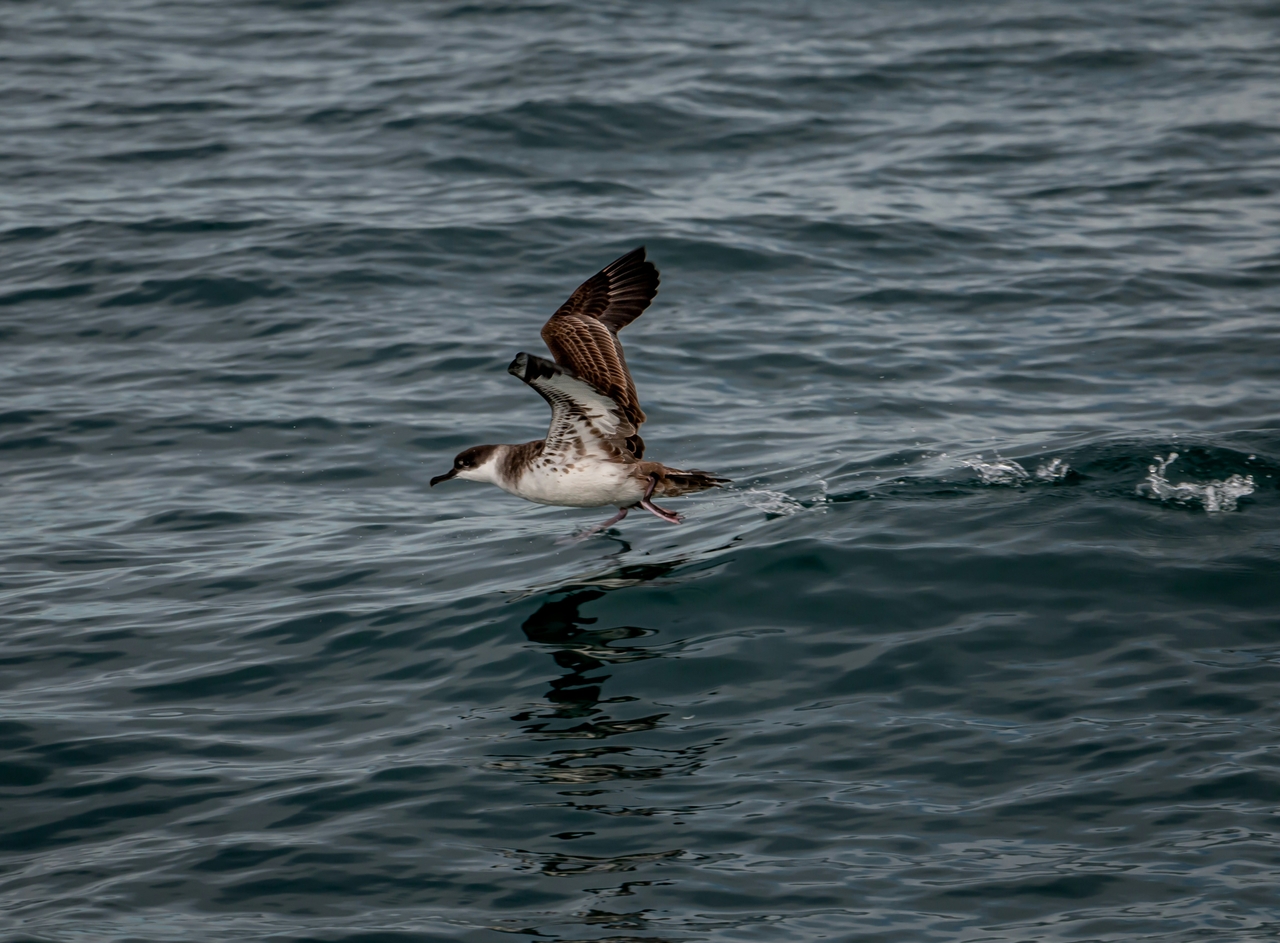
The Yelkovan (Puffinus yelkouan) is a medium-sized seabird, measuring 30–40 cm in length, with a wingspan of 70–95 cm and a weight ranging from 200 to 500 grams. There is no significant size difference between males and females, although females are generally slightly lighter. The upperparts are dark brown while the underparts are white or dirty white. The underwings are white, and a dirty gray stripe may be visible along the axillary feathers. A white stripe on the upper surface of the wings is clearly visible during flight. A white area is also present on the underside of the tail.

Yelkovan Bird (flickr)
The eyes are black, and the bill is dark, large, strong, and hooked. Two tubular structures on the upper part of the bill expel excess salt from the body. The legs are pink or pinkish-purple. The tail is short, and during flight the feet may extend beyond the tail.
The wings are long, narrow, and pointed. This shape enables rapid and balanced flight. During flight, one wing is often held slightly lower than the other, and a sequence of rapid wingbeats alternates with gliding motions.
Juvenile plumage is generally brownish. Juveniles have shorter wings and shorter, black bills. Their eyes are blue-brown. During the breeding season, some individuals display a dark band-like stripe on the upper part of the head.
The Yelkovan (Puffinus yelkouan) is a seabird distributed across the Mediterranean and Black Sea basins. It breeds on islands around the Mediterranean and is observed in regions such as the Aegean Sea, Italy, Spain, Tunisia, Algeria, Morocco, Portugal, and Malta. During migration, large numbers pass through the Bosporus and Dardanelles. The majority of the Mediterranean population leaves the region by late June. While some remain year-round around the Balearic Islands and southeastern Spain, a significant portion disperses to the Adriatic, Aegean, and Black Seas, returning to the Mediterranean in September. A substantial portion of the global population winters in the Black Sea.
During the breeding season, it prefers isolated islands, small islets, and steep rocky cliffs near coastlines. Nesting sites are typically located in soils that are easily excavated, but rock crevices and natural cavities are also used. Nests are usually found at elevations of approximately 150–200 meters above sea level. Coastal rocky slopes, coastal scrublands, and basaltic or limestone islands constitute the primary habitats of this species.
The Yelkovan is a social seabird that lives in flocks. It is typically observed flying alone or in tight groups. It flies close to the sea surface, using wave-induced air currents to minimize wing flapping. During flight, it combines rapid wingbeats with gliding motions, enabling efficient long-distance travel. Occasionally, it dives into the water to feed, and sometimes one wing is held lower than the other during flight.
It may feed in flocks and is often seen alongside gulls and other species around fishing boats. Flocks perform synchronized flight patterns, sometimes forming circular or figure-eight shapes in the sky. It rarely lands on the sea surface to rest.
Yelkovans are long-distance migrants. During migration, they pass through the Bosporus and Dardanelles, with hundreds of individuals observed annually in these regions. They regularly migrate between the Black Sea, the Sea of Marmara, the Aegean, and the Mediterranean. Individuals in the Mediterranean generally migrate northward during summer and southward toward African coastlines during winter.
Yelkovan birds feed on small fish, squid, and various marine invertebrates. Their feeding behavior typically involves picking prey from the sea surface or making short dives. They may forage alone or in flocks. Like other Procellariiformes, Yelkovans drink only seawater and expel excess salt through tubular nasal channels. This system functions via two long tubes located above the bill.
Breeding sites are generally located on isolated islands, rocky coasts, and areas with limited human disturbance. Courtship behaviors, including feather preening and mutual vocalizations, are observed both at the nest and over open sea. Yelkovan birds lay eggs in February and March. The eggs are white and rounded, with an incubation period of 52 days. Nests are usually found in underground burrows, rock cavities, or natural hollows. Females typically lay a single egg, and both parents participate in incubation. Individuals gather over open sea around sunset and return to their colonies before darkness falls, visiting their nests at night.
The Yelkovan (Puffinus yelkouan) is listed as Vulnerable (VU) on the International Union for Conservation of Nature (IUCN) Red List. This assessment is based on its distribution and population trends in the Mediterranean and Black Sea regions.

No Discussion Added Yet
Start discussion for "Yelkovan (Puffinus yelkouan)" article
Taxonomy
Morphological Features
Distribution and Habitat
Behavior and Ecology
Feeding
Breeding
Conservation Status