This article was automatically translated from the original Turkish version.
Type of Geographical İndication | Mahreç Sign | ||||||||
|---|---|---|---|---|---|---|---|---|---|
Registration Number | 11 | ||||||||
Registration Date | 14.11.1997 | ||||||||
Product / Product Group(s) | Rugs and Kilims | ||||||||
Province(s) | Manisa | ||||||||
Applicant/Registrant(s) | Manisa Metropolitan Municipality | ||||||||
Yuntdağı Hand-Knotted Carpet is a traditional carpet-making product that has been produced for centuries in the villages within the boundaries of Manisa Province, particularly in the Yuntdağı region, among communities of Turkmen and Yörük origin. With a history extending back to the 14th century, these carpets possess original patterns, colors, and techniques that reflect the cultural heritage and artisanal knowledge of the region. Registered on 14.11.1997, it has been granted geographical indication protection by the Manisa Metropolitan Municipality as a certification mark.
Carpets produced in the villages north of Yuntdağı are woven using local wool and natural dyes by communities whose livelihoods are based on animal husbandry. Carpet weaving remains an integral part of traditional life in these villages and is actively practiced in settlements such as Pelitalan, Süngüllü, Karahüseyinli, Belen, Siyekli, and Yeniköy. Cooperatives established in the villages of Kozaklar and Örselli have supported a return to traditional methods under the DOBAG (Natural Dye Plants Research and Development) Project.
The Yuntdağı hand-knotted carpet is woven using wool warp, weft, and pile threads dyed with natural pigments, employing the Turkish knot (Gördes technique). Knot density ranges between 510 and 840 knots per square decimeter. The pile height measures 0.5–1 cm, and the weft threads are typically red or brown. The beginning and end edges are woven in a loose kilim weave, while the fringes are left long in a plaited braid pattern. Although single-color edge bindings are preferred, blue, red, and green colors may be used alternately at intervals of 15–20 cm.
The dominant colors of these carpets are dark blue, dark red, and beige. Other tones include second and third shades of red, second shade of blue, yellow, black, brown, fes red, oil green, and camel wool. These colors are derived from natural sources such as root dyes, red earth, chamomile, onion skin, quince leaves, pomegranate rind, sumac, walnut leaves, oak acorns, and ash. The dyeing process is carried out using mordanting techniques.
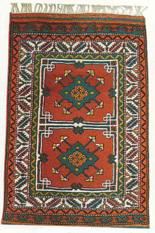
The motifs on Yuntdağı carpets carry both aesthetic and symbolic meanings. The muska motif is believed to offer protection against the evil eye. Border patterns include scorpion tail, bead, plane leaf, hand-on-hip, and badge motifs. Within the mihrab, figures such as an eight-pointed star, shepherd’s mirror, and almond blossom appear. Central motifs resemble hooks or keys. Carpets are named according to their patterns as “yeşilbaş,” “deveboynu,” and “düz biçim.” The “kara bulut” motif is used in border stripes alongside the chicken foot design.
In terms of composition, carpets are generally single- or double-niche. The ground is divided into four, six, eight, or twelve squares, forming what is known as a “tabakalı halı” (layered carpet). Each layer is decorated with geometric motifs called “ok” (arrow).
Yuntdağı hand-knotted carpets vary according to their intended use:
The production of these carpets—including wool procurement, dyeing, and weaving—must take place within the boundaries of Manisa Province. Finishing and washing processes may occur inside or outside the geographical boundary. Monitoring is conducted at least once annually under the coordination of the Manisa Metropolitan Municipality. The monitoring body consists of experts from the Public Education Branch Directorate, the Manisa Provincial Directorate of Culture and Tourism, and Dokuz Eylül University. Criteria for monitoring include knot density, knot type, yarn and dye usage, as well as pattern, color, and composition features.
Turkish Ministry of Culture and Tourism. "Yunt Dağı Halıları." Manisa Provincial Directorate of Culture and Tourism. Accessed October 19, 2025. https://manisa.ktb.gov.tr/TR-72978/yunt-dagi-halilari.html.
Turkish Patent and Trademark Office. "Yuntdağı El Halısı Sicil Belgesi." Accessed October 19, 2025. https://ci.turkpatent.gov.tr/Files/GeographicalSigns/6148a78b-ddc0-44d5-89c8-459a87f80cf4.pdf.
Turkish Patent and Trademark Office. "Yuntdağı El Halısı." Geographical Indications Portal. Accessed October 19, 2025. https://ci.turkpatent.gov.tr/cografi-isaretler/detay/37874.

Type of Geographical İndication | Mahreç Sign | ||||||||
|---|---|---|---|---|---|---|---|---|---|
Registration Number | 11 | ||||||||
Registration Date | 14.11.1997 | ||||||||
Product / Product Group(s) | Rugs and Kilims | ||||||||
Province(s) | Manisa | ||||||||
Applicant/Registrant(s) | Manisa Metropolitan Municipality | ||||||||
No Discussion Added Yet
Start discussion for "Yuntdağı Handwoven Carpet " article
Geographical and Cultural Context
Technical Features
Colors and Dyeing
Patterns and Composition
Types and Uses
Production and Monitoring