


This article was automatically translated from the original Turkish version.
+1 More
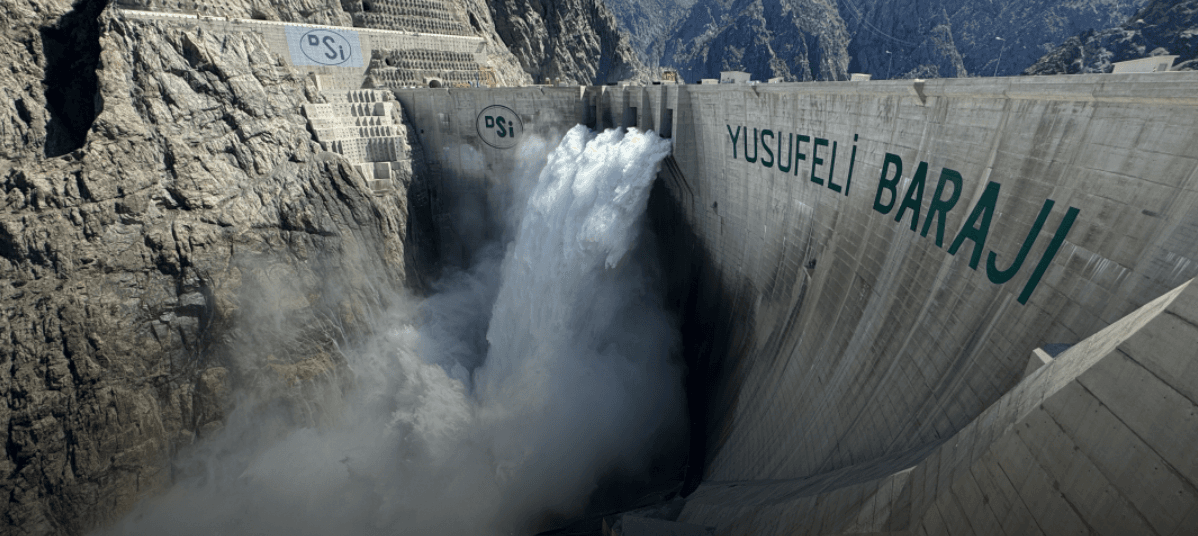
Yusufeli Dam
Location | Artvin / Türkiye | ||||||||
|---|---|---|---|---|---|---|---|---|---|
Dam Type | Double-curvature concrete arch dam | ||||||||
River | Çoruh River | ||||||||
Installed Power | 558 MW | ||||||||
Height(s) | From the thalweg: 220 m | ||||||||
Annual Energy Production | 1.888 billion kWh | ||||||||
Storage Capacity | 2 billion 130 million m³ | ||||||||
Economic Contribution | Revenue of 6.6 billion TL as of the end of 2023 | ||||||||
Water Storage Start | 22 November 2022 | ||||||||
The Yusufeli Dam is a hydroelectric dam located on the Çoruh River in the Yusufeli district of Artvin Province, Türkiye. With a height of 275 metres from its base, it is the tallest double-curvature concrete arch dam in Türkiye and the fifth tallest in the world. Construction began in 2013 and impoundment commenced on 22 November 2022. The dam was implemented by Limak İnşaat and represents Türkiye’s strategic shift toward domestic and renewable energy sources in its energy policy.
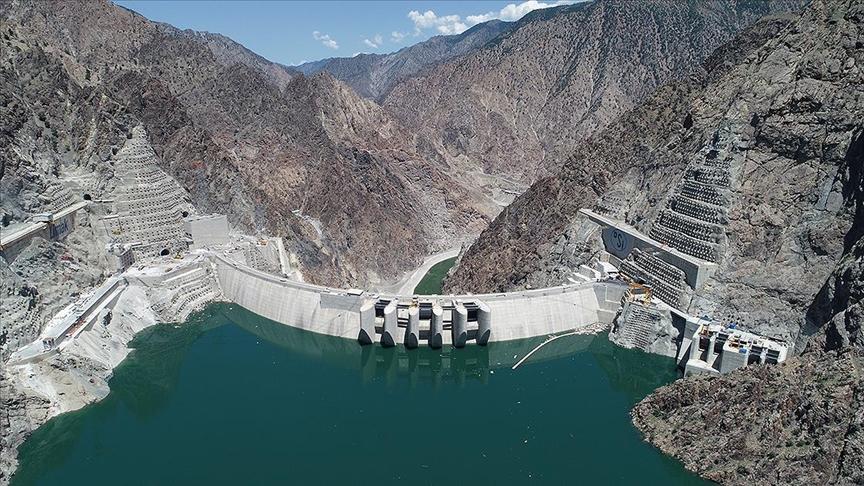
Yusufeli Dam (Anadolu Agency)
The Yusufeli Dam is a double-curvature concrete arch dam with a height of 275 metres from its base, a rated capacity of 558 megawatts, and an average annual electricity generation capacity of 1.888 billion kilowatt-hours, making it the tallest dam in Türkiye and the fifth tallest in the world. The dam has a storage capacity of approximately 2.13 billion cubic metres of water. During construction, 4 million cubic metres of body concrete and a total of 5.8 million cubic metres of concrete were used, along with approximately 70,000 tonnes of steel and iron structural materials.
During the construction process, state social policy initiatives were also prioritised. Policies were developed to ensure psychosocial support services, promote rural development and family farming, implement employment and education programmes for youth, and safeguard social cohesion and cultural continuity.
As of 2023, the electricity generated by the dam has contributed more than 6.6 billion Turkish lira to Türkiye’s economy. The dam’s investment cost is projected to be recovered within approximately six years. Additionally, the Yusufeli Dam contributes to regulating the flow and improving the efficiency of other hydropower projects in the Çoruh Basin, including Deriner, Borçka, and Muratlı.
Due to the dam’s construction, the Yusufeli district centre and three villages (Tekkale, Göcek, Meşecik) were entirely submerged, while 14 other villages were partially flooded. A total of 16,172 people were affected by this process. Expropriation procedures were carried out under Law No. 2942 on Expropriation, offering citizens the choice between monetary compensation or state-provided housing. In the affected villages, 66% of homes, 85% of farmland, 85% of gardens, 60% of vineyards, and 57% of outbuildings such as barns were submerged under the reservoir. The Yusufeli district centre has been relocated seven times throughout history.
As part of this final relocation, 2,698 residential units, 323 commercial premises, seven new village settlements, 110 kilometres of road, 46 tunnels, 23 bridges, and 92 culverts were constructed. Additionally, 5,844 fruit trees and 1.1 million cubic metres of fertile agricultural soil were relocated to new areas. In collaboration with DSİ and OGM, 81,280 saplings were planted, and various greening projects were implemented in the new settlements to ensure environmental and social integration.
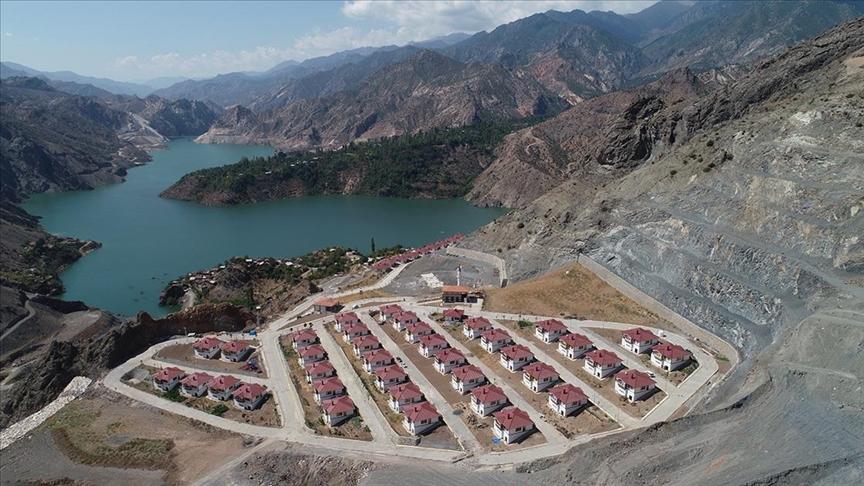
Yusufeli Dam Settlements (Anadolu Agency)
The impacts of the Yusufeli Dam extend beyond the physical realm and are also evident at social, economic, and cultural levels. New settlement areas were designed according to modern urban planning principles, creating disaster-resilient, better-organized, and infrastructure-enhanced neighbourhoods. These new areas are equipped with modern drinking water systems, sewage infrastructure, and transportation links. Regarding housing acquisition, many citizens in rural areas who previously lacked official land titles or property documents gained formal ownership rights through the dam process and accessed modern housing with state support.
2,698 residential units and 323 commercial premises were delivered to their rightful owners in the new Yusufeli district, and new settlement areas were established for seven rural villages. Traditional architectural elements were incorporated into the design to ensure cultural continuity. In terms of employment, the construction phase and new infrastructure investments increased local labour demand, generating economic activity for many local artisans and subcontracting firms. Particularly, the Yusufeli business community experienced a temporary but significant economic boost.
Resettlement practices in countries such as India (Hirakud, Krishna River), China (Shuikou, Yantan), and Thailand (Pak Mun) were studied, highlighting that dam projects are not merely infrastructure investments but also processes of social reconstruction. Reports from the World Commission on Dams and the World Bank indicate that improving the socio-economic conditions of relocated communities is a fundamental condition for the long-term success of such projects.
Yusufeli Dam Documentary YouTube/TRT Documentary)
Anadolu Ajansı. "Yusufeli Barajı Nedeniyle Yerleşim Yerleri Değişen Köylüler Yeni Yuvalarına Alıştı." Accessed May 14, 2025. https://www.aa.com.tr/tr/yasam/yusufeli-baraji-nedeniyle-yerlesim-yerleri-degisen-koyluler-yeni-yuvalarina-alisti/3052235
Anadolu Ajansı. "Yusufeli Barajı ve HES'te su yüksekliği 177 metreyi geçti." Accessed May 14, 2025. https://www.aa.com.tr/tr/gundem/yusufeli-baraji-ve-heste-su-yuksekligi-177-metreyi-gecti-/2936626
Dama, Nergis, and Murat Yılmaz. *Yusufeli Barajı’nın Sosyal Politika Perspektifi: Sorunlar, Fırsatlar ve Beklentiler.* Yusufeli Belediyesi Yayınları, 2023. Accessed adresi
Limak İnşaat. "Yusufeli Barajı ve HES." *limak.* Accessed May 14, 2025. https://www.limak.com.tr/sektorler/insaat/projeler/yurtici/yusufeli-baraji-ve-hes.
T.C. İletişim Başkanlığı. "Yusufeli Barajı ile 2,5 Milyon Kişinin Enerji İhtiyacı Karşılanacak." T.C. İletişim Başkanlığı Web Sitesi. Accessed May 14, 2025. https://www.iletisim.gov.tr/turkce/yerel_basin/detay/yusufeli-baraji-ile-25-milyon-kisinin-enerji-ihtiyaci-karsilanacak.
TRT Haber. "Türkiye’nin En Yüksek Barajı Yusufeli’nden Ekonomiye 66 Milyar Liralık Katkı." trthaber.com, November 24, 2023. Accessed May 14, 2025. https://www.trthaber.com/haber/ekonomi/turkiyenin-en-yuksek-baraji-yusufelinden-ekonomiye-66-milyar-liralik-katki-902310.html
YouTube. "Yusufeli Barajı - Belgesel." TRT Belgesel YouTube Kanalı. Accessed May 14, 2025. https://www.youtube.com/watch?v=Zo_12vggI_o.

Yusufeli Dam
Location | Artvin / Türkiye | ||||||||
|---|---|---|---|---|---|---|---|---|---|
Dam Type | Double-curvature concrete arch dam | ||||||||
River | Çoruh River | ||||||||
Installed Power | 558 MW | ||||||||
Height(s) | From the thalweg: 220 m | ||||||||
Annual Energy Production | 1.888 billion kWh | ||||||||
Storage Capacity | 2 billion 130 million m³ | ||||||||
Economic Contribution | Revenue of 6.6 billion TL as of the end of 2023 | ||||||||
Water Storage Start | 22 November 2022 | ||||||||
Technical Specifications
Energy and Economic Contributions
Expropriation and Relocation Process
Social and International Impacts