

This article was automatically translated from the original Turkish version.
+2 More
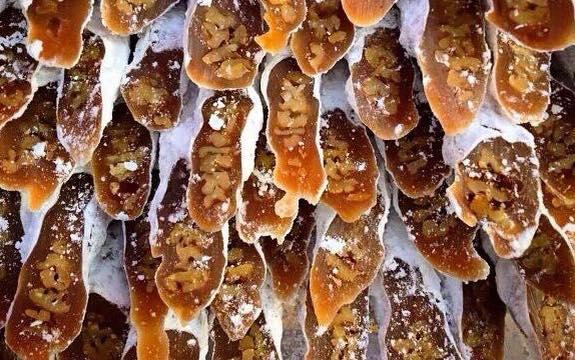
Zile Kömesi is a traditional sweet prepared using walnuts grown within the boundaries of Tokat Province and juice extracted from Narince grapes native to the same region, combined with wheat starch and optionally wheat flour. The product is coated with a layer of this juice mixture and traditionally presented on a wooden frame. The product was registered on 1 November 2017 for protection under the geographical boundaries of Zile district, Tokat Province, effective from 14 March 2014. The registered owner is the Zile Chamber of Commerce and Industry.
The key features that distinguish Zile Kömesi from similar products are as follows:
The production of Zile Kömesi involves the following stages: stringing the walnuts, baking, preparing the juice coating, dipping, and drying. After being strung on threads 40–60 cm in length, the walnuts are baked at 80°C for approximately two minutes to prevent mold formation. For the coating, Narince grapes are crushed to extract juice, and 1 kg of grape molasses soil is added per 100 kg of grapes to balance acidity.
To prepare the coating, a portion of the boiling juice is removed and cooled, then mixed with wheat starch and flour to form a homogeneous blend. This mixture is added to the 90°C juice and cooked with a wooden stirrer. The walnut clusters are dipped into the prepared coating two to three times at one-day intervals, then left to dry for 15–20 days. The dried kömes are placed between cloths for 3–5 days using the “çileye yatırma” method to remove excess moisture. Optionally, wheat starch may be added to prevent spoilage.
Zile Kömesi is cut by visual estimation, placed into packaging, and weighed for sealing. Cardboard packaging is preferred because it allows air circulation and prevents moisture absorption, although plastic, glass, or wooden packaging may also be used.
All stages of Zile Kömesi production must be carried out within the boundaries of Zile district. Oversight is conducted by a five-member body coordinated by the Zile Chamber of Commerce and Industry, comprising representatives from the Zile Directorate of Agriculture and Forestry, the Zile Municipal Mayor’s Office, and Gaziosmanpaşa University in Tokat. This body conducts annual inspections of production capacity, raw material origin, and compliance with technical specifications.
Turk Patent and Trademark Office. "Zile Kömesi." *Geographical Indications Portal.* Accessed March 25, 2026. https://ci.turkpatent.gov.tr/cografi-isaretler/detay/38117
Turkish Patent and Trademark Office. "Zile Kömesi Coğrafi İşaret Sicil Belgesi." *Coğrafi İşaretler Portalı.* Accessed March 25, 2026. https://ci.turkpatent.gov.tr/Files/GeographicalSigns/5b439ba9-1e21-45fc-8093-4a0be82304d9.pdf
[1]
Türk Patent ve Marka Kurumu, ''Zile Kömesi Coğrafi İşaret Sicil Belgesi,'' Coğrafi İşaretler Portalı, Erişim Tarihi: 25 Mart 2026, https://ci.turkpatent.gov.tr/Files/GeographicalSigns/5b439ba9-1e21-45fc-8093-4a0be82304d9.pdf

Distinctive Characteristics
Production Method
Composition Distribution
Geographical Boundary and Oversight