

Bu içerik Türkçe olarak yazılmış olup yapay zeka ile otomatik olarak İngilizceye çevrilmiştir.
+1 Daha
Location | Afyonkarahisar | ||||||||
|---|---|---|---|---|---|---|---|---|---|
Establishment Year | 1994 | ||||||||
Construction Year | 1913–1914 | ||||||||
Builder | Saitoğlu Mehmet Sait Efendi | ||||||||
Architectural Period | First National Architecture Period | ||||||||
Affiliated Institution | Commander-in-Chief Historical National Park Directorate | ||||||||
Museum Type | Historical and Military Museum | ||||||||
The Afyonkarahisar (Victory) Museum is a historically significant building as it was the site where the decision and planning for the Commander-in-Chief’s Battle during the Turkish War of Independence were made. The museum building was constructed between 1913 and 1914 by Saitoğlu Mehmet Sait Efendi, then mayor of the city, as a municipal services building. After Afyonkarahisar was liberated from enemy occupation on 27 August 1922, the building was used as the Western Front Headquarters by Mustafa Kemal Pasha, İsmet Pasha, Fevzi Çakmak Pasha, and Tevfik Bıyıklıoğlu. In this capacity, the building witnessed major military and political developments in the history of the Republic. Used as a municipal building until 1935, it was later repurposed for various public services including a maternity hospital, the General Directorate of PTT, and the Police Directorate. In 1981 it was assigned to the Commander-in-Chief Historical National Park and opened to the public in 1994 under the name “Victory Museum.”

Afyonkarahisar (Victory) Museum (Ministry of Agriculture and Forestry)
The museum building is located on Millî Birlik Avenue, next to the Government House. Exhibiting neoclassical characteristics, the structure reflects the architectural style of the First National Architectural Movement. Although the architect is not definitively known, it is reported to have been constructed by an Armenian master builder. The two-story masonry building has a broken roof covered with Marseille-type tiles. The pointed arch portal on the main facade continues the tradition of portal design in Turkish architecture. The ground floor features flat arch windows while the upper floor has pointed arch windows. The building’s horizontal lines that emphasize floor divisions reflect the architectural aesthetic of its period.
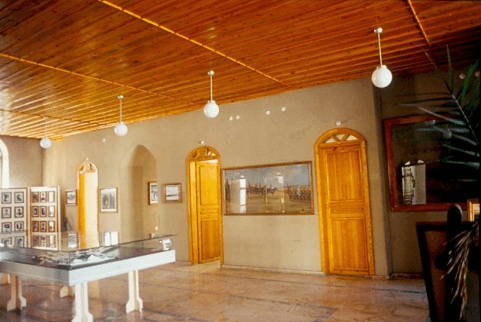
The ground floor contains ten rooms, a meeting hall, and a stage; the upper floor has eight rooms and one large hall. The ground floor is generally used for administrative purposes. The first floor is arranged as museum galleries. In the lobby, a topographic model depicts the battlefields of the Great Offensive. In Atatürk’s Room, there is a desk, a set of chairs, and a painting portraying Atatürk at Kocatepe. Other rooms are dedicated to commanders such as Fevzi Çakmak, İsmet İnönü, and Tevfik Bıyıklıoğlu. In these rooms, war artifacts, weapons, ammunition parts, documents, and photographs are displayed. Additionally, maps, official documents, and personal belongings from the war period are exhibited throughout the galleries.

View from the Ground Floor Lobby of the Victory Museum
For many years, the Victory Museum operated under the Directorate of the Commander-in-Chief Historical National Park with the status of a private museum. Visitors enter through the eastern entrance. The museum houses the “Great Offensive Library,” which contains a limited number of sources. Some of the materials on display in the museum, such as insect specimens, have been criticized for lacking thematic coherence. Due to the building’s historical character, controlling natural light in the exhibition areas is challenging. To enhance its museum function, it has been recommended that the lower level be cleared and the entire building be reorganized in accordance with its historical theme, supported by specialized staff.
As part of the restoration process initiated in 2018, later-added concrete elements were removed, revealing the original architecture. Structural reinforcement and decorative works completed in 2023 finalized the restoration, and the museum reopened to the public on 26 August 2024.
İnce, Kasım. “Afyonkarahisar Zafer Müzesi.” *Nevşehir Üniversitesi Sosyal Bilimler Enstitüsü Dergisi* 1 (2011): 254–267. Accessed July 7, 2025. https://dergipark.org.tr/tr/download/article-file/184870
“Afyonkarahisar Müzeleri.” afyon.ktb.gov.tr. Accessed July 7, 2025. https://afyon.ktb.gov.tr/TR-63477/muzeler.html
“Zafer Müzesi Açılıyor.” tarimorman.gov.tr. Accessed July 7, 2025. https://www.tarimorman.gov.tr/DKMP/Haber/358/Zafer-Muzesi-Aciliyor
“Zafer Müzesi.” kulturportali.gov.tr. Accessed July 7, 2025. https://www.kulturportali.gov.tr/turkiye/afyonkarahisar/gezilecekyer/zafer-muzesi

Location | Afyonkarahisar | ||||||||
|---|---|---|---|---|---|---|---|---|---|
Establishment Year | 1994 | ||||||||
Construction Year | 1913–1914 | ||||||||
Builder | Saitoğlu Mehmet Sait Efendi | ||||||||
Architectural Period | First National Architecture Period | ||||||||
Affiliated Institution | Commander-in-Chief Historical National Park Directorate | ||||||||
Museum Type | Historical and Military Museum | ||||||||
Henüz Tartışma Girilmemiştir
"Afyonkarahisar (Zafer) Museum" maddesi için tartışma başlatın
Architectural Features
Interior Space and Exhibition Layout
Administrative Structure and Museum Management
Restoration Process