

This article was automatically translated from the original Turkish version.
Name(s) | Great Offensive | ||||||||
|---|---|---|---|---|---|---|---|---|---|
Date(s) | 26 August – 18 September 1922 | ||||||||
Place | Uşak–Alaşehir–İzmir direction Afyonkarahisar–Kütahya–Eskişehir line | ||||||||
Parties | Greek Army Turkish Army | ||||||||
Turkish Commanders | Commander of the Western Front İsmet Pasha Chief of the General Staff Fevzi Pasha Commander-in-Chief Mustafa Kemal Pasha | ||||||||
Greek Commanders | General Nikolaos Trikopis General Georgios Hatzianestis General Anastasios Papoulas | ||||||||
Turkish Forces | 145 artillery pieces 819 machine guns 000 rifles 43 000 soldiers Approximately 92 | ||||||||
Greek Forces | 300 artillery pieces 000 machine guns 3 000 rifles 98 000 soldiers Approximately 180 | ||||||||
Course of the War | 18 September: Complete liberation of Western Anatolia from occupation 9 September: Entry of Turkish cavalry into İzmir and the liberation of the city Uşak-Salihli-Manisa and Aydın were liberated 1–9 September: Pursuit operations the Greek Army was surrounded and destroyed 30 August: Decisive outcome in the Commander-in-Chief Battle 28–29 August: Encirclement of the Greek Army on the Dumlupınar plateau 26–27 August: Fall of the fortified hills south and southwest of Afyon | ||||||||
The Great Offensive is a military operation that took place between 26 August and 18 September 1922 and constitutes the final and decisive phase of the Turkish War of Independence. This operation was not merely a victory of the Turkish forces over the Greek troops but also a historic turning point that ended the de facto occupation across a large part of Anatolia and accelerated the process of establishing the new Turkish state.
Depiction of the Greek Army’s Defeat on 30 August as a Result of the Great Offensive (İsmet Görgülü)
The Great Offensive, the product of a year of preparations following the Battle of Sakarya, began with artillery fire at dawn near Kocatepe in Afyonkarahisar and quickly shattered the Greek defensive lines.【1】 The Battle of Commandership at Dumlupınar on 30 August resulted in the annihilation of the Greek army. During the subsequent pursuit operations, İzmir was liberated on 9 September and the entire region of Western Anatolia was freed from occupation by 18 September.
Detailed Documentary on the Great Offensive (Turkish Armed Forces)
The significance of the Great Offensive extends beyond its battlefield outcomes. This victory by the Turkish army effectively ended four years of occupation since the Armistice of Mudros and laid the groundwork for the establishment of a new state within the borders of the National Pact. This process opened the path to the Armistice of Mudanya and the Treaty of Lausanne, compelling international recognition of the Turkish nation’s claim to independence. Following the victory, 30 August was quickly adopted as a national holiday and secured a special place in the official commemorative calendar of the Republic of Türkiye.
The victory at the Battle of Sakarya fundamentally altered the political balance of the National Struggle. This success by the Turkish army not only halted the Greek advance in Anatolia but also strengthened the domestic and international legitimacy of the government in Ankara. In the period following Sakarya, the TBMM Government began to be recognized not merely as a resistance organization but as a permanent political authority in Anatolia.
The Allied Powers, taking note of the new situation, convened a conference in Paris in March 1922 and proposed an armistice to the parties. The immediate peace proposal, which evoked the terms of the Treaty of Sèvres, was categorically rejected by the Turkish side. Nevertheless, the TBMM Government presented its own proposals to achieve peace, but these initiatives were ignored by the Allies. Thus, diplomatic avenues were blocked, and the necessity of achieving a military outcome became evident.
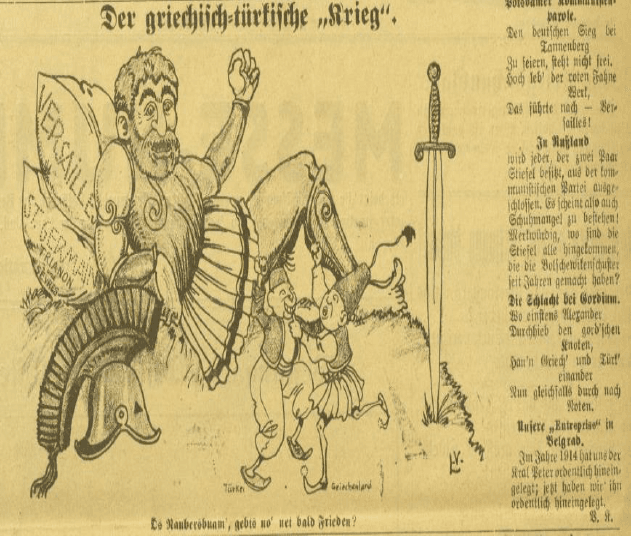
Reflection of the Turkish-Greek War in an Austrian Newspaper (Çiğdem Dumanlı-Emre Saral)
During this period, the Ankara government continued its efforts to maintain a balanced foreign policy.【2】 The relative closeness established with France through the 1921 Ankara Agreement was preserved, while Italy, affected by tensions with its allies, gradually reduced its influence in Anatolia. In contrast, Britain continued to support Greece, making divisions among the Allies more visible. Relations with the Soviet Union developed along a different path: the Moscow government viewed the resistance in Anatolia as a common struggle against imperialism and continued its financial and military assistance.
Podcast on the Great Offensive (MSB)
By the summer of 1922, the TBMM Government had strengthened its domestic political legitimacy and succeeded in undermining the unity of the Allied bloc. Thus, the groundwork for the Great Offensive was not only prepared through military preparations but also through a favorable diplomatic conjuncture.
The area where the Great Offensive was executed is a geography defined by the Eskişehir–Kütahya–Afyonkarahisar triangle and the line extending westward through Uşak–Alaşehir–Manisa to İzmir, marked by transportation networks and passes. This belt carried the natural transit corridors connecting the Central Anatolian plateau to the Aegean basin (plains, valleys, and straits) and the railway–road network that followed them. Consequently, the region acquired decisive strategic importance for both troop concentration and logistical supply and movement.
The Greek army, after its retreat from Sakarya, established its defensive line along the Eskişehir–Afyon axis, aiming to control the Porsuk and Akarçay valleys and protect the railway spine extending from Eskişehir to Afyon and then to İzmir via Uşak–Alaşehir–Manisa. The towns of Eskişehir, Kütahya, Afyonkarahisar, and Uşak along this line served as natural defensive strongpoints due to their elevated terrain and their status as railway junctions. Telegraph lines and station centers along the railway formed the nervous system of the entire logistical network, from communications to supply.
The Impact of Geography on the Great Offensive (Selim Erdoğan)
The decisive factor in the Turkish offensive plan was the relationship between the rugged terrain south and southwest of Afyonkarahisar and the Sincanlı (Şuhut) Plain to its north. Dominant ridges forming part of the Ahır Mountains—such as Kocatepe (the command position), Tınaztepe, Kalecik Sivrisi, Belentepe, and Çiğiltepe—provided observation and fire superiority while also offering concealment and cover for secret troop concentrations and night movements. This allowed the offensive to maintain its element of surprise and enabled penetration into the depth of the enemy’s defensive lines from the slopes facing the plain.
To the west, the Uşak basin and the passes opening into the Banaz Çayı valley and the Gediz basin emerged as natural corridors determining the speed of the pursuit operations. The Dumlupınar plateau and its surrounding straits—including the Zafertepe–Çalköy line—formed a battlefield of interwoven mountainous and hilly terrain with narrow passes, enabling Turkish forces to execute encirclement maneuvers while creating a “constriction” effect for retreating units. This topography played a decisive role in achieving a conclusive result on 30 August, after which the railway–plain corridors enabled a rapid advance toward the Aegean.
Climate and seasonal conditions further enhanced the tactical impact of the geography. The dry and clear weather of late August provided long visibility during the day, while relatively cool and windless nights facilitated infiltration and close-range marches by infantry and cavalry units. The combined use of cover provided by rugged terrain and the speed advantages offered by open plains and valleys enabled a continuous operational flow between the initial breakthrough and the subsequent pursuit phase.
The Geography of the Great Offensive (TTK)
In summary, when the morphology of the operational area (dominant ridges and straits), hydrography (valley–plain corridors), and transportation network (especially the railway) are considered together, a geography emerges that simultaneously contains “holding lines” for defense and “advance corridors” for offense and pursuit. The Turkish plan successfully turned this dual character to its advantage: a combined assault and encirclement from the heights down to the plain, coupled with the use of the western transportation spine, enabled a rapid advance toward the strategic objective of İzmir.
The year following the Battle of Sakarya marked a period in which both sides consolidated their front lines along the Eskişehir–Kütahya–Afyon axis, with clear distinctions emerging between defensive and offensive doctrines. The Greek army, after its retreat, established a deep defensive system anchored on railway junctions and dominant ridges, linking fortified hills with trenches and intermediate lines. However, the dilution caused by extending the front, the morale decline inherited from Sakarya, and dependence on the railway for logistical supply were the fundamental weaknesses undermining this defense. The command structure, under pressure from political uncertainties, failed to demonstrate clear strategic initiative regarding centralized reserve deployment and force conservation.
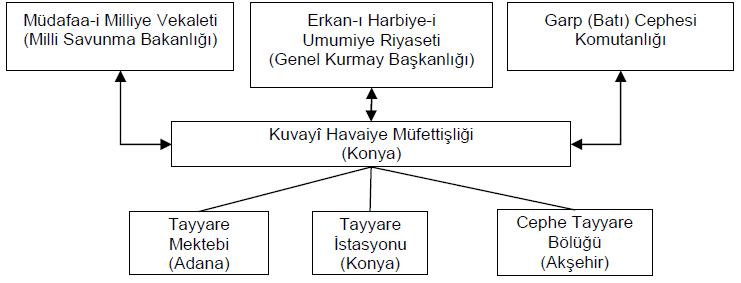
Organization of Air Forces Before the Great Offensive (Murat Bastem)
In the Turkish side, the unity of command between the Commander-in-Chief, the General Staff, and the Western Front Command produced a decisive advantage.【3】 The offensive plan aimed to deliver a decisive blow to the enemy’s flank and rear by concentrating forces southwest of Afyon, while simultaneously engaging enemy forces on other sectors to prevent troop redeployment. The First Army was assigned the breakthrough role along the main offensive axis, the Second Army was tasked with maintaining the front line and applying pressure, and the Fifth Cavalry Corps was prepared to maneuver in depth to sever logistical and communication networks via railways and station junctions. This arrangement relied on operational speed, terrain adaptation, and maneuverability to offset numerical disadvantage.
The implementation of Tekâlif-i Milliye and the mobilization of local resources enabled the establishment of a logistical system capable of meeting the essential needs of combat units despite limited motorized capabilities. The limited capacity of the railway was supplemented by short-range land transport; the supply and provisioning chain was redesigned according to the offensive axes. The limited availability of ammunition, especially for artillery, necessitated prioritization of targets and strict fire discipline: fortified ridges, machine gun nests, and junction points were subjected to brief but intense preparatory fire; infantry assault phases were synchronized with this fire. Thus, the aim was not prolonged attrition but rapid breakthrough and swift penetration into depth.
Training and preparations focused on artillery–infantry coordination, night movements, maximum use of terrain cover, and cavalry reconnaissance, infiltration, and pursuit missions. Concentration was carried out in strict secrecy, using night marches and the concealment offered by rugged terrain. The Kocatepe line provided the command with superior observation and fire control; this coordination proved especially effective during the critical breakthrough moments of the first two days. Cavalry patrols were used alongside limited air assets for reconnaissance; data gathered on station activity, reserve movements, and rear-area organization contributed to adjusting the offensive axes. Communications relied on the combined operation of telegraph, field telephones, and radio stations; radio stations established at army and corps levels ensured command connectivity during critical moments.
Military Situation During the Great Offensive (Habertürk)
In numerical terms, the Greek army held an advantage: the Turkish army had approximately 92,000 troops, 43,000 rifles, 819 machine guns, and 145 artillery pieces on the front; the Greek side had approximately 180,000 personnel, 98,000 rifles, about 3,000 machine guns, and 300 artillery pieces.【4】 This disparity required the Turkish plan to treat “time” as the most scarce resource. The assumption was that when surprise and speed were combined, the enemy’s defensive cohesion would collapse, reserves would lack time to reorganize and move, and strikes against logistical arteries in depth would sever the front’s communications. Therefore, breakthroughs were opened with brief but intense artillery preparation; infantry assaults advanced under cover of night and terrain; simultaneously, cavalry units targeted rear logistical and communication junctions.
Risk management, ammunition economy, and preservation of combat power formed the basis of the plan. A prolonged conflict was unfavorable for the Turkish side due to logistical constraints; the plan aimed to gain initiative quickly and transition to a decisive battle. The dual character of the geography—the concealment provided by mountainous ridges and the natural corridors opening toward plains and valleys—offered a suitable terrain for this objective. Ultimately, the pre-offensive military situation reached a level of maturity that enabled the translation of a concept of offensive warfare centered on surprise, speed, and concentration onto the battlefield, in contrast to a defensive model based on numerical and firepower superiority. This maturity formed the foundation for rapidly converting the initial operational successes into strategic outcomes.
The most fundamental measure taken after Sakarya to rapidly rebuild the army’s combat power and prepare for the anticipated major battle was the nationwide implementation of the Tekâlif-i Milliye system and the transition to a genuine “war economy.” Under this framework, the government established a mobilization system to meet the army’s needs for provisions, clothing, equipment, transportation, and repairs using local resources. The principle was not forced requisition but compulsory supply organized by public authority with payment to be made later.
Tekâlif commissions established in cities and towns collected, according to regulations, raw materials such as clothing, footwear, tent canvas, fabric, leather, iron, and copper, along with grain, fodder, and livestock and vehicles, through a registration and delivery chain extending from villages to districts. They recorded the compensation guarantees alongside delivery receipts. Thus, the army’s essential needs were met without dependence on imports, through the organization of domestic stocks and production. Local artisans and workshops (tailors, saddlers, blacksmiths, carpenters) were directed to meet military requirements.
On Tekâlif-i Milliye (Ekrem Buğra Ekinci)
The transportation network formed the backbone of logistics. Railway lines (especially the main spine extending from Eskişehir to Afyon and Uşak) served as the primary means for the “long-distance” transport of ammunition and provisions. Prior to the war, repairs to lines and tunnels were accelerated; stations were reorganized for loading, unloading, and short-term storage; telegraph connections were reinforced with backup lines. The limited capacity of the railway was supplemented by ox carts and animal-drawn vehicles at the “last mile.”
These carts undertook phased deliveries from intermediate depots established by the logistical organization toward the offensive axes; roadside rest and maintenance points (farrier shops, repair workshops, water and fodder stations) were established along the routes. The clear and dry weather of late August enabled a transport method emphasizing night movements, thus preserving secrecy and conserving animal strength during daytime heat.
Planning for ammunition and weapons was based on the principles of “economy and accuracy.” Units underwent joint training to synchronize artillery fire with infantry assaults. Ammunition and hand grenade allocations for infantry were adjusted according to updated schedules for the offensive days; continuous resupply from forward depots was prioritized to prevent units from carrying excessive loads. The unique needs of the cavalry (fodder, horseshoes, spare tack) were planned separately. The duration of raids and interdiction missions into enemy depth was calculated, and daily fodder requirements per animal were increased.
The provisioning and medical system was as decisive as ammunition in preserving combat power. Mobile ovens and boilers for bread and hot meals were connected to forward depots; water sources were mapped and chlorination and filtration measures were introduced. Foot health, provision of socks and sandals, and spare undergarments became special monitoring priorities for units with high marching speeds. Field hygiene was reinforced with mobile medical units and litter stations to ensure wounded soldiers could be evacuated to the railway at the shortest possible distance; thus, transport vehicles were used reciprocally to carry ammunition and provisions forward and wounded soldiers back.
Repair and maintenance were another critical area for sustainability. Railway workshops and small repair shops supported not only locomotive and wagon maintenance but also field repairs of artillery and machine guns. Mobile gunsmiths were distributed among battalions to address bolt and mechanism failures. Mobile veterinary teams were assigned to ensure animal health and hoof care, minimizing wear on cavalry and transport animals. Local production potential—particularly in leather, felt, and wool weaving, and in horseshoe, nail, and rivet manufacturing—was directed by commissions to meet army standards.
On Tekâlif-i Milliye (Republic)
Secrecy and deception were treated as integral components of logistics. To reduce visibility of concentration, movements were conducted in fragmented waves, mostly at night; during the day, a “calm appearance” was maintained at stations and intermediate depots. To create the impression of activity in secondary sectors, certain amounts of provisions and ammunition were deliberately directed toward active sectors; unusual telegraph traffic was avoided. To ensure continuity of command and control, field telephone lines were backed up, and radio stations were activated at critical levels; this enabled immediate responses to sudden supply directions and fire support requests.
All these measures served the fundamental assumption of the offensive design: to shorten time and intensify impact. For an operation aiming to achieve a rapid breakthrough and swift penetration into depth, the precise and timely use of ammunition, uninterrupted flow of provisioning and supply, absence of logistical bottlenecks, and the ability to conduct repairs on the battlefield were vital. The human-material-service mobilization provided by Tekâlif-i Milliye, the logistical organization built around the railway spine, and the local transport networks completing the “last mile” created the logistical foundation of the Great Offensive, enabling the uninterrupted deployment of combat power to the battlefield within days.
The economic foundation of the Great Offensive preparations was shaped by the goal of maximizing combat power on a limited cash pool. The TBMM Government redefined budget priorities as it entered the final phase of the war: defense allocations were increased, revenue collection was accelerated, cash flow was balanced through advances and immediate payments, and domestic borrowing opportunities were expanded. In parliamentary debates (both open and closed sessions), the issue was not merely a numerical increase but the establishment of an administrative system guaranteeing the timely transfer of resources to units. To this end, intermediate levels in the revenue-collection chain were reduced; financial officials directly working with logistical regions and front headquarters were empowered.
Cash shortages necessitated the activation of “goods-based financing” channels. Tekâlif-i Milliye was not merely a logistical supply system; it was a financing mechanism that allocated market stocks to military needs with payment to be made later. Local production and service capacities (tailor shops, saddlers, blacksmiths, mills, bakeries, transport) were ordered and recorded by commissions; thus, the flow of goods and services to the front was ensured through “public orders and receivables” rather than cash. This method provided a practical way to mobilize production without halting it under conditions of scarce currency. In cash-requiring items (salaries, allowances, travel compensation), payments were standardized through phased schedules; monthly allocations for units were planned to be paid in advance by accounting offices.
On the personnel front, the goal was to ensure the continuity of morale and discipline before the offensive. Retaining troops on the front and preventing desertion were achieved not only through disciplinary measures but also by improving personnel rights. Regular provision of basic needs (bread, hot meals, socks–sandals, shelter) for soldiers and non-commissioned officers, and updating assignments and provisioning according to seasonal and duty burdens, were treated as direct factors affecting combat performance.
The pay and compensation system for officers and non-commissioned officers was simplified; criteria for awards, bonuses, and promotions linked to front service, wounds, and exceptional achievements were clarified. Assistance to families of those killed in action and salary and compensation procedures for disabled personnel reduced uncertainty in the rear and alleviated personnel’s concerns about the future.
In the final months before the offensive, some volatility in cash flow was mitigated through the principle of local administration. Advance limits were increased to allow front headquarters to make small urgent purchases directly; payment documentation was expedited with completion to follow (without compromising record discipline). The Red Crescent and local aid commissions provided complementary contributions in medical supplies and clothing–shelter items, coordinated centrally to prevent duplication and waste. Protocols with the railway administration clarified tariffs and priorities for military transport and wounded evacuation, indirectly aiding cost control.
In areas requiring foreign currency such as ammunition and equipment, the scope of external procurement was limited due to practical conditions, but discipline measures were implemented to ensure the most efficient use of existing stocks. The duration and target priorities of artillery fire were aligned with budgetary realities; strict reporting and monitoring systems were introduced at unit levels to prevent waste. In contrast, production and supply lines for certain low-cost but high-impact infantry items (hand grenades, wire cutters, trench assault equipment) were specially supported.
These adjustments in budget, financial regulations, and personnel systems were not merely “increased welfare”; they were prerequisites for the uninterrupted projection of combat power onto the battlefield during the final phase of the war economy. Correctly balancing cash and goods, ensuring payment reliability and continuous operation of the record system, enabling rapid local decision-making, and giving personnel a sense of “backing” were directly compatible with the design of the Great Offensive to produce decisive results quickly. Thus, the operational speed was protected from becoming a barrier due to cash and material shortages; financial and administrative preparations functioned as an inseparable pillar of the combat plan.
In planning the Great Offensive, the apex of the decision and implementation chain consisted of Commander-in-Chief Gazi Mustafa Kemal Pasha, Chief of the General Staff Fevzi Pasha, and Western Front Commander İsmet Pasha; within the front headquarters’ staff structure, the team led by Asım (Gündüz) Bey played a pivotal role in detailing and executing the plan.
The principle of unified command provided unquestionable superiority both in the preparation phase and during execution. Nurettin Pasha was placed at the head of the First Army, Yakup Şevki Pasha at the head of the Second Army, and Fahrettin (Altay) Pasha at the head of the Cavalry Corps, clearly assigning the three main functions of the offensive (breakthrough, diversion, and deep interdiction). Uncertainties caused by previous command crises—particularly changes at the First Army level—were eliminated; decision-making processes were simplified and lines of responsibility clarified.
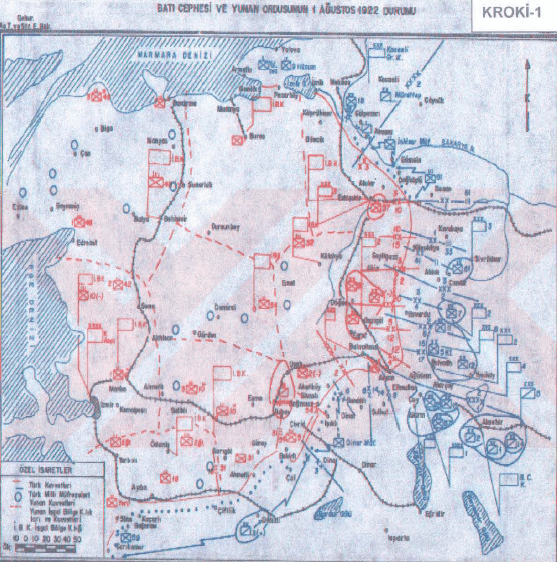
Positions of Turkish and Greek Armies as of 1 August (Erhan Türksoy)
The essence of the operational design was to rapidly achieve a breakthrough and encirclement from the high ground south and southwest of Afyonkarahisar along the Kocatepe–Tınaztepe–Kalecik Sivrisi–Belentepe–Çiğiltepe line, striking the enemy’s flank and rear.【5】 The First Army would form a central weight on this axis; brief but intense artillery fire on fortified ridges would open breakthroughs; infantry assaults would rapidly penetrate depth through close-range night marches.
Simultaneously, the Second Army would maintain pressure on other sectors to prevent Greek reserves from being redeployed; the Cavalry Corps would immediately launch raids on railway stations, telegraph lines, and junctions to render the rear area inoperable. Coordination among these three action arms would be provided from the command position (Kocatepe) from the first hours of the offensive; short preparatory fires in a “strike-and-withdraw” pattern would tightly link infantry and cavalry movements.
For the plan’s success, secrecy and deception were considered as important as fire and maneuver. Information regarding the offensive date and time was shared only with essential personnel; orders were issued downward in a “gradual release” manner. Concentration was carried out at night and in terrain offering concealment; during the day, extreme care was taken to avoid any appearance of troop presence. In secondary sectors and rear areas, diversionary movements and deployments created the impression that offensive preparations were underway in different directions; telegraph and radio traffic was kept at “normal” levels, avoiding unnecessary encrypted correspondence. Thanks to special arrangements with the railway, supplies to forward depots were delivered in small batches at irregular intervals, preventing the appearance of a single large concentration.
The command style aimed for a short but high-intensity battle. Economical use of artillery ammunition and target prioritization were planned from the outset; units underwent joint training to ensure seamless synchronization between artillery fire and infantry assault.
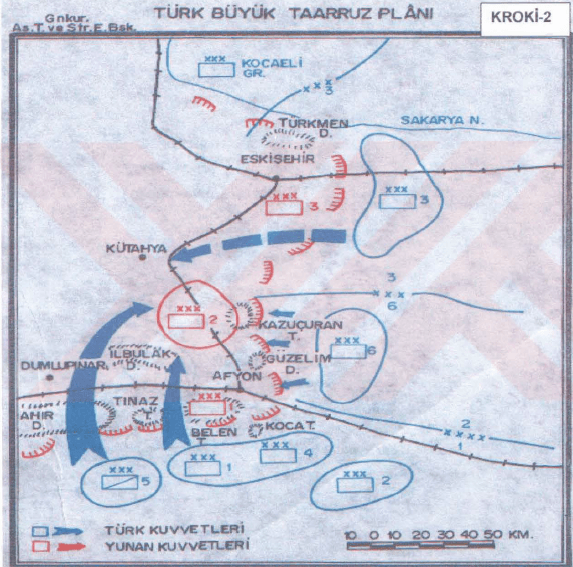
The Great Offensive Plan (Erhan Türksoy)
The duration and range of cavalry missions in depth were pre-calculated; simultaneous raids on key rear nodes were planned from the moment of breakthrough.【6】 Reserve unit positions were placed at locations suitable for short-range movements to compensate for possible delays; explicit orders granted corps and division commanders “initiative freedom” to rapidly exploit emerging opportunities.
The brevity of decision cycles in command and control was ensured by Kocatepe’s wide field of view. The communication system was established redundantly with field telephone lines and radio stations; at critical levels, two separate lines operated. Reports from command intelligence and air–cavalry reconnaissance were transmitted directly to the command position during offensive days; thus, local tactical adjustments (transfer of fire intensity, shifting of assault axes, changing cavalry target priorities) could be implemented without delay. Consistent with the political–diplomatic background, the offensive was designed to produce a decisive result quickly, followed by immediate pursuit; therefore, a pursuit plan exploiting the “time-critical” effect of the railway–plain corridors toward İzmir was prepared from the outset.
The resulting plan, aiming to resolve a numerically superior defense through a short decisive battle rather than prolonged attrition, linked every preparatory step—from personnel organization to supply flow, from communication systems to reconnaissance—to a single objective: operating the breakthrough–encirclement–pursuit triad within a unified operational rhythm and establishing a command architecture capable of achieving the strategic outcome within days.
During the preparation phase of the Great Offensive, intelligence was based on the simultaneous execution of a secrecy regime to preserve the offensive’s element of surprise and an information-gathering system to reduce battlefield uncertainty. The intelligence branch within the Western Front Headquarters coordinated reconnaissance units under front command and civilian intelligence networks in logistical regions under a single authority.
Information obtained through reliable contacts in occupied settlements was verified against routine movement data from local administration, railways, and telegraph organizations; reports based on a single source were not accepted without confirmation. To meet the need for updated information on topography and road conditions, map updates, terrain surveys conducted with local guides, and “position reconnaissance” near the front line were used together; sketches, fire plans, and approach routes for dominant ridges and passes along the offensive axis were prepared in advance.
Military reconnaissance was conducted through a coordinated system using cavalry patrols and limited air assets. Cavalry, conducting night infiltration and daytime short-range forward reconnaissance, gathered data on enemy position depth, machine gun and artillery placements, and communication routes between positions; captured prisoners and documents were rapidly transferred to interrogation centers for analysis. Aerial reconnaissance provided a current “overall picture” regarding railway station loading–unloading activity, reserve troop movements, and depot–headquarters locations in the rear, complementing ground reconnaissance reports. Thus, target priorities, fire intensity distribution, and the timing and location of cavalry raids were updated based on concrete data.
Intelligence in the Great Offensive (RUBASAM)
Censorship in press and communication channels was applied within a narrow framework prioritizing front security. Limited supply movements and drills in secondary sectors maintained an impression of “activity parity,” serving as a deception measure to conceal the true center of gravity.
Verification of information balanced speed and security. Reports from the front were transmitted without delay to the command position thanks to redundant communication lines; during critical moments, radio stations were activated alongside telegraph and field telephones to shorten command–instruction cycles. Cipher instructions were simplified; potential incompatibilities arising from units using different code sets were eliminated in advance. Bias risks in information from local networks were reduced through cross-verification across multiple sources; unverified tips were considered in the offensive plan only when supported by other findings.
The tactical impact of intelligence was especially evident during the first two days in converting breakthroughs into depth and prioritizing cavalry targets in the rear; the sequential disabling of railway junctions, telegraph centers, and logistical depots–stations disrupted the enemy’s both information flow and supply rhythm, accelerating its collapse.
This entire system was established for two fundamental purposes: to prevent the breach of the security–secrecy umbrella preserving the offensive’s element of surprise and to reduce battlefield uncertainty to a militarily manageable level until the moment of attack. When reconnaissance, communication, counterintelligence, and deception measures were coordinated under a single umbrella, the “temporal superiority” required by an operation aiming for rapid results with limited firepower and ammunition was generated; the enemy was forced into delays in its decision-making due to disruptions in information and supply flows. The tempo achieved in the initial phase of the offensive was the most visible outcome of this intelligence architecture.
In the early hours of 26 August, intense artillery fire opened from the Kocatepe line, defining the offensive’s character. The preparatory fire was brief; target priorities were fortified ridges, machine gun nests, and communication points between positions. Rapid corrections between forward observers and batteries increased accuracy; as soon as the fire ceased, infantry assaults were launched. On the southern flank where the First Army concentrated its strength, enemy positions along the Tınaztepe–Kalecik Sivrisi–Belentepe line were assaulted in waves from the first hours. Thanks to terrain cover and night approach marches, units reached the front lines without contact; wire obstacles were rapidly overcome through gaps opened by engineering units.
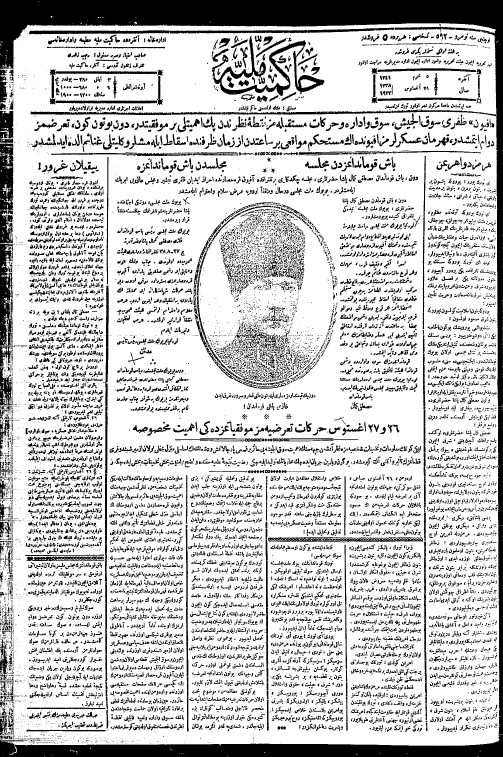
Hâkimiyet-i Milliye Report on the Liberation of Afyon (Uğur Üçüncü)
By midday on the first day, enemy fire on the dominant peaks in the southwest had noticeably weakened.【7】 Although Greek units attempted local counterattacks to hold their ground, renewed artillery fire and suppression of machine guns severed connections between positions. This rupture not only led to the collapse of forward lines but also narrowed the possibility of orderly withdrawal to rear support positions. Simultaneously, the Cavalry Corps infiltrated through sectors where the breakthrough was evident and advanced toward rear junctions; it disrupted communication and supply rhythms by applying pressure on railway stations and telegraph centers. Thus, by the end of the first day, the continuity of the defensive system anchored south and southwest of Afyon was broken; defense now persisted only in isolated pockets rather than as a cohesive line. In a statement to the newspaper Hürriyet, Salih (Bozok) Bey described the offensive’s course as follows;
“From this moment, all batteries began to pour death upon the enemy. Despite knowing how many batteries were firing, our ears could not believe it; it seemed as if only one single cannon, roaring with all its fury, was firing. A magnificent spectacle before us! The earth was continuously spewing up in three places, and heavy, slow smoke drifted above these boiling areas. This spectacle can only be seen; it cannot be described. The targets directed were, from right to left (Kalecik Sivrisi), (Belentepe), (Tınaztepe), and further left (Çiğiltepe). Artillery followed our infantry assaults. Shortly after, news arrived that Tınaztepe and subsequently Kalecik Sivrisi had fallen silent. Belentepe had caught fire from our shells and enemy-burned grasses. Long flames licked the peak. Thick smoke columns rose into the air. For a moment, all Turkish heroes disappeared within this wall of flame and smoke. They had stormed the enemy trenches on Belentepe in a single assault! In the evening, the enemy launched large reinforcements to recapture some of these peaks, but during the night, renewed offensives reclaimed them. And a second, exceptionally important and strongly fortified position, the 1310-meter-high hill, was captured.”【8】
On 27 August, the objective was to widen and deepen the breaches opened the previous day. At dawn, the ridge lines were again subjected to artillery fire; infantry assaults delivered results in the morning hours. The fierce battle at Çiğiltepe became one of the symbolic moments of the offensive. After several waves of assault and close combat, the hill was captured; this gain unraveled the axis of the defensive chain extending from south to north. On the same day, as pressure intensified toward the center of Afyonkarahisar, securing control over the city’s railway junction and depot areas further weakened the defense’s connection to the rear. By afternoon, the capture of Afyonkarahisar marked the crossing of a strategic threshold, both psychologically and in terms of transportation.
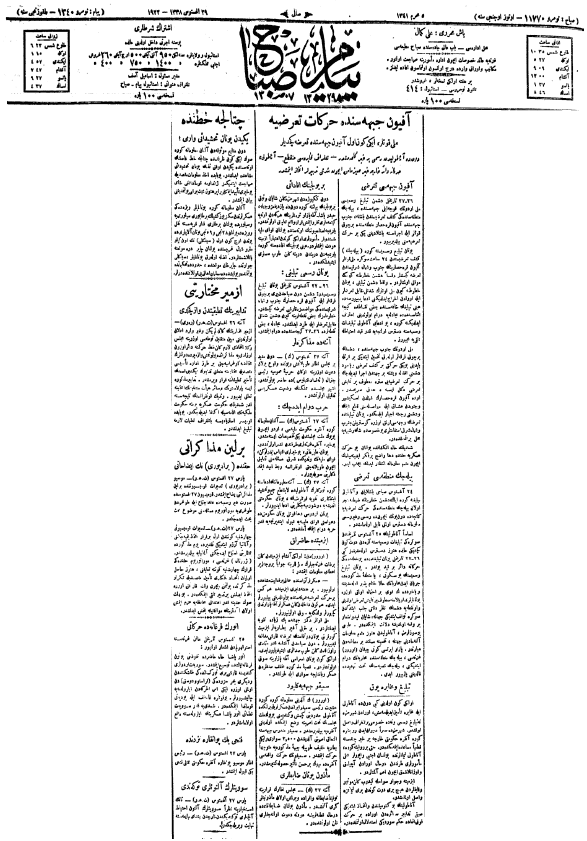
Peyâm-ı Safâ Report on the Start of the Great Offensive ()
The combined effect of the two days was the collapse of the defense from a continuous line into scattered resistance points.【9】 The successes of the First Army on the breakthrough axis and the sustained pressure by the Second Army on other sectors complemented each other; Greek reserve redeployment was delayed, and units in transit became vulnerable to cavalry raids. Under these conditions, the withdrawal order collapsed; local counterattack attempts failed to restore front cohesion. By the evening of 27 August, the fortified ridges south and southwest of Afyon were under Turkish control, the city had been rendered functionally useless as a junction, and the corridors opening west and northwest were prepared for pursuit operations.
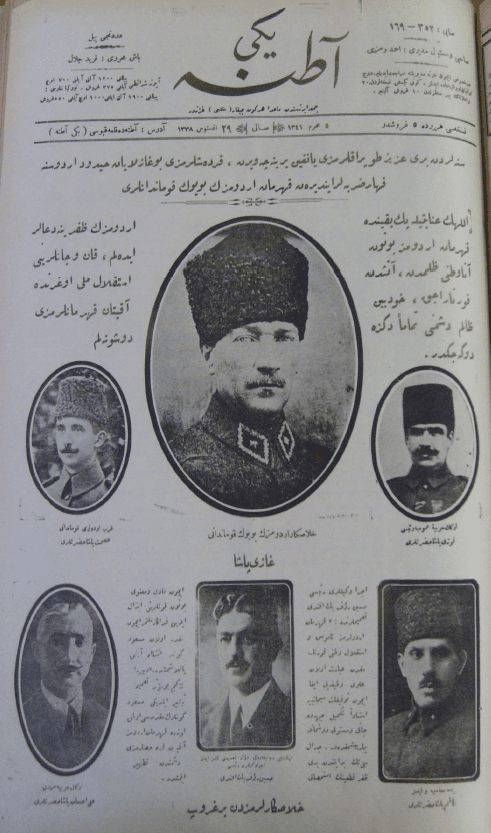
Reflection of the Great Offensive in the New Adana Newspaper (Uğur Üçüncü)
This two-day phase laid the foundation for the military situation leading to the decisive battle on 30 August.【10】 The breakthrough achieved in the enemy’s strongest sector enabled flanking encirclement and permanently disrupted logistical and communication networks. The pressure established by cavalry units in depth removed the rear area from its role as a “safe gathering zone”; thus, the operational tempo necessary for closing the encirclement on 28–29 August and achieving a conclusive result on 30 August was established.
With the capture of Afyonkarahisar and the dominant ridges southwest of it by the evening of 27 August, the continuity of the defense was broken, and the encirclement phase rapidly commenced on the morning of 28 August. The Cavalry Corps and the 2nd and 14th Divisions advanced north of the railway toward Ulucak and Eğret; the 2nd Division captured a motor convoy near Eğret, while the 1st Cavalry Division launched successive raids against Greek units withdrawing west from Ayvalı. The aim was to narrow the escape routes to the north and west.
During the morning hours of the same day, the First Corps attacked with the 23rd and 3rd Divisions around Köprülü and Bal Mahmut, pushing enemy concentrations northward; its right flank opened westward through Bulca–Düzağaç, while the 3rd Division advanced onto the Bakırcık ridges from the north of Düzağaç. The Fourth Corps, with the 5th Division toward Mezarlık from Bal Mahmut and the 11th Division toward Ayvalı–Kumralı (Kumarlı) Farm, squeezed forces attempting to withdraw westward. The area around Bal Mahmut Station became a particularly critical junction. Three heavy and two mountain guns captured along the road were seized (some had been destroyed by the enemy). Movement columns fleeing from the Resulbaba Ridge toward Başkimse were tracked.
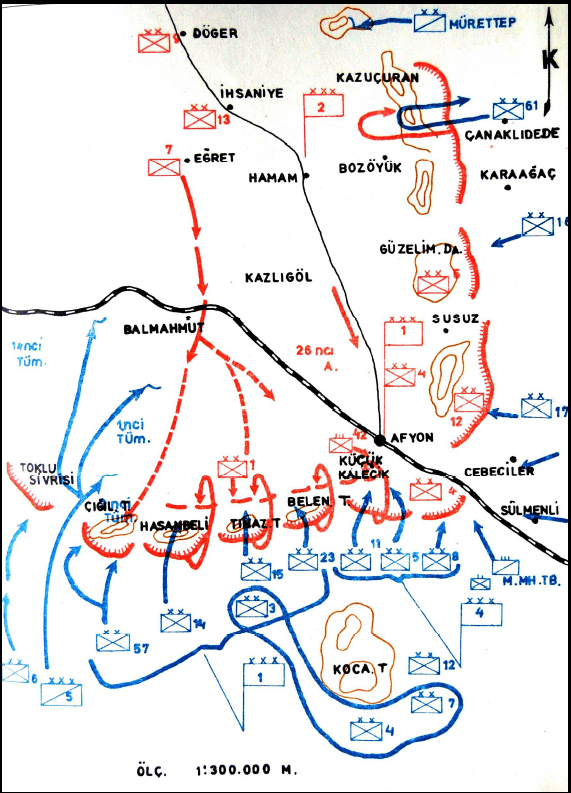
Situation on 26 August (Murat Bastem)
The First Corps directed the 14th Division into tight pursuit toward Akçaşehir, while the 3rd Division was moved closer to the 14th Division via Ayvalı; the 23rd and 15th Divisions were sent to Düzağaç, and the 57th Division to Çobanözü; the corps headquarters was established at Düzağaç.【11】 On the Fourth Corps side, the 11th Division was stationed at Akçaşehir, one regiment at Başkimse; the 5th Division at Yahya Boğazı, one regiment north of Oğlanmezarı; the 12th Division at the east of Ayvalı.
By midday, observations from Bakırcık Ridge identified a force equivalent to two divisions attempting to withdraw toward Dumlupınar via the Olucak–Hamurköy–Çalköy–Aslıhanlar line.
In response, the 5th, 11th, and 3rd Divisions of the Fourth Corps and the 23rd Division of the First Corps halted the withdrawal columns with flanking attacks; the 23rd Division advanced along the Kızılcaköy–Arpa Gediği direction, pushing forces near Bostancı Harabesi toward Aslıhanlar and blocking the Dumlupınar road. Intense battles raged until nightfall along the Kozluca Ridge–south slopes of Hamurköy–south slopes of Çalköy–Çeşme–south of Aslıhanlar’s Koru line; despite counterattack attempts, the defense was steadily pushed back.
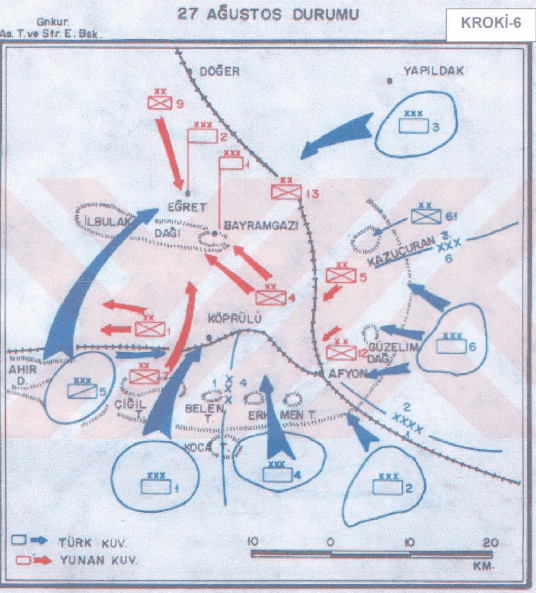
Situation on 27 August (Erhan Türksoy)
The encirclement arc also narrowed on the northeastern front of the Second Army.【12】 The five-kilometer report determined that Greek units had concentrated in the triangle of Manastepe–Hamurköy–Çalköy–Aslıhanlar west of Olucak and were likely to withdraw to Dumlupınar during the night; accordingly, the Fifth Cavalry Corps was ordered to descend southward with both divisions along the Cemilören (west of Büyük Aslıhanlar’s hill)–Aslıhanlar–Çalköy–Hamurköy line for a fierce pursuit. In the same framework, the 1st and 61st Divisions were expected to be deployed behind the enemy near Altıntaş.
On 29 August, the First Army’s mission was clearly defined as “completely blocking and halting the westward movement.” The First Corps, with the 3rd and 23rd Divisions, cut the escape axis toward Dumlupınar along the Çalköy–Aslıhanlar direction; its left flank, the 14th Division, advanced toward Elvan Paşa, and the 27th Division advanced toward Toklu Sivrisi, intensifying the squeeze. The 57th Division captured Kaplangı Mountain on the same day; the First Corps turned toward Kaplangı and Banaz to complete the encirclement west of Dumlupınar.
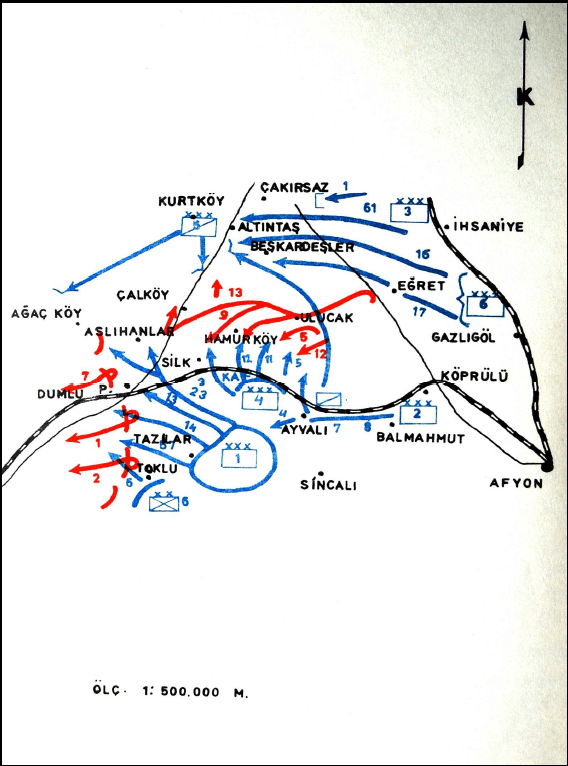
Situation on 28 August (Murat Bastem
Pressure continued through night bayonet assaults against the main force at Ulucak–Hamurköy–Aslıhanlar; from the northeast, the Second Army’s 17th Division struck at Ulucak, and the Cavalry Corps descended from the north of Hamurköy, inflicting morale-shattering losses.【13】 This situation surrounded Greek forces with the First Army to the south, the Second Army and cavalry units to the north and northeast; only a narrow corridor along the steep Kızıltaş Deresi remained open to the west.
Key junctions, stations, and straits became focal points. Seizures of artillery and vehicles around Bal Mahmut Station, control over the Yahya Boğazı and Oğlanmezarı north areas, holding the Ayvalı–Kumarlı Farm line, and occupying the Düzağaç–Bakırcık ridges progressively closed escape routes. The forward movement of corps headquarters along the Düzağaç–Ayvalı axis, frequent repositioning of forward artillery positions, and cavalry raids by the cavalry on Ulucak–Eğret maintained continuous fire and maneuver pressure on the encirclement arc.
Behind this two-day phase, logistical arteries had been pre-positioned to focus on Akşehir depot connections and the Kumrallı–Büyük Çobanlar–Afyonkarahisar line, enabling rapid relocation of forward depots; thus, the battle tempo was sustained without interruption.
In summary, 28–29 August constituted the intermediate phase in which the breakthrough successes south and southwest of Afyon had formed a closing encirclement arc before the Dumlupınar plateau, with escape routes choked at the Bal Mahmut–Ayvalı–Başkimse–Aslıhanlar–Çalköy–Hamurköy junctions. This tightening prepared the battlefield for the decisive battle of the Commander-in-Chief on the morning of 30 August.
Throughout the night of 29–30 August, the main Greek force concentrated in the Hamurköy–Çalköy–Aslıhanlar triangle attempted to break westward, which was met by the Western Front’s order for “complete encirclement and annihilation.” According to the plan, the First Army would apply pressure from the south, the Second Army from the northeast; while the Fourth Corps units (11th Division from south of Çalköy, 5th Division from northwest of Selkisaray, 23rd Division from north of Aslıhanlar, 3rd Division from Ağaçköy and north) launched the assault, the 16th Division of the Second Army and the 61st Division would attack from Çal and Esinören directions to press the trapped forces into the Adatepe area. The Cavalry Corps was ordered to cut off the escape route westward along the Kızıltaş Deresi–Saraycık–Belova line, aiming to leave no single escape corridor open toward Dumlupınar.
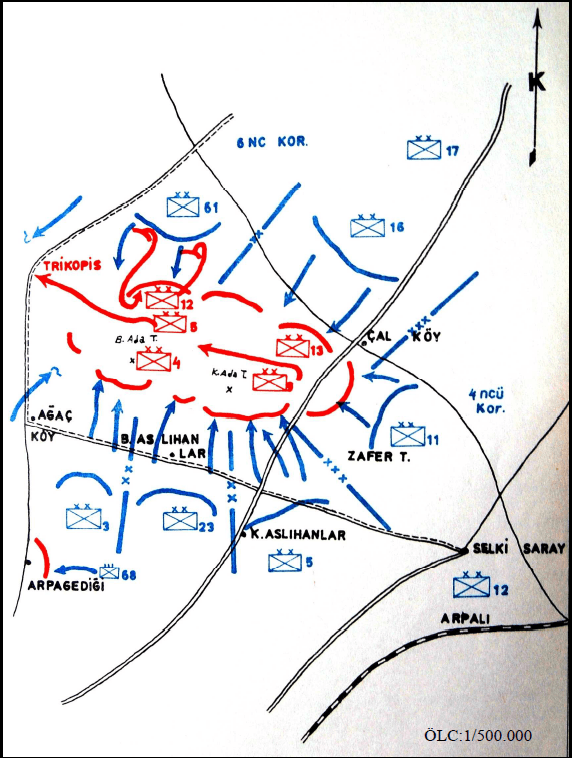
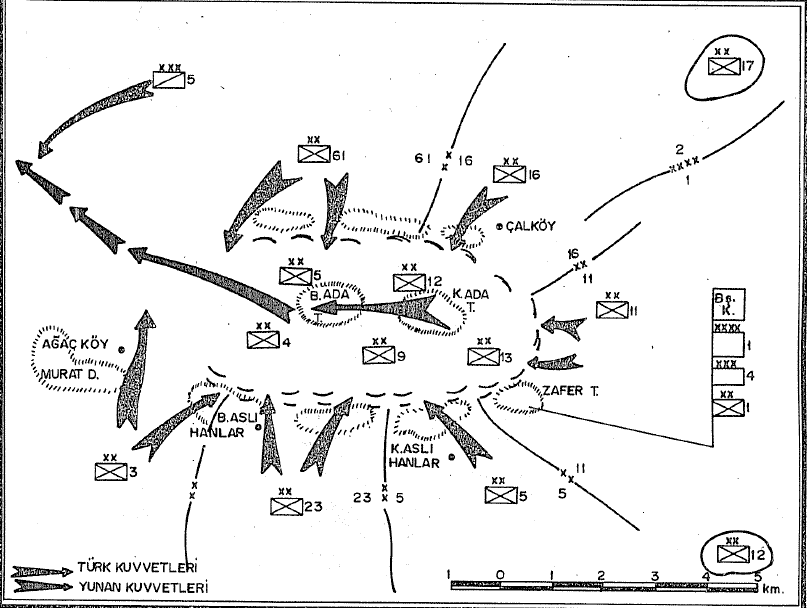
Position During the Commandership Battle (Murat Bastem
In the early morning hours, Greek forces attempting to advance toward Dumlupınar via Aslıhanlar were halted by the 23rd Division; as pressure increased from the northeast by the Second Army and from the south by the First Army, the encirclement narrowed.【14】 Along the same line, the 14th Cavalry Division continued its night assault momentum, inflicting heavy losses on escape columns around Çalköy. At this stage, apart from a narrow, steep corridor along the Kızıltaş Deresi, no escape route remained for the Greek side.
The turning point of the day was Commander-in-Chief Mustafa Kemal Pasha personally directing the battle from the front. At 15:30, Mustafa Kemal Pasha ascended Zafertepe, the observation post of the 11th Division, together with the commanders of the First Army and Fourth Corps. From there, it was observed that Greek forces had concentrated their weight in the center, facing four directions; the Fourth Corps had completed encirclement from east, south, and southwest; the Second Army’s 16th and 61st Divisions were positioned to the north. The 70th Regiment of the 11th Division was advancing rapidly, but terrain steepness and the need to align with the adjacent 5th Caucasian Division’s 9th Regiment slowed the assault.
The Commander-in-Chief’s order at 18:30 to the 5th Caucasian Division to “drive the enemy out with bayonet assault and absolutely capture Adatepe” spread rapidly by word of mouth; the 9th Regiment, after a brief artillery destruction fire, approached the Zafertepe–Örentepe line, captured Berberçam Hill, and forced Greek units in the area into retreat with heavy losses.
Pressure on the northern front deepened at the same time: the 3rd Division approached internal lines on Bakırcık ridges; the 57th Regiment bombarded the Hacettepe internal line all day with artillery; after night-long contact, the Kağşaktepe fortification east of Toklu was occupied. On the Fourth Corps axis, the 5th Caucasian Division advanced along the Oğlanmezarı–Damlar–Çalköy–Kızıltepe direction, the 11th Division occupied Başkimse–Adatepe, the 3rd Division occupied Arpalı–Bostancı Harabesi–Hasandede north and Arpa Gediği, and the 12th Division occupied Yahya Boğazı–Başkimse–Çeşme–Kaymak lines. This expansion gradually eliminated any possibility of enemy regrouping before Dumlupınar.
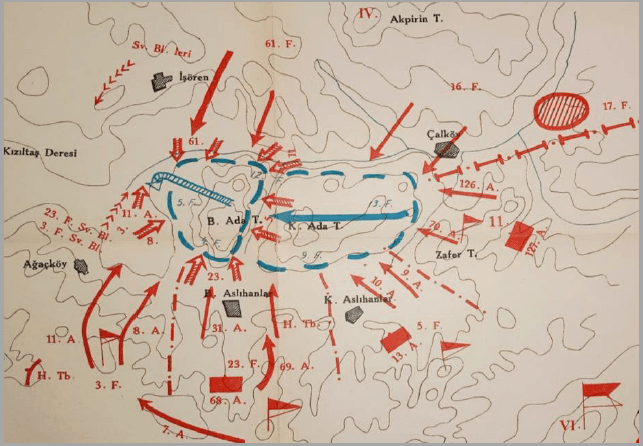
Encirclement of Greek Forces on 30 August (Temuçin Faik Ertan-Kadri Unat)
By the end of the day, Greek resistance around Toklu Sivrisi collapsed under pressure from two Turkish divisions from the rear and the 6th Division from the south; with the capture of Toklu Sivrisi, Turkish forces turned west toward Sultanoğlu, blocking the Dumlupınar road.【15】 General Franko’s attempt to support Trikopis was rendered ineffective due to this collapse. The Franko group (1st, 2nd, 4th, 7th, 12th Divisions and Plastiras detachment) was ultimately forced to withdraw toward the Hallaçlar–Kaplangı Mountain–Yenice line.
The situation in the rear accelerated the disintegration of the Greek army. Large quantities of ammunition, provisions, and equipment were abandoned along the Afyon and station lines; although some were destroyed, 30 wagons of provisions were captured at Bal Mahmut Station, aircraft were downed and destroyed at Garibce, telegraph–radio stations were eliminated, and depots containing forty thousand sacks of sugar were set on fire. Such destruction increased the disorder of the retreat and facilitated Turkish cavalry interdiction missions.
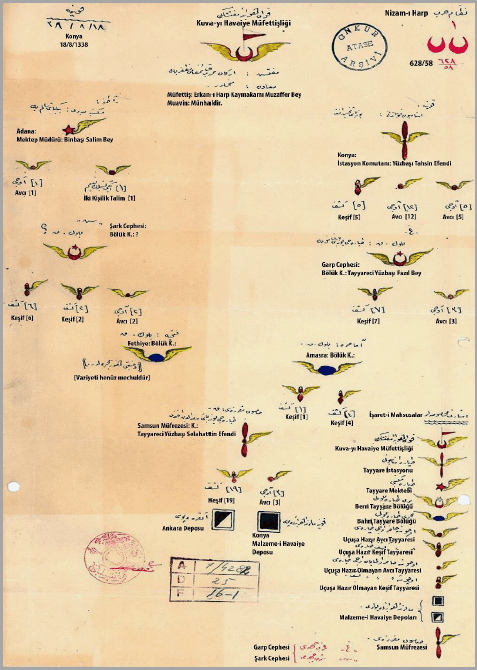
Document Showing Air Power and War Organization (Temuçin Faik Ertan-Kadri Unat
The overall result of the day was the closing of the encirclement in the Dumlupınar–Adatepe–Zafertepe triangle and the annihilation or entrapment of the majority of the Greek army in narrow, dangerous corridors.【16】 Mustafa Kemal Atatürk described the situation in his Nutuk as follows;
Gentlemen, on 26 and 27 August, that is, within two days, we overcame the enemy’s fortified front lines 50 kilometers south and 20–30 kilometers east of Karahisar. We encircled the entire forces of the defeated enemy around Aslıhanlar by 30 August. As a result of the battle we conducted on 30 August (known as the Commandership Battle), we annihilated and captured the enemy’s main forces. The enemy commander-in-chief, General Trikopis, was among the prisoners. Thus, the decisive outcome we envisioned was achieved in five days. On 31 August 1922, while our armies advanced toward İzmir with their main forces, other parts were moving to defeat the enemy forces stationed in Eskişehir and the north.【17】
Immediately after the decisive battle on 30 August, Commander-in-Chief Mustafa Kemal Pasha issued the order on 1 September: “Armies! Your first objective is the Aegean Sea. Forward!” Thus, the pursuit phase was conducted with an unrelenting tempo and a single objective. The Kütahya–Eskişehir–Uşak line was rapidly reclaimed; on the evening of 2 September, the commander of the Greek 1st Corps, Trikopis, the commander of the 2nd Corps, Diyenis, and their staff officers were captured near Uşak; this event greatly boosted Turkish public morale and accelerated the disintegration of the Greek army.
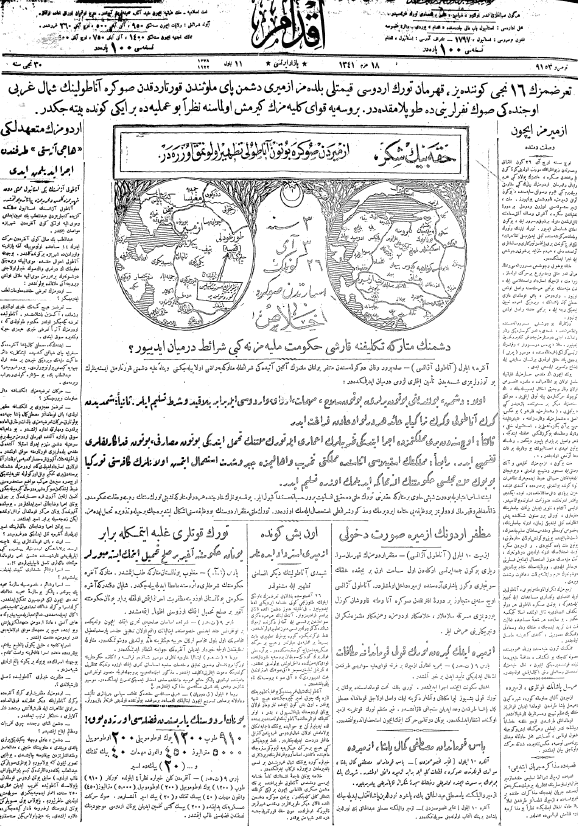
İkdam Newspaper Report on the Success of the Great Offensive ()
The pursuit axis extending west from Dumlupınar was operated along the Uşak–Eşme–Salihli–Akhisar–Turgutlu–İzmir line; Mustafa Kemal Pasha reported daily to the TBMM via telegraph on this advance and battlefield assessments.【18】 On the morning of 5 September, Salihli was entered, and the retreat route of withdrawing forces was secured.
The 1st and 14th Divisions of the Cavalry Corps under Fahrettin Altay advanced toward Salihli, while the 2nd Division advanced toward Salihli from the west of Alaşehir. Although Greek units attempted to hold positions along the Salihli–Ahmetli–Kasaba (Turgutlu) line, continuous Turkish pressure dispersed these temporary defenses; Mustafa Kemal Pasha reported on 6 September that movement was underway along the Eşme–Alaşehir–Salihli axis.
The successive recapture of cities on the northern and southern flanks tightened the encirclement. Manisa and surrounding districts (Akhisar, Kula, Alaşehir, Eşme, Salihli) were announced as under Turkish control in telegrams dated 5 September; on the same days, Nazilli (5 September) and Aydın (7 September) were liberated; Bilecik and Söğüt were also brought back under control on 4–5 September. Along this line, Greek rear units destroyed railways and bridges during their retreat, leaving widespread signs of burning and destruction in numerous settlements, especially Uşak.
Although Greek units attempted a final defense along the Alaşehir–Salihli–Kasaba–Kemalpaşa (Nif) line, persistent pursuit and flank pressure dissolved this line as well; scattered groups began to flee disorderly toward İzmir. During this period, control of railway junctions, raids on station and depot centers, and disruptions of telegraph lines completely eliminated the enemy’s ability to regroup.
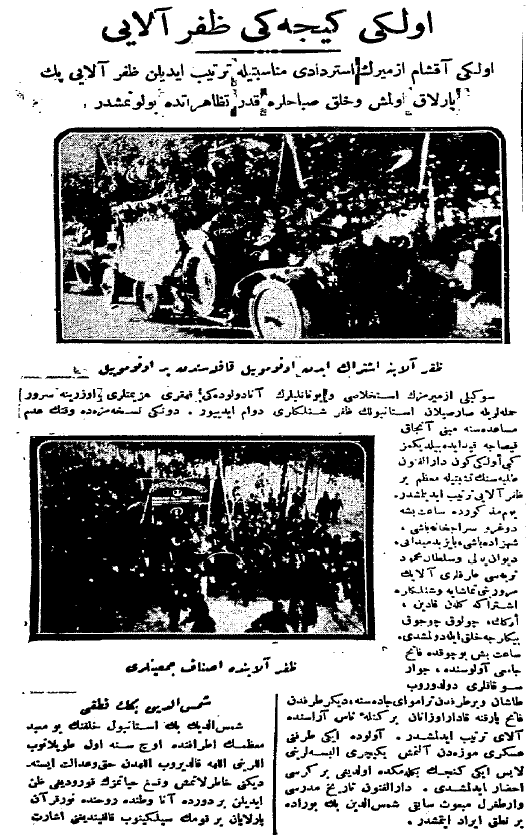
News Report on the Liberation of İzmir ()
On 9 September 1922, Turkish cavalry entered İzmir; the Turkish flag was raised on Kadifekale, and the Commander-in-Chief reported the city’s liberation to Ankara the same day.【19】 The telegram noted that the last resistance on the eastern slopes of İzmir had been broken and that enemy soldiers and officers attempting to board ships at the port had been captured. Mustafa Kemal Pasha moved to İzmir the next day (10 September) and assessed the situation with front and corps commanders at the government mansion.
The northern flank saw Bursa rapidly reclaimed; archival records highlight 9 September, but prior to this, the cleansing of the Aksu and Yenişehir (6 September) and İnegöl (7 September) lines completely eliminated any hope of Greek forces regrouping in the region. With the capture of Çeşme on the Aegean coast and Mudanya on the Marmara line, Greek forces concentrated along the Aegean and Marmara coasts were also eliminated. On 18 September 1922, the complete cleansing of Western Anatolia marked the end of the military phase of the Great Offensive.
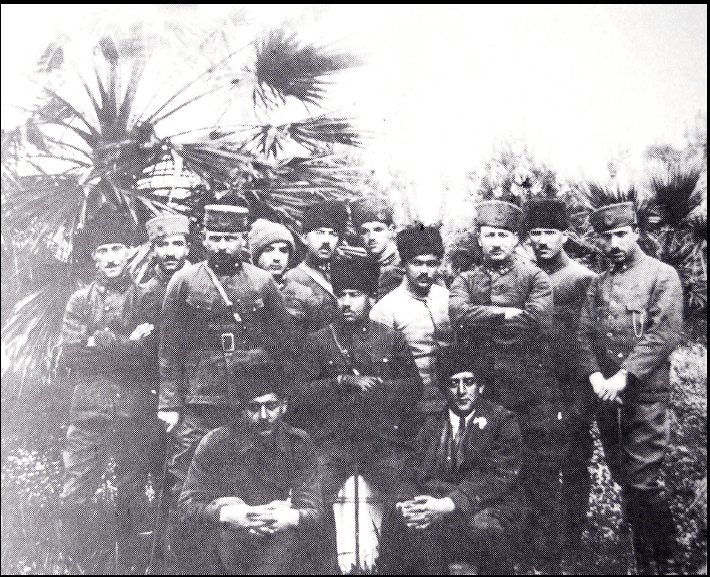
Director and Students of the Air War School Opened After the Liberation of İzmir (Murat Bastem)
The key factors determining the pursuit operations were speed, effective use of the terrain–railway spine, and uninterrupted communication.【20】 The Western Front’s logistical planning based on current reconnaissance reports was conducted alongside regular telegraphic reports to the TBMM; the rapid relocation of forward depots along the line from Dumlupınar to İzmir and the continuous pressure of the cavalry–infantry–artillery triad prevented the Greek army from establishing a new defensive line. Thus, the collapse that began on 30 August was transformed into a decisive victory across an expanding geography by 18 September.
The design of the Great Offensive focused on achieving a rapid result rather than prolonged attrition. For this purpose, clarity of objective (breakthrough on dominant ridges southwest of Afyon and decisive outcome before the Dumlupınar plateau), correct selection of the concentration center (Kocatepe–Tınaztepe–Kalecik Sivrisi–Belentepe–Çiğiltepe line), force conservation (diversionary pressure on flanks), maneuver (penetration into depth immediately after breakthrough), unified command (harmony of the Commander-in-Chief–General Staff–Western Front chain), security–secrecy (night concentration, phased movements), surprise, and timing principles were applied together.
Brief but precise artillery preparation, night approach marches, and continuous maintenance of the forward observer–battery line dismantled the defense from a continuous line into fragmented pieces; thanks to the wide observation and redundant communication (field telephone–radio) provided by Kocatepe, fire intensity and assault axes were managed with real-time adjustments. Breakthrough, encirclement, and immediate pursuit were integrated into a single operational rhythm with no delay permitted.
The Cavalry Corps was the key maneuver arm of the plan. Before the infantry assault began, it crossed the Ahır Mountains line to establish a free maneuver area behind the enemy; at the moment of breakthrough, it secured the flank and prevented enemy reserves from reinforcing the front. On 28–29 August, raids on stations and junctions such as Ulucak and Eğret, seizures at Bal Mahmut Station, and engagements on the Yahya Boğazı–Oğlanmezarı line narrowed escape corridors; successive strikes against the telegraph and railway spine choked command and supply flows.
On 30 August, as the encirclement closed, cavalry descended westward to cut the narrow “escape” corridor along the Kızıltaş Deresi; during the pursuit phase, it maintained continuous pressure along the Salihli–Turgutlu–Kemalpaşa axis, preventing scattered groups from regrouping before İzmir. Thus, the tactical success generated along the infantry–artillery axis was transformed into the strategic elimination of the enemy’s retreat.
Air assets, though limited in quantity, produced decisive effects in critical areas. Reconnaissance data on railway station loading–unloading activity, reserve troop movements, and depot–headquarters concentrations in the rear complemented ground reconnaissance reports; artillery target priorities were updated using this information.
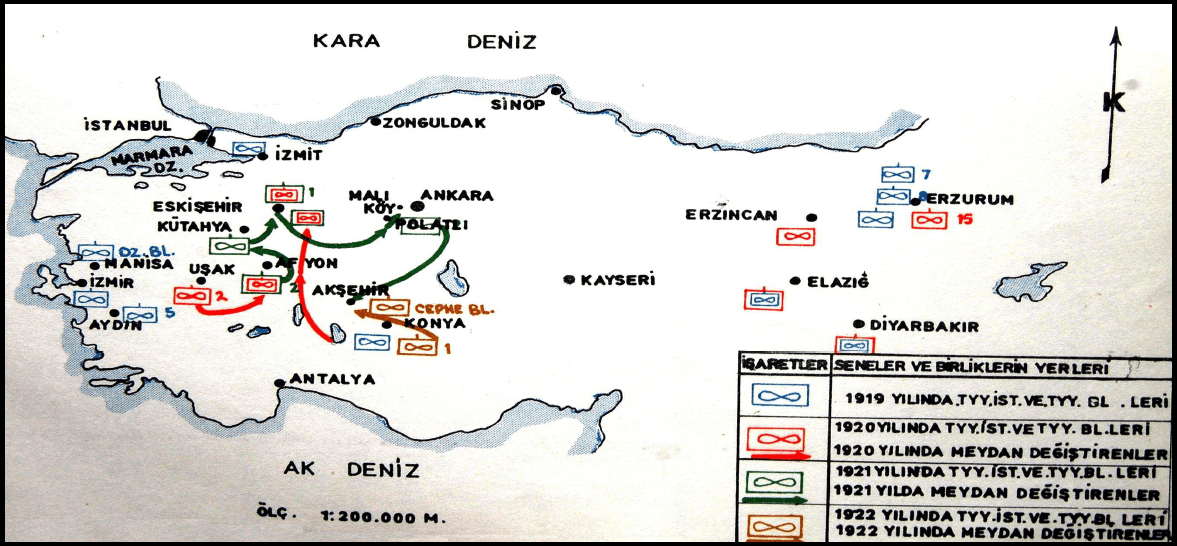
Status of Turkish Air Forces During the Great Offensive (Murat Bastem)
During offensive days, aerial observations provided data for the timing and location planning of cavalry raids; low-altitude harassment flights created psychological effects, particularly in narrow straits, disrupting the enemy’s retreat order.【21】 Ultimately, air power continuously supplied the “intelligence picture” that enhanced the accuracy of fire and the direction of maneuver; it contributed to preserving the temporal superiority required by a short-duration but high-impact operation.
The Great Offensive and the liberation of İzmir created an immediate alarm within the Allied bloc. The advance of Turkish forces toward the Marmara region and their approach to the boundaries of the “neutral zone” around the Straits generated significant concern among British occupation forces in Istanbul. During the same days, British and French press published increasing praise for Mustafa Kemal Pasha’s operational design and command performance, and correspondents were dispatched to Ankara and İzmir for direct contact. This wave of interest demonstrated that battlefield superiority had also been transferred to the diplomatic and public opinion arena.
In mid-September, the Çanakkale Crisis erupted. Between 10–30 September 1922, Turkish and British forces came close to direct contact around the Straits, while deep disagreements emerged within the London cabinet. Britain declared its determination to halt the Turkish advance; however, France and Italy avoided military involvement, and British dominions responded negatively to troop requests, leaving London diplomatically isolated. The crisis centered on the demand that the Turkish army not enter the “neutral” zone around the Straits and on how to manage the situation of Allied forces in that area.
In this pressure environment, Allied capitals attempted to establish a common line at the Paris meetings of 20–23 September 1922. The prepared note proposed inviting Turkey and Greece to a conference, suggesting the meeting be held in Venice or another city, demanding that Turkey refrain from sending troops to the neutral zone around the Straits until the conference concluded, and indicating that Eastern Thrace up to the Maritsa River could be accepted as belonging to Turkey; it was recommended that military details be addressed in İzmit or Mudanya. Thus, an intermediate formula emerged that acknowledged Turkish battlefield superiority while aiming to freeze tensions around the Straits.
The process quickly led to the Armistice of Mudanya. Negotiations, beginning with the arrival of the Greek delegation on 4 October, concluded on 11 October 1922 with the signing of the armistice text, and hostilities were halted from the night of 14–15 October. Although the Greek delegation hesitated at the initial signing, under Allied pressure and the battlefield situation, it accepted the agreement. Mudanya opened the path for the diplomatic recognition of military superiority.
On the international press front, two parallel trends emerged. Western press, particularly in September 1922, focused intensely on Mustafa Kemal and his operational design; Soviet press (Pravda and Izvestiya) interpreted the Turkish victory within the context of imperialist rivalry and sharply criticized Allied plans regarding the Straits; publications on 21 September carried headlines on Turkey’s firm stance against the Allies and the split between the French–Italian line and London.
The basis of the rapprochement between the Soviet Union and the TBMM Government was the perception of risk to Soviet security posed by Western states’ projections over the Straits and Anatolia. Moscow viewed the national resistance in Anatolia as a natural ally in the struggle against the West; this geopolitical reading nourished both diplomatic rapprochement and concrete assistance.
Indeed, relations were institutionalized with the Moscow Agreement of 16 March 1921; financial and military aid provided between 1921 and 1922 directly contributed to the Great Offensive preparations. Approximately 11 million rubles in financial support and commitments of arms and ammunition sufficient to equip two divisions were delivered to Anatolia, including shipments in March–April 1922. These resources were specifically planned for direct arms and ammunition supply and formed the external support pillar of the Tekâlif-based internal mobilization.
The Soviet press’s approach to the Great Offensive was consistent with this political framework. Pravda and Izvestiya, the two highest-circulation newspapers of the period, regularly followed the Turkish offensive and its outcomes. The editorial line developed around criticizing the Greek occupation and its “imperialist” backers and openly endorsing the Turkish victory. Izvestiya’s 20 August 1922 article titled “Greek Brutality in Turkey” extensively reported on events in occupied areas.
In subsequent issues, articles titled “Struggle for Istanbul” and “British Press and Current Situation” addressed the Straits issue, British attitudes, and divisions within the Allies (21 September 1922). Pravda published articles titled “Turkish–Greek War” on 6 September, “Reactions to Turkey’s Victory” on 14 September, and “Kemal Pasha’s Ultimatum to the Allies” on 21 September. This line produced a discourse that endorsed Turkish advances, criticized Allied plans, and consistently kept the Straits issue on the agenda.
The Soviet press did not limit itself to reporting events; the press’s function as an “indirect message channel between governments” became prominent in extraordinary times. In this context, during September 1922 evaluations, the Turkish victory was praised while divisions within the Allies were particularly framed as a split between the French–Italian line and British “adventurism”; claims over the Straits and Istanbul were continuously criticized. The general tendency was to support the Turkish struggle and welcome the Greek army’s departure from Anatolia while sharply questioning Western plans.
British and French newspapers initially published short telegrams and reporter notes confirming the Turkish offensive; in subsequent days, headlines highlighted Greek retreat, Mustafa Kemal Pasha’s command, and diplomatic tensions centered on the Straits. Press interest peaked with the liberation of İzmir; many newspapers dispatched special correspondents to Ankara and İzmir and sought direct interviews. In the same wave, American press debated the possible political consequences of the military victory. Greek press, meanwhile, initially used dismissive language and relied on the narrative of “orderly evacuation”; quickly, internal contradictions and conflicting narratives emerged.
London-based newspapers reported the start of the offensive repeatedly between 24–31 August: The Guardian “Reported Kemalist Move in Anatolia” (24 August), “Futile Diplomacy” (31 August); The Daily Telegraph “The Greek Defeat” (31 August), “Turkish Attacks in Asia Minor” (1 September); Daily Mail and Evening Standard carried news of Turkish advances and Greek retreats in their telegraph columns.
Headlines such as “Turks Take Vital Railway Centre” highlighted the importance of railway junctions. In the following days, British articles linked Turkish advances with diplomatic consequences (Allied divisions, the Straits issue); on 13 September, The Guardian emphasized France’s negotiation efforts. Overall, Mustafa Kemal Pasha’s plan and leadership were accepted even in enemy press; a race to dispatch correspondents to Ankara and İzmir was observed.
Paris newspapers followed both the main battlefield centers and diplomatic developments. Excelsior reported developments on 30 August with “L’armée grecque recule…”, on 3 September with “Les Turcs accentuent leur avance…”, and on 6 September with “La Situation à Smyrne”. Le Temps, Le Matin, Le Petit Parisien, and Le Rappel carried news of the military situation in Anatolia and expectations of the Paris–Venice conference. After the liberation of İzmir, reports on social unrest in Istanbul and public admiration for Mustafa Kemal Pasha also appeared.
Although there were differences in discourse between pro-government and Venizelist lines in the early days of the offensive, the common tendency was to present developments as an “insignificant initiative” to pacify public opinion. As the breakthrough around Afyon and the capture at Uşak became clear, explanations such as “orderly evacuation” and “precautionary withdrawal” were emphasized.
The press announced on 4 September that Trikopis had been appointed commander-in-chief, unaware that he had been captured on 2 September; this revealed the breakdown in information flow. Autonomy debates in the Aegean also rapidly faded after 26 August. Throughout the process, dismissive language and propaganda patterns were evident in Greek newspapers (including Politeia); however, as the battlefield collapse deepened, the discourse fragmented.
In the days following the liberation of İzmir, American newspapers focused on how the military victory might affect Turkey’s position in the regional and Islamic world. The New York Herald reported on the mass scenes in Istanbul and the admiration for Mustafa Kemal Pasha; The Bee (Virginia) drew a broad projection with the headline “Kemal Plans New Moslem Empire; Rout of Greeks is First Step” (14 September).
During the same period, The New York Times debated conflicting claims regarding the İzmir fire in successive reports. The general trend focused on the fractures triggered by the Turkish victory in Allied policy and regional balances, while journalistic teams were dispatched to the Aegean interior to assess the scale of destruction in Anatolia.
The Commandership Battle dissolved the Greek army’s front organization; the pursuit order (1 September) transformed the battle into a consecutive phase of annihilation and capture. Turkish units rapidly reclaimed the Kütahya–Uşak–Eskişehir line; on the evening of 2 September, the commander of the Greek 1st Corps, Nikolaos Trikopis, the commander of the 2nd Corps, Diyenis, and their staff officers were captured near Uşak; this event effectively dismantled the enemy’s command structure.
Pursuit applied pressure toward the Aegean by cutting off western escape corridors. By 8–9 September, the Turgutlu–Ödemiş line was cleared of the enemy; on the morning of 9 September 1922, Turkish cavalry entered İzmir. Bursa was also reclaimed the same day; remnants were squeezed onto Aegean coast piers. The cleansing operation continued to cover exit points such as Çeşme and Mudanya and ended on 18 September 1922 with the complete liberation of Western Anatolia.
Retired Greek Soldier’s Memory of Atatürk (Metin Yılmaz)
Abandonment and destruction in the rear clearly demonstrated the logistical collapse of the Greek army. Large quantities of ammunition, provisions, and equipment were abandoned at Afyon and along station lines; two aircraft were downed during attempted escapes, one was destroyed; telegraph–radio stations were demolished; depots containing forty thousand sacks of sugar were set on fire; 30 wagons of provisions were captured at Bal Mahmut Station. In Afyonkarahisar, 629 tons of coal were abandoned; in İzmir alone, by 10 September, 750 tons of dried fruit, 360 tons of flour, and sufficient footwear for the army were seized as spoils.
The total inventory of spoils and losses rapidly grew on the battlefield. Press reports on 8 September indicated that 284 artillery pieces, 1,400 automobiles, and 23 aircraft had been captured; thousands of prisoners and large quantities of machine and automatic rifles and equipment had been seized. Official telegrams and war reports, however, provided incremental figures for earlier days: 150–200 artillery pieces, 7 aircraft, and 400 trucks; due to speed and scale, the final count was evidently spread over several days.
In summary, the collapse of command after Dumlupınar (capture of Trikopis and staff), the cutting of escape corridors (İzmir–Bursa axis), and the collapse of logistical arteries (station–depot destruction and abandonment) rendered the Greek army incapable of establishing a new line; the military phase of the Great Offensive ended on 18 September 1922 with the complete liberation of Western Anatolia.
The Turkish superiority evident on the battlefield in September 1922 intensified tensions around the Straits and pushed Allied capitals toward an “armistice–negotiation” track. Although Britain defended a firm stance, France and Italy’s reluctance toward military involvement accelerated the shift of the crisis to diplomacy; Mudanya was proposed as the solution venue.
The Mudanya Conference was held between 3–11 October 1922; negotiations concluded on 11 October with the signing of the armistice text. Although the Greek delegation initially refused to sign citing “lack of authority,” under Allied pressure and the battlefield situation, it accepted the agreement on 14 October; hostilities were declared fully halted from the night of 14–15 October.
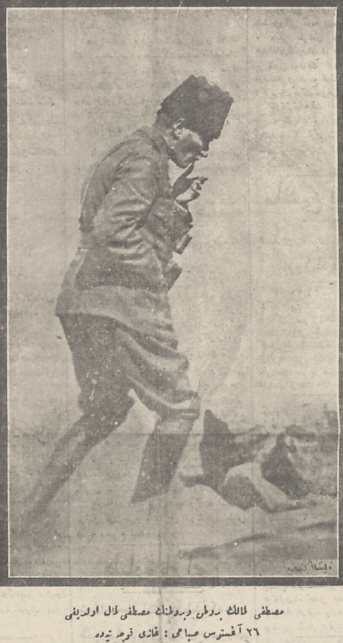
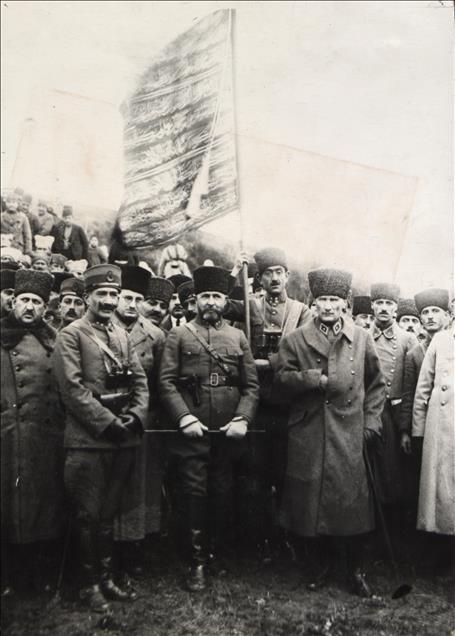
Gazi Mustafa Kemal Pasha at Kocatepe (Gürsoy Şahin)
The core of the armistice was the unopposed transfer of Eastern Thrace to Türkiye and the scheduling of administrative handover.【22】 Accordingly, Greek forces would withdraw west of the Maritsa River; administrative transfer would be completed by Turkish civil authorities within a specified period. The arrangement around the Straits was tied to the principle of “avoiding tension” until the peace conference; this meant freezing the battlefield superiority diplomatically.
The political outcome of Mudanya was the formal recognition of the TBMM Government as the sole legitimate interlocutor and the opening of the peace agenda. Negotiation authority was centralized in Ankara; Istanbul Government’s attempts to participate in the conference proved fruitless. Thus, Mudanya became the threshold to Lausanne: battlefield superiority was translated into diplomatic framework, the transfer of Eastern Thrace was completed before peace, and the Straits–Thrace dossier was transferred to Lausanne for final resolution.
The military outcome of the Great Offensive and the subsequent Armistice of Mudanya placed the Ankara Government as the sole legitimate interlocutor at the peace table; on 1 November 1922, the Sultanate was abolished. Thus, the dual power situation regarding the Ottoman State’s status ended; the path was opened for the construction of a nation-state centered on the TBMM.
On the same day, the Assembly took steps appropriate to the historical and symbolic importance of the decision. Motions submitted to the Assembly Presidency adopted the principle of celebrating the abolition of the Sultanate as a holiday, and it was decided that the decision would be announced to the public with cannon fire on the night of 1–2 November; the decision was proclaimed by a declaration. The law “on designating 12 Rebiyülevvel night and day as a national holiday” was adopted on 24 October 1923, completing the process.
The Great Offensive created a rupture that transformed not only the military balance but also global perception. Official and semi-official texts emphasized that the victory served as an inspiration for “nations under colonial rule by Western states”; the narrative that Muslim communities worldwide celebrated it as “the noblest victory of Islam over Christianity, the East over the West, Asia over Europe” became embedded in early republican memory.
This “example” discourse was prominent in the rhetoric of the era’s writers.
In press coverage, unexpected effects emerged in Central Europe and the Balkans. Hungarian public opinion and press (influenced by the political trauma of Trianon) approached the Turkish independence struggle with sympathy; writings that portrayed “Turkish success” as both military genius and political will strengthened the impact of the National Struggle in Europe.
In Balkan press, Belgrade-based Politika began carrying news of the Greek defeat around Afyon from late August; Muslim media outlets in Skopje and Sarajevo (Hak, Pravda) assessed that the Turkish initiative and its outcomes had enhanced negotiation power at Lausanne. In this context, the interpretation emerged that the Dumlupınar defeat was the continuation of the failed Turkish effort at Sakarya in 1921 and had elevated the Turks at the peace table.
Soviet circles’ congratulations and accompanying discourse reinforced the interpretation of the victory as an anti-imperialist achievement. Russian representatives and consulates’ participation in victory celebrations and their statements that “Russia viewed the Turkish National Struggle as its own” merged with broader narratives.
On the other hand, Western press closely monitored developments at the Mudanya and Lausanne thresholds; despite counter-propaganda generated around the İzmir fire, the general trend evolved into an acceptance that Turkish battlefield superiority had produced political consequences.
During the pursuit operations, retreating Greek units left widespread destruction along station and depot centers. Large quantities of ammunition, provisions, and equipment were abandoned at Afyon and along station lines; two aircraft were downed during attempted escapes, one was destroyed; telegraph–radio stations were demolished; depots containing forty thousand sacks of sugar were set on fire; 30 wagons of provisions were abandoned at Bal Mahmut Station.
The civilian toll of occupation and retreat was heavy. In Eskişehir, cases of looting and pillaging were reported; in the Uşak–Manisa–Kasaba (Turgutlu) line, forced seizures and killings were documented. In Eskişehir, widespread looting caused losses of millions of liras; large quantities of grain, livestock, and vehicles were seized from villages and towns; in Bursa and its surroundings, forced seizures of money and property were recorded.
The Aydın Sanjak was one of the regions with the highest material damage. Losses amounted to 59 million liras in immovable property, 111 million liras in movable property, and 4 million liras in livestock, totaling 174 million liras. After liberation, the TBMM dispatched health and relief teams through the Red Crescent to establish distribution centers, clinics, and pharmacies in Aydın, Nazilli, and Germencik (23 September 1922; team leader Operatör Dr. Kemal Bey).
The military collapse also created a social upheaval on the other side. As of 18 September 1922, with the cleansing of Western Anatolia, Greece faced a massive influx of refugees, adding to its already collapsed economy.
Tekâlif-i Milliye was a mobilization mechanism that met the army’s final-phase needs through “domestic resources, with payment to be made later.” The principles were temporary seizure of forty percent of household grain and fuel stocks, provision of one set of underwear–socks–sandals per household, and monthly transport services up to 100 kilometers; the principle of “participation proportional to capacity” was particularly emphasized.
Although individuals violating orders were warned by İstiklâl Courts, forced use was rare and limited to individual cases; local participation was the decisive factor. The figures of the first collection wave demonstrated the scale of mobilization: 16,703 tons of wheat, 14,074 tons of barley, 224 tons of sugar; 426,609 shirts, 452,672 undershirts, 334,934 pairs of sandals, 363,285 pairs of socks; 14,738 ox carts, 38,434 oxen/bulls, 3,975 donkeys.【23】
Mobilization was integrated with the logistical–transportation network. The Ministry of Finance allocated 60,000 liras weekly to the Western Front, provided 30,000 liras in advance to the Levazım Directorate for station purchases, and mandated cash payments for acquisitions; the Şereflikoçhisar–Aksaray–Niğde commissions were obligated to deliver at least 15 tons of grain daily along the Konya line; the daily flour allocation was set at a minimum of 5 tons. These provisions ensured the flow’s order. Grain transfers by sea from coastal and inland warehouses to Mersin, barley–wheat exchanges from livas such as Niğde–Aksaray to the front line, and advance payments to each liva (for the first 15 days) were also planned.
The social solidarity dimension of mobilization was also evident: campaigns for donations were organized in Istanbul and many parts of Anatolia through Red Crescent appeals; some places held auctions and daily revenue donations; cash donations flowed from the Balkans and the Middle East (Şumnu, Kızanlık, Şam, Trablusşam, etc.).
The first official commemoration of 30 August was held on Saturday, 30 August 1924, near Dumlupınar–Çal village, two years after the war. Due to the intense agenda of 1923 (Lausanne, evacuation of Istanbul, capital relocation to Ankara, proclamation of the Republic), the ceremony was delayed by two years. Hâkimiyet-i Milliye was the first to inform public opinion, announcing on 12 August 1924 that “this year, for the first time, a ceremony will be held.”
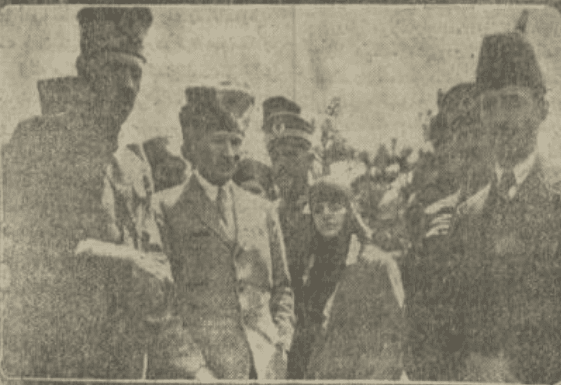
Gazi Mustafa Kemal Pasha and His Wife Latife Hanım Before the Unknown Soldier’s Grave (Çiğdem Dumanlı-Emre Saral)
Ceremony preparations were handled by the government and military high command.【24】 On 9 August, Chief of the General Staff Fevzi Pasha, Minister of National Defense Kâzım Pasha, and Minister of Education Vasıf Bey jointly determined the program. The main skeleton of the program presented to the Council of Ministers was published in newspapers that same month. Special trains were mobilized from Ankara, Istanbul, and İzmir to Dumlupınar; tickets were offered at a fifty percent discount. The program’s start time was announced as 14:00.
The official program was as follows: The opening address would be delivered by Chief of the General Staff Fevzi (Çakmak) Pasha, followed by the laying of the foundation stone for the Unknown Soldier Monument and statue. Speakers representing Istanbul Darülfünunu (University), press, Turkish Hearths, Turkish Teachers Union, Turkish Sports Clubs Union, Red Crescent, and bar associations would deliver ceremonial speeches; Fethi (Okyar) Bey, President of the TBMM, would speak on behalf of the Turkish people; the closing address would be delivered by President Gazi Mustafa Kemal. The ceremony would conclude with a formal parade.
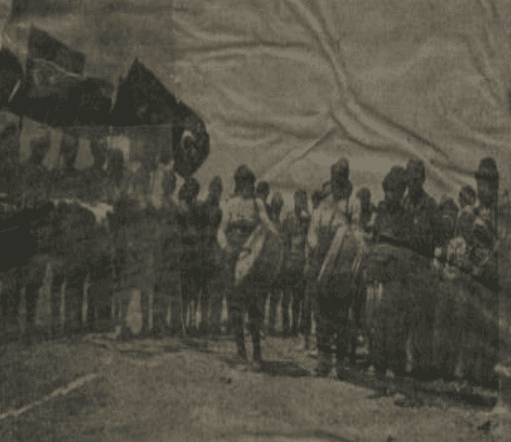
Dumlupınar Victory Celebrations (Çiğdem Dumanlı-Emre Saral)
Mustafa Kemal Pasha traveled to Dumlupınar with his wife Latife Hanım on 29 August for the ceremony.【25】 In his speech on 30 August, he described the Commandership Battle as a turning point in Turkish history. Attendance was broad and diverse. Overnight receptions were held from Eskişehir; people arriving by automobile, truck, and ox cart from different cities including Konya and İzmir waited for the ceremony in tents they had previously set up. The crowds assembled for this first official ceremony were documented in press drawings and sketches.
Cumhuriyet and Vatan newspapers carried photographs of Mustafa Kemal and Fevzi Pasha on their front pages on 30–31 August; praise was given to cavalry and artillery units. Tevhid-i Efkâr published on 31 August both the Pasha’s cavalry inspection and the symbolic drawings from the previous year; in the following days, crowd compositions and ceremony sketches were shared.
The status of 30 August as a “national holiday” was formally established by Law No. 795, adopted by the TBMM on 1 April 1926 and published in the Official Gazette on 12 April 1926. Article 1 of the law states: “The day of 30 August, which secured the decisive victory in the War of Independence, is the Victory Day of the Republic’s army and navy.” Article 2 specifies that the holiday shall be celebrated annually by land, sea, and air forces; additional military ceremonies shall be held in Dumlupınar according to the Ministry of National Defense program; and all offices and schools shall be closed on this day. Article 3 concerns enforcement, and Article 4 concerns implementation.
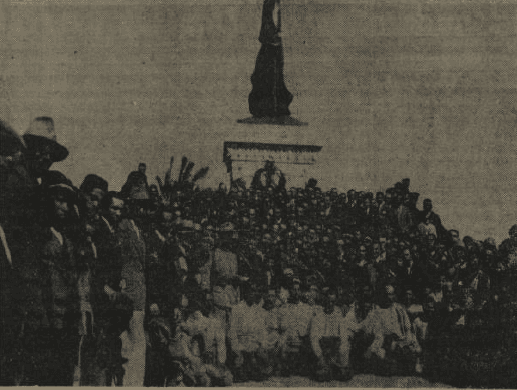
Delegations from Different Cities Before the Unknown Soldier Monument (Çiğdem Dumanlı-Emre Saral)
During parliamentary debates, the initial text defined 30 August primarily as an “army holiday,” prompting debate.【26】 Deputy Hakkı Bey from Van argued that the victory belonged not only to the army but to the entire nation and therefore the scope should be expanded; accordingly, the phrase “...additional military ceremonies shall be held in Dumlupınar and all offices and schools shall be closed on this day” was added to Article 2. Thus, 30 August was legally defined as a national holiday involving the participation of all citizens.
The law’s adoption was followed by an implementation framework. On 25 August 1926, a decree signed by the Council of Ministers under the presidency of Gazi Mustafa Kemal published the “Program for Military and Ceremonial Observances of 30 August Victory Day”; on 26 August 1926, Minister of National Defense Recep Peker issued a circular to relevant authorities.
The program designated the area around the Unknown Soldier Monument in Dumlupınar as the ceremony site; it foresaw the ceremony to be conducted under the supervision of the regional military inspector, facilitated transportation and provisioning for participants, and mandated a 21-gun salute at the opening. These same principles guided ceremonies across the country.
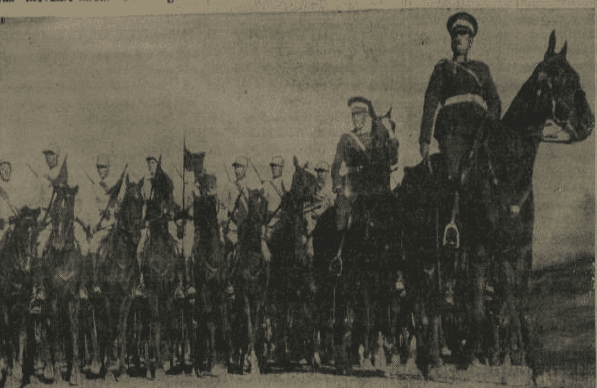
Cavalry Parade at Dumlupınar Celebrations (Çiğdem Dumanlı-Emre Saral)
The 1935 “Law on National Holidays and General Holidays” redefined 30 August as “the day the final victory of the War of Independence was won” and reiterated that observances would follow the Ministry of National Defense program; this text omitted any specific reference to Dumlupınar.【27】 Thus, the 1926 foundational framework was standardized within the general calendar by the 1935 codification.
In summary, the 1926 arrangement institutionalized 30 August both legally and ceremonially: it anchored the victory in the sacrifice of the army and defined it as the nation’s shared holiday; it established Dumlupınar as the central commemorative site; and it set nationwide holiday and official ceremony standards. This framework directed commemorative practices in subsequent years.
In early republican commemorative calendars, the linkage of 30 August with aviation was permanently established through initiatives of the Turkish Aeronautical Association (TTC). The Association first adopted 31 August, the day after the Commander-in-Chief anniversary, as “Turkish Aviation Day.”
Subsequently, in accordance with the 25 August 1926 decision of the Council of Ministers, the principle was adopted that ceremonies would be held on the same day as the 30 August Victory Day and that the TTC would participate jointly in celebrations. The 1935 “Law on National Holidays and General Holidays” retained only the name “Victory Day” in legislation; however, the phrase “Victory and Aviation Day” remained in public and press usage for a long time.
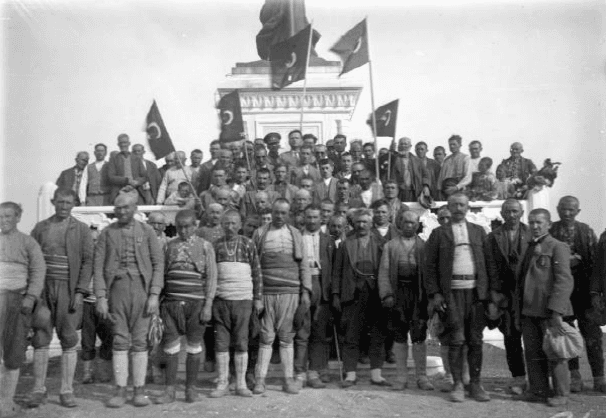
Dumlupınar Victory Celebrations (Çiğdem Dumanlı-Emre Saral)
The TTC declared the period from 30 August to 5 September as “Aviation Week” to popularize aviation culture and raise funds through donations.【28】 Throughout the week, circumcision celebrations, balls, concerts, cinema–theater performances, and sports competitions were organized; entertainment and donations were combined in the same framework.
Istanbul served as the showcase of this social mobilization. Signs reading “Today’s earnings belong to the Turkish Aeronautical Association” were hung in shop windows; thousands of merchants donated the day’s revenue to the Association. The press emphasized that the joint celebration of Victory Day and Aviation Day “enlarged the day’s meaning.”
In Ankara, military–civil protocol combined with “flying displays”: after official greetings at Sarı Kışla, nearly twenty aircraft flew in formation into the city; TTC thank-you declarations and aviation badges were distributed from the air; high state officials attended the Association’s official reception, and medals were awarded to donors.
In the provinces, the triad of donation–education–display was implemented in the same style. In Kütahya, speeches before the Military Branch building emphasized that “the airplane is the future battlefield”; the revenue from evening performances in the municipal park was transferred to the TTC. In Ayaş, an hour-long auction raised 378 liras; in Haymana, arrangements generated 1,000 liras; in centers like Gümüşhacıköy and Zonguldak, all businesses donated their entire day’s earnings to the Association.
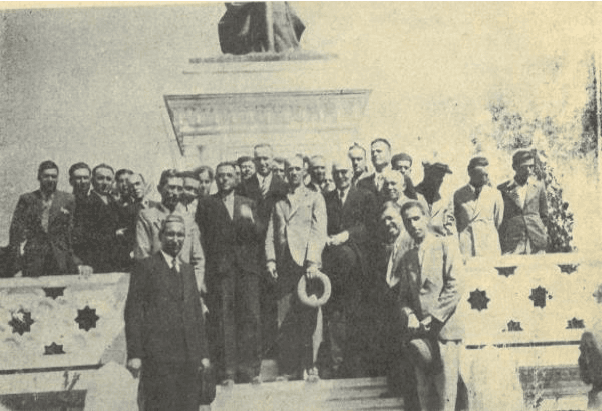
Kütahya Governor and Delegation Before the Monument (Çiğdem Dumanlı-Emre Saral)
Visual culture in the 1930s demonstrated that Victory and Aviation Day had become a major urban ritual.【29】 In 1933, newspapers published photographs of official parades and air displays together; in 1934, Victory/Aviation celebrations became part of the same narrative universe as other “progress” anniversaries such as the 100th anniversary of Harbiye and the 10th anniversary of İş Bankası; aircraft models on trucks visualized the aviation emphasis.
During this period, donation campaigns were formalized into platforms. The press announced in 1931 that 37 and in 1932 that 40 aircraft had been donated to the army by the nation, popularizing the idea that “the skies are also a battlefield.” Thus, 30 August became not only the anniversary of the “final victory” but also a source of funding for national aviation.
In the early years of the Republic, 30 August became both an official ceremony and a broad civic duty. The program’s fixed elements included recounting the stages of the Commandership Battle, speeches by commanders and guests, poetry and orations, placing wreaths at the Unknown Soldier/Comrade Monument in Dumlupınar, prayers for martyrs, and honoring veterans; additionally, parades with air force formations and military parades were included. Within this framework, emphasis was placed on gratitude toward the commander of the victory, martyrs, and veterans; trust in the army and loyalty to the republican ideal.
The legal–organizational foundation of the celebrations was solidified by the 1926 Victory Day Law and subsequent implementation programs. The law mandated that the holiday be celebrated annually by land, sea, and air forces; additional official ceremonies be held in Dumlupınar; and all offices and schools be closed on this day. Subsequent decrees and circulars detailed the ceremony procedures. The area around the Unknown Soldier Monument was designated as the ceremony site, a 21-gun salute was mandated at the opening, and facilitation of transportation and provisioning for participants became fundamental principles.
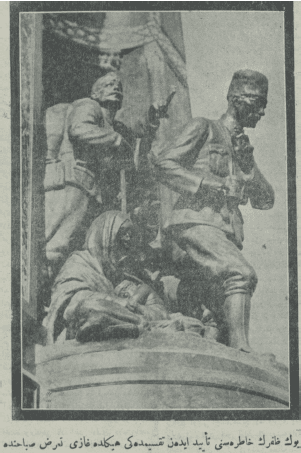
Monument Erected to Commemorate the Great Offensive (Gürsoy Şahin)
Public participation expanded the meaning of the celebrations.【30】 In the ceremonial language of the era, Dumlupınar and the Unknown Soldier Monument increasingly acquired a “national shrine” atmosphere; from officers to members of parliament, from administrators to Istanbul University professors, from teachers and students to merchants and laborers, from party–association representatives to villagers and urban dwellers, men and women, young and old, all participated in a shared emotional space.
The selection of Dumlupınar/Çalköy as the strategic node of the war and the establishment of the Unknown Soldier/Comrade Monument in 1924 crystallized the memory of the victory into a concrete geography. This choice united the triad of martyrdom–victory–republic in a single scene, making commemoration enduring.
The press, through drawings and photographs combining the monument and Mustafa Kemal, imprinted the leadership and sacrifice dimensions of the victory into a single symbol; some pages depicted naval inspections and acts of reverence before the Unknown Soldier Grave as primary images embodying “army–nation” unity. Thus, 30 August became a holiday generating a broad shared memory language through both the founding leader and the anonymous hero figure.
In summary, in early republican practice, 30 August was established as a national holiday with a solid legal foundation, distinct ritual steps, and powerful spatial and visual symbols. Ceremony forms standardized around the “knowledge–respect–gratitude–parade” sequence; Dumlupınar and the Unknown Soldier Monument became the central commemorative stage of the Republic.
Today’s perception and ceremonial practice of 30 August are a continuation of the legal–organizational framework established by the 1926 Victory Day Law and the 1935 Law on National Holidays and General Holidays. The 1926 arrangement mandated that the holiday be celebrated by land, sea, and air forces, that a general holiday be observed nationwide, and that additional ceremonies be held in Dumlupınar; the 1935 codification defined 30 August as “the day the final victory of the War of Independence was won” and standardized ceremonies according to the Ministry of National Defense program, also designating 30 August to 5 September as “Victory Week.” This dual foundation has been the primary support transforming 30 August into a lasting ritual in both official and civil spheres.
The ritual’s form continues the early standards. Acceptance of greetings, speeches on the meaning and importance of the day, official parades, decoration of the city’s main spaces with flags, and broad public participation are the contemporary manifestations of the “protocol–speech–parade” sequence established by the 1926 circular. In Istanbul, this continuity is especially visible. The historical venues of the celebrations have shifted between Taksim and Beyazıt Squares, and today the official ceremony is still held at Taksim Square. The sequence of accepting greetings at the corps/army headquarters, followed by speeches in the square and the parade; the detailed routes and security plans ensuring crowd flow and order, are characteristic of the established ceremonial architecture.
Official Protocol of Victory Day Celebrations (Anka)
Dumlupınar remains the fixed center of the meaning map. Ceremonies held since 1926 around the Unknown Soldier Monument have been conducted every year with official and private participation from all corners of the country; Dumlupınar has become a memory space uniting victory, martyrdom, and republic. This spatial anchor continues to nourish the symbolic narrative of 30 August in contemporary commemorations.
In terms of social function, 30 August assumes the general role of official holidays. By recalling the transformative threshold of recent history, it sustains collective memory, makes the “army–nation” bond visible, and expands shared values and spaces. In this sense, Victory Day is not merely the anniversary of a military turning point but also a civic ritual that facilitates the definition and transmission of values to new generations.
Anka Haber Ajansı. "TBMM 30 Ağustos Zafer Bayramı Kutlama Programı." YouTube. Accessed August 29, 2025. https://www.youtube.com/watch?v=1Tv71i4Uy6w.
Atatürk, Mustafa Kemal. *Nutuk.* 1st ed. Istanbul: Kaynak Yayınları, September 2015. General Publication Director: Şule Perinçek; Editors: Nejat Bayramoğlu, Kurtuluş Güran; Translators: Ercüment Hüsnü Baki, Yücel Demirel, Ahmet Hezarfen, Sadık Perinçek, Musa Sankaya. Accessed August 29, 2025. https://archive.org/details/mustafa-kemal-ataturk-nutuk-orijinal-metin/page/n5/mode/2up.
Audiovisual Sources
Bastem, Murat. *Büyük Taarruzda Hava Muharebeleri.* Master's thesis, Afyon Kocatepe University Institute of Social Sciences, 2010. Advisor: Yrd. Doç. Dr. Abdurrahman Ateş. Accessed August 29, 2025. https://tez.yok.gov.tr/UlusalTezMerkezi/tezDetay.jsp?id=wTE2dd1lCKY0ZC_xrVONBA&no=9C8Xb4a3pgj8_Ew9-mbuPA.
Bayındır Uluskan, Seda, Levent Kuru, Atakan Esen, and Erdal Aydın, eds. *Büyük Taarruz: 100’üncü Yıl Dönümünde Türk’ün Zafere Yürüyüşü.* Istanbul: Milli Savunma Üniversitesi Merkez Basım ve Yayınevi, 2022. Accessed August 29, 2025. https://msu.edu.tr/docs/FatihHATEN/.
Belen, Fahri. “Büyük Taarruz.” *Belgelerle Türk Tarihi Dergisi* 18 (August 1986). Accessed August 29, 2025. https://isamveri.org/pdfsbv/D00521/1986_18/1986_18_BELENF.pdf.
Cumhuriyet. "Tekâlif-i Milliye nedir?" YouTube. Accessed August 29, 2025. https://www.youtube.com/watch?v=HdAVzeaFd7Q.
Doğanay, Rahmi, and Ahmet Çelik. “Büyük Taarruz ve Sonuçlarının Dönemin Sovyet Rusya Basınında Ele Alınışı.” Bildiri, XIX. Türk Tarih Kongresi, October 10, 2023. Accessed August 29, 2025. https://ttk.gov.tr/wp-content/uploads/2024/06/177-RahmiDoganay-AhmetCelik.pdf.
Dumanlı, Çiğdem, and Emre Saral, eds. *Sakarya’dan Büyük Taarruz’a 100. Yılında Başkomutanlık Meydan Muharebesi.* Ankara: Hacettepe Üniversitesi Atatürk İlkeleri ve İnkılâp Tarihi Enstitüsü ve Polatlı Belediyesi işbirliğiyle, 1st ed., 2022. Accessed August 29, 2025. https://buyuktaarruz.hacettepe.edu.tr/PolatliSempozyumKitabi_2022.pdf.
Ertan, Temuçin Faik, and Kadri Unat, eds. *100. Yılında Büyük Taarruz.* Ankara: Ankara Üniversitesi Yayınları, 2022. (Ankara Üniversitesi Yayınları No. 769; Türk İnkılap Tarihi Enstitüsü Yayınları No. 68). Accessed August 29, 2025. https://tite.ankara.edu.tr/wp-content/uploads/sites/154/2023/01/100.-YILINDA-BUYUK-TAARRUZ.pdf.
Gök, Hacı Veli. “30 Ağustos Zaferinin İlk Resmî Töreni ve Cumhuriyetin İlk On Yılında Büyük Zaferin Yıldönümleri: İstanbul Örneği.” *Avrasya Uluslararası Araştırmalar Dergisi* 9, no. 29 (December 2021): 165–186. Accessed August 29, 2025. https://www.researchgate.net/publication/357330265.
Görgülü, İsmet. *Büyük Taarruz*. Ankara: Genelkurmay Basımevi, 1992. (Genelkurmay Basımevi Publication No. 92/59). Accessed August 29, 2025. https://www.msb.gov.tr/Content/Upload/Docs/askeritariharsiv/buyuktaaruz.pdf.
Habertürk TV. "Gün gün Büyük Taarruz... Ordu sayıları, taktik özellikleri..." YouTube. Accessed August 29, 2025. https://www.youtube.com/watch?v=OUq27GUIVbs.
Kurnaz Şahin, Feyza. “Büyük Taarruz’un Kazanılmasının İngiliz Prestij Faktörüne Etkileri [The Effects of the Winning of the Great Offensive on the English Prestige Factor].” *Afyon Kocatepe Üniversitesi Sosyal Bilimler Dergisi* 24, no. “100. Yılında Kocatepe-Büyük Taarruz” Özel Sayısı (November 2022): 108–128. Accessed August 29, 2025. https://www.academia.edu/94572373/.
Metin Yılmaz. "Yunan askerin Atatürk anısı: 'Türklerden Ne İstediniz?'" YouTube. Accessed August 29, 2025. https://www.youtube.com/watch?v=EdvTZywu8CI.
Prof. Dr. Ekrem Buğra Ekinci. "Tekâlif-i Milliye ve Harb Vergileri - Ekrem Buğra Ekinci." YouTube. Accessed August 29, 2025. https://www.youtube.com/watch?v=Vp-RfVq56gY.
RUBASAM. "Büyük Taarruz Dünyanın En Büyük İstihbarat Operasyonudur." YouTube. Accessed August 29, 2025. https://www.youtube.com/watch?v=tNAgvFiaddE.
Research Works
Sarısaman, Sadık, and Uğur Üçüncü. “Arşiv Belgelerine Göre Büyük Taarruz.” *Tarih Okulu Dergisi (Journal of History School)* 9, no. XXV (March 2016): 269–310. Accessed August 29, 2025. https://johschool.com/?mod=tammetin&makaleadi=&makaleurl=540641640_U%C4%9EUR%20%C3%9C%C3%87%C3%9CNC%C3%9C-SADIK%20SARISAMAN.pdf&key=24132.
Sayılır, Burhan. “30 Ağustos Zafer Bayramı Kanunu, İlk Zafer Kutlaması ve Büyük Taarruz ile İlgili Bazı Bilgiler.” *Çanakkale Araştırmaları Türk Yıllığı* 12, no. 16 (Spring 2014): 89–114. Accessed August 29, 2025. https://dergipark.org.tr/tr/download/article-file/45137.
Selim Erdoğan. "COĞRAFYA ve MUHAREBE - Sakarya Meydan Muharebesi ve Büyük Taarruz Örnekleriyle Harp Coğrafyası." YouTube. Accessed August 29, 2025. https://www.youtube.com/watch?v=ZknS1hypmqo.
T.C. Millî Savunma Bakanlığı. "Büyük Taarruz 1. Bölüm - MSB Podcast." YouTube. Accessed August 29, 2025. https://www.youtube.com/watch?v=06VksL0Vbf4.
Turk Tarih Kurumu. "Afyon'dan İzmir'e Adım Adım Büyük Zafer - 1. Bölüm: Paşa'nın Hayalet Süvarileri." YouTube. Accessed August 29, 2025. https://www.youtube.com/watch?v=K55mM6NYbsA.
Turkish Armed Forces. "Büyük Taarruz Belgeseli - Documentary On The Great Offensive." YouTube. Accessed August 29, 2025. https://www.youtube.com/watch?v=O0ThmCb2ro8.
Türksoy, M. Erhan. *Askerî ve Stratejik Açıdan Büyük Taarruz.* Master's thesis, Dokuz Eylül University Institute of Atatürk's Principles and History of Revolution, 2004. Advisor: Assist. Prof. Dr. Ahmet Mehmetefendioğlu. Accessed August 29, 2025. https://tez.yok.gov.tr/UlusalTezMerkezi/tezDetay.jsp?id=Xwk_uIURRNudl0cS-3gjjw&no=ecdXHdV7NG_LTuaedIBigw.
Öngel, Çağlar, and Ahmet Altıntaş. “2. Süvari Tümeni’nin Büyük Taarruz Harekâtı.” *Near East Historical Review* 12, no. 3 (July 2022): 275–293. Accessed August 29, 2025. https://www.researchgate.net/publication/362376408.
Öztürk, Yücel. “30 Ağustos Zafer ve Tayyare Bayramı Kutlamaları: Amaç, Süreç ve Kazanımlar [30 August Victory and Plane Day Celebrations: Objectives, Processes and Gains].” *Journal of History Studies* 10, no. 9 (December 2018): 231–244. Accessed August 29, 2025. https://www.academia.edu/38587119/30_A%C4%9.
Üçüncü, Uğur. *Türk Kamuoyunda Büyük Taarruz.* PhD thesis, Afyon Kocatepe Üniversitesi Sosyal Bilimler Enstitüsü, 2010. Advisor: Prof. Dr. Sadık Sarısaman. Accessed August 29, 2025. https://acikerisim.aku.edu.tr/xmlui/bitstream/handle/11630/2984/Referans%20No%20368933.pdf?sequence=1&isAllowed=y.
Şahin, Gürsoy, ed. *100. Yılında Büyük Taarruz ve Başkomutan Meydan Muharebesi. Cilt I.* Afyonkarahisar: Afyon Kocatepe Üniversitesi Yayınları, 2023. Accessed August 29, 2025. https://buyuktaarruzsempozyumu.aku.edu.tr/aku/buyuktaarruzsempozyumu/cilt1.pdf.
Şahin, Gürsoy, ed. *100. Yılında Büyük Taarruz ve Başkomutan Meydan Muharebesi. Cilt II.* Afyonkarahisar: Afyon Kocatepe Üniversitesi Yayınları, 2023. Accessed August 29, 2025. https://buyuktaarruzsempozyumu.aku.edu.tr/aku/buyuktaarruzsempozyumu/cilt2.pdf.
Şahin, Gürsoy, ed. *100. Yılında Büyük Taarruz ve Başkomutan Meydan Muharebesi. Cilt III.* Afyonkarahisar: Afyon Kocatepe Üniversitesi Yayınları, 2023. Accessed August 29, 2025. https://buyuktaarruzsempozyumu.aku.edu.tr/aku/buyuktaarruzsempozyumu/cilt3.pdf.
Şahin, Gürsoy, ed. *100. Yılında Büyük Taarruz ve Başkomutan Meydan Muharebesi. Cilt IV.* Afyonkarahisar: Afyon Kocatepe Üniversitesi Yayınları, 2023. Accessed August 29, 2025. https://buyuktaarruzsempozyumu.aku.edu.tr/aku/buyuktaarruzsempozyumu/cilt4.pdf.
[1]
İsmet Görgülü, Büyük Taarruz (Ankara: Genelkurmay Basımevi, 1992), Genelkurmay Basımevi Yayın No. 92/59, s. 67.
[2]
Çiğdem Dumanlı ve Emre Saral, ed., Sakarya’dan Büyük Taarruz’a 100. Yılında Başkomutanlık Meydan Muharebesi (Ankara: Hacettepe Üniversitesi Atatürk İlkeleri ve İnkılâp Tarihi Enstitüsü ve Polatlı Belediyesi işbirliğiyle, 1. baskı, 2022), s. 216.
Karikatürün Yanında Yer alan Açıklama
Bir zamanlar İskender’in
Gordium düğümünü böldüğü yerde,
Dövüyor birbirini Yunan ve Türk,
Yine notalarla aynı şekilde.
[3]
Murat Bastem, Büyük Taarruzda Hava Muharebeleri (Yüksek lisans tezi, Afyon Kocatepe Üniversitesi Sosyal Bilimler Enstitüsü, 2010), s. 45.
[4]
Fahri Belen, “Büyük Taarruz,” Belgelerle Türk Tarihi Dergisi 18 (Ağustos 1986), s. 54.
[5]
M. Erhan Türksoy, Askerî ve Stratejik Açıdan Büyük Taarruz (Yüksek lisans tezi, Dokuz Eylül Üniversitesi Atatürk İlkeleri ve İnkılap Tarihi Enstitüsü, 2004), s. 20.
[6]
Erhan, Türksoy. (a.g.e), s. 25.
[7]
Uğur Üçüncü, Türk Kamuoyunda Büyük Taarruz. (Doktora tezi, Afyon Kocatepe Üniversitesi Sosyal Bilimler Enstitüsü, 2010), s. 410.
Gazete Manşeti'nin Transkripsiyonu;
Afyon zaferi sevkü'l-ceyş, sevk ve idâre ve harekât-ı müstakbelemiz nokta-i nazârından pek ehemmiyetli bir muvaffakiyyetdir. Dün bütün gün taarruzumuz devâm etmişdir. Kahraman askerlerimiz Afyon'da en müstahkem mevâki'i bir saatten az zaman zarfında ıskât eylemişler ve külliyetli ganâim elde edilmişdir.
[8]
Uğur, Üçüncü. (a.g.e), s. 50.
[9]
Uğur, Üçüncü. (a.g.e), s. 411.
Gazete Manşeti'nin Transkripsiyonu;
Afyon Cephesi'nde Harekât-ı Taarruziyye
Milli kuvvetler iki gün evvel Afyon Cephesi'nde taarruza geçtiler. Derinde (?) Anadolu'dan resmi bir haber gelmemiştir - Telgraf muhâberesi münkat'- Anadolu harekâta dâir hârice haber sızmamak içün şiddetli tedbir ittihâz etmiştir.
[10]
Uğur, Üçüncü. (a.g.e), s. 420.
Gazete Manşeti'nin Transkripsiyonu;
Senelerden beri azîz topraklarımızı yangın yerine çeviren, kardeşlerimizi boğazlayan haydut ordusuna kahhâr darbeler indiren kahraman ordumuzun büyük kumandanları.
[11]
Murat, Bastem. (a.g.e), s. 143.
[12]
Erhan, Türksoy. (a.g.e), s. 65.
[13]
Murat, Bastem. (a.g.e), s. 144.
[14]
Murat, Bastem. (a.g.e), s. 145.
[15]
Temuçin Faik Ertan ve Kadri Unat, ed., 100. Yılında Büyük Taarruz (Ankara: Ankara Üniversitesi Yayınları, 2022), s. 86.
[16]
Temuçin, Faik Ertan ve Kadri Unat. (a.g.e), s. 133.
[17]
Mustafa Kemal Atatürk, Nutuk (İstanbul: Kaynak Yayınları, 1. basım, Eylül 2015), Genel Yayın Yönetmeni: Şule Perinçek; Editörler: Nejat Bayramoğlu, Kurtuluş Güran; Çevriyazı: Ercüment Hüsnü Baki, Yücel Demirel, Ahmet Hezarfen, Sadık Perinçek, Musa Sankaya, s. 513.
[18]
Uğur, Üçüncü. (a.g.e), s. 409.
Gazete Manşeti'nin Transkripsiyonu;
Taarruzumuzun 16. günündeyiz, Kahraman Türk ordusu kıymetli beldemiz İzmir'i düşman pây-ı mülevvesinden kurtardıkdan sonra Anadolu'nun şimâl-i garbî ucundaki son neferlerini de toplamaktadır. Bursa'ya kuvâ-yı külliyemizin girmiş olmasına nazâran bu ameliyye de bir iki güne bitecekdir.
Hakka bin şükür! İzmir'den sonra bütün Anadolu tathîr olunmak üzeredir. 3 Sene, 3 ay 26 günlük esâretden sonra halâs.
[19]
Uğur, Üçüncü. (a.g.e), s. 408.
Gazete Manşeti'nin Transkripsiyonu;
Evvelki Geceki Zafer Alayı
Evvelki akşam İzmir'in İstirdâdı münâsebetiyle tertîb edilen zafer alayı pek parlak olmuş ve halk sabahlara kadar tezâhüratda bulunmuşdur.
[20]
Murat, Bastem. (a.g.e), s. 169.
[21]
Murat, Bastem. (a.g.e), s. 137.
[22]
Gürsoy Şahin, ed., 100. Yılında Büyük Taarruz ve Başkomutan Meydan Muharebesi. Cilt IV (Afyonkarahisar: Afyon Kocatepe Üniversitesi Yayınları, 2023), s. 2130.
Metin Transkripsiyonu
Mustafa Kemal'in bir vatan, bir vatanın Mustafa Kemal olduğu 26 Ağustos sabahı: Gazi Kocatepe'de.
[23]
Gürsoy Şahin, ed., 100. Yılında Büyük Taarruz ve Başkomutan Meydan Muharebesi. Cilt II (Afyonkarahisar: Afyon Kocatepe Üniversitesi Yayınları, 2023), s. 774-775.
[24]
Çiğdem, Dumanlı ve Emre Saral. (a.g.e), s. 102.
[25]
Çiğdem, Dumanlı ve Emre Saral. (a.g.e), s. 103.
[26]
Çiğdem, Dumanlı ve Emre Saral. (a.g.e), s. 103.
[27]
Çiğdem, Dumanlı ve Emre Saral. (a.g.e), s. 104.
[28]
Çiğdem, Dumanlı ve Emre Saral. (a.g.e), s. 107.
[29]
Çiğdem, Dumanlı ve Emre Saral. (a.g.e), s. 107.
[30]
Gürsoy, Şahin. (a.g.e), s. 2137.
Metin Transkripsiyonu
Büyük zaferin hatırasını teyid eden Taksim'deki heykelde Gazi taarruz sabahında.


Name(s) | Great Offensive | ||||||||
|---|---|---|---|---|---|---|---|---|---|
Date(s) | 26 August – 18 September 1922 | ||||||||
Place | Uşak–Alaşehir–İzmir direction Afyonkarahisar–Kütahya–Eskişehir line | ||||||||
Parties | Greek Army Turkish Army | ||||||||
Turkish Commanders | Commander of the Western Front İsmet Pasha Chief of the General Staff Fevzi Pasha Commander-in-Chief Mustafa Kemal Pasha | ||||||||
Greek Commanders | General Nikolaos Trikopis General Georgios Hatzianestis General Anastasios Papoulas | ||||||||
Turkish Forces | 145 artillery pieces 819 machine guns 000 rifles 43 000 soldiers Approximately 92 | ||||||||
Greek Forces | 300 artillery pieces 000 machine guns 3 000 rifles 98 000 soldiers Approximately 180 | ||||||||
Course of the War | 18 September: Complete liberation of Western Anatolia from occupation 9 September: Entry of Turkish cavalry into İzmir and the liberation of the city Uşak-Salihli-Manisa and Aydın were liberated 1–9 September: Pursuit operations the Greek Army was surrounded and destroyed 30 August: Decisive outcome in the Commander-in-Chief Battle 28–29 August: Encirclement of the Greek Army on the Dumlupınar plateau 26–27 August: Fall of the fortified hills south and southwest of Afyon | ||||||||
General Situation Before the Offensive
Political Situation
Geographical Situation
Military Situation
Preparation Period
Tekâlif-i Milliye and Logistical Preparations
Financial Resources and Military Personnel Reorganization
Command Structure and Preparation of the Offensive Plan
Intelligence and Counterintelligence Activities
Course of the Offensive
Artillery Fire from Kocatepe and the Fall of the First Lines (26–27 August)
Encirclement of Greek Units (28–29 August)
Commandership Battle (30 August)
Pursuit Operations: From Uşak to İzmir (1–18 September 1922)
General Military and Strategic Evaluation
War Principles Applied by the Turkish Army
Role of Cavalry Units
Contributions of Air Power
Diplomatic and International Dimensions
Reactions of the Allied Powers
Support from the Soviet Union and Its Reflections in the Press
The Great Offensive in British, French, Greek, and American Press
British Press
French Press
Greek Press
American Press
Consequences of the Victory
Military Consequences: The Elimination of the Greek Army
Political Consequences: The Armistice of Mudanya and the Path to Lausanne
Process Leading to the Abolition of the Sultanate
International Consequences
Social and Economic Consequences
Destruction and Migration in Western Anatolia
Role of the Population in Mobilization
30 August Victory Day and Commemoration Tradition
First Commemorations (1924 Dumlupınar Ceremony)
Proclamation as a National Holiday
Observance as Victory and Aviation Day
Forms of Commemoration and Symbolic Significance in the Early Republic
Current Status and Meaning of Victory Day