

Bu içerik Türkçe olarak yazılmış olup yapay zeka ile otomatik olarak İngilizceye çevrilmiştir.
+2 Daha
Bathonea Ancient City Excavations
Location | Firuzköy Peninsula Türkiye Istanbul western shore of Küçükçekmece Lake | ||||||||
|---|---|---|---|---|---|---|---|---|---|
Early Works | 2009 | ||||||||
Settlement | Chalcolithic Period (approximately 5500 BCE), Continuous Settlement from the 2nd Century BCE to the 11th Century CE, Roman and Byzantine Periods | ||||||||
Prominent Structures | Ancient Harbor Structures, Stone-Paved Roads, Piers, Monumental Cistern, Remains of a Lighthouse, Martyrion Structure (Saint's Tomb Structure), Basilica-Plan Church, Opus Sectile Flooring and Mosaics | ||||||||
Bathonea is an ancient settlement located on the Firuzköy Peninsula, along the western shore of Lake Küçükçekmece in western Istanbul. Bathonea is the only ancient port city discovered within the boundaries of Istanbul province, making it notable both archaeologically and historically. Excavations, which began in 2009, are conducted by faculty members of Kocaeli University under the authorization of the Ministry of Culture and Tourism.
Bathonea is an ancient city with a long history of continuous habitation. Archaeological research has revealed that human settlement in the region extends back to prehistoric periods. The earliest traces date as far back as the Chalcolithic Age (approximately 5500 BCE). The periods of most intense occupation were the Hellenistic, Roman, and Byzantine eras.
Excavations and surface surveys indicate that Bathonea experienced uninterrupted settlement from the 2nd century BCE through the 11th century CE. During this time, the city gained strategic importance both militarily and commercially. As part of the Roman transportation network, Bathonea further gained prominence in the Byzantine period for its religious functions. The construction of religious buildings between the 4th and 6th centuries CE demonstrates that the city became a significant center of Christianity.
The architectural elements identified at Bathonea—including port facilities, cisterns, roads, churches, and martyria—reveal that the site maintained connections not only locally but also on an international scale. The fact that building materials and mosaic decorations used in the city originated from diverse geographical regions confirms its integration into the Mediterranean trade network.
The settlement was likely destroyed by a major earthquake in the 6th century CE, after which it lost its former vitality. However, written sources indicate that due to its religious significance, the site continued to be visited by the local population in subsequent centuries.
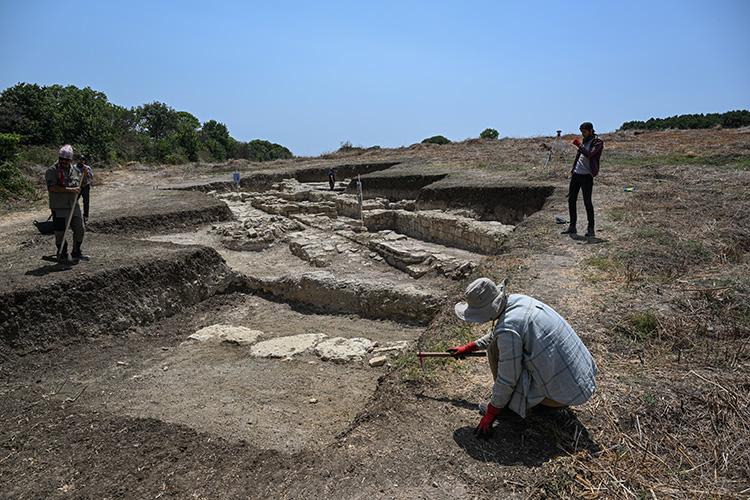
Bathonea Excavations (YouTube)
The ancient city spans approximately four kilometers in length and two kilometers in width. The settlement area includes an agora, port structures, walls, water channels, religious buildings, roads, and examples of civil architecture. A stone-paved ancient road and pier have been identified along the eastern coastline, the remains of a sea lighthouse at the southern tip, a monumental cistern in the northeast, and various church structures.
One of the most striking structures is a centrally planned building adorned with opus sectile (cut stone inlay), mosaics, and frescoes. This structure, square in plan from the exterior and octagonal internally, contains a crypt tomb at its center. Due to its architectural features and interior decorations, it has been identified as a martyrion (saint’s tomb). When considered together with another basilica-style structure in the same area, it is believed that the site functioned as a pilgrimage center or monastery complex.
The stones used in the opus sectile pavements include marbles and stones imported from various regions, such as Giallo Antico, Porfido Rosso Antico, and Verde Antico. The use of stones originating from Egypt, Greece, and Anatolia further demonstrates Bathonea’s integration into the Mediterranean trade network. Geometric patterns of rhombuses, octagons, and hexagons were preferred in the pavement designs.
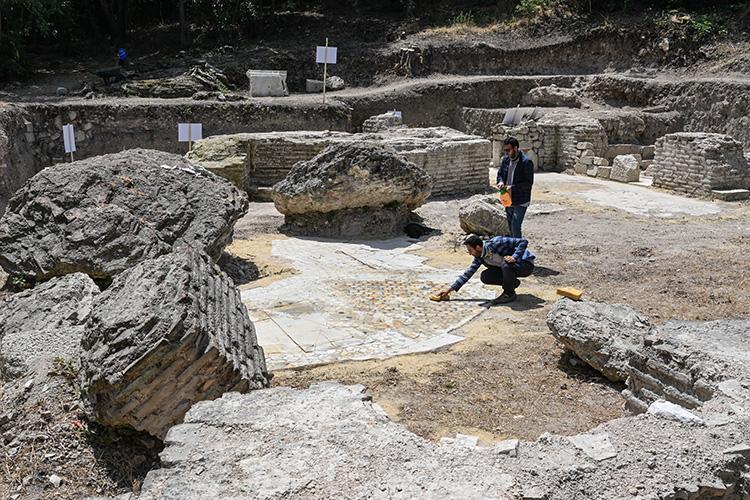
Bathonea Excavation (Anadolu Agency)
The architectural structures at Bathonea suffered extensive damage from an earthquake in the 6th century CE. Nevertheless, the ruins have remained largely intact in situ. Written sources indicate that the site continued to be visited by the local population in the centuries that followed.
Anadolu Ajansı. "Bathonea Antik Kenti kazı çalışmaları İstanbul'un tarihine ışık tutacak." Accessed June 19, 2025. https://www.aa.com.tr/tr/kultur/bathonea-antik-kenti-kazi-calismalari-istanbulun-tarihine-isik-tutacak/2954905
Aydıngün, Şengül, and Ahmet Emre Bilgili. "İstanbul Tarih Öncesi Arkeolojik Yüzey Araştırmaları ve Küçükçekmece Göl Havzası (Bathonea) Kazılarının İstanbul'a Katkıları." *Antik Çağ’dan XXI. Yüzyıla Büyük İstanbul Tarihi*. Volume 1. pp. 374-389. Accessed June 19, 2025. https://istanbultarihi.ist/17-istanbul-tarih-oncesi-arkeolojik-yuzey-arastirmalari-ve-kucukcekmece-gol-havzasi-bathonea-kazilarinin-istanbula-katkilari
Enez, Ayberk, and Şengül Aydıngün. "Bathonea." Türkiye Turizm Ansiklopedisi. 2020. Accessed June 19, 2025. https://turkiyeturizmansiklopedisi.com/bathonea
Ministry of Culture and Tourism of the Republic of Türkiye. "Bathonea: The Only Known Ancient Port City in Istanbul." Accessed June 19, 2025. https://www.bathonea.org/istanbuldaki-bilinen-tek-antik-liman-kenti-bathonea/
Sazak, Batuhan, Şengül Aydıngün, and Haldun Aydıngün. “Bathonea’dan Erken Hristiyanlık Dönemine Ait Bir Martyrion Ve Opus Sectile Döşemesi”. *Journal of Mosaic Research*, no. 16 (November 2023): 343-59. https://dergipark.org.tr/tr/pub/jmr/issue/80430/1376862
YouTube. "1- Bathonea Kazısı Genel Tanıtım(Hava)." Bathonea Excavation. Accessed June 19, 2025. https://www.youtube.com/watch?v=IenbzrcsUhc&t=139s

Bathonea Ancient City Excavations
Location | Firuzköy Peninsula Türkiye Istanbul western shore of Küçükçekmece Lake | ||||||||
|---|---|---|---|---|---|---|---|---|---|
Early Works | 2009 | ||||||||
Settlement | Chalcolithic Period (approximately 5500 BCE), Continuous Settlement from the 2nd Century BCE to the 11th Century CE, Roman and Byzantine Periods | ||||||||
Prominent Structures | Ancient Harbor Structures, Stone-Paved Roads, Piers, Monumental Cistern, Remains of a Lighthouse, Martyrion Structure (Saint's Tomb Structure), Basilica-Plan Church, Opus Sectile Flooring and Mosaics | ||||||||
Henüz Tartışma Girilmemiştir
"Ancient City of Bathonea" maddesi için tartışma başlatın
History
Architecture and Urban Fabric
Religious Structures and Martyria
Materials and Decoration Techniques
Natural Disasters and Destruction