


Bu içerik Türkçe olarak yazılmış olup yapay zeka ile otomatik olarak İngilizceye çevrilmiştir.
+1 Daha
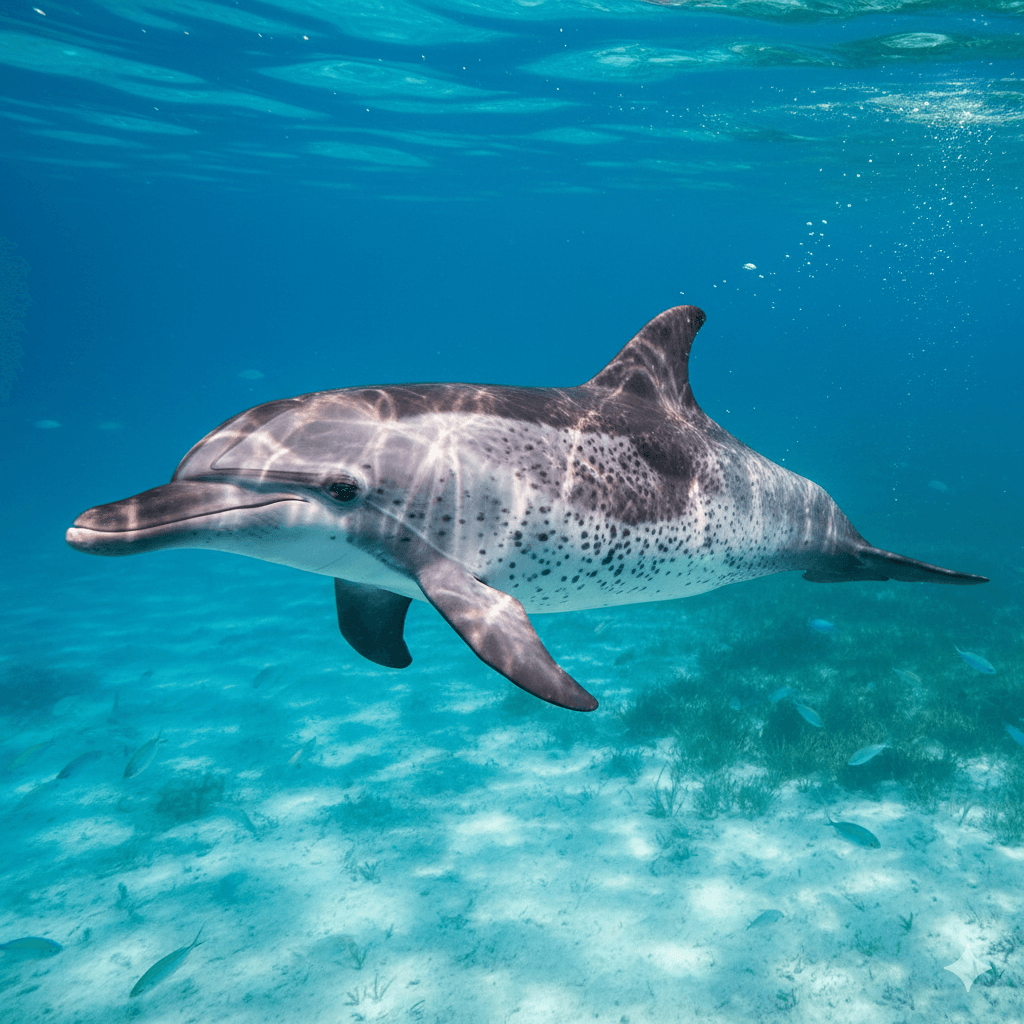
Atlantik Benekli Yunusu (Yapay Zeka ile Oluşturulmuştur.)
The Atlantic spotted dolphin (Stenella frontalis) is a smart and social marine mammal species belonging to the Delphinidae (oceanic dolphins) family, inhabiting tropical, warm and temperate waters of Atlantic Ocean. These dolphins are recognized by their unique spot patterns that develop with age and their echolocation abilities.
Atlantic spotted dolphins have a three-part body coloration and a two-part spotting pattern. Their backs are dark gray with white spots, their sides are light gray with white spots, and their bellies are white with dark spots. Newborn calves and juveniles are not spotted; spots first appear on the belly region around the weaning age of 2 to 6 years. As dolphins mature, more spots develop on the sides and back. The number of spots varies among populations depending on geographic location. For example, individuals in open ocean or temperate regions have few or no spots and tend to be smaller, with an average head length of 360 mm. In contrast, individuals in coastal populations typically exhibit dense spotting and are larger, with an average head length of 461 mm.
Atlantic spotted dolphins have white-tipped beaks measuring 90 to 140 mm in length, and a distinct bulge called the "melon" between the beak and the rest of the head. Their dorsal fins are curved and measure 160 to 250 mm in length, positioned near the middle of the back. They have 32 to 42 teeth in the upper jaw and 30 to 40 in the lower jaw. Adult males can reach lengths of up to 2.6 meters and weights of up to 140 kg, while females can reach lengths of up to 2.29 meters and weights of up to 130 kg. Newborns are approximately 0.9 to 1.1 meters long, although newborn weights have not been recorded. Average body mass ranges from 110 to 143 kg. Other physical characteristics include endothermy and bilateral symmetry. Newborn calves are approximately 89 to 109 cm (35 to 43 inches) in length.
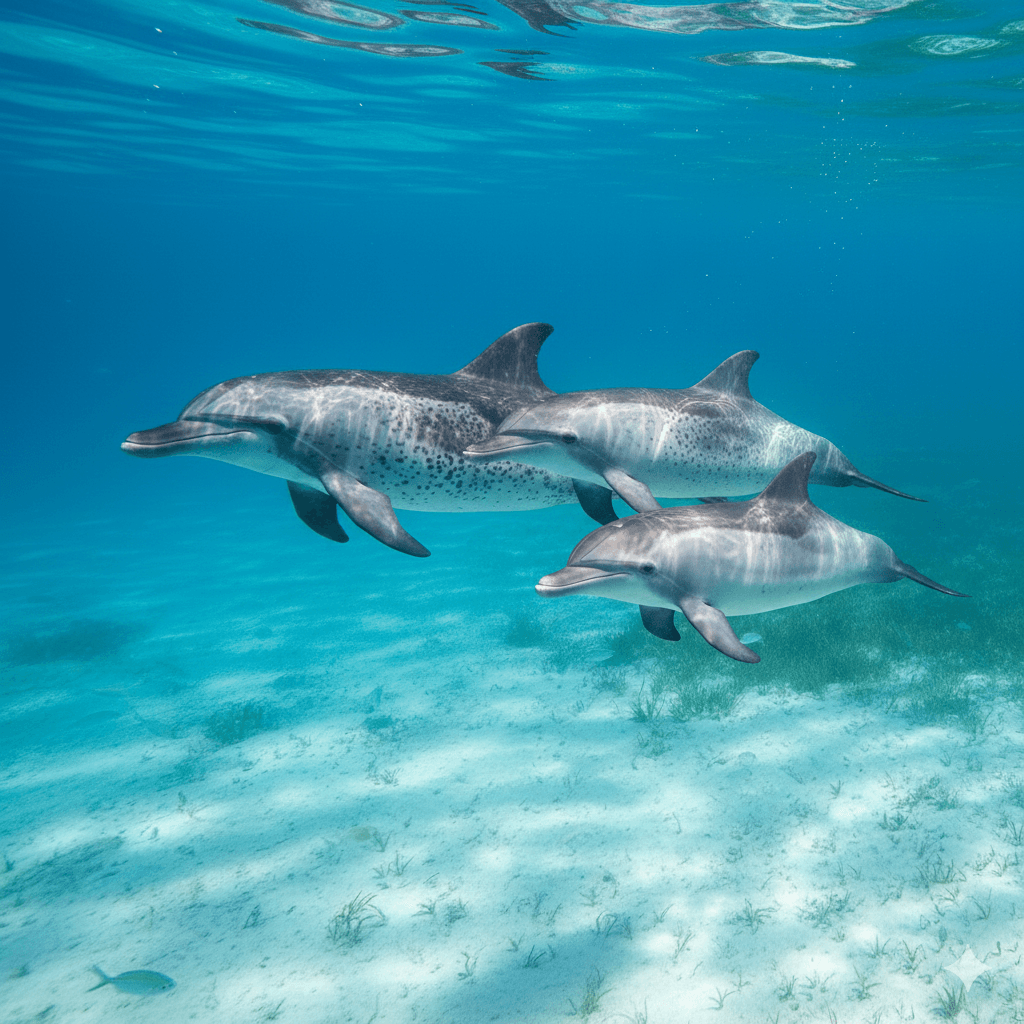
Atlantic Spotted Dolphin (Generated by Artificial Intelligence)
The Atlantic spotted dolphin is a species within the order Cetacea (whales), family Delphinidae (oceanic dolphins), and genus Stenella. It is classified within Linnaeus’s kingdom Animalia (animals), phylum Chordata (chordates), subphylum Vertebrata (vertebrates), and class Mammalia (mammals). The species was first described by Cuvier in 1828 and its scientific name is Stenella frontalis. There has been long-standing uncertainty among experts regarding whether variations in physical form warrant classification as a subspecies or a separate species.
Atlantic spotted dolphins are endemic to the tropical, warm and temperate waters of the Atlantic Ocean, occurring between 50 degrees North and 25 degrees South latitude. Their distribution primarily encompasses shallow waters along the continental shelf and upper continental slope. Although commonly observed in coastal waters, they also migrate into deeper waters. In the western Atlantic Ocean, their range extends from the eastern coasts of Canada and the United States, through the Gulf of Mexico and the Caribbean Sea, to the eastern coasts of Central and South America as far as Uruguay. In the eastern Atlantic Ocean, they are found along the western coast of Africa as far south as Angola, and around oceanic islands such as St. Helena, the Azores and the Canary Islands. Atlantic spotted dolphins are absent from the Mediterranean Sea and the western South Atlantic. They are most commonly observed at depths of up to 200 meters, but populations living farther from shore can inhabit depths of up to 1000 meters. Some populations near the Bahamas occur only in shallow sandy flats 6 to 12 meters deep. Dolphins spend most of their time in waters less than 10 meters deep, but can dive to depths of 40 to 60 meters for up to 6 minutes while foraging. Their habitat regions are tropical and marine, with water biomes classified as pelagic and coastal. Habitat depth ranges from 6 to 1000 meters (19.69 to 3280.84 ft), with an average depth of 200 meters (656.17 ft).
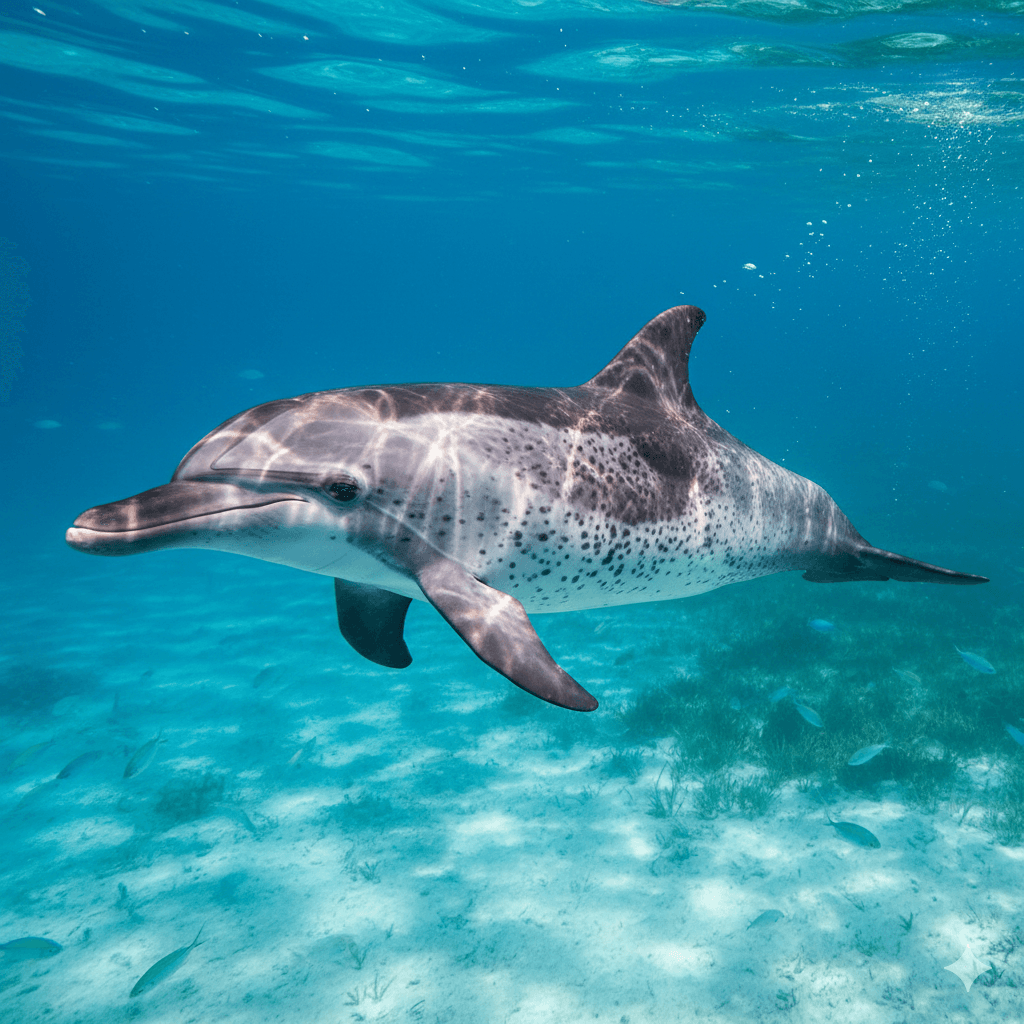
Atlantic Spotted Dolphin (Generated by Artificial Intelligence)
Atlantic spotted dolphins are social and considered intelligent. They are fast swimmers and acrobatic, often leaping out of the water and riding the bow waves of ships. They typically occur in groups (pods); coastal groups consist of 5 to 15 individuals, while deeper water groups may contain up to 50 individuals. They are known to interact both playfully and aggressively with bottlenose dolphins (Tursiops truncatus). They are not considered migratory; the same individuals have been observed year after year in the Bahamas. In the wild, their average lifespan is 23 years. In captivity, they typically live one year or less, as they refuse to eat.
Atlantic spotted dolphins have intraspecific communication methods and use both vocal and non-vocal signals that vary depending on context. They possess highly developed hearing and produce high-frequency sounds between 0.1 and 18 kHz. They typically communicate using a series of clicks, ranging from 8 to 1200 clicks per continuous call. They do not use vocal cords; instead, they use a mass of fatty tissue in their forehead called the "melon." They use three main vocal communication types: whistles, clicks and burst-pulsed sounds. Whistles are primarily used for social communication and emotional expression. Clicks are used for navigating and locating objects in their environment (echolocation). Dolphins produce whistles using the right side of their melon and clicks using the left side. Other vocalizations such as squawks, synchronized squawks, screams and barks are also associated with contextual and social behaviors. Additional sounds related to feeding and foraging include buzzes, trills and rising whistles.
Due to limited underwater visibility, they do not rely heavily on visual signals, but they do produce bubbles from their blowholes for visual communication. They also use tactile stimuli to convey information. Pectoral fin rubbing between a female and her calf may serve to calm the calf, while such behavior between unrelated dolphins may indicate a need for assistance. During the breeding season, females communicate chemical cues by releasing specific pheromones to signal readiness to mate.
Atlantic spotted dolphins feed on a variety of prey, and their diet varies by geographic location. Prey items include flatfish (order Pleuronectiformes), clupeid fish similar to herring (family Clupeidae), halfbeaks (family Hemiramphidae) and carangids (family Carangidae), among other small, soft-bodied fish. They also consume squid and some other cephalopods (class Cephalopoda) and other invertebrates. Dolphins typically herd their prey into traps near islands or seamounts. They are also known to follow trawler vessels and feed on organisms discarded by fishermen. Their primary diet is carnivorous (fish-eating, cephalopod-eating, other marine invertebrate-eating).
Atlantic spotted dolphins have a polygynandrous (promiscuous) reproductive system, typically breeding between early spring and late autumn. Mating events usually involve three or four males following a single female. Males follow the female down to the seafloor and keep other male groups at bay until the female is ready to mate. Small groups of males initially attract females through synchronized swimming, vocalizations and specific postures.
Females reach reproductive maturity between 8 and 11 years of age. The age at which males reach sexual maturity is unknown but estimated to be around 10 years. Gestation lasts 11 to 12 months, and females give birth to only one calf per breeding season. Newborns are approximately one-third the length of their mothers. Calves are considered fully weaned between 3 and 5 years after birth, but begin catching and consuming solid food between 6 and 10 months after birth. The birth interval for Atlantic spotted dolphins is 3 to 4 years, meaning females can become pregnant while still nursing an older calf. Calves typically remain with their mothers for about 3 years after birth. However, if the mother does not become pregnant in subsequent years, calves may remain partially dependent for up to 9 years after birth.
Atlantic spotted dolphins exhibit extended parental investment. While males do not specifically care for their own offspring, they occasionally protect pregnant females or those with small calves. Females are responsible for feeding and protecting their young, and newborns rely on their mothers for learning and development. Calves are fully dependent on their mothers for approximately 3 years, during which time mothers teach them to hunt. To do this, mothers capture prey and release it near the seafloor. They then point their jaws toward the prey and allow the calf to join in the hunt.
Atlantic spotted dolphins feed on small, soft-bodied fish, squids and other invertebrates. They themselves serve as prey for bull sharks (Carcharhinus leucas), tiger sharks (Galeocerdo cuvier) and Orkars (Orcinus orca). Humans also kill them intentionally for food and unintentionally through fishing practices. Dolphins can become entangled in fishing gear, leading to drowning or injury. Known parasites of these dolphins include Bolbosoma vasculosum in the intestines, Anisakis typica in the stomach and Phyllobothrium delphini in the blubber layer.
Dolphins exhibit various anti-predator behaviors to deter potential predators, including slapping with their flippers, head shaking and releasing bubble clouds. They may also confront predators directly by spreading their flippers to appear larger and more intimidating. To alert other group members to the presence of predators, they repeatedly strike the water surface with their tails, producing low, noisy sounds. They can detect the high-frequency sounds emitted by orcas during hunting and thereby avoid predation.
They are listed as "data deficient" on the IUCN Red List, meaning their conservation status cannot be assessed until more information is gathered. They are listed on Appendix II of CITES (Convention on International Trade in Endangered Species of Wild Fauna and Flora), which regulates their import and export and emphasizes humane treatment. They are also protected under the Marine Mammal Protection Act. Atlantic spotted dolphins are included in the Agreement on the Conservation of Small Cetaceans of the Baltic and North Seas (ASCOBANS) and the Agreement on the Conservation of Cetaceans in the Black Sea, Mediterranean Sea and Contiguous Atlantic Area (ACCOBAMS).
Populations are threatened by fishing and whaling practices. Currently, there are groups targeting Atlantic spotted dolphins for whaling. Their coastal foraging behavior and tendency to follow vessels to feed on discarded fish lead to close interactions with ships and fishing areas. These interactions result in accidental entanglement or injury in fishing gear.
Braulik, Gill, and Thomas A. Jefferson. “Stenella frontalis. The IUCN Red List of Threatened Species" 2018: e.T20732A50375312. ResearchGate. Accessed October 20, 2025. https://www.researchgate.net/publication/330360156_Stenella_frontalis_THE_IUCN_RED_LIST_OF_THREATENED_SPECIES
Brimer, Kelsey. “Stenella frontalis (Atlantic Spotted Dolphin).” *Animal Diversity Web*. Accessed October 20, 2025. https://animaldiversity.org/accounts/Stenella_frontalis/

Atlantik Benekli Yunusu (Yapay Zeka ile Oluşturulmuştur.)
Henüz Tartışma Girilmemiştir
"Atlantic Spotted Dolphin (Stenella frontalis)" maddesi için tartışma başlatın
Physical Characteristics
Taxonomy and Classification
Geographic Range and Natural Habitat
Behavior and Lifespan
Communication
Diet
Reproduction
Ecosystem Roles and Threats
Conservation Status