

Bu içerik Türkçe olarak yazılmış olup yapay zeka ile otomatik olarak İngilizceye çevrilmiştir.
+2 Daha
Original Name(s) | Bogatyri | ||||||||
|---|---|---|---|---|---|---|---|---|---|
Type(s) | Historical-epic painting / folkloric historical painting | ||||||||
Location | Moscow Tretyakov State Gallery | ||||||||
Technique | Oil on canvas | ||||||||
Creation Date | 1881–1898 | ||||||||
Artist | Viktor Mikhailovich Vasnetsov | ||||||||
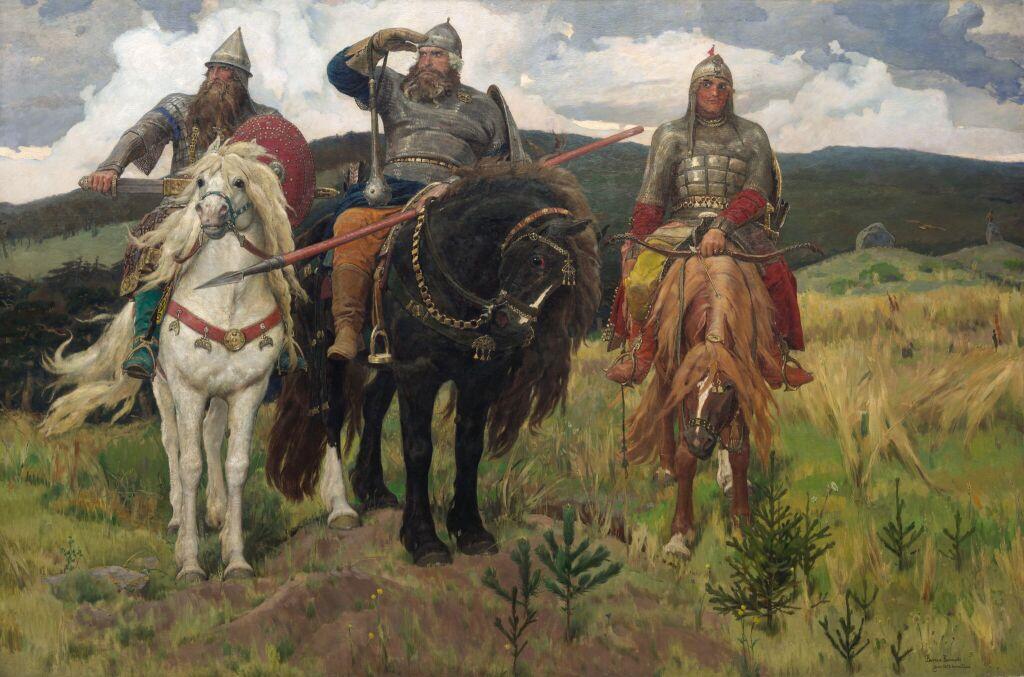
Viktor Mikhaylovich Vasnetsov’s painting “Bogatyr” is an oil-on-canvas epic-historical work depicting the three heroes from Russian folk epics (bylina). Completed between 1881 and 1898, the painting portrays Ilya Muromets, Dobrynya Nikitič, and Alyosha Popovič together. Each bogatyr is distinctly rendered through physical traits and characteristic qualities. The painting presents Russia’s epic heroes by combining historical accuracy with folkloric detail.

Viktor Mikhaylovich Vasnetsov (Tretyakov Gallery)
Long before Vasnetsov painted them, the bogatyr had existed independently in popular tradition for approximately five centuries. Originally transmitted through bylinas centered on warriors, these heroes later entered the oral culture of peasants. In epics, the heroes are endowed with superhuman strength and wisdom, while their enemies increasingly acquire a fairy-tale character. For example, Dobrynya Nikitič’s defeat of Zmey Gorynych to rescue the prince’s nephew exemplifies the exaggeration and metaphor typical of epic storytelling. Narratives such as Ilya Muromets lying on a stove for thirty-three years before gaining miraculous strength reflect the folkloric structure of the bylinas. He traveled, took advice from wayfarers, journeyed to Kiev, entered the service of Prince Vladimir, and performed numerous heroic deeds. He defeated Solovey-Razboynik and expelled the idol-worshipping Pogany, symbolizing the Tatars.
The historical prototype of Ilya Muromets is Ilya Pečerskiy, who before becoming a monk was known as Chobotok and demonstrated the ability to defeat enemies single-handedly. Mikhail Gerasimov’s skull reconstruction reveals a facial structure strikingly similar to Vasnetsov’s depiction of Ilya Muromets. Dobrynya Nikitič, originating from Ryazan, is portrayed as a warrior endowed with wisdom and cultural knowledge. Alyosha Popovič comes from Rostov and is characterized as young, agile, and witty. Vladimir Propp interpreted the bogatyr as concrete embodiments of the people’s heroic qualities.
Viktor Mikhaylovich Vasnetsov showed an interest in art from childhood and received training at various art schools to develop his talent. In St. Petersburg he worked on book illustrations, then turned his focus to Russian history and literary monuments, creating his own mythical world. In the 1880s he shifted emphasis from everyday subjects to folkloric and epic themes. His participation in the Society for Travelling Art Exhibitions (Peredvizhniki) enabled him to continue his work from a perspective that rejected academic traditions.

Viktor M. Vasnetsov’s Painting Bogatyr (Tretyakov Gallery)
For the painting “Bogatyr,” Vasnetsov spent approximately thirty years developing the subject, preparing sketches, and selecting appropriate models. The portrait of Dobrynya Nikitič was composed from three individuals; Ilya Muromets was modeled after a common man from the people; and Alyosha Popovič was modeled after Mamontov’s son. Vasnetsov employed visual exaggeration to emphasize the physical and characteristic traits of the bogatyr, endowing each figure with fundamental qualities of the Russian character.
The painting was prepared with both artistic and scientific rigor; archaeological prototypes, weapons, and armor of the period were examined in detail.
The painting highlights the distinct characters and strategies of the three bogatyr:
The horses of the bogatyr reflect their individual qualities, and their lightly equipped armor enhances their mobility. The atmosphere of the painting features a vast steppe, hills, wind, and a cloudy sky, emphasizing the power of the Russian landscape. The scenery incorporates natural elements from the Abramtsevo and Vyatka regions.
When designing the weapons and armor of the bogatyr, Vasnetsov drew upon authentic archaeological examples. Dobrynya Nikitič’s armor and sword are associated with the collection of the Armory Chamber in the Moscow Kremlin and reflect the characteristic features of Russian swords from the 9th to 11th centuries. The fibula on Ilya Muromets’s armor was used solely as a decorative and status symbol.
The painting “Bogatyr” concretizes the epic heroes and culture of the Russian people, reflecting their historical and cultural values. The individual traits of the three bogatyr represent fundamental qualities of the Russian character: Ilya Muromets’s strength and experience, Dobrynya Nikitič’s wisdom and pride, and Alyosha Popovič’s agility and intellect carry both epic and cultural significance.
The painting established an iconic reference point for the representation of the bogatyr in Russian painting and has been accepted in popular consciousness as a symbol of courage, power, and patriotism.
Filipeva, V. "Obraz Bogatırya v Tvorçestve Russkih Hudojnikov “V. M. Vasnetsova.”" Pervie Şagi ve Nauke – Sborik Materialov, Çelyabinsk, 2013, pp. 97-101. Accessed March 8, 2026. https://www.elibrary.ru/download/elibrary_32723243_34495065.pdf
Kokarev, I. S. “Obrazıy Russkogo Bogatırstva u M. A. Vrubelya i V. M. Vasnetsova.” *Şuyskaya Sessiya Studentov, Aspirantov, Pedegogov, Molodıh Uçenıh, Materialıy XI Mejdunarodnoy Nauçnoy Konferentsii*, 2018. Accessed March 8, 2026. https://www.elibrary.ru/download/elibrary_36475294_71155068.pdf
Krûçkova, Yekaterina Viktorovna. “Viktor Mihayloviç Vasnetsov: Bogatır Russkoy Jivopisi.” *Rossiya i Mir v İstoriçeskoy Retrospektive*, 2023, 2021–2024. Accessed March 8, 2026. https://www.elibrary.ru/download/elibrary_52080758_20417458.pdf
Pılneva, E. I. “Kartina ‘Bogatıri’ V. M. Vasnetsova: İstoriya, Prototipıy, Obrazıy.” *Kulturnıe Trendıy Sovremennoy Rossii: Ot Natsionalnıh İstokov K Kulturnım İnnovatsiyam*, vol. I, Belgorod, 2022, pp. 211–215. Accessed March 8, 2026. https://www.elibrary.ru/download/elibrary_48861111_53929879.pdf
Tretyakov Gallery. "Bogatyrs 1881-1898." My Tretyakov. Accessed March 8, 2026. https://my.tretyakov.ru/app/masterpiece/8392
Tretyakov Gallery. "Portret Viktora Vasnetsova." *My Tretyakov.* Accessed March 8, 2026. https://my.tretyakov.ru/app/masterpiece/21528
Original Name(s) | Bogatyri | ||||||||
|---|---|---|---|---|---|---|---|---|---|
Type(s) | Historical-epic painting / folkloric historical painting | ||||||||
Location | Moscow Tretyakov State Gallery | ||||||||
Technique | Oil on canvas | ||||||||
Creation Date | 1881–1898 | ||||||||
Artist | Viktor Mikhailovich Vasnetsov | ||||||||
Henüz Tartışma Girilmemiştir
"Bogatyrs (Painting)" maddesi için tartışma başlatın
Origins and Epic Narratives of the Bogatyr
Historical Prototypes
Vasnetsov’s Artistic Career
Technical Features of the Work
Composition and Depiction
Archaeological and Historical Accuracy
Cultural and Artistic Significance