


Bu içerik Türkçe olarak yazılmış olup yapay zeka ile otomatik olarak İngilizceye çevrilmiştir.
+2 Daha
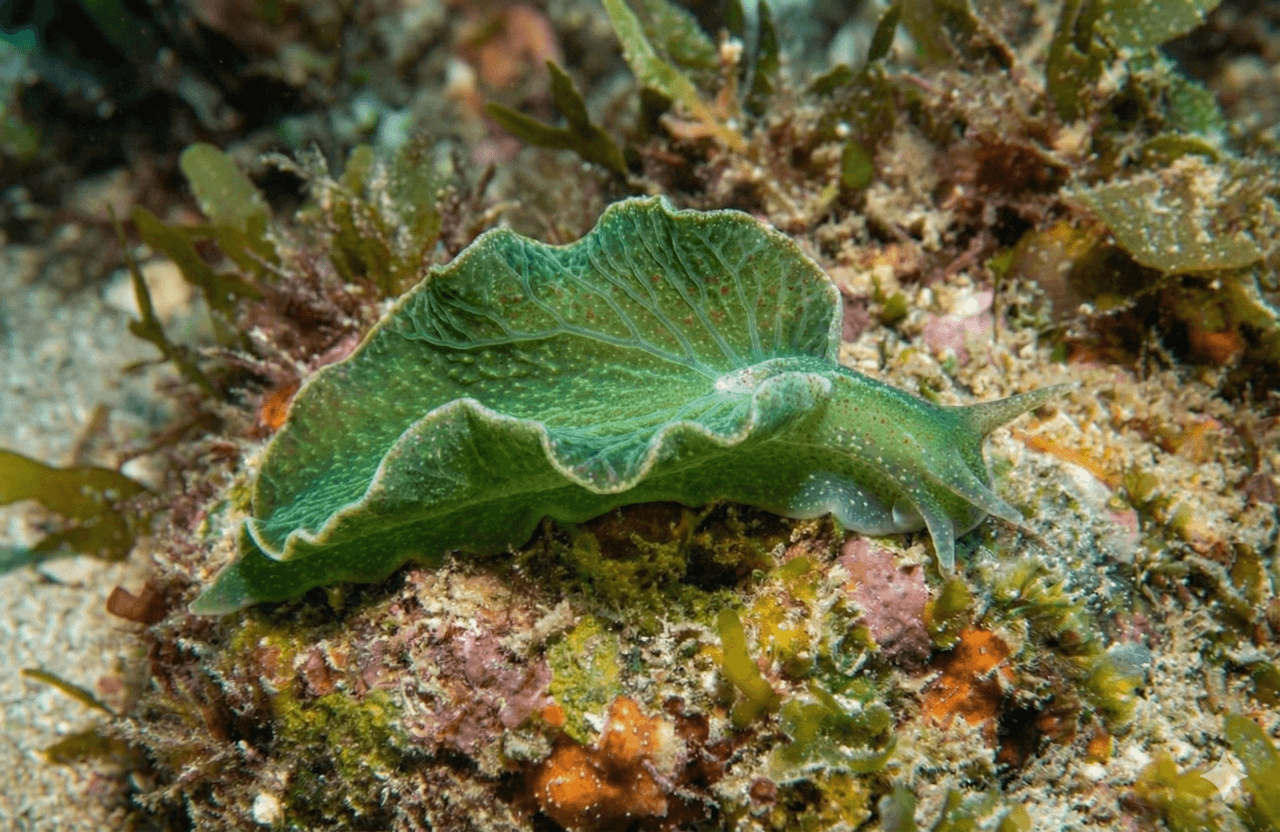
Elysia Chlorotica (Generated by Artificial Intelligence)
Branch | Mollusca (Mollusks) | ||||||||
|---|---|---|---|---|---|---|---|---|---|
Team(s) | Sacoglossa | ||||||||
Size(s) | Average 20–30 mm (Maximum 60 mm) | ||||||||
Habitat | shallow pools (0–0.5 m depth) Salt marshes | ||||||||
Notable Feature | Ability to perform photosynthesis through chloroplast theft (kleptoplasty) | ||||||||
Geographic Distribution | East Coast of North America (from Nova Scotia to Florida) | ||||||||
Lifespan | Approximately 11 months | ||||||||
Primary Food Source | Vaucheria litorea | ||||||||
Diet Type | Herbivore (Algal feeder), Kleptoplastic (Photosynthetic) | ||||||||
Class | Gastropoda (Gastropods) | ||||||||
World | Animalia (Animals) | ||||||||
Elysia chlorotica is a species of sea slug, also known as the eastern emerald elysia, capable of performing photosynthesis by retaining chloroplasts obtained from the alga Vaucheria litorea (alg) within cells of its digestive system. Belonging to the order Sacoglossa (sap-sucking mollusks), this species can survive for months on sunlight alone, even in the absence of food, thanks to the rare ability among animals known as kleptoplasty (chloroplast theft). It inhabits salt marshes and shallow creek beds along the eastern coast of the United States, ranging from Nova Scotia (Canada) to southern Florida.

Elysia Chlorotica (Generated by Artificial Intelligence)
Elysia chlorotica undergoes significant morphological and color changes throughout its life cycle. Development begins with the veliger larva, a free-swimming planktonic stage equipped with a ciliated velum and a shell. After metamorphosis, juvenile individuals that have not yet fed on algae are brown and exhibit reddish pigment spots on their ventral surfaces.
Adults acquire a bright green color after feeding on Vaucheria litorea and incorporating its chloroplasts. These chloroplasts are distributed throughout the animal’s extensive digestive system diverticula (extensions). Adults typically measure 20 to 30 mm in length, though specimens up to 60 mm have been documented.
Elysia Chlorotica (bhattacharyalab)
The adult form resembles a leaf due to broad, wing-like extensions called parapodia on either side of the body. These structures provide camouflage and optimize light absorption by increasing surface area for photosynthesis. When chloroplasts lose functionality or are shed, the slug loses its green color and turns gray.
The species’ life cycle lasts approximately 11 months and ends each year in a synchronized mass mortality event. Developmental stages are as follows:

Elysia Chlorotica Life Cycle (Generated by Artificial Intelligence)
Elysia chlorotica belongs to the group of “sap-sucking” sea snails mollusks (Sacoglossa). Its diet is primarily based on the alga Vaucheria litorea, though it may occasionally feed on Vaucheria compacta. The slug uses its radula (toothed tongue) to pierce algal cell walls and suck out cellular contents.
During this process, the algal cytoplasm and nucleus are digested, while the chloroplasts are intact and taken up by digestive epithelial cells via phagocytosis. These chloroplasts remain functional within the animal’s cytoplasm for months—up to 10 to 12 months—continuing to perform photosynthesis. During this period, the slug can survive solely on light and carbon dioxide without ingesting external food.
How this symbiotic relationship is maintained remains a subject of intense scientific research. The ability of chloroplasts to continue protein synthesis and function without the algal nucleus raises the question of whether the necessary genes are present in the slug’s genome.
Elysia chlorotica is a euryhaline osmokonformer with high tolerance to salinity. It can survive in salinity levels ranging from nearly freshwater (~24 mosm) to highly saline water (~2422 mosm). Its natural habitat consists of salt marsh pools and shallow creeks less than 0.5 meters deep, typically found near its primary food source, Vaucheria litorea.
Elysia chlorotica is a simultaneous hermaphrodite, possessing both male and female reproductive organs. Although capable of self-fertilization, cross-fertilization (mating with another individual) is preferred. During mating, sperm is injected directly into the body surface via hypodermic insemination. Fertilized eggs are laid in long mucus strands and hatch after approximately one week. No parental care is observed.
Bilim Genç. "Fotosentez Yapan Hayvan." Bilim Genç (TÜBİTAK), August 24, 2020. Accessed January 1, 2026. https://bilimgenc.tubitak.gov.tr/bunlari-biliyor-musunuz/fotosentez-yapan-hayvan.
Blanchet, Chelsea. “Elysia chlorotica.” *Animal Diversity Web*, 2012. Accessed January 1, 2026. https://animaldiversity.org/accounts/Elysia_chlorotica/.
Cai, Huimin, Qiye Li, Xiaodong Fang, Ji Li, Nicholas E. Curtis, Andreas Altenburger, Tomoko Shibata, Mingji Feng, Taro Maeda, Julie A. Schwartz, Shuji Shigenobu, Nina Lundholm, Tomoaki Nishiyama, Huanming Yang, Mitsuyasu Hasebe, Shuaicheng Li, Sidney K. Pierce, and Jian Wang. “A Draft Genome Assembly of the Solar-Powered Sea Slug Elysia chlorotica.” Scientific Data 6 (2019): 190022. Accessed January 1, 2026. https://doi.org/10.1038/sdata.2019.22.
Chan, Cheong Xin, Pavel Vaysberg, Dana C. Price, Karen N. Pelletreau, Mary E. Rumpho, and Debashish Bhattacharya. “Active Host Response to Algal Symbionts in the Sea Slug Elysia Chlorotica.” *Molecular Biology and Evolution* 35, no. 7 (2018): 1706–1718. Accessed January 1, 2026. https://doi.org/10.1093/molbev/msy061.
Encyclopédie de l’Environnement. “Elysia chlorotica, the Slug That Behaves Like a Leaf.” Encyclopédie de l’Environnement. Accessed January 1, 2026. https://www.encyclopedie-environnement.org/en/zoom/elysia-chlorotica-the-slug-who-thinks-shes-a-leaf/.
Rumpho, Mary E., Elizabeth J. Summer, and James R. Manhart. “Solar-Powered Sea Slugs: Kleptoplasty and Endosymbiosis in Sacoglossa.” *Proceedings of the National Academy of Sciences* 93, no. 22 (1996): 12333–12338. Accessed January 1, 2026. https://doi.org/10.1073/pnas.93.22.12333.
Rumpho, Mary E., Jared M. Worful, Jungho Lee, Krishna Kannan, Mary S. Tyler, Debashish Bhattacharya, Ahmed Moustafa, and James R. Manhart. “Horizontal Gene Transfer of the Algal Nuclear Gene psbO to the Photosynthetic Sea Slug Elysia Chlorotica.” *Proceedings of the National Academy of Sciences* 105, no. 46 (November 11, 2008): 17867–71. Accessed January 1, 2026. https://doi.org/10.1073/pnas.0804968105.
YouTube. "Elysia chlorotica - Photosynthetic Sea Slug Movie 2." bhattacharyalab, May 2, 2009. Accessed January 1, 2026. https://www.youtube.com/watch?v=aQR_aaUqMPc.
Elysia Chlorotica (Generated by Artificial Intelligence)
Branch | Mollusca (Mollusks) | ||||||||
|---|---|---|---|---|---|---|---|---|---|
Team(s) | Sacoglossa | ||||||||
Size(s) | Average 20–30 mm (Maximum 60 mm) | ||||||||
Habitat | shallow pools (0–0.5 m depth) Salt marshes | ||||||||
Notable Feature | Ability to perform photosynthesis through chloroplast theft (kleptoplasty) | ||||||||
Geographic Distribution | East Coast of North America (from Nova Scotia to Florida) | ||||||||
Lifespan | Approximately 11 months | ||||||||
Primary Food Source | Vaucheria litorea | ||||||||
Diet Type | Herbivore (Algal feeder), Kleptoplastic (Photosynthetic) | ||||||||
Class | Gastropoda (Gastropods) | ||||||||
World | Animalia (Animals) | ||||||||
Henüz Tartışma Girilmemiştir
"Elysia chlorotica" maddesi için tartışma başlatın
Physical Characteristics
Life Cycle and Development
Feeding and Kleptoplasty
Genetic and Molecular Adaptations
Habitat and Distribution
Reproduction