
Bu içerik Türkçe olarak yazılmış olup yapay zeka ile otomatik olarak İngilizceye çevrilmiştir.
+2 Daha
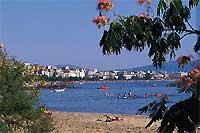
Erdek Bay is a semi-enclosed marine basin located in the southwest of the Marmara Sea. It is bounded by the Kapıdağ Peninsula to the north and northeast, the islands of Avşa, Koyun, and Paşalimanı to the north, and the coasts of Gönen and Bandırma to the south. The bay measures approximately 49 kilometers in length, 21 kilometers in width, and reaches a maximum depth of 55 meters. Morphogenetically, it contains a variety of coastal forms including tombolo, lagoon, delta, and cliff structures.
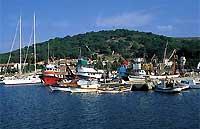
Erdek Bay (Ministry of Culture and Tourism)
Erdek Bay is a semi-enclosed marine basin situated in the southwestern sector of the Marmara Sea. Geographically, the bay is bounded on the east and northeast by the Kapıdağ Peninsula, connected to the mainland by a tombolo (spit island); to the north by the islands of Avşa, Koyun, and Paşalimanı; and to the south by the coastlines of Gönen and Bandırma. On its western side, the bay opens into the open waters of the Marmara Sea, with a total length of approximately 49 kilometers and a maximum width of 21 kilometers.【1】
The maximum depth of the bay, reaching 55 meters, occurs between Muratbayırı Cape and Topçu Cape. The southern coast generally exhibits a shallow profile, while the eastern and northern coasts feature prominent cliff (yalıyar) structures rising between sandy beaches. The physical geography of the region has been shaped primarily by prevailing winds, river discharge regimes, and wave action. As a result, various morphological units such as tombolo, lagoon, delta, beach, and cliff have developed around the bay.【2】 The bay’s water budget and sediment composition are significantly influenced by drainage activity from rivers such as the Gönen River, which flows into the bay from the south.
Erdek Bay possesses a coastal morphology shaped by the interaction of wave action, prevailing winds, and river drainage systems. Characteristic geomorphological units observed around the bay include tombolo, lagoon, delta, beach, and cliff (yalıyar).
One of the region’s most notable landforms is the Erdek-Bandırma tombolo, which connects the Kapıdağ Peninsula to the mainland. This spit formation has developed through the accumulation of sand and sediments transported by waves and currents. Along the bay’s shores, in addition to these accumulation features, small-scale delta formations occur where rivers discharge into the sea, accompanied by lagoon lakes formed as a result of these processes.
The northern coast of the bay exhibits "geomorphosites"—landforms of scientific and touristic value. Here, steep cliffs formed by wave erosion are interspersed with natural beaches, creating an intricate landscape. Areas such as Muratbayırı Cape and Topçu Cape represent zones where the bay deepens and coastal morphology becomes more pronounced. In contrast, the southern coast is dominated by alluvial coastal plains shaped by the sedimentary influence of the Gönen River, characterized by shallower waters and intense sedimentation.
The seafloor morphology continues the diversity observed along the shoreline. In the shallow zones, sandy and gravelly sediments predominate, while in the intermediate and deeper areas, muddy lithology is dominant.
Erdek Bay Pinna Introduction (TRT News)
Erdek Bay hosts a rich marine biodiversity and a distinctive benthic microfauna (microscopic organisms living within or on the sediments of seas or lakes) within the broader ecosystem of the Marmara Sea.
Micropaleontological studies (a discipline that examines microfossils from geological periods to reconstruct past environmental changes, sea-level fluctuations, and sediment age) conducted on the bay’s current seafloor sediments have identified 74 species of benthic foraminifera belonging to 46 genera and 24 families.【3】
While agglutinated species do not dominate numerically, five main assemblages composed of calcareous-shelled foraminifera have been identified. These assemblages include:
The distribution of these microorganisms varies according to sediment composition (mud, sand, gravel) and depth. Sandy substrates in shallow areas support different species compositions than muddy zones in deeper regions.
The bay’s biodiversity is not limited to the microscale; it also supports critical macro-scale species. Healthy populations of the "noble pen shell" (Pinna nobilis), known as the "natural filter of the seas" and whose numbers are declining in both the Mediterranean and the Marmara Sea, have been documented in Erdek Bay.
However, the region’s biodiversity is under threat due to anthropogenic pressures and climate change. Particularly, the proliferation of mucilage (sea snot) covering the seafloor reduces oxygen exchange and disrupts feeding processes, thereby suppressing species richness in the benthic ecosystem.
Due to its semi-enclosed basin nature, Erdek Bay is a highly sensitive ecosystem to terrestrial pollution sources and human activities. The environmental condition of the region is shaped by industrial waste, agricultural practices, and biological events triggered by climate change.
One of the most significant environmental stressors in the bay is heavy metal accumulation. Rivers such as the Gönen River, discharging from the southern coast, and those flowing from the Karabiga region, act as conduits for industrial effluents and domestic waste. Core sediment analyses have detected elevated concentrations of copper (Cu), lead (Pb), zinc (Zn), and chromium (Cr). This reflects an increasing enrichment factor linked to industrialization and anthropogenic pollution.【4】
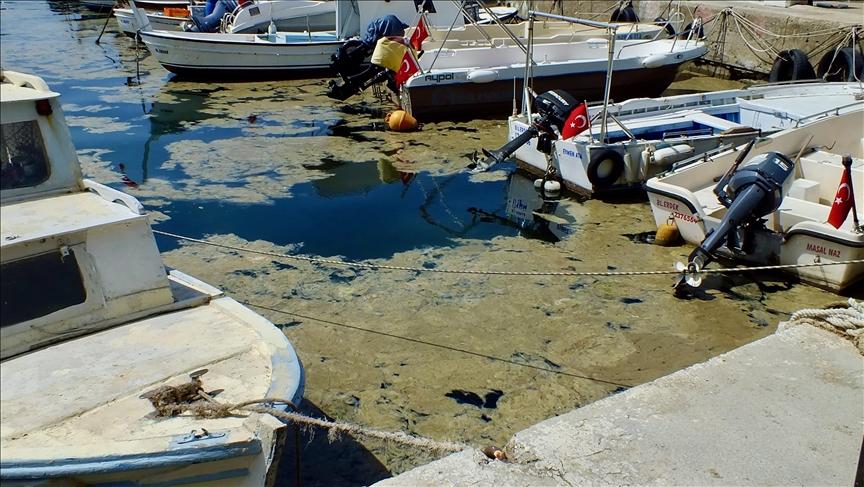
Erdek Bay Mucilage Problem (AA)
In recent years, mucilage (sea snot)—a viscous substance produced by excessive blooms of phytoplankton—has become a major environmental issue in the Marmara Sea, with severe impacts on the shores of Erdek Bay. The combination of rising sea surface temperatures and increased pollution has led to massive mucilage production. This substance not only creates visual pollution by covering the sea surface but also settles on the seafloor, threatening benthic life. The mucilage layer blocks oxygen exchange with the seabed, leading to the death of marine organisms, particularly pen shells (Pinna nobilis), and clogging their feeding mechanisms.
Erdek Bay hosts "geomorphosites"—areas of scientific, educational, and touristic value—due to its diverse coastal morphology and geological features. The region’s geomorphotourism potential arises from tombolo formations, shallow coastal lagoons, cliff structures, and island ecosystems integrated with thermal springs.
One of the region’s natural heritage landmarks is the Erdek-Bandırma tombolo connecting the Kapıdağ Peninsula to the mainland. This massive spit formation is not only a geographical feature but also a defining geomorphosite that shapes the region’s tourism identity. The steep cliffs along the northern coast, interspersed with sheltered natural beaches, offer significant potential for recreational activities. Areas such as Muratbayırı Cape and Topçu Cape are visually striking geomorphological units that exemplify characteristic wave erosion patterns.
Located within the bay, Zeytinli Ada is a center where geological and cultural heritage intertwine. Thermal spring outlets on the island and their historical use enhance the region’s value for health tourism.【5】
Within the framework of natural heritage, the marine biodiversity of Erdek Bay is of critical importance. The presence of populations of "noble pen shells" (Pinna nobilis) transforms the bay into a biological heritage area. These organisms’ capacity to filter seawater constitutes a natural ecological service vital to maintaining the bay’s environmental balance. Their existence supports the potential for alternative tourism sectors such as diving tourism and nature observation.
Anadolu Ajansı. "Erdek Körfezi Kıyılarında Müsilaj Görüldü." Accessed March 12, 2026. https://www.aa.com.tr/tr/yasam/erdek-korfezi-kiyilarinda-musilaj-goruldu/3560827
Anadolu Ajansı. "Erdek Körfezi'nde Denizlerin Doğal Filtresi 'Genç Pinalara' Rastlandı." Accessed March 12, 2026. https://www.aa.com.tr/tr/gundem/erdek-korfezinde-denizlerin-dogal-filtresi-genc-pinalara-rastlandi/3100126
Arslan Kaya, Tuğçe Nagihan, Erol Sarı, Mehmet Ali Kurt, and Dursun Acar. "Erdek Körfezi Karot Çökellerinin Ağır Metal Dağılımı ve Zenginleşme Derecesi." *Türkiye Jeoloji Bülteni* 63, no. 1 (2020): 57-68. Accessed March 12, 2026. https://dergipark.org.tr/tr/download/article-file/956350
Avşar, Niyazi, Aysun Aksu, and Feyza Dinçer. "Erdek Körfezi (GB Marmara Denizi) Bentik Foraminifer Toplulukları." Yerbilimleri 27, no. 3 (2006): 125-141. Accessed March 12, 2026. https://dergipark.org.tr/tr/download/article-file/145588
Kurt, Sümeyra, and Deniz Ekinci. "Erdek Körfezi Kuzey Kıyılarının Jeomorfoturizm Özellikleri." 3rd International Geography Symposium - GEOMED 2013 Symposium Proceedings (2013): 450-460. Accessed March 12, 206. https://web.deu.edu.tr/geomed/proceedings/download/044_GeoMed_2013_Proceedings_450-460.pdf
Seymen, Aytemiz Oya. "Erdek." Türkiye Turizm Ansiklopedisi. Accessed March 12, 2026. https://turkiyeturizmansiklopedisi.com/erdek
T.C. Ministry of Culture and Tourism. "Erdek." Accessed March 12, 2026. https://tanitma.ktb.gov.tr/TR-22627/erdek.html
TRT Haber. "Marmara Denizi'nin doğal filtreleri." YouTube, 3:45. Date Published June 15, 2024. Accessed March 12, 2026. https://www.youtube.com/watch?v=K7eWLfMb_Ds
[1]
Sümeyra Kurt and Deniz Ekinci, "Geomorphic Tourism Characteristics of the Northern Coasts of Erdek Bay," 3rd International Geography Symposium - GEOMED 2013 Proceedings, 450, access date: 11 March 2026, https://web.deu.edu.tr/geomed/proceedings/download/044_GeoMed_2013_Proceedings_450-460.pdf.
[2]
Sümeyra Kurt and Deniz Ekinci, "Geomorphic Tourism Characteristics of the Northern Coasts of Erdek Bay," 3rd International Geography Symposium - GEOMED 2013 Proceedings, 450, access date: 11 March 2026, https://web.deu.edu.tr/geomed/proceedings/download/044_GeoMed_2013_Proceedings_450-460.pdf.
[3]
Niyazi Avşar, Aysun Aksu and Feyza Dinçer, "Benthic Foraminiferal Assemblages in Erdek Bay (SW Marmara Sea)," Yerbilimleri 27, no. 3 (2006): 125, access date: 11 March 2026, https://dergipark.org.tr/tr/download/article-file/145588.
[4]
Tuğçe Nagihan Arslan Kaya, Erol Sarı, Mehmet Ali Kurt and Dursun Acar, "Heavy Metal Distribution and Enrichment Degree in Erdek Bay Core Sediments," Turkish Journal of Geology 63, no. 1 (2020): 64-65, access date: 11 March 2026 https://dergipark.org.tr/tr/download/article-file/956350.
[5]
Sümeyra Kurt and Deniz Ekinci, "Geomorphic Tourism Characteristics of the Northern Coasts of Erdek Bay," 3rd International Geography Symposium - GEOMED 2013 Symposium Proceedings (2013): 458, access date: 19 March 2026, https://web.deu.edu.tr/geomed/proceedings/download/044_GeoMed_2013_Proceedings_450-460.pdf.


Henüz Tartışma Girilmemiştir
"Erdek Bay" maddesi için tartışma başlatın
Location and General Geographical Features
Geomorphological Structure and Coastal Forms
Marine Biodiversity and Benthic Microfauna
Environmental Status and Anthropogenic Impacts
Heavy Metal Distribution and Sediment Contamination
Mucilage Formation and Ecological Consequences
Geomorphotourism and Natural Heritage Values
Coastal Geomorphosites and Tourism
Zeytinli Ada and Natural Heritage
Ecological Heritage: Pen Shells and Marine Life