

Bu içerik Türkçe olarak yazılmış olup yapay zeka ile otomatik olarak İngilizceye çevrilmiştir.
Triggering Methods | Edge-Triggered Level-Triggered | ||||||||
|---|---|---|---|---|---|---|---|---|---|
Main Flip-Flop Types | JK Flip-Flop T (Toggle) Flip-Flop D (Data) Flip-Flop SR (Set-Reset) Flip-Flop | ||||||||
Important Timing Parameters | Metastability Propagation Delay Clock-to-Q Delay Hold Time Setup Time | ||||||||
Application Area(s) | FPGA-Based Systems Delay Elements and Timers Data Synchronization Finite State Machines - FSM Counters Registers | ||||||||
Flip-flop circuits are defined as fundamental memory elements in digital electronic systems capable of storing a single bit of data. These circuits play a central role in the design of synchronous sequential circuits. Flip-flops retain input data in their outputs by associating it with a control signal—typically a clock signal—and maintain this output state until the next control signal. Due to these properties, flip-flops are used in time-dependent systems for functions such as state memory, counters, registers, and timers.
A flip-flop is a fundamental sequential circuit element used in binary digital systems that has exactly two stable states. A flip-flop can change its output state based on input signals and a clock signal, and it maintains this state until the next clock signal. Flip-flops perform the memory function in digital systems; that is, they can hold a single bit for a specified duration. Therefore, flip-flops are an indispensable building block of digital electronic systems. Each flip-flop operates in synchronization with the system’s timing, thereby forming the foundation of sequential circuits.
Flip-flops are bistable circuits with two stable states (0 or 1). This stability is achieved when the flip-flop transitions to a specific state through a combination of inputs and retains that state until the next transition. Flip-flops can be constructed using various logic gates such as NAND or NOR gates. Flip-flop structures are classified into two main categories based on their triggering method: level-triggered and edge-triggered. Level-triggered flip-flops operate as long as the clock signal remains at a specific level (e.g., logical 1), whereas edge-triggered flip-flops produce an output only at the transition moment of the clock signal (positive or negative edge).
Edge-triggered flip-flops provide more reliable results in sequential circuits by achieving precise timing alignment with the clock signal. Such structures are preferred in systems requiring sensitivity to clock transitions. Most flip-flop circuits maintain their current state through feedback paths in their outputs. Thus, even if the input changes, the output remains unchanged until a triggering event occurs, at which point the new input value is transferred to the output.
The SR flip-flop operates with two input signals: Set (S) and Reset (R). The output state is determined at the active edge of the clock signal based on these inputs. If S=1 and R=0, the flip-flop sets (Q=1); if S=0 and R=1, it resets (Q=0). When both S and R are simultaneously 1, the output becomes undefined. This condition must be avoided in practical circuits.

SR flip-flop circuit (tutorialspoint)
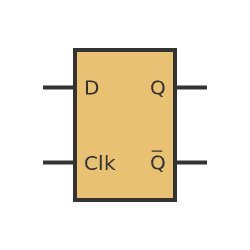
The D flip-flop is a structure that directly transfers the data input to the output at the rising edge of the clock signal. These flip-flops are widely used for data storage. The Q output takes the value of the D input at every clock pulse. The characteristic table of the D flip-flop is given below.

D flip-flop circuit (StackExchange)
The T flip-flop operates based on the T input and the current output state. When T=1, the output toggles with each clock pulse. When T=0, the output retains its current state. Due to these properties, T flip-flops are frequently used in counter circuits. The characteristic table of the T flip-flop is given below.

T flip-flop circuit (tutorialspoint)
The JK flip-flop is a variant of the SR flip-flop developed to eliminate the undefined state. It operates based on the J and K inputs. When J=K=1, the output toggles. In all other cases, it behaves similarly to the SR flip-flop and is preferred in multi-purpose digital applications. The characteristic table of the JK flip-flop is given below.

JK flip-flop circuit (DCAClab)
For flip-flops to operate correctly, certain timing constraints must be satisfied. These include setup time, hold time, and clock-to-Q delay. Violations of these parameters can compromise system reliability by causing problems such as metastability.
Violation of these timing values can cause the flip-flop to enter a metastable state. Metastability results in the flip-flop remaining in an unstable condition and producing random outputs. Therefore, simulation and timing analysis must be performed during the design phase to ensure that timing constraints are met.
Flip-flops serve as fundamental components in many digital circuit structures such as registers, counters, state machines, and timers. D flip-flops are used for data storage, while T and JK flip-flops are used for counting operations. Additionally, they function as state memory elements in finite state machines (FSMs).
Additionally, flip-flops serve as fundamental components in FPGA-based systems, digital filters, signal processing circuits, and various control units. By selecting the appropriate flip-flop type according to design requirements, system performance and accuracy can be enhanced.
Flip-flops are indispensable components for time and memory management in digital systems. Different types respond to different design requirements. When used in accordance with timing rules, they ensure system accuracy and stability. Therefore, careful selection of each flip-flop according to its intended purpose is essential.
Brown, Stephen and Zvonko Vranesic. "Fundamentals of Digital Logic with Verilog Design." 3rd ed. New York: McGraw-Hill, Accessed July 8, 2025. https://students.aiu.edu/submissions/profiles/resources/onlineBook/d6m3G9_Fundamentals_of_Digital_Logic_with_Verilog_Design.pdf
Dheeraj, Ajay. "J K Flip Flop Explained in Detail." DCAClab Blog, Accessed July 8, 2025. https://dcaclab.com/blog/j-k-flip-flop-explained-in-detail/.
Electronics Stack Exchange. "Difference between D-Type Flip-Flop and Edge-Triggered D-Type Flip-Flop." Electronics Stack Exchange, Accessed July 8, 2025. https://electronics.stackexchange.com/questions/223576/difference-between-d-type-flip-flop-and-edge-triggered-d-type-flip-flop.
M. Morris Mano and Michael D. Ciletti. "Digital Design." Pearson Prentice Hall, Accessed July 8, 2025.
Tocci, Ronald J., Neal S. Widmer, and Gregory L. Moss. "Digital Systems: Principles and Applications." 10th ed. Boston: Pearson, Accessed July 8, 2025. https://theswissbay.ch/pdf/Gentoomen%20Library/Electronics/Digital%20Systems%20Principles%20And%20Applications%20%20%5Bby%20Ronald%20Tocci%5D.pdf
Tutorialspoint. "What is Set-Reset (SR) Flip Flop." Accessed July 8, 2025. https://www.tutorialspoint.com/digital-electronics/what-is-t-flip-flop.htm
Tutorialspoint. "What is T Flip Flop." Accessed July 8, 2025. https://www.tutorialspoint.com/digital-electronics/what-is-t-flip-flop.htm

Triggering Methods | Edge-Triggered Level-Triggered | ||||||||
|---|---|---|---|---|---|---|---|---|---|
Main Flip-Flop Types | JK Flip-Flop T (Toggle) Flip-Flop D (Data) Flip-Flop SR (Set-Reset) Flip-Flop | ||||||||
Important Timing Parameters | Metastability Propagation Delay Clock-to-Q Delay Hold Time Setup Time | ||||||||
Application Area(s) | FPGA-Based Systems Delay Elements and Timers Data Synchronization Finite State Machines - FSM Counters Registers | ||||||||
Henüz Tartışma Girilmemiştir
"Flip-Flop Circuits" maddesi için tartışma başlatın
General Definition
Basic Structure of Flip-Flops
SR (Set-Reset) Flip-Flop
D (Data) Flip-Flop
T (Toggle) Flip-Flop
JK Flip-Flop
Timing Parameters
Applications