

Bu içerik Türkçe olarak yazılmış olup yapay zeka ile otomatik olarak İngilizceye çevrilmiştir.
+1 Daha
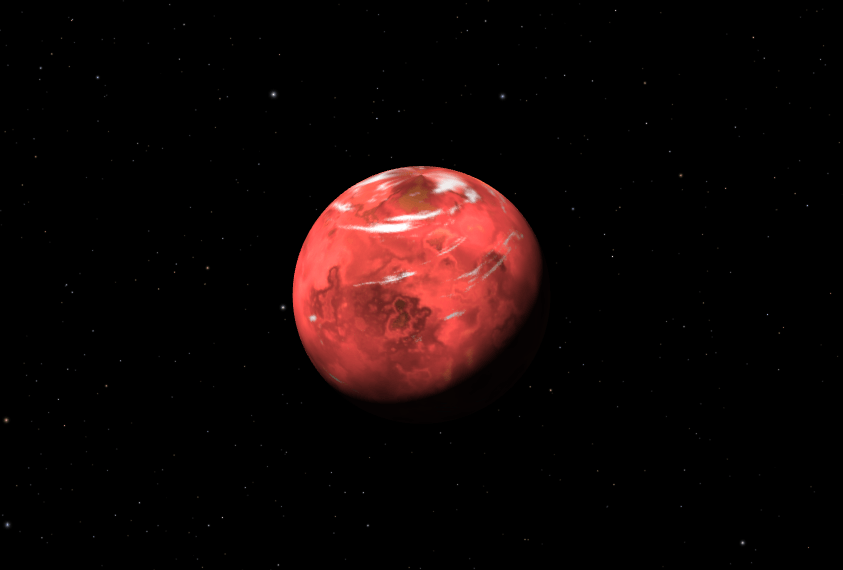
GJ 273 b, also known as Luyten b, is an exoplanet orbiting the red dwarf star GJ 273 (Luyten’s Star), located in the constellation Canis Minor at a distance of approximately 12.3 light years from Earth. Discovered in 2017, this planet belongs to the class of planets with masses greater than Earth’s and is classified as a “super-Earth”.

GJ 273 b (NASA)
It has been determined that GJ 273 b resides within the habitable zone of its host star and is relatively close to Earth. Due to these characteristics, the planet has become one of the primary targets for both potential habitability studies and METI (Messaging to Extraterrestrial Intelligence) projects aimed at establishing communication with extraterrestrial intelligence.
GJ 273 b was discovered using the radial velocity method. Observations were conducted with the High Accuracy Radial velocity Planet Searcher (HARPS) spectrograph located at the La Silla Observatory in Chile, operated by the European Southern Observatory (ESO). The discovery was carried out by an astronomy team led by Nicola Astudillo-Defru.
The team analyzed long-term variations in the spectrum of Luyten’s Star, identifying periodic stellar wobbles caused by the gravitational influence of orbiting planets. These analyses revealed a clear signal with an orbital period of approximately 18.6 days, indicating the presence of GJ 273 b. The same dataset also confirmed the existence of a second, smaller planet, GJ 273 c, located closer to the star. These findings were published in 2017 in the journal Astronomy & Astrophysics.
Luyten’s Star, cataloged as GJ 273, is a red dwarf of spectral type M3.5V named after Dutch-American astronomer Willem Jacob Luyten. Its proximity—only 12.3 light years from the Solar System—makes it a significant target for astronomical observation. The star’s mass and radius are approximately 29% of the Sun’s. With a surface temperature of about 3,100 Kelvin, Luyten’s Star is cooler and less luminous than the Sun, and its age is estimated to be several billion years.
One of Luyten’s Star’s most notable features is its magnetically quiet nature, unlike many other stars of similar spectral class. This stability reduces the likelihood that planetary atmospheres in its orbit would be stripped away by intense stellar flares, enhancing its potential for habitability. The star’s calmness and proximity to Earth make it critically important for studies aiming to investigate the atmospheric conditions and habitability potential of exoplanets such as GJ 273 b.
GJ 273 b is considered a potentially rocky super-Earth based on its physical and orbital properties. The planet completes one orbit around its host star in approximately 18.6 days at an average distance of 0.091 astronomical units. Its minimum mass, determined via the radial velocity method, is about 2.89 times that of Earth. This mass suggests the planet is not a gas giant but likely a solid-bodied world. However, since GJ 273 b does not transit its star, its radius and average density cannot be measured directly.
Nevertheless, theoretical structural models predict that if its composition is similar to Earth’s, its radius would be approximately 1.5 times that of Earth. Calculations based on the energy received from its star, excluding atmospheric effects, indicate an equilibrium temperature of about 293 Kelvin (20 °C). This temperature suggests conditions favorable for liquid water to exist on the surface, making GJ 273 b one of the most compelling targets for habitability studies.
GJ 273 b is one of the rare exoplanets that stands out in the search for extraterrestrial life due to its habitability potential. The planet lies near the inner edge of the “conservative habitable zone” of its host star, Luyten’s Star. This position means it receives only about 6% more stellar energy than Earth receives from the Sun. Such an energy balance suggests thermal conditions suitable for liquid water to exist on its surface. Additionally, GJ 273 b’s mass, several times that of Earth, implies it can gravitationally retain a thick atmosphere. Such an atmosphere could stabilize temperature variations and help prevent surface water from evaporating.
However, its proximity to the star likely results in tidal locking, meaning one hemisphere permanently faces the star while the other remains in darkness. In such a configuration, the most favorable region for life may be the twilight zone, known as the terminator line, between permanent day and night. This narrow band could offer moderate temperatures and potentially stable atmospheric conditions, making it the most likely region for life to exist.
Due to its relative proximity to Earth and potential habitability, GJ 273 b became one of the first exoplanets intentionally targeted by METI (Messaging to Extraterrestrial Intelligence) projects in human history. The initiative, named “Sónar Calling GJ 273b,” was a collaboration between the Sónar music festival in Spain, METI International, and the Catalan Institute of Space Studies (IEEC). The project carries both scientific and cultural objectives: to explore the possibility of communication with extraterrestrial intelligence and to peacefully announce humanity’s existence in the cosmos.
Through the EISCAT radio antenna in Tromsø, Norway, two separate radio signals were transmitted toward GJ 273 b. The first transmission occurred in October 2017, and the second in May 2018. The signals consist of an “instructional” section introducing fundamental mathematical and physical principles, along with musical compositions by various artists. After a journey of approximately 12 years, the signals are expected to reach the planet around 2029. If an advanced civilization exists there and responds, humanity could receive the reply no earlier than 2041. This project stands out as a pioneering example of merging scientific research with artistic expression.
GJ 273 b is part of a multi-planet system, offering an important example for understanding the dynamical structure of planetary systems. Two confirmed planets orbit the star: GJ 273 b and GJ 273 c. GJ 273 c, a close-in inner planet, has a minimum mass of about 1.18 times that of Earth and an orbital period of only 4.7 days. Due to its proximity to the star, conditions on its surface are not considered suitable for life. GJ 273 b, by contrast, is the most notable member of the system due to its location within the habitable zone and its longer orbital period.
In addition, there are tentative data indicating the possible presence of two additional planetary candidates that have not yet been confirmed. One candidate has an orbital period of approximately 473 days, and the other about 1,758 days. If these signals represent real planets, the system may have a more complex architecture. However, current observational data are insufficient to definitively confirm their existence. Therefore, the GJ 273 system remains a promising area for future research, requiring more precise observations to fully elucidate its planetary composition.

Henüz Tartışma Girilmemiştir
"GJ 273b" maddesi için tartışma başlatın
Discovery and Initial Observations
Host Star: Luyten’s Star (GJ 273)
Physical and Orbital Characteristics
Potential for Habitability
METI Project: Sónar Calling GJ 273b
Planetary System