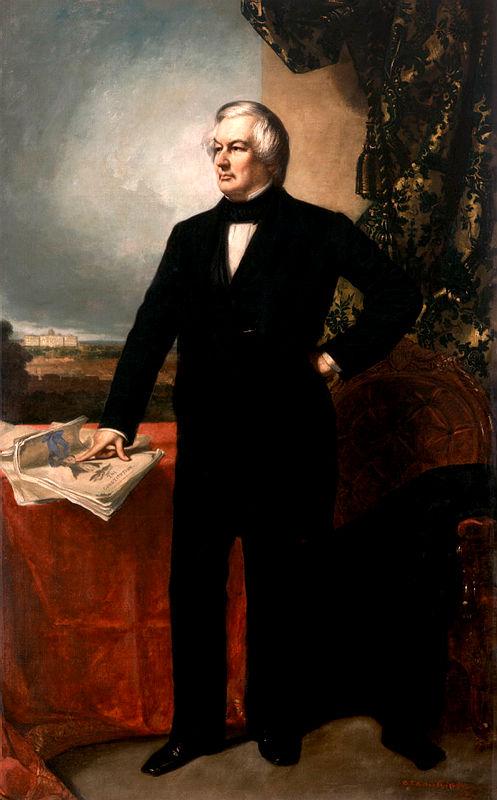



Doğum tarihi | 1800-01-07 | ||||||||
|---|---|---|---|---|---|---|---|---|---|
Eş | Caroline Carmichael McIntosh (1858–1874) Abigail Powers Fillmore (1826–1853) | ||||||||
Place of Birth | Locke Township (present-day Summerhill), Cayuga County, New York, USA | ||||||||
Ölüm tarihi | 1874-03-08 | ||||||||
Place of Death | Buffalo, New York, USA | ||||||||
Çocuk | Mary Abigail Fillmore Millard Powers Fillmore | ||||||||
Presidential Order | 13th President of the United States | ||||||||
Millard Fillmore was born on January 7, 1800, in Cayuga County, New York. His family belonged to a poor farming household, and Fillmore grew up under difficult living conditions. During a time when educational opportunities were limited, he was directed toward various trades. Driven by his interest in education, he pursued self-improvement independently. He met Abigail Powers, his teacher at the New Hope Academy, and married her in later years. In 1823, he was admitted to the New York Bar and began his legal practice in Buffalo.
Fillmore’s political career began with his election to the New York State Assembly in 1829. He subsequently served three terms in the U.S. House of Representatives between 1833 and 1835 and again between 1837 and 1843. During this period, he supported legislation opposing debtors’ imprisonment and engaged in work on tax policy. Becoming a prominent figure within the Whig Party, Fillmore was appointed Comptroller of New York State in 1847, drawing attention for his expertise in financial matters. In the 1848 presidential election, he was nominated as vice presidential candidate alongside presidential nominee Zachary Taylor, marking his entry into federal leadership.
Fillmore assumed the presidency of the United States on July 10, 1850, following the sudden death of President Zachary Taylor on July 9. His succession led to a significant shift in the direction of the federal government. Taylor’s cabinet resigned, and Fillmore appointed moderate Whig figures to these positions. His appointment of Daniel Webster as Secretary of State was a clear indication of his preference for a conciliatory policy.
In the early months of his presidency, steps were taken to address slavery-related legislative proposals that had been delayed during Taylor’s term and had generated nationwide tension. Fillmore supported the Compromise of 1850, initially proposed by Henry Clay and later broken into separate bills by Stephen A. Douglas. This legislative package included the admission of California as a free state, the redrawing of Texas’s boundaries, the abolition of the slave trade in Washington D.C., and the enactment of the Fugitive Slave Act.
Fillmore’s support for the Compromise of 1850 laws drew strong opposition from anti-slavery Whig voters in the North. The Fugitive Slave Act, in particular, faced widespread criticism for granting broad powers to slaveholders and mandating the return of escaped slaves even in free states. This act became one of the primary reasons Fillmore was not renominated by the Whig Party in the 1852 presidential election.
After his term ended in 1853, Fillmore withdrew from political life for a time. That same year, his wife Abigail Fillmore passed away. In 1856, he was again nominated for president by the Know-Nothing (American) Party, known for its anti-immigrant and anti-Catholic policies. Fillmore won electoral votes only in the state of Maryland.
After returning to civilian life, Fillmore contributed to the cultural and social development of Buffalo. He played a role in founding the Buffalo Historical Society, the Buffalo Academy of Fine Arts, and the Grosvenor Library. He married Caroline Carmichael McIntosh in 1858. During the American Civil War, he maintained a Unionist stance but criticized President Abraham Lincoln’s policies. Nevertheless, he was instrumental in establishing the Buffalo Union Continentals, a local militia unit.
Fillmore died on March 8, 1874, following a stroke. He was buried in Forest Lawn Cemetery in Buffalo, where he had spent much of his life. He is remembered in American political history as the last president of the Whig Party and for his role in using the Compromise of 1850 to temporarily avert civil conflict in the nation.
American Battlefield Trust. “Millard Fillmore.” American Battlefield Trust. Accessed July 15, 2025. https://www.battlefields.org/learn/biographies/millard-fillmore
American History Central. "Millard Fillmore." American History Central. Accessed July 15, 2025. https://www.americanhistorycentral.com/entries/millard-fillmore/
History, Art & Archives, U.S. House of Representatives. “Fillmore, Millard.” *Biographical Directory of the United States Congress*. Accessed July 15, 2025. https://history.house.gov/People/Detail/13119?ret=True
Miller Center. “Millard Fillmore: Life Before the Presidency.” Miller Center, University of Virginia. Accessed July 15, 2025. https://millercenter.org/president/fillmore/life-before-the-presidency
Obama White House Archives. “Millard Fillmore.” The White House. Accessed July 15, 2025. https://obamawhitehouse.archives.gov/1600/presidents/millardfillmore
The White House Historical Association. “Millard Fillmore.” *White House History*. Accessed July 15, 2025. https://www.whitehousehistory.org/bios/millard-fillmore

Doğum tarihi | 1800-01-07 | ||||||||
|---|---|---|---|---|---|---|---|---|---|
Eş | Caroline Carmichael McIntosh (1858–1874) Abigail Powers Fillmore (1826–1853) | ||||||||
Place of Birth | Locke Township (present-day Summerhill), Cayuga County, New York, USA | ||||||||
Ölüm tarihi | 1874-03-08 | ||||||||
Place of Death | Buffalo, New York, USA | ||||||||
Çocuk | Mary Abigail Fillmore Millard Powers Fillmore | ||||||||
Presidential Order | 13th President of the United States | ||||||||
Henüz Tartışma Girilmemiştir
"Millard Fillmore" maddesi için tartışma başlatın
Presidency and the Compromise of 1850
Later Life and Political Legacy