


Bu içerik Türkçe olarak yazılmış olup yapay zeka ile otomatik olarak İngilizceye çevrilmiştir.
Musketry in the Ottoman Empire
Origin(s) | 14th century | ||||||||
|---|---|---|---|---|---|---|---|---|---|
Type(s) | Talisman | ||||||||
Purposes of Use | protection escaping from a misfortune harming an enemy overcoming psychological problems attracting affection gaining status or position Finding a cure | ||||||||
Those Who Make Muska | Astrologers, sorcerers, charmers | ||||||||
Muskas are among the most widespread talismans used by people to protect themselves from visible and invisible malevolent entities, or to attract blessing, fortune and good fortune. From the Sumerians, humanity’s first civilization, and even before the invention of writing as understood from the Göbeklitepe discovered in close history, muskas had already taken root at the foundation of civilization.
In ancient societies, the tradition of muska-making emerged as a means of protection against the wrath of supernatural forces and later manifested in various forms and structures in medieval, early modern and modern societies. No religion or culture has ever been able to purify itself entirely of muskas. In the Ottoman Empire, muska-making developed particularly in connection with ilm-i nücum, ilm-i cifr and ilm-i reml【1】, permeating society and spreading not only among the only people but also among the ricali, eventually attaining institutional status within astrology.
Etymologically, the word muska is a Turkish corruption of the Arabic word nüsha, meaning “written inscription.” The question of what concept the term muska precisely denotes and what it excludes appears highly complex. In scholarly literature, the only point on which there is general agreement is the purpose of the muska.
A muska may be created to protect individuals from all physical or spiritual harm and threats, or to bring luck, open fortune, warm hearts, or fulfill a desire. Until now, muskas have generally been defined as nüsha, while those inscribed specifically to be given to a person or object are termed black nüsha. While there is little disagreement in muska literature up to this point, definitions of what a muska actually is vary widely thereafter.
The school closer to ancient history equates muskas with the Latin term “amulet,” defining muska as “anything believed to possess supernatural power to protect humans from evil spirits and malevolent entities.” Under this definition, any object, image or inscription bearing protective symbols—such as depictions of deities, sphinxes and statues believed to have protective power, or any item inscribed with protective words—qualifies as a muska. This definition greatly expands the concept, leading us to the point where “everything magical is a muska.”
The school closer to Islamic history associates the term muska with nüsha and while its definition is similar, it centers on writing. Thus, generally, “any written object possessing a protective effect is a muska.” Here too, there is ambiguity regarding the definitions of vefk, cifr and rukye. It is not certain whether each of these constitutes a separate muska, or whether they become muskas only when written on paper and carried by people.
From all these debates, it is understood that muska is one of the subcategories of talismans, which denote all magical objects. Vefk, rukye and cifr are distinct sciences that form the constituent elements of a muska. A single muska may contain all three—vefk, rukye and cifr—or only one of them. Thus, muska refers to the total composition of the medium on which writing is inscribed, the script itself and the ritual involved.
According to general consensus, muskas originated from the desire of ancient societies to counter natural disasters, which they could not otherwise control, with an equivalent supernatural force. The earliest known muskas appear in the geography of Egypt. These were made by engraving symbols of protective deities such as Ka and Ra onto precious metals and are regarded as the first protective muskas. Subsequently, this tradition was found among all ancient civilizations including Greek, Hittite, Assyrian, Sumerian and Babylonian cultures.
Muska-making was also widespread among the nomadic Arab tribes of Arabia. During the Jahiliyya period, muska practices especially manifested in the form of deity representations, but were partially eradicated following Islam’s prohibition of such practices. However, from the 9th century onward, particularly through the influence of Mu'tazilite and Kharijite scholars such as Ja'far al-Sadiq and Jabir ibn Hayyan, muska-making gained wider acceptance, and by the 10th century, with the works of Ibn Wahshiyya and Ahmed ibn Crescent titled Kitabü’r-ruk’a ve’t-tevaiz【2】, it became established throughout the Islamic world.
Many Islamic scholars permitted the making and carrying of muskas on the condition that they avoided shirk and did not believe in the muska’s inherent protective power. In the Ottoman Empire, continuing the Sunni Islamic tradition, the practice persisted under the names rukye-hanlık or nüshacılık, and ultimately acquired official status with the establishment of the müneccimbaşılık institution in the 15th century. It is even recorded that Ottoman sultans embarked on campaigns wearing muska-inscribed shirts.
Although from the mid-19th century onward increasing Europe pressure and modernization initiatives led to attempts to ban certain such practices and astrological texts, these efforts undoubtedly failed to eradicate the deeply rooted muska culture among the populace.
Cifr refers to the science of assigning numerical values to each letter of the Arabic alphabet and using these values to derive hidden meanings or interpret signs (Appendix 5). These numerical values were frequently used in literature and historiography, especially in dating events, where dates were often written not as numerals but as letter combinations calculated according to cifr. Additionally, arranging the cifr values of verses to correspond with the Hijri calendar, the birth of the Prophet Muhammad, and the dates of conquests was employed as a art. Since each letter was believed to possess unique properties, the numbers and letters used in muskas were always arranged in accordance with cifr calculations.
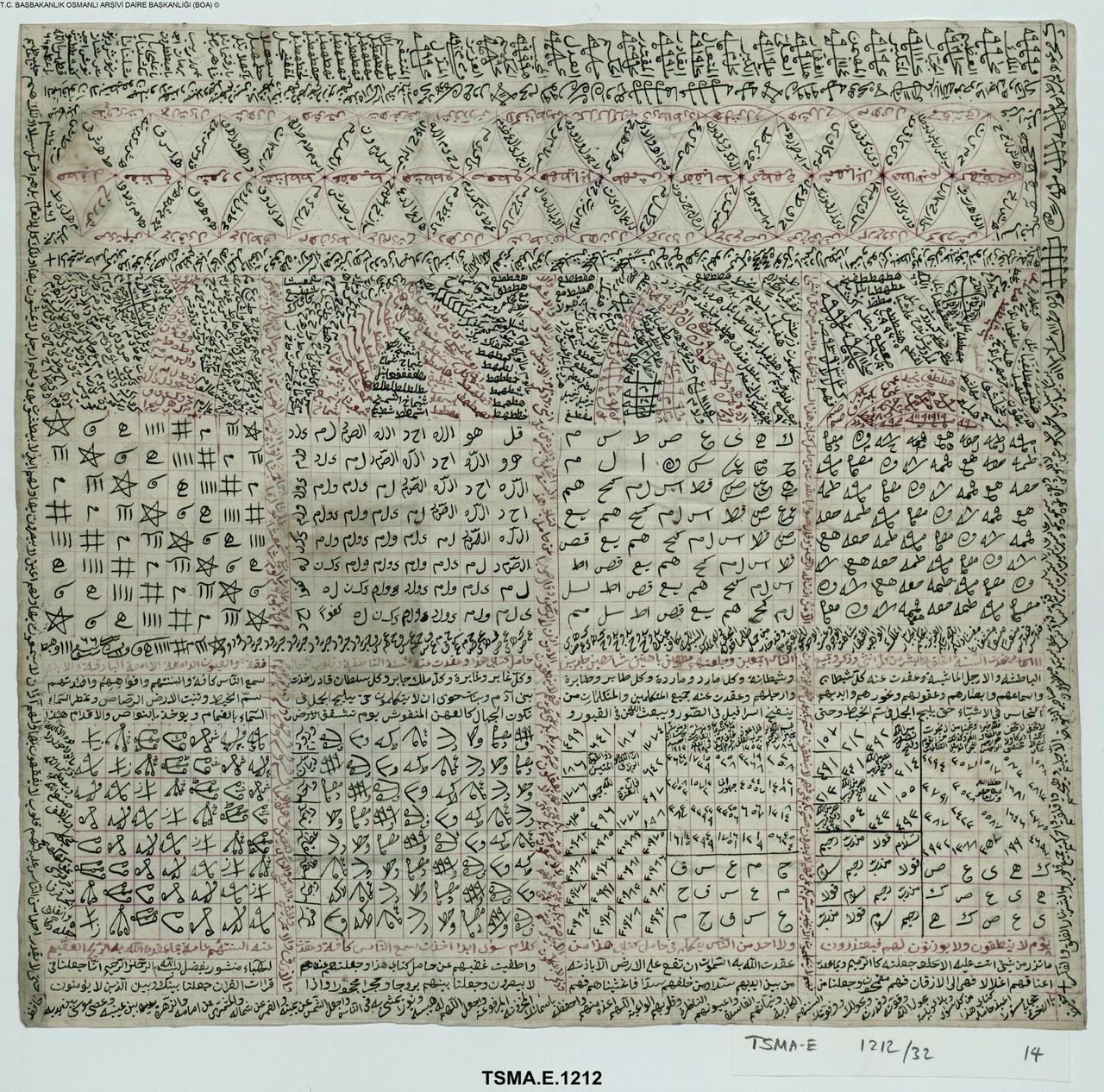
Vefk, meaning “harmony” in Arabic, denotes a grid-like space typically composed of 3x3, 4x4 or 5x5 squares, within which letters or numbers arranged according to cifr calculations may be placed. These squares could also contain Quranic surahs, ayahs or symbolic figures.
The reason this rectangular area is referred to as “alignment” is due to the arrangement of letters, verses, or symbols according to a specific pattern. Whether the muska was created for protection or law, various verses or names could be divided and placed within the vefk according to cifr calculations, or undivided portions of names or surahs could be arranged in sequence. These were generally identical when viewed from top to bottom or diagonally. For instance, when examining crossing, all identical letters or numbers appear in the same order, while viewing from top to bottom or right to left reveals different shapes or letters arranged together (Appendix-1).
The foundation of this arrangement rests on two key questions: For whom is the muska being made? And for what purpose is it being made? Depending on the answers to these questions, odd or even numbers are used within the vefk, and symbols are selected according to context. For example, in a muska intended for healing, Surah Al-Fatiha or its equivalent cifr is used predominantly, whereas in muskas created for protection, Ayat al-Kursi, Al-Mu’awwidhatayn, or Nas are used primarily.
The muskas produced in the Ottoman period and the symbols employed within them were highly diverse and not uniform. The age, gender, and religious affiliation of the person for whom the muska was made could influence its design, as could the intended purpose of the muska, which introduced further variations. Excluding the generic muskas given by those with little knowledge of this science, muskas were in fact custom-made according to individual circumstances, persons, and purposes; specific cifr calculations were performed, and sometimes assistance was drawn from the science of astrology.
Muskas can fundamentally be divided into three categories: those written on paper, those inscribed on metals, and those created on natural materials. Since a muska was typically worn on the person, materials capable of withstanding wear were preferred. Consequently, the most common type consisted of writings on high-quality, thick paper, covered with a prayer cloth. However, paper was not the only material used for muskas.
It was possible to create muskas from any material, provided it was clean and unused. Thus, muskas were made from wood, silver, clay, leather, and even stone. Among these, muskas made from iron and similar metals were the second most common, while those made from materials such as stone and wood were the least frequent. These natural material muskas likely did not survive to the present day because they deteriorated quickly or were intentionally burned as part of incense rituals; hence their scarcity.
A muska could be created using cifr calculations, data derived from astrology, or simply by writing verses, surahs, and symbols appropriate to the situation. In some rare cases, all these sciences were applied simultaneously, requiring extensive expertise. Astrologers who observed planetary movements, calculated their positions, and interpreted them for use in muskas possessed the highest level of knowledge in this field and generally incorporated cifr calculations into their designs.
Muskas created solely through cifr calculations were the second most difficult to produce. For such muskas, merely knowing the numerical values of letters was insufficient; one also needed to understand the meanings of numbers, the contexts in which they should be applied, and which numbers brought benefit versus harm. Muskas composed exclusively of verses and symbols (Appendix-7) were the easiest to make, since their meanings were already known; this method was most frequently used by those unfamiliar with these sciences but seeking to profit from muska-making.
The most common symbols used in muskas include: the six-pointed seal of the prophet who held dominion over jinn and nature, the hand of Ayşe main, believed to bring healing【3】, the letter “mim” representing Prophet Muhammad, three lines symbolizing Jesus, and the staircase symbol representing miracles. In addition, many other shapes and symbol whose meanings remain undeciphered are also used.
A muska could serve not only protective purposes but also be employed to foster affection between individuals. Such muskas typically contained vefks arranged according to cifr calculations, including the names of both the person for whom the muska was made and the person who commissioned it, along with their mothers’ names.
Example Text
Izzetlü, saâdetlü, şerâfetlü, muhabbetlü nûr-ı aynım oğlum Mehmed Efendi hazretleri, vakt-ü şerifiniz saîd ve ömr-ü devletiniz mezîd olsun. Benim oğlum, benim canım bu defa siz oğlumuzun saâdeti ve cümleye sevgüli ve şirin görünmeniz içün devletiniz dâima müzdâd olmaklık içün ve matlûbunuz olan murâdınız istediğiniz gibi hâsıl olmaklık içün ve sâirler ve cümleye şirin görünmek içün ve şevketlü efendimize ve silahdar ağa efendimize şirin görünmek içün ve an-karîb mukarreb olmanız içün bu def’a bir sâhib-i kemâlin bir vefkini tarafınıza memhûren göndermişizdir. Hulûsan sıdk ile boynunuzda taşıcaksınız. Manzûrunuz olup ve içindekini sırren, ihtibâen sarıp hammal köse ile tarafımıza gönderüp kendi elim ile bir gümüş muskaya koyup ve kapağını dahi lahm edüp gine tarafınıza irsâl edelüm. Heamân hakk teâlâ hazretleri te’sirini halk eylesün âmin ve cümlesine şirin göründürsün ve muhabbetler ve sevgüleri senin üzerine olsun. Benim oğlum adeti ve şurûtı üzere min-bâd babanın dergahına bu vefk-i şerif içün on iki buçuk guruş nisâbını ben verdim. Yine vefk-i şerîfi gönderdiğiniz vakit ol on iki buçuk guruşı gönderesiz. Ve bi’l- ihtifâ muskası içün de bir mikdar pâre ve bu muska-i şerîfi yazan sizin ve benim cümlemizin pederi makamında olan Seyfeddin çerağ olup ve otuz beş senede dâr-ı bekâ edüp bu sahib-i mühr, sadrâzam efendimizin silahdârlığında dizdârlığını bırakup ve siz gibi dermiyân olup harc-ı hass hesâbından mâhiyye yüz guruşa kâin olan sâbık Kütahya dizdârı Mehmed Efendi’ye verildü. Bizim merhum Beşir ağanın içerüde iken lalası ve sen oğlumu bile evlatlığa kabul etdi ve bu vefk-i şerîfi ziyade hıfzetmenizi niyâz etdi ve cümleden ketm etmenizi niyâz ederler ve husûsen size minnet ederler ve hayr duandadırlar ve bu vefk-i şerîfin kabı(?) yapılmağa gönderdüğünüzde hammal köse yine benim elime versin sâire vermesün hemân sağ olasın, gönder ki ne müşahadesin görürürsün ve ne müşahade olunur ise tarafımıza bildüresiz...
This document, dated approximately 1214 AH / 1799 CE, provides valuable information regarding muska usage. As clearly indicated in the text, the muska was composed with the aim of gaining favor in the eyes of Mehmed Efendi’s superiors, who belonged to the group of silahdars. Thus, its primary purpose was to foster affection toward Mehmed Efendi. The key observation here is the distinction made in the text between “vefk” and “muska.” The written portion is referred to as the vefk, while the silver container into which the vefk was placed (likely rectangular and small) is termed the muska. In this context, “muska” refers to the container holding the vefk.
The text also describes rituals associated with the muska. Mehmed Efendi’s mother requested that he return the vefk to her so she could place it herself into a silver muska. Why did she not simply have the vefk placed directly into the muska and send it? Several possibilities exist. In muskas designed specifically to foster affection, it was common practice to include a personal item of the intended recipient—such as hair or a fragment of skin—within the muska. Thus, the vefk may have first been sent to Mehmed Efendi. Another possibility is the principle that only the person for whom the vefk was prepared could open it; hence, the vefk was sent back to his mother for her to open and transform it into a muska. A third and more probable explanation concerns money. Commissioning a silver muska involved considerable expense, as silver was the most durable and easily workable material suitable for muskas. In the letter, Mehmed Bey’s mother states that she paid for the vefk and requested that he return it along with payment for both the vefk and the muska.
Furthermore, it is evident that secrecy was the most critical ritual associated with muskas. The muska was sent covertly; Mehmed Bey was instructed to open it secretly and wear it discreetly, and he was repeatedly warned not to reveal its presence to anyone. There are two reasons for this. First, there was fear that if the muska fell into another’s hands, its efficacy would be lost. Second, regardless of circumstances, objects associated with such practices were generally disapproved of, and their possession could lead to trouble. Additionally, the mother’s request for confirmation of the muska’s effectiveness indicates that muskas were not blindly trusted; their efficacy was actively tested. Finally, the mention of a muska’s price in 18th-century Ottoman society is another significant detail.
Since muskas are writings inscribed on materials with intentions of benefit or protection, writings composed using cifr calculations to interpret signs from the future also fall within the category of muskas. The purpose here is to foresee future dangers, warn the recipient, and safeguard them from these threats.
Example Text
Benim azîzim sultânım hazretleri, murâdınız her ne ise inşallâh-ü tealâ nâil-i murâd olursız, hemân bâri-i tealâ hazretleri ma’niden halâs eyleye ve kaldı ki bir murâdınız var ise biz hâkire sırren bildiresiz, biz dahî havass yüzünden ve gerek ahar yüzünden leyl-i nehâr, vâcibü’l-vücûd olan mevlâ-i müteâl hazretlerine teveccüh edelim. İnşallâhü teala husûlü me’mulünüzdür ve nice dürlü nefhamız aşikâre ola vesselam, bâkiü’d-duâ. Hurûf-ı ümmehât bunlardır, bunlardan dahî nice hurûflar zuhûr eylemiştir. Kesr-i bast ile ve tarh ile benim sultânım hazretleri, birkaç türlü cifr buluruz, bundan akvâ kavl yoktur. Bu cifr kâidesince "ala yağlem gaybi alellah" cenâbınıza inşallâh-ü teâlâ çok hayrlar vardır ve lâkin üç sekteniz vardır. Birisi kırk dokuz günden bir mikdâr sürûrdur. Ondan geçince, doksan dört günde devlet umûrunda bir umûr zuhûr eder. Şems-kamer umurudur ya ma’den veya darp haline müteallik umûrdur andan sonra 196 aded günde seyyârınız (yıldız manasında) bi-külli açığa çıkup ve bahtınız küşâd olup bir büyük sadra geçüp âlem size teslim olur inşallahu teâlâ, ve iki hasmınız vardır. Biri boyu uzun yani arpa boydur ve benzi kızıl ve boz nişanlı ve dişi ayıplı kimesnedir, andan hazer gerekdir ve bir ulu kimesne yüzünden feth ola vesselâm.
Sample Text
My sovereign sultan, it is known to Your Imperial Presence that... By the grace and blessings of Your Sultanate, secrets have been revealed to me through the study of the sciences of reml and cifr, as well as the arcane and wondrous sciences, such that day and night I find no rest until I present to Your Imperial Presence that this original marvel and mystery has never occurred before except for three individuals since the time of the Prophet peace be upon him. Know, O Sultan, that the extraordinary secrets of Your Majesty have been manifested in a manner without end, for such an original mystery has never occurred to any sovereign before.
In the earliest text, dated approximately AH 1255 / CE 1839, we encounter a cifr calculation directly composed for the sultan.【4】 The practice of using cifr to discern signs of the future is a tradition extending from ancient civilizations to the present day. However, because in Islam only Allah is believed to know the future, cifr in the Ottoman context did not emerge as a direct means of foretelling events, but rather as an interpretive tool for discerning signs and warnings about the future. This condition is clearly evident in the text, as the person performing the cifr felt compelled to declare immediately before revealing any future insight: “I am bound by the unseen will of Allah” means.
How were such muskas applied? Again, the person performing the cifr briefly explained the process to the sultan, writing down the symbols and the numbers and letters derived from them. According to this method, after the cifr calculation, the primary letters were arranged according to specific rules to generate new letters, from which, in conjunction with the science of nücum, predictions about the future were made. The emphasis placed here on the seyyara—the star of the person performing the cifr—suggests that the practitioner was expected to be a learned müneccim well-versed in astrology. Thus, to produce such a muska, it was insufficient to be merely a common rukye-caravanserai; mastery of the science of stars was also required. In other words, this type of muska belonged to the most difficult category of muskas. The phrase “there are three sekteniz” in the text has become a popular tradition, still used in folk fortune-telling in the form “up to three times.”
The second text, dated approximately AH 1100 / CE 1689, is significant because it explicitly identifies the sciences associated with this type of muska. According to this text, to produce a muska intended to receive news or good tidings of the future, one had to be knowledgeable not only in cifr and reml, but also in the sciences dealing with acâib and garâib. When combined with the information from the previous text, it becomes clear that mastery of the four sciences—vefk, cifr, nücum, and reml—was required to produce such a muska, making it perhaps the most difficult of all muskas to compose.
Muskas could also be used to avert evil or to achieve healing. In muskas intended to avert evil, the aim was to prevent an existing or likely evil from occurring; in muskas created for healing, the aim was either to prevent illness before it appeared or to cure an existing disease.
Sample Text
It is the desired act of His Imperial Majesty that the invocation be carried out upon arrival. These copies have been sent to Osman Efendi. If their ritual fails to bring peace and order, and if the generals Orlof, Irşikof, and Romançuk return, let Osman Efendi be buried in the quarter they pass through. If they pass over it, they will certainly be forced to flee...
Sample Text
...As a token of my profound gratitude to my noble master, I have sent you, from the risale of the late Nusret Efendi, copies intended to prevent the appearance of plague, smallpox, and other sores. I have instructed Mehmed Ağa, servant of your imperial household, to deliver them. I earnestly beseech you not to forget them once they arrive, but to sew them inside the garment...
Based on the event described in the text, the first text, dated AH 1151 / CE 1738, refers to an intriguing muska composed during the peace negotiations of the Ottoman-Russian War of 1735–1739. According to the text, the order to prepare and implement this muska was transmitted by the Rikap kaymakamlığı to the army, with emphasis placed on the fact that it was directly requested by the sultan himself. The purpose of the muska was to compel the Russian peace delegation’s generals to flee if the peace talks failed to yield a favorable outcome. Thus, this muska was fundamentally designed to avert evil.
The ritual of application involved burying the muska along the path the targeted individuals would traverse. This practice is one of the common methods used in muska rituals, alongside fumigation, mixing into water for ingestion, or carrying it on the person, because it was widely believed that for the muska to be effective, it must be placed in close proximity to or directly upon the intended person.
The second text provides detailed information regarding muskas created for healing. Dated approximately AH 1228 / CE 1813, this text describes how a certain Osman Efendi, in gratitude for receiving silks as a gift from the palace (likely from grand vizier), composed and sent a protective muska against illness. The ritual of preparation is particularly noteworthy. According to the text, Osman Bey must have prepared the muska using a vefk or cifr taken from the Risale of Nusret Efendi. The work referred to here is the Mucerrebat-ı Nusret, also known as Risale-i Mahazar or Mahazar Fi’t-tıb. This work is related to medicine, and its opening sections discuss healing methods involving vefk and prayers. It is likely that Osman Efendi selected one of the vefk examples from this book to create his muska. Thus, it appears that while some muskas were custom-made from scratch for specific individuals, others were constructed using pre-existing vefk examples drawn from such texts.
The requirement to sew the muska inside the garment directly reflects the principle that the muska must remain close to and concealed from the person it is intended to protect. It is also significant that the illnesses against which this muska was designed—plague, smallpox, and sores—were notoriously difficult and often fatal to treat in that era.
Muskas are still used today for ailments such as jaundice, madness, depression, and their efficacy is generally accepted among those who practice them. Just as in the Ottoman era, muskas were accepted as methods for addressing psychological distress.
Sample Text
Hasan of Tirana, a private soldier in the first platoon of the third company of the Second Nizamiye Infantry Regiment stationed at Hanya on the island of Crete, received this amulet from Cinci Mehmet Efendi. Due to the ineffectiveness of this amulet, the said soldier threw himself into the sea and later went to the bathhouse where he cut his throat with a razor and killed himself. Consequently, the military council convened by Mirliva Saadetlü Mehmed Pasha and submitted to the Sublime Porte as the Supreme Military Tribunal, issued a ruling on 18 Recep 1278, numbered nineteen, by the Directorate of the Supreme Council of Judicial Decrees. The question before the court was whether Mehmet Efendi had committed a physical act that was legally and religiously provable: did the soldier acquire this amulet because he suffered from acute madness, and was this the reason he obtained it from Mehmet Efendi? It was ordered that this matter be formally reported and submitted to the religious authorities. Although every order issued by the Sublime Porte is binding upon our superior responsibilities, the said Arab Mehmet was a poor man from Hanya, living in (...) and (...) conditions, possessing no knowledge or skill whatsoever, and being an ordinary ignorant person, yet some uneducated individuals convinced him that he possessed expertise in amulet-making. Through this means, he collected five or ten kurushes from those who sought him out, falsely presenting himself as an effective amulet-maker. Even though he gave an amulet to the said soldier, it had no effect whatsoever. A dispute arose between the soldier and Mehmet Efendi over the refund of the payment, and Mehmet Efendi was arrested and detained by the zabtiye police station. However, no party submitted any testimony or complaint regarding the trial, and his detention period was extended. Due to his deteriorating mental state, he was subjected to psychiatric evaluation. For this reason, five and a half months prior to this, he had left for his homeland, Edirne, under surveillance. Although necessary investigations were also conducted this time, no reliable evidence could be obtained to prove that the soldier obtained the amulet because of his acute madness. Moreover, approximately one month after the dispute, it became evident that the soldier had intentionally harmed himself in the bathhouse. Hence, the circumstances of the incident were summarized in this report...
In this text dated h. 1278 / m. 1861, we encounter an example of an amulet prepared to address psychological distress. Although no details are provided regarding the preparation of the amulet, two issues stand out. First, the accusation against Cinci Mehmet Efendi is highly intriguing: he is blamed for the amulet’s ineffectiveness, and the court formally investigates whether he wrote the amulet specifically to alleviate the soldier’s madness. Furthermore, due to the same perceived ineffectiveness, he was later involved in legal proceedings with Hasan, who subsequently committed suicide. Thus, amulet-making was not, as commonly assumed, a trivial practice devoid of responsibility; rather, it was a profession for which the recipient expected tangible results and which was subject to official scrutiny. Here, even if it were proven that Mehmet Efendi wrote the amulet specifically to treat the soldier’s madness, he would still be implied to be liable for punishment.
Additionally, the same text emphasizes that Mehmet Efendi possessed no knowledge whatsoever on this subject. Conversely, this implies that there were individuals who did possess such knowledge and whose amulets were believed to be effective. Another significant issue in the text is the designation “cinci.” While Ottoman documents typically refer to amulet-makers as nushacı, muskacı, remmal, müneccim, or rukye-han, the fact that a cinci was consulted in this case of madness suggests that cincis were particularly associated with addressing such psychological phenomena.
In conclusion, muskacılık—the art of amulet-making, a sub-branch of sorcery and talismanic practices—has exerted influence across all cultures since ancient civilizations. In the Ottoman context, this practice emerged as nushacılık, rukye-hanlık, or remmallık. The various forms of amulets produced by muskacılar were employed for a wide range of purposes: warding off evil, attracting good fortune, opening luck, alleviating madness, healing illnesses, achieving desired goals, gaining knowledge of the future, and fostering affection between people. These practices continue to be used to this day.
Appendix-1
A highly complex amulet incorporating vefk, cifr, and nücum calculations, alongside numerous known and unknown symbols, names, numbers, and verses. The Seal of Solomon, the letter mim, a ladder, and four lines on the left center are well-known common symbols, while the symbols directly beneath them in the vefk are rarer.

Appendix-2
An amulet featuring a 7x7 vefk constructed by dividing the verses of Surah Al-Fatiha and assigning numerical values according to cifr calculations. (From right to left: 1-Bismillahirrahmanirrahim, 2-elhamdulillahi rabbil alemin errahmanirrahim, 3-maliki yevmiddin, 4-iyyake nağbudu ve iyyake nestain, 5-ihdinessıratal müstakim sıratellezine, 6-enamte aleyhim, 7-gayril mağzubi aleyhim veleddallin; Center: “O Allah, grant him sovereignty, power, and strength, by the grace of Allah the Exalted.”)

Appendix-3
An example of a vefk constructed by assigning numerical values to the days of the month and week according to cifr calculations, and deriving corresponding letters from those numbers.

Appendix-4
An amulet featuring a 9x8 cifr-based vefk alongside inscribed text. The irregular arrangement of the vefk and the writing suggests either haste or that it was not produced by a professional hand.

Appendix 5
A document containing a written and graphical explanation of a cifr calculation performed for the Sultan.

Appendix 6
An example of a talisman featuring two opposing veftes of dimensions 9x6, incorporating cifr and nujum calculations based on the placement of the names of Allah. The inclusion of a circular veft and the presence of twelve central circles indicate extensive use of nujum knowledge in its construction. It is likely that the cifr equivalents of the names of Allah were employed in the cifr calculation.

Appendix 7
An example of a talisman containing a 7x6 veft constructed using symbolic elements.

Archival Sources
Ayşe, Yanardağ. "Osmanlı Devleti’nde Islahatlar Bağlamında Muska ve Falcılıkla Mücadele Örnekleri", Milli Folklor Dergisi, No. 30, (Sivas 2018)
BOA, Ottoman Archives. Meclis-i Vala [MVL]. File No. 788, Shirt No. 22.
BOA, Ottoman Archives. Nezaret veDevair Evrakı [A.MKT.NZD.]. File No. 295, Shirt No. 62.
BOA, Ottoman Archives.Topkapı Sarayı Museum Archives [TS.MA.e]. File No. 1212, Shirt No. 30.
BOA, Ottoman Archives.Topkapı Sarayı Museum Archives [TS.MA.e]. File No. 1212, Shirt No. 32.
BOA, Ottoman Archives.Topkapı Sarayı Museum Archives [TS.MA.e]. File No. 304, Shirt No. 69.
BOA, Ottoman Archives.Topkapı Sarayı Museum Archives [TS.MA.e]. File No. 655, Shirt No. 19.
BOA, Ottoman Archives.Topkapı Sarayı Museum Archives [TS.MA.e]. File No. 671, Shirt No. 27.
BOA, Ottoman Archives.Topkapı Sarayı Museum Archives [TS.MA.e]. File No. 865, Shirt No. 72.
BOA, Ottoman Archives.Topkapı Sarayı Museum Archives [TS.MA.e]. File No. 868, Shirt No. 24.
BOA, Ottoman Archives.Yıldız Esas Documents [Y..EE..]. File No. 37, Shirt No. 75.
Hayrunnisa, Turan. "Kudüs ve Yafa’daki Bazı Örnekler Işığında Osmanlı Tılsımları", Uluslararası Sosyal Araştırmalar Dergisi, Volume 11, No. 55, (2018)
Hikmet Tanyu, "Büyü", DİA, VI, 501-506
Kürşat Demirci, "Muska", DİA, XXXI, 265-267.
Metin Yurdagür, "Cefr", DİA, XXII, 124-126.
Research Works
Serkan, Çınar. "Ebubekir Nusret Efendi’nin Risale-i Nusret Efendi Adlı Eseri", Karabük Üniversitesi Sosyal Bilimler Enstitüsü, Türk Dili ve Edebiyatı Anabilim Dalı, Master's thesis, (Karabük 2019)
Tevfik Fehd, "İlm-i Ahkam-ı Nücum", DİA, XXXV, 219-222.
İlyas Çelebi, "Muska", DİA, XXXI, 267-269.
İlyas Çelebi, "Rukye", DİA, XXXV, 219-222.
İlyas Çelebi, "Sihir", DİA, XXXVII, 170-172.
İlyas Çelebi, "Tılsım", DİA, XLI, 91-94.
İlyas Çelebi, "Vefk", DİA, XLII, 605-607.
[1]
İlm-i nücum: Yıldızlar ilmi demektir. Bugünkü astronomi ve astrolojinin bir birleşimidir.
İlm-i cifr: Sayılar ve harfler ilmidir. Arapça her bir harfin bir sayı değerine sahip olduğuna inanıldığından ortaya çıkmıştır. Sayılar ve harflerin uyum içinde kullanılarak belli etkiler elde edilmesine dayanır.
İlm-i reml: Fal ilmidir. Gelecekten haber alma ile ilgili her türlü mesele ile alakalıdır.
[2]
Bu ikisinin eserlerinin ismi aynı olduğundan bir arada yazılmıştır.
[3]
Pençe-i âl-i âbâ olarak da bilinir.
[4]
Osmanlı'da "Sultan" kelimesi her zaman padişahı ifade etmezdi. Bazen alt rütbeli bir devlet görevlisi üstüne yazı yazarken de "sultan" kelimesini kullanabilirdi. Bu yüzden bu cifr bizim tahminimizce padişah için yapılmış olsa da bu kesin bir bilgi değildir.

Musketry in the Ottoman Empire
Origin(s) | 14th century | ||||||||
|---|---|---|---|---|---|---|---|---|---|
Type(s) | Talisman | ||||||||
Purposes of Use | protection escaping from a misfortune harming an enemy overcoming psychological problems attracting affection gaining status or position Finding a cure | ||||||||
Those Who Make Muska | Astrologers, sorcerers, charmers | ||||||||
Henüz Tartışma Girilmemiştir
"Musketry in the Ottoman Empire" maddesi için tartışma başlatın
Definition of Muska
A Brief History of Muska
Vefk and Cifr
Muska Types and Symbols Used in Muskas
1. Muskas According to Material Used
2. Muskas According to Writing Method
Purposes and Ritual Practices of Muskas
1. Muskas Used to Foster Affection Between People
2. Muskas Created to Receive Signs About the Future
3. Muskas Created to Avert Evil and Achieve Healing
4. Use and Efficacy of Muskas in Addressing Psychological Issues
Appendices