


Bu içerik Türkçe olarak yazılmış olup yapay zeka ile otomatik olarak İngilizceye çevrilmiştir.
+2 Daha
Onychophagia, is defined as a repetitive and habitual behavior characterized by biting and chewing of the nails and the soft tissues surrounding them. In the literature, this behavior is classified under body-focused repetitive behaviors (BFRBs).
Onychophagia is described as a highly prevalent body-focused repetitive behavior in the general population, with varying rates across different age groups. The literature indicates that this behavior is more common during childhood and adolescence, with a tendency to decrease in frequency with advancing age. Although prevalence may persist into adolescence, it varies considerably among individuals.
Clinical studies show that onychophagia often reflects underlying emotional disorders. Among children exhibiting nail-biting behavior, the most frequently observed psychiatric condition is attention deficit hyperactivity disorder at 74.6%, followed by separation anxiety at 20.6%, enuresis at 15.6%, tic disorder at 12.7%, and obsessive-compulsive disorder at 11.1%.【1】 This behavior can also contribute to physical problems such as parasitosis, dental root damage, malocclusion, and jaw disorders, thereby negatively affecting children’s health in multiple domains.
In adulthood, the overall frequency of onychophagia tends to decline, although in some individuals the behavior may persist for extended periods or become chronic.
Overall, findings indicate that onychophagia becomes more prominent during developmental stages and shows a declining trend in frequency with age.
The development of onychophagia is understood as a multifactorial process, and it is emphasized that the behavior cannot be reduced to a single cause. The literature highlights that this behavior is associated with both psychological and environmental factors.
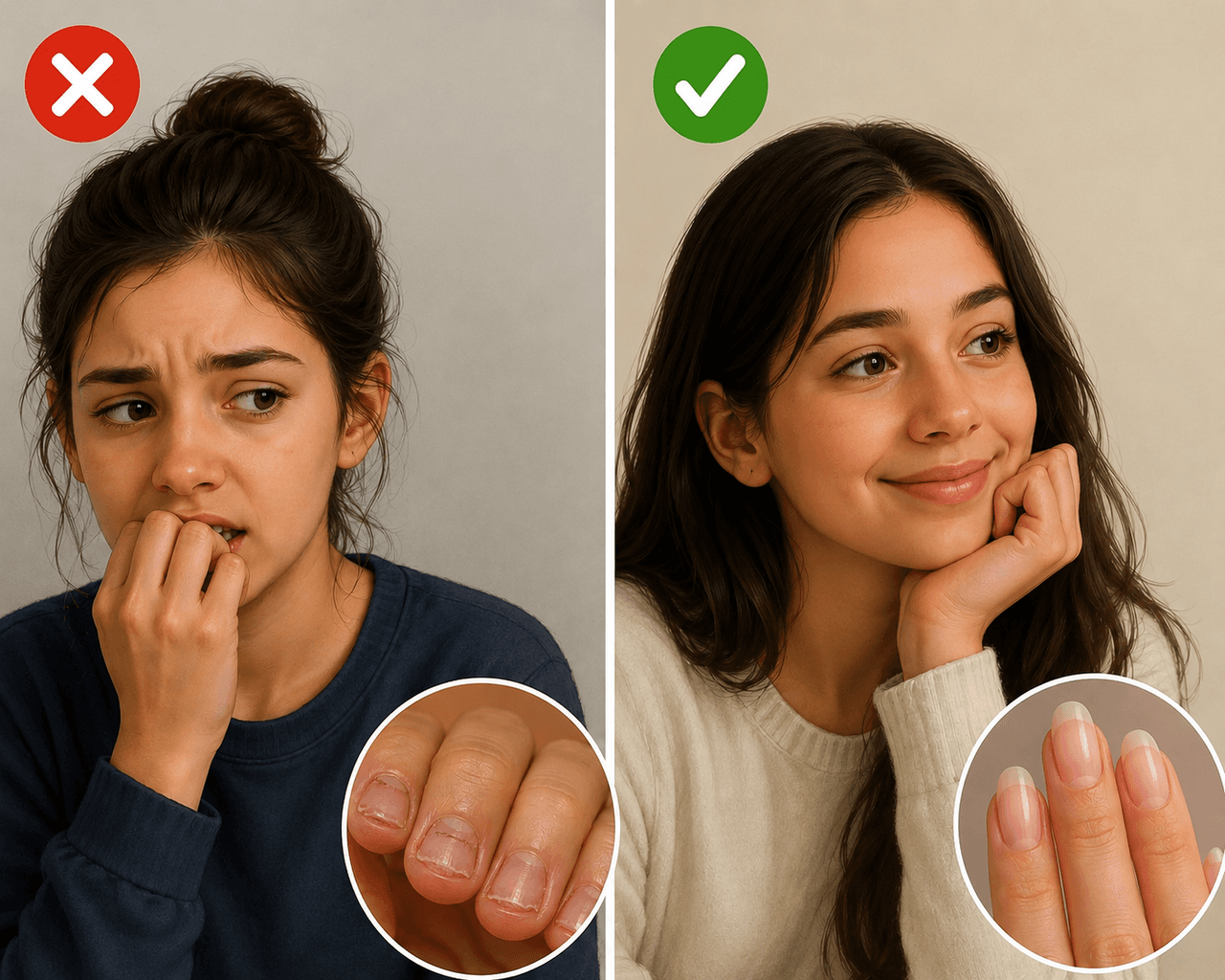
Nail Biting (Generated by Artificial Intelligence.)
Onychophagia typically emerges in relation to an individual’s emotional state. Stress, anxiety, tension, boredom, and negative self-perception are frequently cited as triggers for this behavior. In this context, nail biting is described as a coping mechanism used by individuals to manage internal tension.
Learned reinforcement processes play a significant role in the persistence of the behavior. Nail biting is said to produce a brief sense of relief, leading to its repetition and eventual establishment as a habit. Thus, the behavior becomes a self-sustaining cycle due to its temporary calming effect.
Family factors may also contribute to the development of onychophagia. The presence of similar behaviors among family members is thought to increase the likelihood of this habit appearing in children. This may be related to environmental modeling and the learning process through observation.
The literature indicates that onychophagia is rarely an isolated behavior and is frequently observed alongside various psychiatric conditions. This aligns with the view that onychophagia belongs to the spectrum of body-focused repetitive behaviors and obsessive-compulsive disorders.

Nail Biting (Generated by Artificial Intelligence.)
Studies highlight a strong association between onychophagia and attention deficit hyperactivity disorder (ADHD), anxiety disorders, and obsessive-compulsive symptoms. These comorbidities are thought to be linked to difficulties in impulse control, stress management, and behavioral regulation.
In addition, clinical observations report the presence of other repetitive behavior patterns alongside onychophagia, such as other body-focused repetitive habits. This supports the view that onychophagia should be considered within a broader behavioral spectrum.
Overall, the current literature suggests that onychophagia may be associated with psychiatric comorbidities and therefore requires evaluation not only of the behavior itself but also of co-occurring psychological conditions.
Onychophagia extends beyond being a behavioral habit and can lead to various adverse outcomes for both physical health and the structure of the nails and surrounding tissues. The literature emphasizes that this behavior frequently causes mechanical damage to the nails and adjacent soft tissues.
Chronic nail biting can result in deformities of the nail plate and injuries to the surrounding soft tissues. Over time, this may compromise nail integrity and increase sensitivity in adjacent areas. Repeated trauma is also associated with an elevated risk of infection around the nail bed.
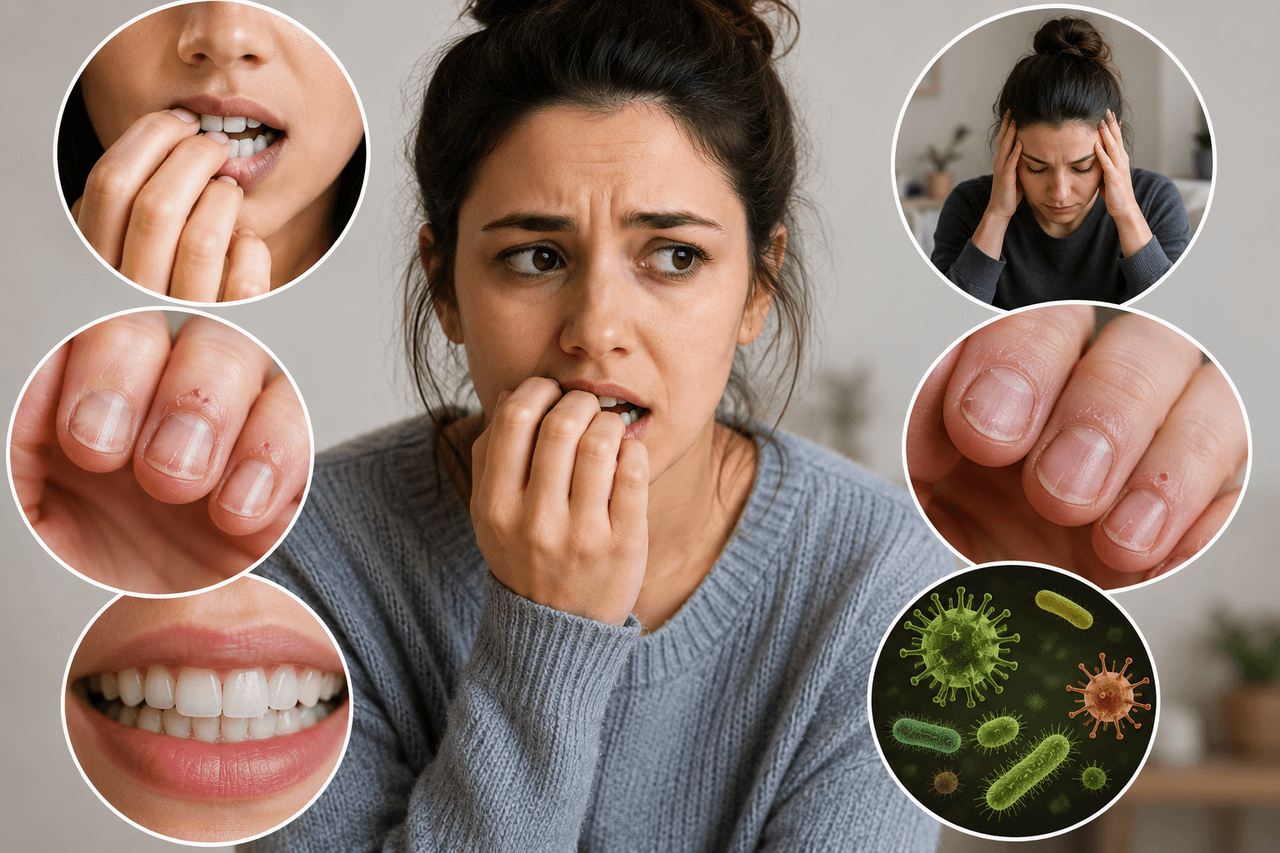
Nail Biting (Generated by Artificial Intelligence.)
During onychophagia, contact between fingers and the mouth can facilitate the transfer of microorganisms into the body. This risk is particularly heightened when hand hygiene is inadequate. The literature underscores that this behavior poses a microbiological transmission risk.
Nail biting can exert mechanical pressure on the teeth, potentially leading to various adverse effects on dental structure. Repeated biting motions are specifically noted as posing risks to oral and dental health.
The literature emphasizes that behavioral techniques form the primary approach in interventions for onychophagia. Structured psychological interventions aimed at breaking the habit are prioritized, and various therapeutic methods are often used in combination to manage this behavior.
One of the most commonly used approaches in studies is Habit Reversal Training (HRT). In this method, individuals are trained to recognize situations that trigger nail biting and to develop alternative responses. The goal is to reduce the habit by restructuring hand and mouth behaviors.
The literature highlights that controlling environmental cues that trigger the behavior is a key component of intervention. It is recommended to reduce exposure to situations that provoke nail biting and to develop alternative motor activities. The aim is to disrupt the automatic nature of the habit.
Some studies suggest that pharmacological interventions may be considered in severe or treatment-resistant cases. However, such interventions are typically used in conjunction with behavioral approaches rather than alone. Cases requiring medication should be evaluated by a specialist.
Warning: The content provided in this article is intended solely for general encyclopedic information. The information presented here should not be used for diagnosis, treatment, or medical guidance. Before making any decisions regarding health matters, you must consult a physician or qualified healthcare professional. The author of this article and KÜRE Digital Encyclopedia assume no responsibility for any consequences arising from the use of this information for diagnostic or therapeutic purposes.
Azak, Merve, and Birsen Mutlu. “Çocuklarda Tırnak Yeme Davranışı: Onikofaji.” *Balıkesir Sağlık Bilimleri Dergisi* 9, no. 3 (2020): 227–232. Accessed May 24, 2026. https://dergipark.org.tr/en/download/article-file/1142624
Lee, Debra K., and Shari R. Lipner. "Update on Diagnosis and Management of Onychophagia and Onychotillomania." *International Journal of Environmental Research and Public Health* 19, no. 6 (2022): 3392. Accessed May 24, 2026. https://doi.org/10.3390/ijerph19063392
Siddiqui, Javed Ather, and Shazia Farheen Qureshi. "Onychophagia (Nail Biting): An Overview." *Indian Journal of Mental Health* 7, no. 2 (2020): 97–104. Accessed May 24, 2026. https://www.researchgate.net/publication/344548574_Onychophagia_Nail_Biting_an_overview
[1]
Azak, Merve, ve Birsen Mutlu. “Çocuklarda Tırnak Yeme Davranışı: Onikofaji,” Balıkesir Sağlık Bilimleri Dergisi 9, no. 3 (2020): 227. https://dergipark.org.tr/en/download/article-file/1142624

Henüz Tartışma Girilmemiştir
"Nail Biting (Onychophagia)" maddesi için tartışma başlatın
Epidemiology and Prevalence
Etiological Factors and Psychological Foundations
Emotional and Psychological Triggers
Reinforcement Mechanism
Family and Learning Influence
Psychiatric Comorbidities
Health Effects and Complications
Physical Effects
Infection and Microbiological Risks
Effects on Dental and Oral Health
Treatment and Intervention Methods
Behavioral Interventions
Stimulus Control and Alternative Behaviors
Pharmacological Approaches