
Launch Date | July 8, 2003 | ||||||||
|---|---|---|---|---|---|---|---|---|---|
Maximum Speed | 0.18 km/h | ||||||||
Cost | 400 Million USD | ||||||||
Mission Duration | Planned: 90 Martian Sols (92.5 Earth days),Actual: 5.352 Sols (8 Martian Years), 5.498 Earth days | ||||||||
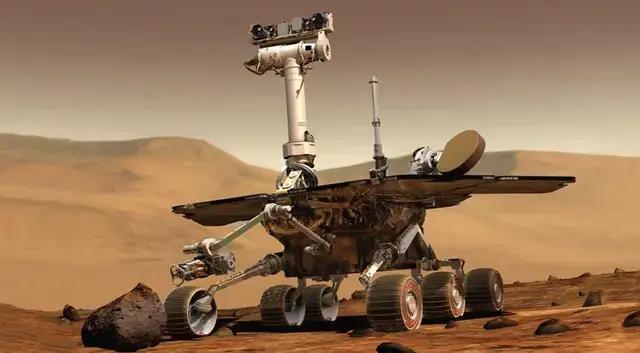
Opportunity (MER-B) is a robotic rover developed by the National Aeronautics and Space Administration (NASA) of the United States as part of the Mars Exploration Program. It was designed to collect long-term data on the surface of Mars, conduct geological studies, and obtain evidence of past water presence. The vehicle, particularly through the findings obtained during its mission, provided significant scientific data indicating that water once existed on Mars.

Victoria Crater Captured by the Opportunity Rover. (NASA)
Opportunity is one of two exploration rovers developed under NASA's Mars Exploration Rover (MER) program. Along with its twin Spirit (MER-A), it was developed by the Jet Propulsion Laboratory (JPL) and launched from Cape Canaveral on July 7, 2003, aboard a Delta II rocket. Opportunity successfully landed on January 25, 2004, in the Meridiani Planum region.
Opportunity weighed approximately 185 kg and measured 1.6 m in length, 2.3 m in width, and 1.5 m in height. It was equipped with a six-wheeled suspension system. The rover was powered by solar panels.

AI-Generated Visualization of Opportunity’s Technical Specifications
Powered by solar panels, Opportunity was able to carry out a long-term mission. The scientific instruments onboard included:
Opportunity exceeded its projected 90-Martian-day (Sol) mission duration significantly, collecting data for a total of 5111 Sols (approximately 15 Earth years). At its landing site, Eagle Crater, multi-layered sedimentary rocks were identified, which were determined to have formed through interaction with water.
Opportunity's landing site, Meridiani Planum, was chosen due to its crystalline hematite content. This mineral, which on Earth typically forms through water activity, served as strong evidence for the past presence of liquid water on Mars. The rover discovered small spherical structures referred to as “blueberries,” which pointed to aqueous geological conditions.
During the mission, numerous craters were studied, with detailed investigations carried out especially in Victoria and Endeavour Craters. In Endeavour Crater, the discovery of clay minerals indicated the presence of neutral pH water, suggesting that the area may have once had conditions suitable for life.
In 2018, during a massive dust storm on Mars, Opportunity lost contact with Earth. The storm covered its solar panels, cutting off power generation. After several recovery attempts, NASA officially declared the mission over on February 13, 2019.
This development evoked an emotional response in the scientific community and the public. The phrase reported as Opportunity’s farewell message — “My battery is low and it’s getting dark” — symbolized the emotional significance the rover had gained throughout its mission.

Opportunity’s Self-Portrait. (NASA)
Through data gathered during its mission, Opportunity demonstrated that:
The mission also provided valuable engineering experience in robotic systems, space technologies, and long-term planetary exploration. The data obtained continues to be used in scientific research

Opportunity Entering Endurance Crater. (NASA)
Opportunity marked a significant milestone in Mars exploration with its long-duration mission and the scientific data it provided from the Martian surface. The mission contributed to our understanding of the potential for life on Mars and laid the groundwork for future exploration missions.
NASA. "MER Opportunity." NASA Science – Solar System Exploration. Accessed July 9, 2025. https://science.nasa.gov/mission/mer-opportunity/.
NASA. (2004). Opportunity Rover Mission Overview. Accessed July 9, 2025. https://mars.nasa.gov/mer/
NASA. “Mars Exploration Rover Mission Animation.” NASA Science: Solar System Exploration. Accessed July 9, 2025. https://science.nasa.gov/resource/mars-exploration-rover-mission-animation/.
NASA. “Location of Opportunity Rover.” NASA Science: Solar System Exploration. Accessed July 9, 2025. https://science.nasa.gov/resource/location-of-opportunity-rover/.
NASA. “Opportunity Rover’s Full Marathon-Length Traverse.” NASA Science: Solar System Exploration. Accessed July 9, 2025. https://science.nasa.gov/resource/opportunity-rovers-full-marathon-length-traverse/.

Launch Date | July 8, 2003 | ||||||||
|---|---|---|---|---|---|---|---|---|---|
Maximum Speed | 0.18 km/h | ||||||||
Cost | 400 Million USD | ||||||||
Mission Duration | Planned: 90 Martian Sols (92.5 Earth days),Actual: 5.352 Sols (8 Martian Years), 5.498 Earth days | ||||||||
Henüz Tartışma Girilmemiştir
"Opportunity Rover" maddesi için tartışma başlatın
Mission Description and Development Process
Technical Specifications
Mission Timeline and Key Discoveries
Mission Start and Initial Findings
Meridiani Planum and the Discovery of Hematite
Victoria and Endeavour Craters
End of the Mission
Scientific and Technological Contributions
Bu madde yapay zeka desteği ile üretilmiştir.