


Bu içerik Türkçe olarak yazılmış olup yapay zeka ile otomatik olarak İngilizceye çevrilmiştir.
+1 Daha
The Patronage Tradition is a deeply institutionalized social, cultural, and political support system in the Islamic world, in which an individual (the patron) protects and supports another individual, community, or institution engaged in scholarly, artistic, political, or professional activities, thereby contributing to their development. This tradition encompasses multifaceted functions including protection, material support, provision of prestige, guidance, education, and professional advancement. Especially from the Abbasids to the Ottomans, state administration, scholarship, literature, art, and crafts in Islamic societies were largely organized through patronage relationships.
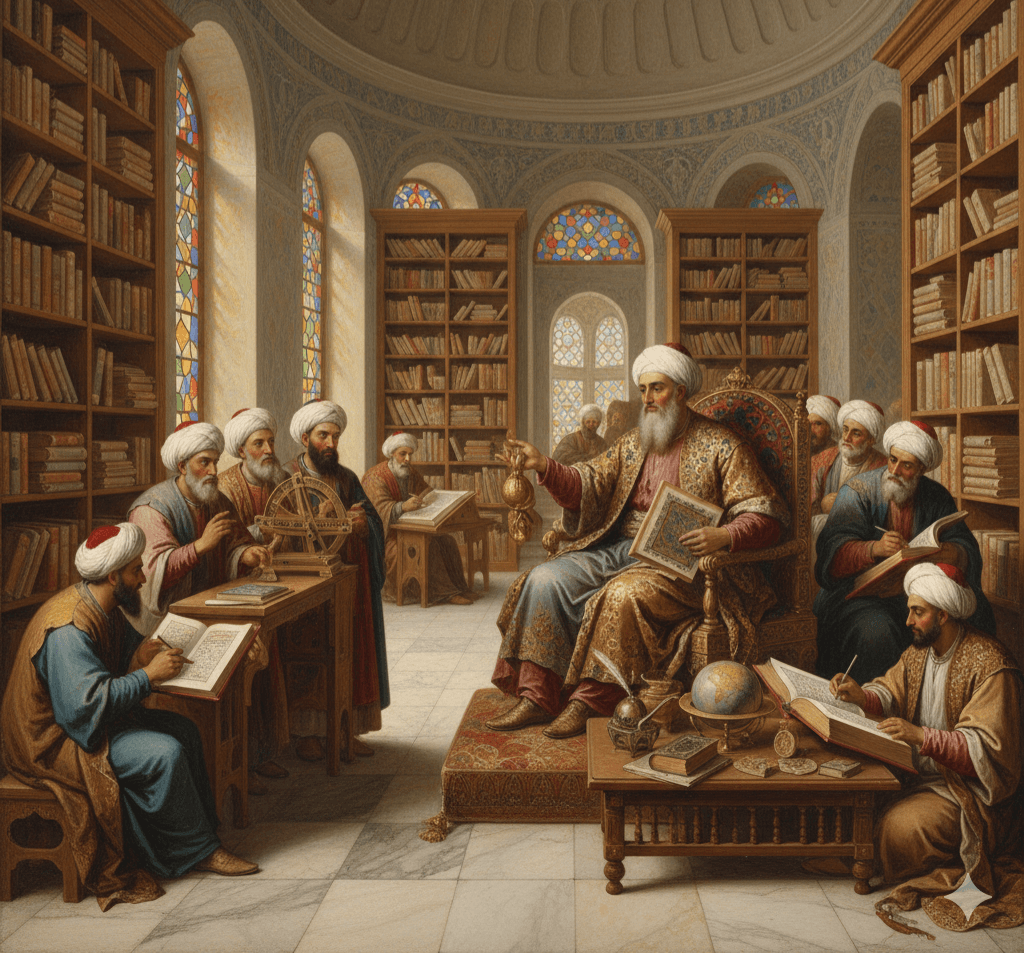
Representation of the Patronage Tradition (Generated by Artificial Intelligence.)
The patronage system did not emerge as an indigenous structure of Islamic society but developed through the reconfiguration of “protector–protected” relationships found in ancient Mesopotamia, the Iranian court, Byzantine aristocracy, and Arab tribal traditions within the framework of Islamic social order. From the time of the Prophet Muhammad, the support of scholars, the patronage of poets and preachers, and the social status preservation practices of tribal leaders laid the foundational basis for the institution of patronage. During the Umayyad and Abbasid periods, the court circles, vizierate offices, and prominent families institutionalized patronage by supporting scholars, poets, physicians, and artisans. At this stage, patronage ceased to be merely an individual act of benevolence or loyalty and became a mechanism for the transfer of power and the production of culture.
During the Abbasid era, caliphs, viziers, and aristocratic families fostered scholars, poets, physicians, and artisans, creating a vibrant scholarly environment in which translation activities and scientific production flourished. This period is regarded as one in which patronage relations were no longer based solely on personal loyalty but were actively directed by the state to encourage intellectual and cultural production. With the rise of the Seljuks, large educational institutions such as the Nizamiyya madrasas provided the structural foundation for the institutional reorganization of patronage relations; the state appointed and protected specific scholars, transforming the patronage system into a tool for implementing religious, juridical, and administrative policies.
Waqfs also became institutional sustainers of the patronage tradition, assuming responsibility for supporting scholarly figures through systems that funded madrasas, khanqahs (places of worship and education for Sufis), darüşşifas (hospitals), and libraries.
In Ottoman society, patronage acquired a far more pronounced and systematic character than in other Islamic states. The Ottoman palace particularly patronized poets, intellectuals, and artisans; princes, viziers, Shaykh al-Islams, and pashas each cultivated their own circles in various fields. These patronage relationships not only supported cultural production but also became a mechanism for “social mobility” within the state apparatus.
Within the ulama class, the Shaykh al-Islam and madrasa circles shaped the scholarly careers of young scholars, enabling the scholarly hierarchy to function through patronage networks. Meanwhile, guilds of craftsmen and tradespeople represented the social base of the patronage tradition, as masters protected and guided apprentices and journeymen.
Patronage was not merely a matter of material support; it also meant recognition, protection, and integration into a specific social circle. The patron provided security to the protected individual, offering opportunities for employment, livelihood, social capital, and political protection. In return, the protected individual sustained the relationship through loyalty, service, the presentation of works, or the production of knowledge.
This system fulfilled fundamental functions within the social structure, including solidarity, protection, loyalty, commitment, the transfer of prestige, and professional production. On one hand, patronage served as a mechanism ensuring individual survival; on the other, it facilitated the consolidation of political power relations.
From the 19th century onward, with Ottoman modernization, patronage relations began to be replaced by more institutional and bureaucratic mechanisms. The expansion of modern schooling, the shift toward merit-based appointments in state offices, and the emergence of new civil institutions weakened the traditional patronage structure. Nevertheless, in the fields of culture, art, and academia, patronage continued in new forms resembling modern “patronage.”
During the Republican period, state-supported cultural policies, scholarship programs, art funds, and academic institutions emerged as new forms of the modern patronage system.
Patronage was one of the primary pillars of cultural production in Islamic and Ottoman societies, playing a crucial role in the construction of the scholarly tradition, the formation of artistic schools, the development of professional organizations, and the facilitation of social mobility.
Poets dedicating their divans to their patrons, scholars dedicating their works to state officials, and artisans trained within the palace environment all exemplify the cultural impact of this tradition. Moreover, as a mechanism shaping social status relations, patronage determined individuals’ positions within the state and society.
Bozkurt, Nebi. "Himaye." Türkiye Diyanet Vakfı İslâm Ansiklopedisi (DİA), 18 (1998): 56. Accessed November 23, 2025.
Durmuş, Tuba Işınsu and Vildan Serdaroğlu. "Tutsan Elini Ben Fakirin: Osmanlı Edebiyatında Hamilik Geleneği." Osmanlı Araştırmaları 38, no. 38 (2011): 264–268. Accessed November 23, 2025.
Feyzi, A., and H. T. Sümbüllü. "Patronaj ve Müzik İlişkisi Açısından Osmanlı Arşiv Belgeleri Üzerine Bir Durum Değerlendirmesi." Journal of Human Sciences 16, no. 4 (2019): 1038–1050. Accessed November 23, 2025.
Türkoğlu, Serkan. "Himâye Arayan Şairin Sultana Niyazı: II. Bayezid Dönemi Şairi Gaybî ve Terbiyet-Nâme’si." EKEV Akademi Dergisi no. 73 (2018): 513–556. Accessed November 23, 2025.
Şimşek, Ayşe. "Osmanlı Hukuk Sisteminde Yetimlerin Himayesi ve Maddi Haklarının Korunması – Kurumsal Süreç." Mevzu – Sosyal Bilimler Dergisi 5 (2021): 89–126. Accessed November 23, 2025.

Henüz Tartışma Girilmemiştir
"Pregnancy Tradition" maddesi için tartışma başlatın
Historical Origins of the Patronage Tradition
Institutionalization of the Patronage Tradition in the Islamic World
Patronage in the Ottoman Period: State, Palace, and Ulama
Functioning and Social Dimensions of Patronage Relationships
Transformation of the Patronage Tradition in the Process of Modernization
Social and Cultural Impacts of the Patronage Tradition