
Bu içerik Türkçe olarak yazılmış olup yapay zeka ile otomatik olarak İngilizceye çevrilmiştir.
RASAT
Name(s) | RASAT | ||||||||
|---|---|---|---|---|---|---|---|---|---|
Type(s) | Earth Observation Satellite | ||||||||
Weight(s) | 93 kg | ||||||||
Orbit | Circular, sun-synchronous at 700 km | ||||||||
Attitude Control | Three-axis controlled | ||||||||
Launch Date | 17 August 2011 | ||||||||
Launch Site | Yasny Launch Site, Russia | ||||||||
Launch Vehicle | Dnepr | ||||||||
Planned Mission Duration | 3 years | ||||||||
Actual Mission Duration | 11 years | ||||||||
Mission End | August 2022 | ||||||||
RASAT is Türkiye’s first Earth observation satellite entirely designed and manufactured using domestic capabilities. It was developed by TÜBİTAK Space Technologies Research Institute, under the Scientific and Technological Research Council of Türkiye (TÜBİTAK). Produced within a project supported by the Presidency of Defence Industries, RASAT aimed to enhance Türkiye’s independence in space and strengthen domestic competencies in satellite technologies.
RASAT was launched into space on 17 August 2011 aboard a Dnepr carrier rocket from Russia’s Yasny launch site. Its orbit is sun-synchronous at an altitude of 685 kilometers, enabling the satellite to observe any point on Earth at the same local time during each pass. The orbital period is approximately 98 minutes, allowing it to complete 14 revolutions around Earth per day.

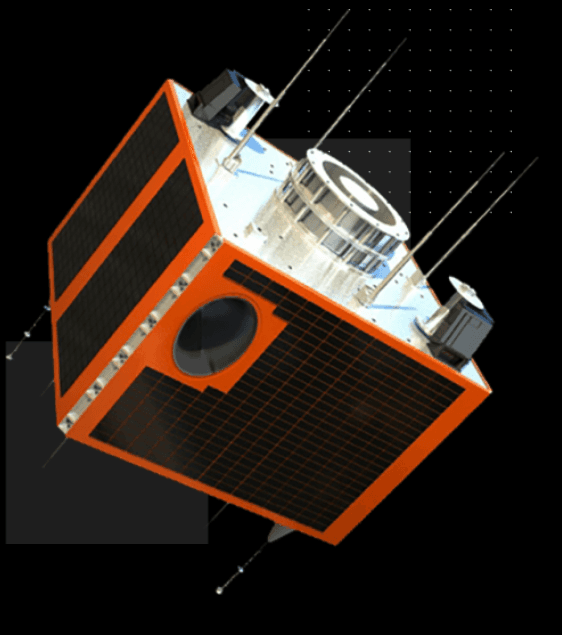
RASAT Research Satellite Image (TÜBİTAK Space)
RASAT is a 100% domestically engineered product. All subsystems, including the satellite platform and ground station software, were developed by TÜBİTAK UZAY. The satellite is capable of capturing images with a resolution of 7.1 meters in black-and-white (panchromatic) and 15 meters in multispectral bands. The optical camera system, used as the mission payload, was designed specifically for Earth observation. Additionally, the satellite includes advanced systems supporting data compression, encryption, and high-speed data downlink.
RASAT was developed for Earth observation purposes, primarily targeting civil applications such as urban planning, agriculture, forestry, environmental monitoring, and disaster management. Images acquired by the satellite were processed using domestic software such as TAMSAT and GEZGİN to support map production, planning, and analytical activities. Over the course of its mission, RASAT captured more than 30,000 images, all of which are archived at the TÜBİTAK UZAY Archive.
RASAT: The First National Earth Observation Satellite (TUA)
Although RASAT’s initial planned mission duration was three years, the satellite exceeded its technical lifespan by providing uninterrupted data transmission for 11 years. It successfully completed its mission in 2022 and made significant contributions to the development of Türkiye’s knowledge base and engineering capabilities in space technologies. In this regard, RASAT stands not only as Türkiye’s first indigenous satellite but also as a major milestone due to its long and successful operational life.
RASAT marked a turning point in Türkiye’s ability to launch satellites using its own engineering capabilities. The development of the satellite paved the way for subsequent, more advanced satellite projects such as GÖKTÜRK, İMECE, and TÜRKSAT 6A. RASAT serves as a foundational pillar in Türkiye’s space vision, contributing critically to the training of technical personnel and the development of infrastructure.
Accessed November 26, 2025.
Anadolu Ajansı. “İlk Yerli Gözlem Uydusu RASAT’ın Görev Süresi Doldu.” AA. September 30, 2022. Accessed May 11, 2025. https://www.aa.com.tr/tr/bilim-teknoloji/ilk-yerli-gozlem-uydusu-rasatin-gorev-suresi-doldu/2671079.
Ministry of Industry and Technology Turkey Space Agency. "RASAT." Accessed May 11, 2025. https://www.tua.gov.tr/tr/proje/rasat.
TÜBİTAK UZAY. "RASAT." TÜBİTAK UZAY. Accessed May 11, 2025. https://uzay.tubitak.gov.tr/rasat/.
TÜBİTAK UZAY. "İlk Yer Gözlem Uydumuz RASAT 11. Yılında Görevini Tamamladı." Accessed May 11, 2025. https://uzay.tubitak.gov.tr/ilk-yer-gozlem-uydumuz-rasat-11-yilinda-gorevini-tamamladi/.
TÜBİTAK. "RASAT." Accessed May 11, 2025. https://tubitak.gov.tr/tr/ar-ge-
TÜBİTAK. “Türkiye’nin Yerli Uydu Üretim Gururu Cumhuriyetin 100. Yılında İMECE ve TÜRKSAT 6A ile Taçlanacak.” TÜBİTAK. July 6, 2023. Accessed May 11, 2025. https://tubitak.gov.tr/tr/haber/turkiyenin-yerli-uydu-uretim-gururu-cumhuriyetin-100-yilinda-imece-ve-turksat-6a-ile-taclanacak.
TÜRKSAT. "Türkiye’nin Uzaydaki Gözleri." TÜRKSAT. Accessed May 11, 2025. https://uydu.turksat.com.tr/tr/haberler/turkiyenin-uzaydaki-gozleri.
YouTube. "RASAT Uydusu Belgeseli." YouTube Video, November 24, 2022. Accessed May 11, 2025. https://www.youtube.com/watch?v=24LcXXKWifE.

RASAT
Name(s) | RASAT | ||||||||
|---|---|---|---|---|---|---|---|---|---|
Type(s) | Earth Observation Satellite | ||||||||
Weight(s) | 93 kg | ||||||||
Orbit | Circular, sun-synchronous at 700 km | ||||||||
Attitude Control | Three-axis controlled | ||||||||
Launch Date | 17 August 2011 | ||||||||
Launch Site | Yasny Launch Site, Russia | ||||||||
Launch Vehicle | Dnepr | ||||||||
Planned Mission Duration | 3 years | ||||||||
Actual Mission Duration | 11 years | ||||||||
Mission End | August 2022 | ||||||||
Henüz Tartışma Girilmemiştir
"RASAT (Rasat Research Satellite)" maddesi için tartışma başlatın
Launch and Orbital Characteristics
Design and Technical Specifications
Mission and Applications
Mission Duration and Achievements
RASAT’s Place in Türkiye’s Space Program