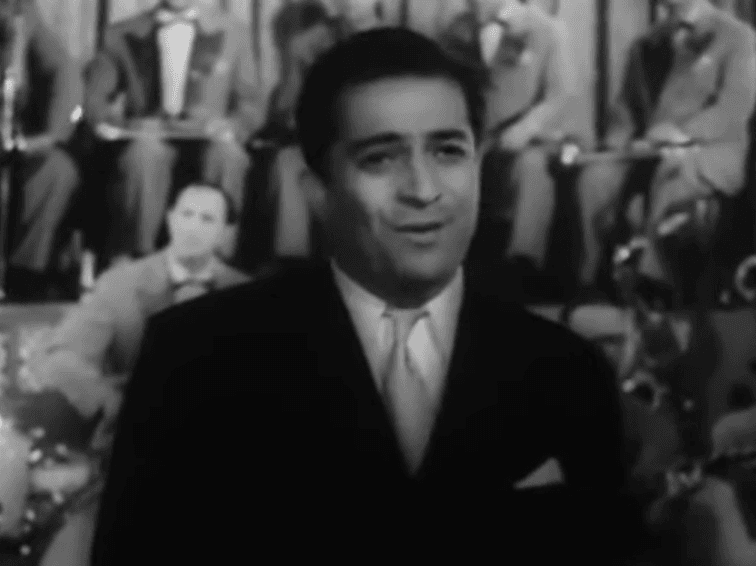



One of the most important representatives of Azerbaijani music in the 20th century, Resid Behbudov was a renowned artist whose voice repertoire and stage experience made him famous throughout the Soviet Union, especially in Azerbaijan.
He gained fame particularly for his role as a soldier in the film Arshin Mal Alan (1945) and influenced generations through performances ranging from folk songs to works by contemporary composers, classical romances to opera and musical theater scenes.
He directed the Azerbaijan State Song Theatre, which he founded in 1966, until his death and became one of the key figures in introducing his country’s vocal culture to the world.
Behbudov's Performance of Nazende Sevgilim (Cevdet Karakurt)
Resid Behbudov was born on 14 December 1915 in Tbilisi into the family of Mecid Behbudov Behbudali, a singer originally from Shusha. His mother, Firuze Vekilova, belonged to the Vekilov family from the Upper Salahlı village in the Kazakh region. In 1933 he enrolled in the Railway Technical School but soon shifted his focus to music, having participated since childhood in the school choir and worked with his own ensemble orchestra.
During his military service, Resid Behbudov served as a soloist in the army ensemble. After completing his service, he performed as a soloist with one of the entertainment groups in Tbilisi and soon began singing with the Azerbaijan State Jazz Orchestra under the direction of composer Artemi Ayvazyan. In the 1930s he sang solo parts in the choruses of classical operas at the Azerbaijan State Opera and Ballet Theatre. In 1939 he performed with the theatre’s ensemble during Azerbaijan Art Days in Moscow. In 1942 he traveled with the ensemble to the Crimean Front. That same year he went on tour to Iran with the Azerbaijan State Jazz Orchestra.
After demobilization, he worked as a soloist in pop groups in Tbilisi and soon joined the Armenia State Jazz Orchestra under composer Artemi Ayvazyan, participating in tours extending from the Caucasus to the Far East. In the late 1930s he sang tenor solos in classical operas at the A. A. Spendiaryan Armenian State Opera and Ballet Theatre. During World War II he gave concerts for soldiers on the home front and the Crimean Front, performing war songs and popular pieces.
In late 1943, when the Baku Film Studio decided to adapt Uzeyir Hajibeyov’s operetta to cinema, Behbudov caught attention with his soldier aria performed at a concert at the Baku Officers’ Club and was invited for the lead role. The film premiered in 1945 and quickly achieved success throughout the Soviet Union and some foreign countries. For this role, Behbudov received the Second Class Stalin Prize in 1946.
From 1944 to 1956 he was a soloist with the Azerbaijan State Philharmonic Orchestra and intermittently from 1953 to 1960 with the M. F. Akhundov Azerbaijan State Opera and Ballet Theatre. In 1949 he performed at the World Festival of Youth and Students in Budapest.
Reshid Behbudov's Execution of Asker Arasi (Raks Music)
From the 1950s onward, Behbudov gave concerts in many countries including Bulgaria, Hungary, Italy, India, and China, as well as Latin America, the Middle East (Syria, Egypt, Jordan, Iran, Iraq), Turkey, Finland, and Poland, often singing songs from these countries in their original languages. He compiled his memories of the Indian tour in the book In Far India.
In addition to Azerbaijani folk songs and works by composers such as Tofiq Quliyev and Süleyman Rüstemov, he also interpreted popular Soviet pieces like “Moscow Nights” and “I Love You, Life,” making a significant contribution to the international recognition of Azerbaijani vocal music.
Behbudov is known for his lyric tenor (“tenor altino”) timbre. He developed a hybrid vocal aesthetic that combined European legato and breath techniques with ornamentations and free phrasing characteristic of the muğam tradition. His command of language and diction enabled him to sing without accent in languages including Russian, and he adopted an energetic, cheerful, and highly communicative stage persona.
Example of Reshid Behbudov's Russian-language Performance (Music on Soviet Television)
In 1957 Behbudov founded a concert ensemble within the Philharmonic that fused jazz elements with traditional Azerbaijani instruments. In 1966 he established the Azerbaijan State Song Theatre (today bearing his name), defining its aesthetic direction as artistic director and soloist. Through programs synthesizing jazz, ballet, pantomime, and stage music, he transformed the theatre into one of Baku’s signature cultural institutions. The artist was also active in politics, serving as a deputy in the Supreme Soviet of the USSR.
Performance of "Today Is the Third of the Month" by Rəşid Behbudov (Retro Azerbaijan)
Hero of Socialist Labour — 23 April 1980
People’s Artist of the USSR — 9 June 1959
People’s Artist of the Azerbaijan SSR — 20 June 1951
Honored Artist of the Azerbaijan SSR — 1946
Honored Artist of the Georgian SSR — 11 December 1977
People’s Artist of the Dagestan ASSR
Stalin Prize (Second Class) — 1946 (for his role as the soldier in Arshin Mal Alan)
State Prize of the Azerbaijan SSR — 1978 (for concert programs)
Two Orders of Lenin — 6 January 1976; 23 April 1980
Order of the Red Banner of Labour — 1 February 1966
Order of Friendship of Peoples — 13 December 1985
His wife was Ceyran (Cəyran) Behbudova. The couple had a daughter, artist Rəşidə (Reşide) Behbudova, who was known on stage as Reşide Reşid. Family accounts emphasize Behbudov’s early interest in jazz and cinema during his youth in Tbilisi, the deep impact of losing his mother at an early age, and his disciplined work ethic.
After an intense period of work, Resid Behbudov died on 9 June 1989 during treatment at the Moscow Central Committee Hospital. Official records list the cause of death as kidney failure and medical complications. His body was buried in the Fahri Hıyaban in Baku.

Behbudov’s Grave at Fahri Hıyaban (Photo: Duygu Şahinler)
Azer History. "Душераздирающая история великого Рашида Бейбутова." Accessed November 11, 2025. https://azerhistory.com/?p=8924
Cevdet Karakurt Youtube Kanalı. "REŞİD BEHBUDOV - Nazende Sevgilim." Accessed November 11, 2025. https://www.youtube.com/watch?v=s12DpFRP79o&list=RDs12DpFRP79o&start_radio=1
Music on Soviet Television YouTube Channel. "Rashid Beibutov 'I Met a Girl' (1958)." Accessed November 11, 2025. https://www.youtube.com/watch?v=bU4lqc1UWRo&list=RDbU4lqc1UWRo&start_radio=1
Raks Müzik Youtube Kanalı. "Rəşid Behbudov - Əsgərin Ariyası Official Video." Accessed November 11, 2025. https://www.youtube.com/watch?v=BHR2g49yYOY&list=RDBHR2g49yYOY&start_radio=1
Retro Azərbaycan YouTube Channel. "Rəşid Behbudov Bu gün Ayın Üçüdür." Accessed November 11, 2025. https://www.youtube.com/watch?v=sEYhTIOLdgs
Кино-Театр.Ру. "Рашид Бейбутов." Accessed November 11, 2025. https://www.kino-teatr.ru/kino/acter/m/sov/17758/bio/

Henüz Tartışma Girilmemiştir
"Reşid Behbudov" maddesi için tartışma başlatın
Youth and Education
Early Career (1930–1945)
Rise to Fame in the Soviet Union through the Film Arshin Mal Alan
International Tours
Voice and Performance Style
The Song Theatre (1966–1989)
Awards and Honors
Personal Life
Death
Legacy and Influence