


This article was automatically translated from the original Turkish version.
+1 More
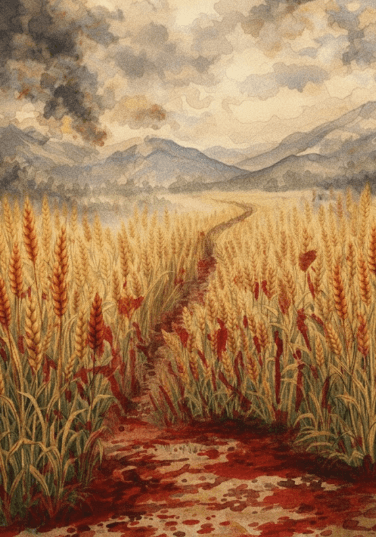
Red Wheat (Generated with Artificial Intelligence)
Region(s) | Manisa | ||||||||
|---|---|---|---|---|---|---|---|---|---|
Rhythm | 9/8 | ||||||||
Final Note | La | ||||||||
Modal Sequence | Kürdi | ||||||||
Notator | Muzaffer Sarısözen | ||||||||
Collector | Muzaffer Sarısözen | ||||||||
Source Person | Haydar Bayçın | ||||||||
Red Wheat is a folk song belonging to the oral culture tradition of the Aegean Region, associated with the years of the National Struggle. The song is centered around a historical event and the local resistance leader Ali Osman Efe; through oral transmission, it developed into different variants and has reached the present day in two distinct versions. The song, which combines historical narrative elements with themes of love and longing, is one of the documented examples of folk music in repertoire recordings.

Wounded Ali Osman Efe and Wheat Stained Red (Generated by Artificial Intelligence)
Red wheat does not separate from its blood
Ali Osman Efe’s soul has become inseparable from its soul
Bullets have entered our Efe from every side
Walk freely, white Aşem, let your braided hair flow
Uncover your white neck, Aşem, let your chest be seen
I passed safely under Göçbeyli, I passed unharmed
I fell into an ambush at Sarıcalar Creek and lost myself
I gathered my wits with difficulty, Aşem, I fled to Cinge
The hero, Ali Osman Efe, lies on the ground
In his sack, the wheat lies stained with blood
Red wheat does not separate, oh, from my hair
May my Lord grant me a white Aşem from among the beauties’ young
Who has parted from me, Aşem? I cannot part from my spouse
Walk freely, white Aşem, let your braided hair flow
Uncover your white neck, Aşem, let your chest be seen
Red Wheat (Kubat)
Red wheat does not separate from you (from you)
My Lord, my Lord, grant me a young beauty
Who has parted from me? I cannot part from my spouse
Walk, walk, beloved, let your hair flow
Uncover, uncover your chest, let your diamond neck be seen
They have set a trap on the road for Ilyas
I do not want, I do not want the one who wears blue trousers
I want the one who wears a shirt and pants
Walk, walk, beloved, let your hair flow
Uncover, uncover your chest, let your diamond neck be seen
The song mentions place names such as Göçbeyli, Sarıcalar Creek, and Cinge. These locations are associated with the Bergama region of İzmir. Given that Greek forces occupied Bergama on 11 June 1919, the song is considered to refer to the early stages of the National Struggle.
The central figure in the song is Ali Osman Efe. He was beloved by the local population and participated in local resistance against the occupation. The female figure known as “White Aşem” is the second key character, reflecting both the historical and emotional dimensions of the song. In Version I, the themes of struggle and injury dominate, while in Version II, personal emotions take center stage.
The Ali Osman Efe mentioned in the song was an efend who, along with his band, fought against Greek raids in the Aegean Region. After learning of Greek military activities in Menemen, he joined forces with the band formed by Parti Pehlivan and attempted to gather men from the region. On 21 May 1919, during a clash with Greek forces in the Menemen Plain, Ali Osman Efe was wounded. It is recorded that after this battle, he was cared for by Fatma Hanım, recovered, and later married her.
Despite knowing that Bölcek Village, under Bergama, was in an occupied border zone, he insisted on going there. During this time, he was identified by a Greek officer known as “Sarı Yüzbaşı,” leading to another confrontation. During this incident, it is said that Ali Osman Efe, wounded again, crawled into a field, where his blood stained the wheat red. It is claimed that these blood-stained wheat grains were later used as seed, and that crops grown in that region proved more productive than those from other areas, with their color turning reddish.
Ali Osman Efe survived this second wound and continued his resistance, eventually joining the command of Lieutenant Colonel Kemal Bey, who operated in Balıkesir. After the war, he lived in Alibeyli Village near Bergama, where he died; his grave is said to be located today in the Bergama Cemetery.

Red Wheat (Türküpedia)
The story of the Red Wheat song was collected on 28 February 1941 in Bergama. Version II was collected and transcribed by Muzaffer Sarısözen. In repertoire records, the song’s region of origin is listed as Manisa. The source informant is Haydar Bayçın. The song is composed in the Kürdî maqam system and in 9/8 rhythm; its final and resolution note is La. Its lowest note is Sol and its highest note is La, giving it a vocal range of nine notes.
The song reflects a narrative shaped around the figure of Ali Osman Efe in local memory and serves as an oral testimony to the impact of the National Struggle on the people of the Aegean Region.
Kubat. “Kırmızı Buğday.” YouTube, 04:47. November 22, 2018. Accessed February 16, 2026. https://www.youtube.com/watch?v=mmey6qCjSTM.
Saraçoğlu, Eslem. "Türkülerle Millî Mücadele". Yıldız Sosyal Bilimler Enstitüsü Dergisi 6, no. 2 (2022): 137-48. Accessed February 16, 2026. https://dergipark.org.tr/tr/pub/ysbed/article/1208211.
Türküpedia. "Kırmızı Buğday Ayrılmıyor Sezinden." Repertükül - Türküpedia. Accessed February 16, 2026. https://www.repertukul.com/KIRMIZI-BUGDAY-AYRILMIYOR-SEZINDEN-441.

Red Wheat (Generated with Artificial Intelligence)
Region(s) | Manisa | ||||||||
|---|---|---|---|---|---|---|---|---|---|
Rhythm | 9/8 | ||||||||
Final Note | La | ||||||||
Modal Sequence | Kürdi | ||||||||
Notator | Muzaffer Sarısözen | ||||||||
Collector | Muzaffer Sarısözen | ||||||||
Source Person | Haydar Bayçın | ||||||||
No Discussion Added Yet
Start discussion for "Red Wheat (Folk Song)" article
Lyrics of the Song
Version I
Version II
Place, Time, and Characters
The Story of the Song
Collection and Repertoire Information