

Bu içerik Türkçe olarak yazılmış olup yapay zeka ile otomatik olarak İngilizceye çevrilmiştir.
+2 Daha
is an ancient city located within the boundaries of Sadak Village in the Kelkit district of Gümüşhane province in Türkiye. It is situated 88 kilometers from the city center of Gümüşhane and 28 kilometers from the district of Kelkit. The city was built on a rugged and mountainous plateau at an elevation of approximately 1,670 meters above sea level. Due to its position along key trade routes connecting Cappadocia to the Black Sea and at the intersection of major north-south and east-west roads, it held a strategic location. It also functioned as a garrison town established to guard the frontier of the Euphrates River.

Satala was founded by the Hittites and throughout its historical development served as a settlement for various civilizations including the Assyrians, Pontic, Urartian, Persian-Sasanian, Macedonian, Roman and Byzantine empires. The city’s rise to prominence began when the Roman Empire captured Kelkit and its surroundings in 331 BCE and transformed the Satala region into a military base (legion) in the 60s CE. The Roman Empire used Satala as the primary base of the Fifteenth Legion for approximately 600 years.
During the 1st and 2nd centuries CE, the Euphrates River formed the eastern frontier of the Roman Empire, along which four major legions were stationed; Satala was one of them. According to Suetonius, the first legion sent to Satala was established around 70 CE by Emperor Vespasian to counter the Parthians and hostile groups in the Caucasus. Later, it was relocated to Samosata (Samsat) by Emperor Hadrian and replaced by the Sixteenth Legion. This legion earned the title “Pia Fidelis” (Loyal and Faithful) under Emperor Marcus Aurelius for refusing to join the revolt of Avidius Cassius. In the years 252–256 CE, the Fifteenth Legion suffered a severe defeat at Satala during the invasions of the Sasanian King Shapur I and the city remained under Sasanian control for about two years.

Satala holds great significance as the only Roman legionary fortress in Anatolia visited by five Roman emperors. It is recorded that Emperor Trajan personally resided in Satala in 114 CE while preparing for his Parthian campaign. Emperor Hadrian is known to have ordered the construction of the stone fortress there.
After the division of the Roman Empire, Satala retained its military importance during the Byzantine period. In 529 CE, following Persian incursions across the eastern frontier, the fortress was rebuilt. It is believed that the settlement continued to serve a military function until the Arab raids of the 7th century. During Late Antiquity, it became familiar with Christianity, evolved into a bishopric, and maintained this ecclesiastical role until 1256 CE. After its capture by the Persian King Osroes II in 10 CE, reliable historical information about the region became scarce.
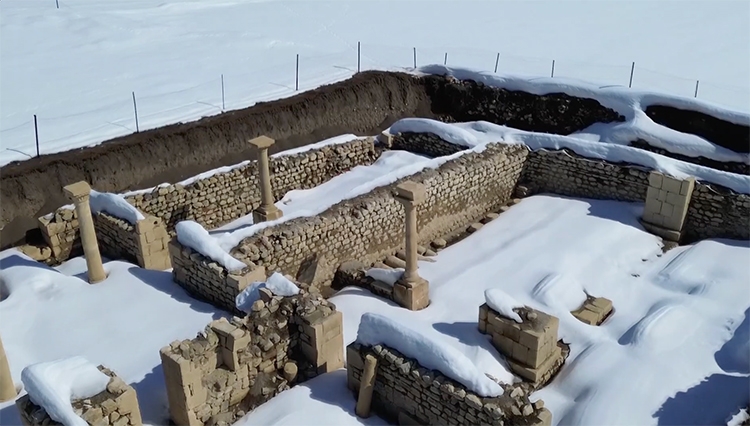
The Ancient City of Satala was designated as a third-degree archaeological site and placed under protection by the Erzurum Regional Board for the Conservation of Cultural and Natural Heritage on 5 April 1988. Due to the lack of systematic archaeological excavations over many years, only minimal surface remains are visible. Archaeological excavations at the site are ongoing. Initially launched in 2019 by a 25-member team led by Assoc. Prof. Dr. Şahin Yıldırım, Director of the Archaeology Application and Research Center at Bartın University, the excavations are currently conducted by an 18-member team under the leadership of Dr. Elif Yavuz Çakmur, Faculty Member in the Department of Archaeology at Karadeniz Technical University.
Satala has been included in the Ministry of Culture and Tourism’s "Inheritance for the Future Project". Excavations have uncovered artifacts dating back 5,000 years and findings that may reshape the history of Anatolia. Remains of a 2,000-year-old legionary fortress wall, along with artifacts from the Early Bronze Age and the Urartian period, have been discovered. A Urartian arch, approximately 2,800 years old, was unearthed and is now exhibited at the Gümüşhane City Museum. A 1,500-year-old Roman legionary armor is currently on display in Erzurum and is scheduled to be transferred to Gümüşhane in the near future. In necropolis excavations, 16 graves were uncovered within approximately two months, including an intriguing female burial. Military equipment and structural remains belonging to Roman legionaries have also been found. The bronze bust of Aphrodite dated to the late 2nd century BCE, currently exhibited at the British Museum in London, and the Nike relief from the 5th–6th centuries BCE displayed at the Erzurum Museum, both originate from the ancient city of Satala.

The main outlines of the Roman legionary fortress are still discernible, although the architectural style of its walls reflects more medieval characteristics than Roman. Traces of towers and walls are visible to the north and east. Of the 47-arch aqueduct believed to have been constructed during the Roman period, only four to five arches remain intact today, with seven arches confirmed as preserved. Within the city, structures thought to have been a fortress, an aqueduct, or a church have been identified, along with cisterns, bathhouses, and various mosaics. The fortress has a rectangular plan covering an area of 15.7 hectares. Its walls are largely destroyed but evidence suggests the presence of towers at regular intervals. Notable features include the ancient water source at Gölbaşı and surrounding structures, as well as a colonnaded building ruin located in the southeast of the city.

Henüz Tartışma Girilmemiştir
"Satala Ancient City" maddesi için tartışma başlatın
History
Imperial Visits
Archaeological Research and Discoveries
Architectural Remains