


Bu içerik Türkçe olarak yazılmış olup yapay zeka ile otomatik olarak İngilizceye çevrilmiştir.
+1 Daha
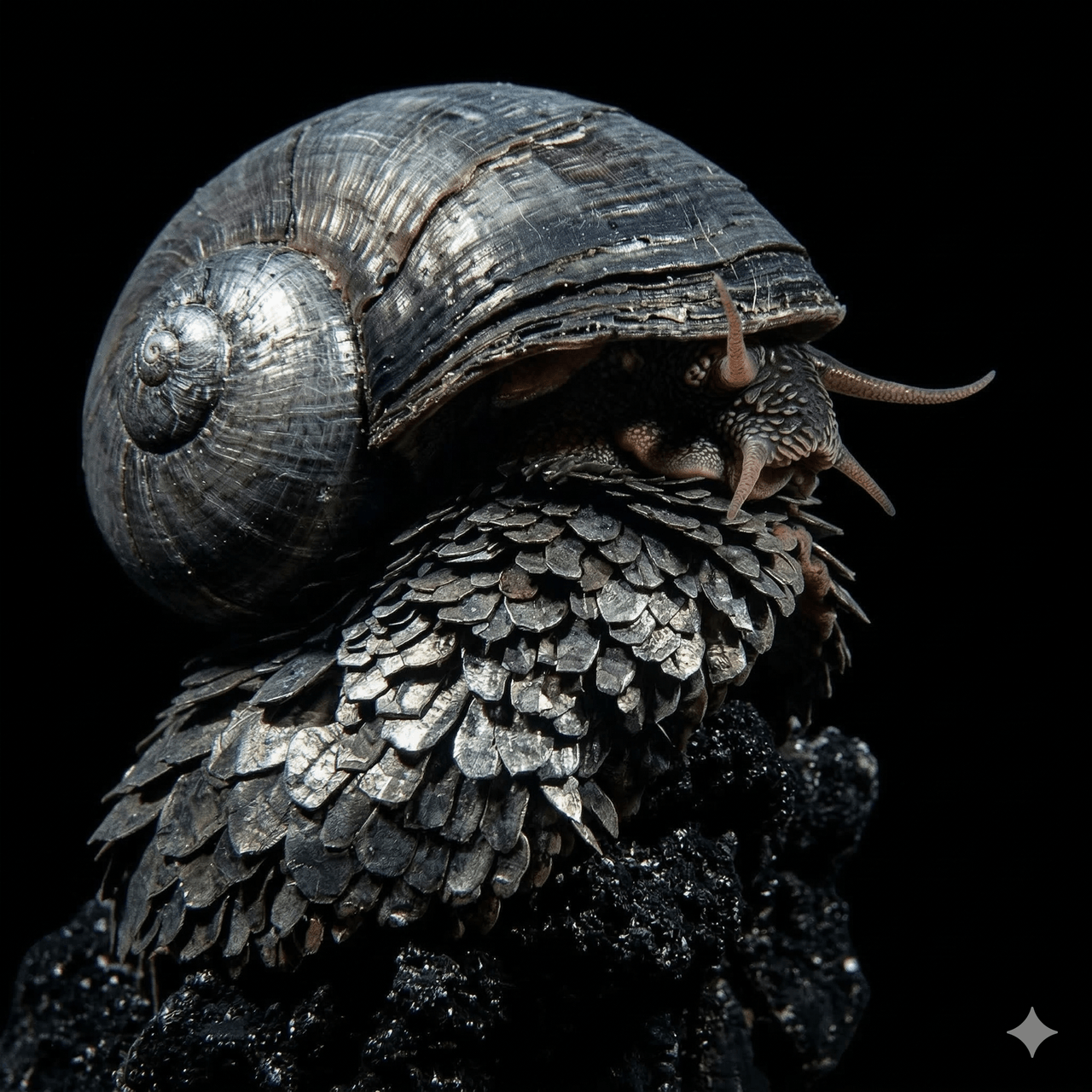
Pullu Ayaklı Salyangoz
(Yapay Zeka ile Oluşturulmuştur)
Black Smokers and Live Scaled Foot Snail at the Longqi Vent Field(expeditionlog)
Taxonomically, it belongs to the phylum Mollusca within the kingdom Animalia, class Gastropoda, order Neomphalida, and family Peltospiridae.
Its distribution is restricted to the western regions of the Indian Ocean and so far has been documented only at three hydrothermal vent fields: the Kairei and Solitaire sites on the Central Indian Ridge and the Longqi site on the Southwest Indian Ridge. Its natural habitat consists of active black smoker vents and diffuse seep areas located 2400 to 2900 meters below the ocean surface.
While other members of the Peltospiridae family generally reach sizes under 15 millimeters, Chrysomallon squamiferum exhibits remarkable gigantism within its group, with a shell length reaching up to 45 millimeters. Its soft body resides within a loosely coiled shell of approximately two turns, and the animal lacks eyes or any remnants of optic nerves. Instead of the typical ganglia, it possesses a fused and consolidated massive neural mass, functioning as a brain.
The digestive system is highly reduced, consistent with its feeding strategy. It has a small stomach and a simple gut with only one loop. In stark contrast, the esophageal glands are enormously enlarged, occupying approximately 9.3% of the body volume. This massive organ contains an extremely dense network of blood vessels facilitating fluid flow. Unlike other gastropods that feed by grazing externally, the gut contents of this snail contain chalky, solidified pellets rather than coarse inorganic material.

Image of the Scaled Foot Snail—Image generated by artificial intelligence.
The most striking anatomical feature is its enlarged circulatory system. A single, large bipinnate ctenidium (gill) occupies approximately 15.5% of the body volume. The heart, composed of a single atrium and a ventricle with thick, muscular walls, located posterior to the gill, accounts for about 4% of total body volume. This disproportionately massive heart functions primarily to pump oxygenated blood from the gills directly and rapidly to the enlarged esophageal glands.
Examination of its reproductive anatomy reveals that Chrysomallon squamiferum is a simultaneous hermaphrodite. Adult individuals possess both testes and ovaries within their bodies. There is no modified copulatory extension in the anterior region; fertilization occurs via transfer of reproductive packets called spermatophores.
The species is entirely dependent on endosymbiotic bacteria from the gammaproteobacterial group that oxidize sulfur, rather than acquiring its own food. While most gastropods in similar ecosystems harbor endosymbionts in their gills, the Scaled Foot Snail houses its bacteria within the vascularized esophageal glands. The snail’s massive heart and circulatory system have evolved specifically to transport oxygen from the gills and hydrogen sulfide from vent fluids directly to these bacteria. As a result, the animal functions as a biological carrier, sustaining and propagating its bacterial symbionts.
The organism has a relatively compact genome of 444.4 megabases (Mb), divided into 15 pseudochromosomal groups and exhibiting a high heterozygosity rate of 1.38%. A complete ANTP Hox gene complex containing 11 Hox genes is located on chromosome 11. The snail utilizes 25 transcription factors from an ancient Lophotrochozoan toolkit to generate its distinct armor structures—the scales and the shell. The epithelial tissue producing scales and the mantle tissue producing the shell synthesize these structures using entirely different genetic combinations. The DMBT1 gene, containing SRCR (scavenger receptor cysteine-rich) domains, is highly active in both scales and mantle, while the "pif" gene, associated with calcium carbonate formation, is active only in the mantle and absent in the scales.
To produce iron sulfide armor, the species actively collects sulfur from the external environment or transports it through nano-scale channels within its own scales, enabling chemical reactions with iron ions in the surrounding fluid to generate iron sulfide nanoparticles. Populations in the Kairei hydrothermal region possess iron sulfide coatings, whereas the Solitaire population, inhabiting iron-poor environments, naturally lacks this mineral armor. The species’ survival in highly toxic, iron-rich environments is made possible by the MTP9 (metal tolerance protein) gene, which shows 27-fold higher activity in the Kairei population.
Chrysomallon squamiferum is classified as Endangered (EN B2ab(iii)) on the IUCN Red List due to its limited natural distribution and ongoing threats. Its known occupancy area is estimated at only 12 square kilometers. International exploration licenses for sulfide mining and deep-sea mining in its primary habitats, including Longqi and Kairei, have been granted, placing this unique organism at significant risk of habitat destruction.

Pullu Ayaklı Salyangoz
(Yapay Zeka ile Oluşturulmuştur)
Henüz Tartışma Girilmemiştir
"Scaled-foot Snail (Chrysomallon squamiferum)" maddesi için tartışma başlatın
Taxonomy and Geographic Distribution
Anatomy and Morphology
Endosymbiosis and Feeding Strategy
Genomic Structure and Biomineralization
Conservation Status