


Bu içerik Türkçe olarak yazılmış olup yapay zeka ile otomatik olarak İngilizceye çevrilmiştir.
+2 Daha
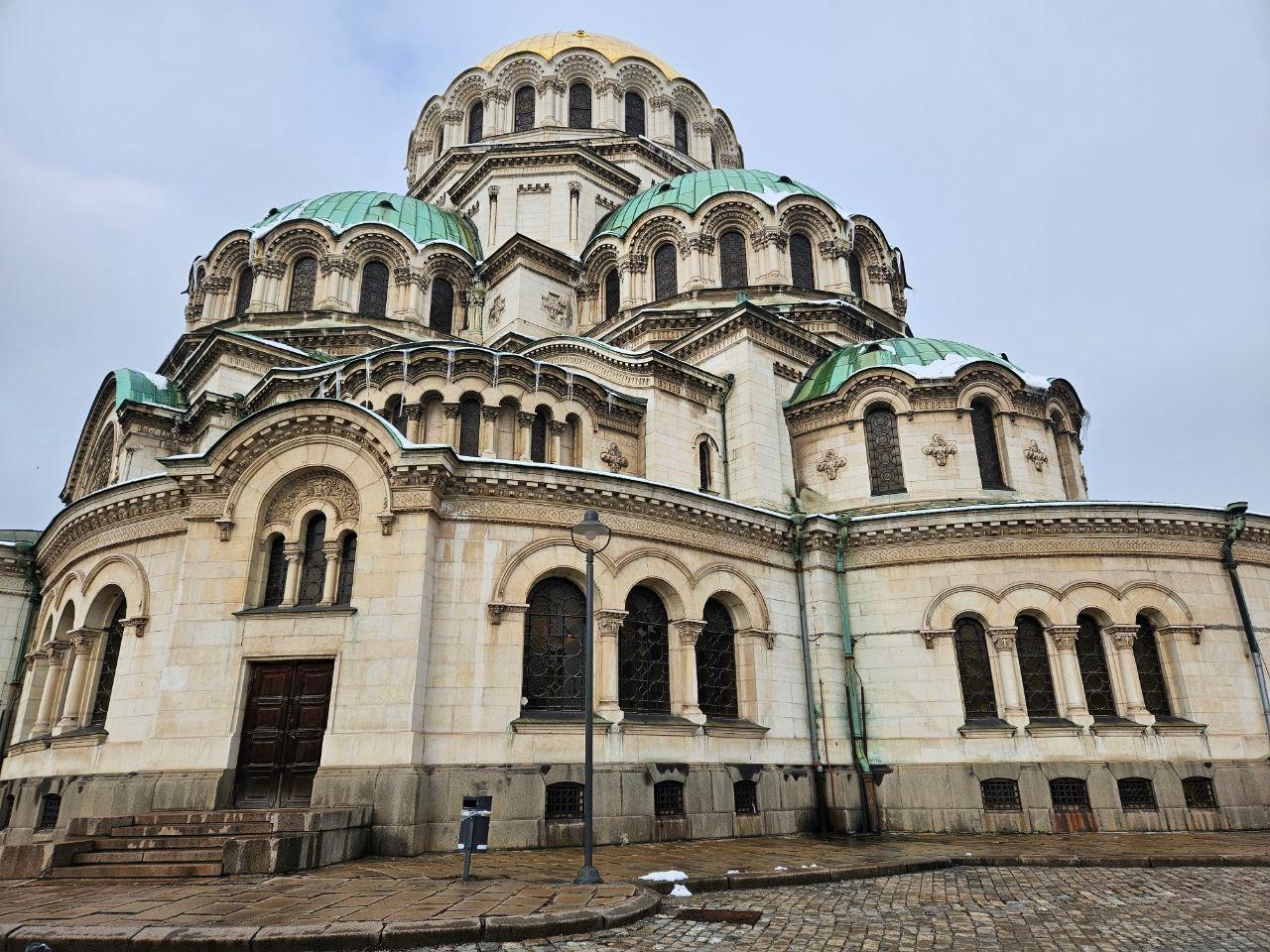
St. Alexander Nevski Katedrali (Fotoğraf: Meryem Şentürk Çoban)
St. Alexander Nevski Cathedral is a patriarchal cathedral located in Sofia, the capital of Bulgaria, and one of the country’s most significant symbolic structures. Built as a monument to national independence and religious identity, it is among Bulgaria’s most renowned landmarks due to its architectural grandeur, interior and exterior decorations, and historical significance.

St. Alexander Nevski Cathedral (Photo: Meryem Şentürk Çoban)
The idea of constructing St. Alexander Nevski Cathedral emerged after Bulgaria gained independence following the Russo-Turkish War of 1877–1878. On 13 April 1879, the first National Assembly convened in Tarnovo decided to build a memorial church symbolizing the shared faith and struggle between the Bulgarian and Russian peoples. The foundation stone was laid in Sofia on 19 February 1882.
The initial design was prepared by Russian architect Ivan Semenoviç Bogomolov, but construction was halted after his death in 1886. In 1895, Aleksandr Nikanoroviç Pomerantsev, a professor at the Imperial Academy of Arts in St. Petersburg, was appointed as the new architect. His designs envisioned a large cross-shaped, domed structure inspired by Byzantine architecture. Construction was completed in 1912, and the cathedral was consecrated in 1924.
The cathedral is a five-nave basilica based on the Byzantine architectural tradition.

St. Alexander Nevski Cathedral (Photo: Meryem Şentürk Çoban)
The interior of the cathedral is adorned with marble, mosaics, and frescoes.
The cathedral symbolizes Bulgaria’s separation from Ottoman rule. Its dedication to St. Alexander Nevski serves as a tribute to Russia’s role in Bulgaria’s liberation and as a symbol of Slavic-Orthodox brotherhood. Although its religious function diminished during the communist era, today it remains one of the strongest symbols of both Bulgarian national independence and Orthodox faith.

St. Alexander Nevski Cathedral (Photo: Meryem Şentürk Çoban)
The cathedral is Bulgaria’s largest place of worship, with a capacity of 5,600 people. The crypt beneath it has served since the 1960s as a museum displaying icons dating from the Middle Ages to the 19th century. It is one of Sofia’s most important cultural and tourist centers.
Leandro, Gloria. "The Cathedral of St Alexander Nevski in Sofia." *Inferno.* Volume IX (2004): 1-6. https://research-repository.st-andrews.ac.uk/handle/10023/621
Partov, Doncho N., Christo T. Christov, Vesselin K. Kantchev, Dobromir E. Dinev, Aleksander K. Taushanov, Edelvais E. Popova, and Deian P. Mitev. "State of Art of Historic Structures in Bulgaria." *European Research on Cultural Heritage State of the Art Studies*. Ed. Milos Drdacky. Volume 3. Prague (2004): 395-414. Bağlantı
Patriarchal Cathedral "St. Alexander Nevsky". "Architecture." Accessed September 18, 2025. https://www.cathedral.bg/en/architecture
Patriarchal Cathedral "St. Alexander Nevsky". "History." Accessed September 18, 2025. https://www.cathedral.bg/en/history

St. Alexander Nevski Katedrali (Fotoğraf: Meryem Şentürk Çoban)
Henüz Tartışma Girilmemiştir
"St. Alexander Nevski Cathedral" maddesi için tartışma başlatın
History
Architecture
Art and Decoration
Cultural Significance and Symbolism
Current Status