

 Son Eklenen:
Bu içerik Türkçe olarak yazılmış olup yapay zeka ile otomatik olarak İngilizceye çevrilmiştir.
The U.S. Supreme Court’s ruling invalidating Trump’s tariffs is the decision issued on 20 February 2026 following judicial review of the legality of the global import tariffs imposed by President Donald Trump on 2 April 2025 under the International Emergency Economic Powers Act (IEEPA). The Court ruled that the President had exceeded his authority under IEEPA and declared the tariffs implemented under this law invalid.

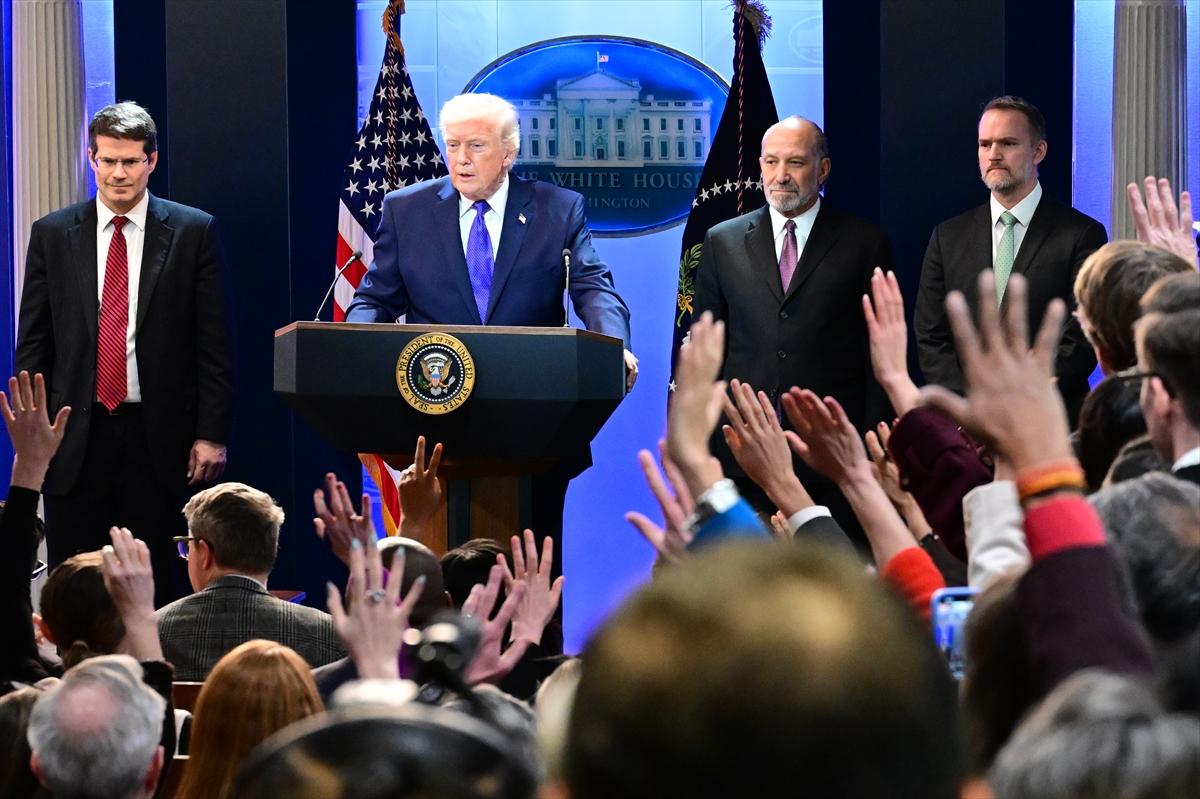
Trump holds a press conference in Washington regarding the U.S. Supreme Court’s tariff ruling, 20 February 2026 – (Anadolu Ajansı)
The Trump administration declared an economic emergency on 2 April 2025 and implemented global tariffs covering numerous countries. The imposed tariffs included a minimum global tariff rate of 10 percent on most imported goods and special adjustments.
Following the announcement of the tariffs, Chicago-based companies Learning Resources, Inc. and hand2mind argued that the IEEPA (International Emergency Economic Powers Act), on which the President based the customs duties, did not grant the President authority to impose taxes or customs duties. During the litigation, the central issue was whether these tariffs fell within the Congressional power to levy taxes, as reserved under the U.S. Constitution.
On 20 February 2026, the U.S. Supreme Court ruled 6–3 that the tariffs imposed by the President under IEEPA constituted an excess of authority. The Court determined that IEEPA did not explicitly and clearly grant the President the power to set customs tariffs. The ruling emphasized that for sweeping economic and political measures, an explicit and clear delegation of authority from Congress is required.
As a result of this ruling, global and reciprocity-based tariffs imposed under IEEPA, as well as tariffs linked to fentanyl (imposed under the pretext of combating the drug crisis, particularly on China and Mexico), were declared invalid.
The International Emergency Economic Powers Act (IEEPA) is a federal law enacted in 1977. The law is rooted in the 1917 Trading with the Enemy Act (TWEA), which granted the President authority to restrict foreign trade and economic transactions during wartime.
IEEPA, by contrast, enables the President to take economic measures under specific conditions even outside of declared war. The law aims to safeguard national security against extraordinary and unusual threats originating from abroad.
Under IEEPA, the President may declare a national emergency upon determining the existence of an “extraordinary and unusual threat” to the United States. Following such a declaration, the President is authorized to regulate, limit, or block economic transactions involving foreign countries or individuals.
The phrase “regulate imports” in the text of the law became the central point of contention during the litigation. The Trump administration argued that this phrase encompassed the authority to impose customs tariffs. The plaintiffs, however, contended that the term referred only to measures such as outright bans or restrictions on imports, and did not include the power to impose customs duties.
In the past, IEEPA has primarily been used in the following areas:
On 2 April 2025, U.S. President Donald Trump declared a national emergency and announced the implementation of new and comprehensive customs tariffs on imports. This declaration was based on the International Emergency Economic Powers Act (IEEPA) of 1977. The White House stated that the law enables the imposition of economic measures in foreign trade relations.
The executive order stipulated:
At 00:01 on 5 April 2025, the U.S. Customs and Border Protection (CBP) began collecting the 10 percent import tax. The implementation took effect simultaneously at all seaports, airports, and customs warehouses. A 51-day transition period was granted for goods shipped before 00:01 on 5 April 2025. These goods would be exempt from the 10 percent tariff if they arrived in the United States by 27 May 2025.
Under the regulation:
The country-specific rates announced between 2 and 9 April 2025 were as follows:
It was confirmed that the previously existing 25 percent tariffs on Canada and Mexico remained in effect.
The tariff rate on China was increased through reciprocal steps.
China responded by imposing customs duties on U.S. products at escalating rates: first 34 percent, then 84 percent, and ultimately 125 percent. China also initiated proceedings before the World Trade Organization.
On 12 May 2025, following negotiations in Geneva, a joint statement was issued and a temporary agreement was signed.
Under this agreement:
These temporary measures remained in effect until 12 August 2025.
Following the implementation of the tariffs, between April and July 2025 more than 75 trading partner countries initiated bilateral trade talks with the United States. Additionally, trade agreements were signed with 21 countries.
The core of the legal proceedings was the case Learning Resources, Inc. v. Trump (No. 24-1287). The plaintiffs, educational material manufacturers Learning Resources, Inc. and hand2mind, argued that the President lacked authority under the International Emergency Economic Powers Act (IEEPA) to set general customs tariffs. They contended that the phrase “regulate imports” in the law did not encompass taxation-related customs duties. It was asserted that the power to set customs tariffs falls under the Congressional power to levy taxes as defined by the U.S. Constitution.
The dispute first came before the U.S. Court of International Trade (CIT). On 28 May 2025, the court ruled that IEEPA did not grant the President unlimited authority to impose tariffs and that the legal basis for these measures was insufficient. The U.S. government appealed the decision to the U.S. Court of Appeals for the Federal Circuit, arguing that the ruling harmed government diplomacy and encroached on presidential authority.
Although the appellate court temporarily stayed the lower court’s ruling, on 29 August 2025 it largely upheld the CIT’s finding of “excess of authority.” However, it declined to immediately invalidate the tariffs and granted the government time to appeal to the Supreme Court. The Trump administration requested an expedited review from the Supreme Court, arguing that most of the tariffs were unlawful.
During the process, commercial entities such as V.O.S. Selections and several U.S. states filed similar lawsuits against the federal government. Their pleadings argued that the tariffs had lasting economic consequences and that IEEPA could not be used in this manner outside of temporary emergencies. The economic impacts of the tariffs were also cited in the legal filings.
On 9 September 2025, the U.S. Supreme Court granted certiorari to review the cases. Due to their legal similarities, the Learning Resources case and other state and corporate petitions were consolidated into a single docket. On 5 November 2025, the Court heard oral arguments from both sides and agreed to examine whether the President, in exercising IEEPA powers, had intruded upon the legislative authority of Congress and exceeded constitutional limits on executive power.
The U.S. Supreme Court invalidated the customs tariffs imposed by President Donald Trump under the International Emergency Economic Powers Act (IEEPA) on the grounds that they exceeded constitutional limits on executive authority. In its 6–3 decision, the Court held that the executive branch, through a declaration of economic emergency, cannot unilaterally impose taxes.
The Court determined that while IEEPA grants the President authority to “regulate” foreign trade, it does not authorize the collection of taxes from the public or businesses. The ruling emphasized that customs tariffs are, in legal terms, taxes and that under the U.S. Constitution, the power to levy taxes belongs exclusively to Congress.
The ruling was grounded in the legal principle known in jurisprudence as the “Major Questions Doctrine”. Under this doctrine, the Court held that sweeping measures affecting billions of dollars in economic activity and altering the nation’s foreign policy cannot be justified by ambiguous statutory language. For decisions of this magnitude, Congress must have made a clear, explicit, and unambiguous delegation of authority to the President.
The ruling applies to the following tariffs imposed under IEEPA:
Trump held a press conference at the White House on 20 February regarding the U.S. Supreme Court’s tariff ruling. Trump stated that the Court’s decision on the tariffs had caused “extreme disappointment” and expressed shame toward some of the Justices.
Trump said, “Foreign countries that have been draining us for years are very happy, dancing in the streets. But you can be sure they won’t be dancing for long.” Emphasizing the importance of the case to him, he added, “The good news is that there are far stronger methods, practices, laws, and authorities available to me as President than the IEEPA tariffs, all of which are recognized by the Court and Congress.”
Trump stated, “Today, I will sign an executive order imposing a 10 percent global tariff under Section 122 of the existing tariffs. Additionally, we will launch various investigations under Section 301 and other provisions to protect our country from unfair trade practices by other nations and corporations.”
Trump claimed he had used tariffs effectively to “Make America Great Again” and said he would now use alternative authorities instead of IEEPA, which the Court had “wrongly” interpreted.
While arguing that the Court’s decision was incorrect, Trump maintained that it was insignificant because he had access to far stronger alternatives. He asserted, “The ruling is wrong but irrelevant, because we have many powerful alternatives already approved by this decision.”
Although he did not accept the ruling, Trump noted that it did not substantially limit a President’s future authority to impose customs duties. He emphasized that he could now demand far higher fees than before, citing laws that grant the President authority to impose customs duties and justify tariffs.
Trump acknowledged that these alternative legal pathways would take longer to implement, but concluded, “Therefore, today’s Supreme Court ruling has not weakened but strengthened and clarified the President’s authority to regulate trade and impose customs duties. There will be no more doubt, and thanks to this ruling, our revenues will increase and our businesses and country will be better protected.”

Trump holds a press conference in Washington regarding the U.S. Supreme Court’s tariff ruling, 20 February 2026 – (Anadolu Ajansı)
Following the Supreme Court’s invalidation ruling on 20 February 2026, President Trump signed a new executive order during a press conference, invoking his authority under Section 122 of the Trade Act of 1974 to impose a new 10 percent global tariff applicable to all countries. The order was announced to take effect on 24 February 2026 at 00:01 local time.
Section 122 grants the President authority to impose additional duties and special import restrictions to address fundamental balance-of-payments problems and trade deficits. This new tariff under Section 122 will remain in effect for 150 days (approximately five months).
In a post on Truth Social, Trump stated, “I am proud to have just signed a global 10 percent customs duty on all countries,” claiming this move would generate more revenue than previous measures.
The Supreme Court’s ruling applied only to tariffs imposed under IEEPA. Tariffs in effect under Section 232 (national security) and Section 301 (unfair trade practices) remained valid. Simultaneously with the new tariff order, Trump directed the U.S. Trade Representative (USTR) to initiate broad investigations under Section 301 of the Trade Act of 1974. These investigations are intended to identify “unreasonable and discriminatory” trade practices against the United States and lay the groundwork for new sanctions.
Al Jazeera. “Trump Tariffs Live.” Accessed February 21, 2026. https://www.aljazeera.com/news/liveblog/2026/2/20/trump-tariffs-live-us-supreme-court-rules-against-sweeping-global-tariffs
Anadolu Ajansı. "ABD Başkanı Trump, Tüm Ülkelere Yüzde 10 Tarife Uygulanmasına İlişkin Kararı İmzaladı." Accessed February 21, 2026. https://www.aa.com.tr/tr/dunya/abd-baskani-trump-tum-ulkelere-yuzde-10-tarife-uygulanmasina-iliskin-karari-imzaladi/3836123/
Anadolu Ajansı. “ABD Başkanı Trump, Yüksek Mahkemenin Kararını Beklerken Tarifeleri Savundu.” Accessed February 21, 2026. https://www.aa.com.tr/tr/dunya/abd-baskani-trump-yuksek-mahkemenin-kararini-beklerken-tarifeleri-savundu/3835277/
Anadolu Ajansı. “ABD Yüksek Mahkemesi, Trump’ın Acil Durum Tarifelerini Yasaya Aykırı Buldu.” Accessed February 21, 2026. https://www.aa.com.tr/tr/dunya/abd-yuksek-mahkemesi-trumpin-acil-durum-tarifelerini-yasaya-aykiri-buldu/3835981/
BBC News. “How will Trump's new 10% global tariffs work and what's next?” Accessed February 21, 2026. https://www.bbc.com/news/articles/c8r1e327z46o
BBC News. “Trump brings in new 10% tariff as Supreme Court rejects his global import taxes.” Accessed February 21, 2026. https://www.bbc.com/news/articles/cn8146l0n55o
CNN. "Takeaways: Supreme Court Stands Up to Trump on Emergency Tariffs." Accessed February 21, 2026. https://edition.cnn.com/2026/02/20/politics/takeaways-supreme-court-stands-up-to-trump-on-emergency-tariffs
Cornell Law School. “Learning Resources, Inc. v. Trump, No. 24-1287.” Legal Information Institute. Accessed February 21, 2026. https://www.law.cornell.edu/supct/cert/24-1287
Justia. “Learning Resources, Inc. v. Trump, 607 U.S. ___ (2026).” Justia U.S. Supreme Court Center. Accessed February 21, 2026. https://supreme.justia.com/cases/federal/us/607/24-1287/
The Guardian. “What Will Happen to Trump Tariffs After Supreme Court Verdict?” Accessed February 21, 2026. https://www.theguardian.com/us-news/2026/feb/20/what-will-happen-to-trump-tariffs-after-supreme-court-verdict
Thomson Reuters. “Supreme Court Tariff Ruling in Learning Resources Inc. v. Trump: What Corporate Tax and Trade Teams Need to Know.” Thomson Reuters Tax & Accounting Blog. Accessed February 21, 2026. https://tax.thomsonreuters.com/blog/supreme-court-tariff-ruling-in-learning-resources-inc-v-trump-what-corporate-tax-and-trade-teams-need-to-know/
Following the Supreme Court ruling on February 20 2026 President Donald Trump made a post on his American Truth Social account regarding the matter. In response to the ruling Trump described the decision as "a ridiculous poorly written and exceptionally anti-American outcome announced after months of deliberation".
Trump stated that based on a comprehensive detailed and thorough review of the ruling he would immediately raise the global customs duty rate applied to countries worldwide from 10% to 15%.
Trump noted that his administration would determine and explain new legally permitted tariffs within the coming months and reaffirmed its commitment to continuing what he described as the "Make America Great Again" process which he called "extraordinarily successful".
Prior to this decision President Trump had signed an order imposing a 10% global customs duty on all countries under Section 122 of the Trade Act of 1974. With this latest increase the global tariff rate under Section 122 has been raised from 10% to 15%.
It has been indicated that temporary tariffs under Section 122 may exclude certain products and that critical minerals metals and pharmaceuticals could be granted exemptions. Furthermore existing tariffs on sectors such as steel aluminum lumber and automobiles implemented under different legal authorities were not affected by the Supreme Court ruling.
Anadolu Ajansı. “ABD Başkanı Trump, Küresel Tarife Oranını Yüzde 10’dan Yüzde 15’e Çıkaracağını Açıkladı.” Accessed February 23, 2026. https://www.aa.com.tr/tr/dunya/abd-baskani-trump-kuresel-tarife-oranini-yuzde-10dan-yuzde-15e-cikaracagini-acikladi/3836706/
BBC News. “Trump to Increase Global Tariff Rate to 15%.” Accessed February 23, 2026. https://www.bbc.com/news/articles/cn8z48xwqn3o
The Guardian. “Trump raises tariffs to 15% on imports from all countries.” Accessed February 23, 2026. https://www.theguardian.com/us-news/2026/feb/21/trump-tariffs-15-percent

On 20 February 2026 the U.S. Supreme Court invalidated President Donald Trump’s global tariffs imposed under the IEEPA by a 6–3 vote. The Court ruled that the President had exceeded his authority under the IEEPA to impose customs duties and declared the tariffs invalid. The decision emphasized that customs tariffs have the character of taxes and that the power to impose taxes belongs to Congress under the Constitution. On the same day Trump signed a new global tariff of 10 percent applicable to all countries under Section 122 of the Trade Act of 1974 and announced that this measure would remain in effect for 150 days.
Henüz Tartışma Girilmemiştir
"U.S. Supreme Court's Ruling to Overturn Trump Tariffs Under IEEPA (2026) " maddesi için tartışma başlatın
21 Şubat 2026
Subject and Nature of the Ruling
21 Şubat 2026
International Emergency Economic Powers Act (IEEPA)
21 Şubat 2026
Trump Administration’s Emergency Declaration and Tariff Policy
21 Şubat 2026
Commencement of Legal Proceedings and Lawsuits
21 Şubat 2026
U.S. Supreme Court’s 6–3 Invalidating Ruling (20 February 2026)
21 Şubat 2026
U.S. President Donald Trump’s Response to the Ruling
21 Şubat 2026
New 10 Percent Global Tariff Decision (February 2026)
23 Şubat 2026
Global Tariff Rate Raised to 15%