


This article was automatically translated from the original Turkish version.
2 seems you've provided only a title or heading: "2025 Kanada Federal Seçimleri". Translated into English following all specified guidelines: **2025 Canadian Federal Election**
Election Date | 2025-04-28 | ||||||||
|---|---|---|---|---|---|---|---|---|---|
Election Type | Federal General Election | ||||||||
Total Number of Seats | 343 | ||||||||
Total Registered Voters | 28.525638 | ||||||||
Number of Voters Who Voted | 18.752617 | ||||||||
Voter Turnout Rate | 65.74 | ||||||||
Seat Distribution | Independent Candidates + Others: 0 People's Party of Canada (PPC): 0 Green Party: 1 New Democratic Party (NDP): 7 Quebec Bloc: 23 Conservative Party: 145 Liberal Party: 167 | ||||||||
Canada’s Federal Election (2025) was a snap general election held on 28 April 2025 to elect members of the country’s 45th federal parliament. The election process was organized by Elections Canada, an independent public agency. The Liberal Party under the leadership of Mark Carney finished in first place.

Canada Federal Election, 28 April 2025 – Anadolu Ajansı
The 2025 Canada Federal Election took place on Monday 28 April 2025. The decision to hold the election was made by Prime Minister Mark Carney on 23 March 2025, and parliament was dissolved on the same day. The decision to call an early election was justified by ongoing commercial and diplomatic developments with the United States and the need to update national security policies.

Prime Minister and Liberal Party leader Mark Carney’s election campaign event in Peterborough, Ontario, Canada, 19 April 2025 – Anadolu Ajansı
On election day, a total of 75,479 polling stations were established across the country. Of these, 98.48 percent reported their results by the end of election night. Voting operations began and ended at different times across the country due to time zone differences. The voting process followed the “first-past-the-post” system as defined by Canadian election law; under this system, the candidate receiving the most votes in each electoral district wins a seat in parliament.
The total number of registered voters was announced as 28,525,638. A total of 18,752,617 voters cast their ballots on election day and in the pre-election period. This figure included only those who had registered prior to election day; voters who registered on election day were not counted in this total. Based on this, the voter turnout rate was calculated at 65.74 percent.
During the early voting period prior to election day, approximately 7.3 million voters cast their ballots. This figure represents one of the highest rates of early voting in Canadian history.

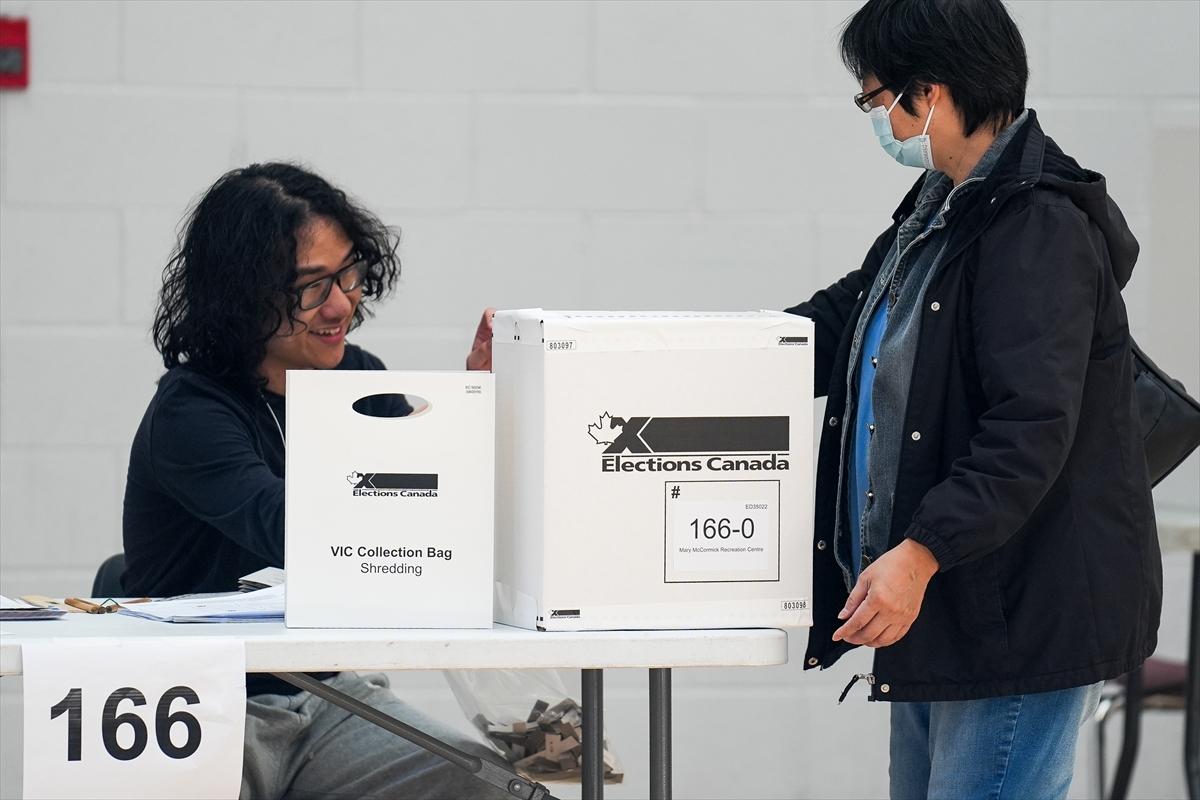
Canadian voters waiting in line to vote, 28 April 2025 – Anadolu Ajansı
The official results were announced by Elections Canada, the federal election regulatory body. The first results were released to the public starting at 19:00 Eastern Standard Time (EST), following the closure of polling stations in eastern regions. Vote counting continued throughout election night; initial data were published by media outlets from 22:00 onwards, accompanied by graphics and regional analyses.
In the election results, the 343 seats of the House of Commons were distributed among the major parties as follows: the Liberal Party won 167 seats, the Conservative Party won 145 seats, the Bloc Québécois won 23 seats, the New Democratic Party (NDP) won 7 seats, and the Green Party won 1 seat. No party reached the threshold of 172 seats required to form a majority government. As a result, the election produced a minority government scenario.

Seat distribution in Canada’s snap election – Graphic generated with AI assistance.
A total of 18,752,617 votes were cast. The voter turnout rate was calculated at 65.74 percent. This rate included only voters registered prior to election day; it did not account for registrations made on election day.
Parties are ranked by vote share as follows:
Other smaller parties and independent candidates collectively accounted for approximately 1.2% of the total votes. These included the People’s Party of Canada (PPC) with 0.7% (137,117 votes), the Christian Heritage Party with 9,894 votes, the Animal Protection Party with 1,238 votes, the Communist Party with 5,095 votes, the Marxist-Leninist Party with 5,464 votes, and various other groups.
The Quebec Bloc, which fielded candidates only in the province of Quebec, achieved regional success. The NDP, despite its national vote share, won only a limited number of seats.
The main political parties and their leaders in the 2025 Canadian federal election are listed below:
The Liberal Party contested the election under the leadership of Mark Carney. Carney assumed leadership of the party on March 14, 2025, following the resignation of former Prime Minister Justin Trudeau. A center-left political party, the Liberals secured the highest vote share at 43.4% and won 167 seats. During the campaign, Carney emphasized his economic management experience and adopted a stance that prioritized Canadian sovereignty in relations with the United States.

Prime Minister Mark Carney (pictured) speaking at the "Canada Strong" Election Night event in Ottawa, April 28, 2025 – Anadolu Agency
The Conservative Party competed under the leadership of Pierre Poilievre. The party won 145 seats with 41.5% of the vote. Poilievre focused his campaign primarily on domestic issues such as the cost of living, housing shortages, immigration, and crime rates. While adopting a more cautious stance toward U.S. President Trump’s policies, he pledged change in economic and national security matters during the campaign.

Conservative Party Leader Pierre Poilievre at a rally in Vaughan, April 23, 2025 – Anadolu Agency
The Quebec Bloc, led by Yves-François Blanchet, fielded candidates exclusively in the province of Quebec. The party won 23 seats with 6.5% of the vote. The Quebec Bloc pursues a political strategy focused on representing Quebec’s interests within the federal parliament.
The New Democratic Party contested the election under the leadership of Jagmeet Singh. The party won 7 seats with 6.2% of the vote. Following the election, NDP leader Jagmeet Singh announced his intention to step down from party leadership after failing to win his own riding.
The Green Party won one seat with 1.2% of the vote. The party focused its platform on environmental policies and the fight against climate change.
Other participants in the election included the People’s Party of Canada (PPC), the Communist Party, the Christian Heritage Party, the Centrist Party, the CFP, the Animal Protection Party, the Marxist-Leninist Party, the Rhinoceros Party, and independent candidates. These groups collectively received only a small fraction of the total vote and failed to secure parliamentary representation.
During the 2025 Canadian federal election campaign, political parties and leaders highlighted several key issues. The main campaign themes were as follows:
The economy was one of the central focuses of the campaign. The Liberal Party emphasized strengthening Canada’s economic resilience against external threats. Party leader Mark Carney stated that Canada must reinforce its economic independence and develop new trade partnerships. The Conservative Party campaigned on promises to support economic growth, reduce tax rates, and lower the cost of living.
Canada’s relations with the United States became a major topic of debate during the election. Statements by U.S. President Donald Trump suggesting that Canada should become the “51st state” significantly influenced the campaign agenda. Liberal Party leader Mark Carney pledged to defend Canadian sovereignty. Conservative Party leader Pierre Poilievre also committed to defending Canada’s national interests.
Immigration and housing shortages were prominently raised by the Conservative Party. Party leader Pierre Poilievre argued for better regulation of migration flows and increased investment in affordable housing. These issues influenced voter behavior in major cities where the cost of living had risen sharply.
Public safety, crime rates, and domestic security policies were among the key campaign issues. The Conservative Party made pledges to combat crime and restore public order.
During the 2025 Canadian federal election, relations with the United States became one of the defining issues. U.S. President Donald Trump’s imposition of tariffs on Canadian goods and his remarks suggesting Canada should become the “51st state” intensified political debates in Canada. These developments led to widespread calls during the campaign for the protection of Canada’s economic independence and national sovereignty.
Prime Minister candidate Mark Carney stated during the campaign that traditional economic and political ties with the United States had ended, and emphasized the need for Canada to diversify its foreign trade relationships. Carney confirmed that Canada had responded in kind to U.S. reciprocal tariffs. He also placed on the agenda the goal of establishing new security and trade partnerships with other countries to avoid overreliance on the U.S. economy.
Trump’s threats against the Canadian economy during the campaign fueled the rise of nationalist sentiment in Canada and generated widespread public reaction. Trump’s threats of additional taxes on Canadian products and his statements about integrating Canada into the U.S. economy were frequently raised during the campaign, particularly by the Liberal Party and other center-left parties.
Following the election, the Liberal Party emerged as the largest party with 167 seats out of 343. However, it fell short of the 172 seats required to form a majority government. This result necessitated the formation of a minority government.
In his election night speech, Prime Minister Mark Carney stated that he would represent all Canadians and work toward preserving national unity. He affirmed Canada’s continued commitment to defending its national interests and called for solidarity in addressing economic challenges.

Prime Minister Mark Carney (pictured) at the "Canada Strong" Election Night event in Ottawa, April 28, 2025 – Anadolu Agency
Opposition leader Pierre Poilievre has stated that he accepts the election results and that the Conservative Party will assume the role of overseeing the government in parliament. Poilievre has indicated that they will hold the government accountable particularly on economic policies and foreign relations.
Al Jazeera. “Canada Election Results 2025 Live: First Polls Close on East Coast.” Accessed April 29, 2025. https://www.aljazeera.com/news/liveblog/2025/4/28/canada-election-results-2025-live-first-polls-set-to-close-on-east-coast.
Al Jazeera. “Canada’s Liberal Party Wins Election Dominated by Trump’s Trade War.” Accessed April 29, 2025. https://www.aljazeera.com/news/2025/4/29/canadas-liberal-party-wins-election-dominated-by-trumps-trade-war.
Anadolu Ajansı. “Kanada’da Resmi Olmayan Sonuçlara Göre Liberal Parti Seçimi Önde Götürüyor.” Accessed April 29, 2025. https://www.aa.com.tr/tr/dunya/kanadada-resmi-olmayan-sonuclara-gore-liberal-parti-secimi-onde-goturuyor/3551395.
Associated Press. “Canada Election 2025 Updates and Results.” AP News. Accessed April 29, 2025. https://apnews.com/live/canada-election-updates-results.
BBC News. “Canada Election 2025: Results and Updates.” Accessed April 29, 2025. https://www.bbc.com/news/articles/cn4jd39g8y1o.
CNN. “Canada Election 2025 Results: Carney’s Liberals Defeat Poilievre’s Conservatives.” Accessed April 29, 2025. https://edition.cnn.com/2025/04/28/americas/canada-election-results-carney-poilievre-intl-hnk/index.html.
Elections Canada. “Official Voting Results - National.” Accessed April 29, 2025. https://enr.elections.ca/National.aspx?lang=e.
Reuters. “Canadians Vote in Election Dominated by Concerns About Trump.” Accessed April 29, 2025. https://www.reuters.com/world/americas/canadians-vote-election-dominated-by-concerns-about-trump-2025-04-28/.
The Guardian. “Canada Election 2025: Latest Results as Mark Carney Seeks to Stay on as PM.” Accessed April 29, 2025. https://www.theguardian.com/world/ng-interactive/2025/apr/29/canada-election-2025-latest-results-as-mark-carney-seeks-to-stay-on-as-pm.

2 seems you've provided only a title or heading: "2025 Kanada Federal Seçimleri". Translated into English following all specified guidelines: **2025 Canadian Federal Election**
Election Date | 2025-04-28 | ||||||||
|---|---|---|---|---|---|---|---|---|---|
Election Type | Federal General Election | ||||||||
Total Number of Seats | 343 | ||||||||
Total Registered Voters | 28.525638 | ||||||||
Number of Voters Who Voted | 18.752617 | ||||||||
Voter Turnout Rate | 65.74 | ||||||||
Seat Distribution | Independent Candidates + Others: 0 People's Party of Canada (PPC): 0 Green Party: 1 New Democratic Party (NDP): 7 Quebec Bloc: 23 Conservative Party: 145 Liberal Party: 167 | ||||||||
No Discussion Added Yet
Start discussion for "Canadian Federal Elections (2025)" article
Election Calendar and Process
Election Results
Number of Seats and Vote Share by Party (April 28, 2025)
Political Parties and Leaders
Liberal Party (Mark Carney)
Conservative Party (Pierre Poilievre)
Quebec Bloc (Yves-François Blanchet)
New Democratic Party (NDP) (Jagmeet Singh)
Green Party
Other Parties and Independent Candidates
Key Themes of the Campaign
Economy and Trade Policies
Relations with the United States and Sovereignty Rhetoric
Immigration and Housing Policies
National Security and Public Order
Relations with the United States and Their Impact on the Election
Post-Election Situation