


 Recently Added:
This article was automatically translated from the original Turkish version.
On January 5, 2026, United States of America President Donald Trump declared that Greenland holds essential strategic importance for U.S. national security. Trump stated that Greenland’s location in the Arctic region, its role as a geostrategic transit point between the North Atlantic and North America, and its significance for regional military infrastructure place it squarely within the United States’ direct area of interest. The statement indicated that various possibilities regarding Greenland’s future were being considered, and emphasized that the United States would not retreat on this issue.
Later the same day, Greenland’s Prime Minister Jens-Frederik Nielsen issued a public statement in response to Trump’s remarks. Nielsen affirmed that Greenland is not for sale and will not accept becoming part of another state. The statement emphasized that only the people of Greenland have the right to determine its future, and rejected any rhetoric involving external pressure or threats. The Greenlandic government underscored that its status must be determined within the framework of international law and existing constitutional arrangements.
U.S. Statements on Greenland (BBC NEWS
On January 6, 2026, the White House Press Office stated that the U.S. administration is evaluating “all options” regarding Greenland. The statement indicated that these options include diplomatic initiatives, political arrangements, and military measures. White House officials noted that the use of the U.S. military remains a possibility within the bounds of constitutional authority. This statement followed Trump’s remarks from the previous day.
A White House assessment reported by Reuters on January 6, 2026, indicated that the Trump administration had been exploring various pathways to incorporate Greenland into the United States. The assessment stated that the use of military force was among the possibilities under consideration and had not been entirely ruled out. Reuters’ report linked this approach to the United States’ broader security planning in the Arctic region.
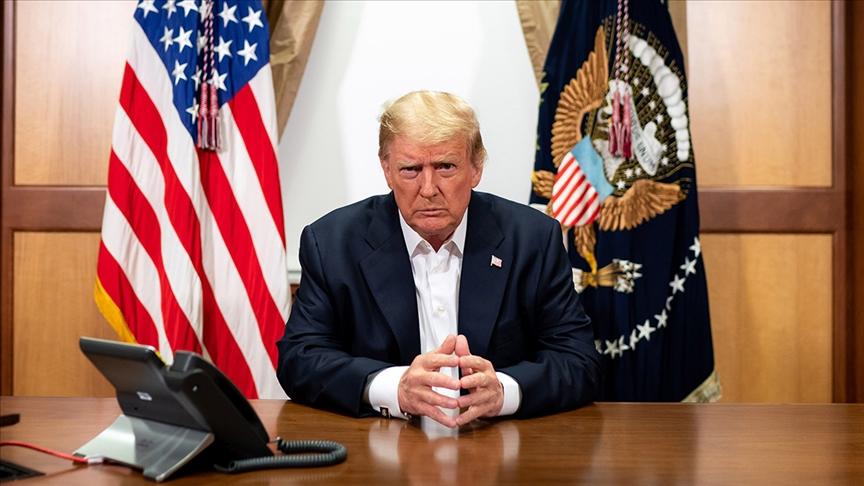
U.S. President Donald Trump (Anadolu Ajansı)
On the same day, Denmark government issued an official response to Trump’s statements regarding Greenland. Danish Prime Minister Mette Frederiksen stated that threats to the territorial integrity of a member state of NATO are unacceptable. Danish officials emphasized that Greenland is an autonomous territory within the Kingdom of Denmark, that defense and foreign policy fall under Denmark’s jurisdiction, and that this status cannot be altered by unilateral declarations.
On January 6, 2026, Germany, France, Italy, Poland, Spain, the United Kingdom, and Denmark issued a joint statement on Greenland. The statement affirmed that sovereignty, territorial integrity, and the inviolability of borders are fundamental principles of international law. It emphasized that only Denmark and the people of Greenland have the right to determine Greenland’s future, and stressed that Arctic security must be ensured through cooperation among NATO allies.
Reactions from Denmark and Greenland to Trump’s Statements (Guardian)
On January 7, 2026, several European countries issued statements of support for Denmark following Trump’s remarks on Greenland. These messages expressed backing for Denmark’s sovereign rights and Greenland’s current status. Statements from European capitals emphasized that any coercive action is unacceptable and that the issue must be addressed through diplomatic channels.
On January 7, 2026, the U.S. administration continued to assert that the military option had not been entirely ruled out regarding Greenland. Official statements affirmed that the United States would act in accordance with its national security interests, and noted that Washington’s stance had not changed despite objections from European countries. This development has created a new area of debate within U.S.-European relations and NATO’s internal balance.
According to a report by The New York Times (NYT), the 1951 “Agreement on the Defense of Greenland” signed between the United States and Denmark grants the Washington administration the authority to establish military bases across the territory, deploy personnel, and control air and maritime traffic. The agreement is said to provide the United States with broad authority to construct, operate, and maintain military facilities in Greenland.
The agreement was updated in 2004 to recognize Greenland’s semi-autonomous governance and to require consultation with Denmark and Greenland prior to “significant changes” in U.S. military activities. Mikkel Runge Olesen, a researcher at the Danish Institute for International Studies in Copenhagen, stated, “The United States can move so freely in Greenland that it can almost do anything it wants.”
U.S. Vice President JD Vance stated that European allies must take President Donald Trump’s statements on Greenland seriously, saying, “Our expectation from our European friends is that they take the security of this landmass more seriously, otherwise the United States will be forced to act on this issue.”
In response to questions about the future of U.S. policy toward Greenland, Vance referenced Trump’s earlier remarks, saying, “My advice to European leaders is to take the U.S. President seriously. Our expectation from our European friends is that they take the security of this landmass more seriously, otherwise the United States will be forced to act on this issue.”
Vance, citing Trump's remarks about Greenland, stated that “Greenland is critically important for the missile defense of both America and the world at large.”
U.S. President Donald Trump stated that both the United States and Europe must “defend” Greenland for their national security, saying, “We cannot allow China or Russia to occupy Greenland.” Trump reiterated that his position on Greenland had not changed and that the United States wanted to “own” it, defending this stance as an act of goodwill toward European nations.
Trump said, “We do not want Russia or China to go to Greenland. If we do not take control of it, Russia or China will become your neighbor. That will not happen.” He affirmed the U.S. resolve on the issue.
U.S. President Trump added, “We cannot allow China or Russia to occupy Greenland. We also cannot allow China or Russia to occupy Venezuela. If we had not acted as we did, China or Russia would be in Venezuela.” Trump noted his desire to reach an agreement with Denmark on Greenland, but warned that if no agreement is reached, the United States is prepared to use “the hard way.”
On January 11, 2026, media reports alleged that U.S. President Donald Trump instructed special operations commanders to prepare a military plan for the takeover of Greenland. The allegations were based on reports by the British newspaper Daily Mail, citing sources close to the issue.
In the report, it was claimed that close circles around Trump were emboldened by the prospect of a U.S. military intervention targeting Venezuelan President Nicolas Maduro and his spouse, and that there was a push to take control of Greenland before Russia or China could act.
It was alleged that this directive was communicated to the U.S. Joint Special Operations Command (JSOC). However, senior military officials reportedly opposed the plan, arguing that such an operation would be illegal and would fail to gain the support of the U.S. Congress.
Same reports suggested that military officials sought to divert Trump’s attention to other issues by raising less controversial topics such as countering Russia’s “ghost fleet” or military options related to Iran.
It was recalled that in previous statements, Trump had said, “We do not want Russia or China to go to Greenland. If we do not take it, Russia or China will be your neighbor.”
It is known that Greenland, an autonomous territory under Denmark, has previously rejected approaches from the United States that included proposals for sovereignty transfer. On January 5, Mette Frederiksen stated in a public address that if the United States were to make a military attack decision against a NATO ally, the alliance would come to an end, and she strongly criticized Trump’s national security rhetoric regarding Greenland.
According to reports published on January 12, 2026, the United Kingdom has begun working on plans to deploy troops to Greenland. It was claimed that the plan aims to deter the United States, which is alleged to seek both to protect Greenland from the growing presence of China and Russia and to seize the territory.
The British newspaper The Telegraph reported that the plan is being discussed in coordination with European allies. It was stated that the United Kingdom is in contact with France and Germany on the issue of Greenland’s security. The report noted that British military officials have held discussions with their German and French counterparts and are conducting preparatory work for a possible military mission in Greenland. Initial planning considerations include the potential deployment of British troops alongside warships and air assets to the island.
It was indicated that the planned mission is envisioned to be conducted under the NATO umbrella and would constitute a separate operation distinct from existing missions in the Baltic states and Poland. British officials stated they are already engaged in preparations for Arctic security. An unnamed government official speaking to the newspaper said Prime Minister Keir Starmer takes the threats from Russia and China seriously and believes concrete action is necessary. Another official stated that the United Kingdom agrees with U.S. President Trump’s view that the security of the Euro-Atlantic region must be strengthened in response to Russia’s increasing activities in the North Atlantic. The British Foreign Office also stated in its official comment that the United Kingdom is determined to work with its allies to defend the Arctic under NATO.
On January 12, 2026, Republican member of the U.S. Congress Randy Fine introduced a bill titled “Greenland Annexation and Statehood Act” to the House of Representatives. The bill proposes that Greenland voluntarily join the United States as the 51st state.
In a written statement by Fine, it was stated that the bill would grant the Donald Trump administration the authority to take necessary steps toward Greenland’s accession to the United States. The statement emphasized that Greenland holds a strategic position for national security and is of critical importance due to its control over Arctic sea routes and defense infrastructure. No official schedule has been released regarding whether the bill will be considered by the House of Representatives.
On the same day, it was recalled that Greenland, as an autonomous territory under Denmark, has previously rejected similar approaches involving sovereignty transfer. Mette Frederiksen, in her January 5 statement, had warned that the possibility of a military intervention against a NATO ally would have serious consequences and criticized Trump’s statements regarding Greenland.
On January 12, 2026, Jose Manuel Albares made remarks regarding potential U.S. plans targeting Greenland. In a statement delivered in Madrid, Albares stated that if a situation threatening NATO security were to emerge in the Arctic region or in Greenland, security measures could be strengthened within the NATO framework.
The statement indicated that if Denmark’s European Union or its security under NATO were deemed insufficiently guaranteed, allies could jointly conduct analyses and enhance security in line with shared interests. Albares said he did not view a U.S. military intervention in Greenland as a likely scenario, but noted that NATO mechanisms could be activated in response to potential threats.
In the same remarks, Albares emphasized that the European Union must adopt a more effective stance in the face of international crises, highlighting the importance of Europe’s collective capacity to act against threats to sovereignty.
On January 13, 2026, the European Commission publicly declared its full solidarity with Greenland amid rising international debate over its status. European Commission spokesperson Anitta Hipper responded to journalists’ questions at a daily press briefing in Brussels, emphasizing that any approach to Greenland’s sovereignty is directly linked to the European Union’s fundamental principles.
Hipper stated that he did not wish to delve into the legal details regarding Greenland’s protection under European Union agreements; however, he affirmed that Greenland is a territory belonging to its own people and that the EU stands in full solidarity with Greenland in this context. The statement particularly emphasized the principle that “no nation’s security can be achieved at the expense of another’s sovereignty,” and noted that this principle has long been valid for countries engaged in alliance relationships.
The European Commission spokesperson noted that the United States of America continues to be an indispensable partner for the European Union; however, he underscored that sovereignty and principles of international law must be upheld independently of alliance relationships. These remarks followed previous statements by U.S. President Donald Trump regarding Greenland, which emphasized ownership.
Trump argued that if the United States does not control Greenland, Russia or China could increase their influence in the region; he contended that military presence alone is insufficient and that ownership is also necessary. He further pointed out that Chinese and Russian submarines and warships are operating near Greenland and declared that such activities would not be tolerated. Regarding questions about whether Trump’s approach would undermine unity and solidarity within NATO, it was reported that the United States responded by asserting that it is less dependent on its allies than they are on it.
Greenland, as an autonomous territory under Denmark, has explicitly rejected previous approaches from the United States that implied a transfer of sovereignty.
On January 14, 2026, Greenland’s Minister of Industry, Raw Materials, Mining, Energy, Law Enforcement, and Equality, Naaja Nathanielsen, provided comprehensive remarks in London regarding the future of Greenland. In her assessment to the press following a meeting of the All-Party Parliamentary Group on Greenland within the UK Parliament, Nathanielsen stated that statements from the United States about annexing or purchasing Greenland had generated serious concern among the Greenlandic population.
Nathanielsen said that this issue has become central to daily life in Greenland, with people struggling to sleep due to anxiety about the future. At the political level, she emphasized that all parties hold a clear position: Greenlanders have no intention of becoming American, do not identify as Americans, and are content to remain part of the Kingdom of Denmark.
Nathanielsen noted that statements from the United States have caused disappointment within the context of an alliance relationship. She characterized the discussion of annexation or purchase as “unwarranted.” At the same time, she emphasized that Greenland remains open to American mining companies and investors and affirmed that U.S. concerns regarding national security and access to subsurface resources are negotiable.
Nathanielsen stated that Greenland does not wish to see itself as involved in a conflict with the United States and pledged to continue pursuing peaceful solutions. Referring to President Trump’s remarks about Russian and Chinese activities in the Arctic, she noted that Russia is an Arctic coastal state and that China has long shown interest in the region; however, she stated that no direct military or economic pressure has been detected against Greenland.
In her assessment of a potential U.S. occupation scenario, Nathanielsen stated that such an event would fundamentally undermine the rules-based international order. She emphasized that an attack by one NATO member state on another would constitute an attack on all allies. Nathanielsen asserted that in the event of occupation, international law and existing agreements would lose their validity, leading to negative and shameful consequences for all parties involved. Finally, she clarified that Greenlanders are not seeking independence from Denmark and have no principled objection to the increased deployment of allied military personnel on the island under the NATO framework. She recalled that Greenland has historically hosted a more substantial military presence than today and noted that this is not perceived as foreign by the local population.
On February 6, 2026, France announced its decision to open a consulate in Nuuk, the capital of Greenland. French Minister of Foreign Affairs, Jean-Noël Barrot, stated on the RTL radio program that Greenland, due to its energy resources and strategic location, has become a focal point for global powers. Barrot indicated that France aims to strengthen its presence in Greenland across political, economic, and diplomatic dimensions and emphasized that the opening of the consulate in Nuuk is a concrete manifestation of this approach.
Jean-Noël Barrot noted that the establishment of this consulate is part of a diplomatic plan publicly announced by Emmanuel Macron during his visit to Greenland the previous year. During that visit, France had declared its intention to enhance its institutional engagement with the Arctic region.
With the opening of the consulate in Nuuk, France has joined the group of countries with official diplomatic representation in Greenland. This step is regarded as significant for expanding France’s diplomatic engagement in the Arctic and enabling direct monitoring of developments in Greenland within the framework of its Arctic policy.
On January 14, 2026, the Danish Ministry of Defense announced in a written statement that it had decided to increase its military presence in Greenland. The statement drew attention to growing security concerns in the Arctic region and stated: “The Government of Greenland and the Danish Ministry of Defense have decided to increase joint military exercises with NATO allies in Greenland. This means that from today, our military presence in Greenland and its surrounding areas will be enhanced.” The ministry indicated that the decision aims to strengthen defense cooperation within the NATO framework. It further stated that in the coming period, there will be an increase in the number of aircraft, ships, and troops around Greenland.
Defense Minister Troels Lund Poulsen, when asked about the possibility of a U.S. military intervention in Greenland, described it as “entirely hypothetical.” In his assessment in Copenhagen, he said: “I view any potential U.S. attack on Greenland as a completely hypothetical scenario.”
Swedish Prime Minister Ulf Kristersson, in a statement made on the U.S.-based X social media platform, said: “Swedish Armed Forces officers are traveling to Greenland today.” Kristersson noted that his country supports Denmark’s decision to conduct exercises in Greenland and stated that “the steps to be taken within the framework of the exercises will be prepared jointly.”
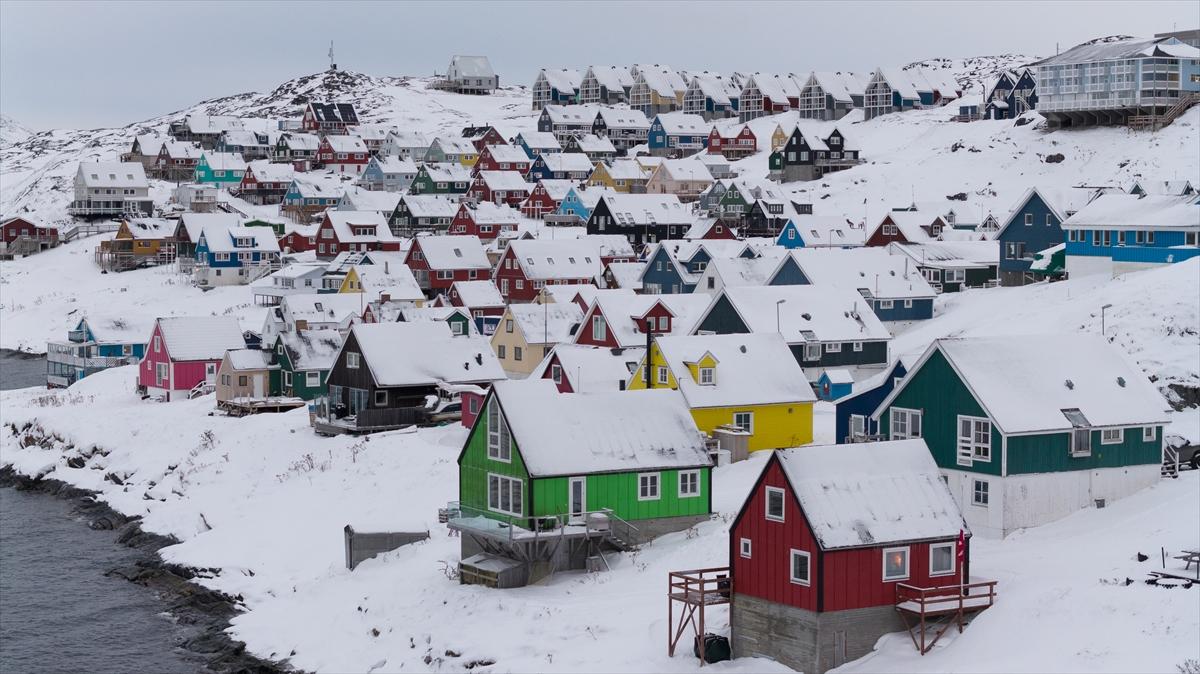
Greenland, 16 January 2026 – (Anadolu Agency)
The German Ministry of Defense, in a statement issued on 14 January 2026, announced that it would participate in the multinational reconnaissance operations in Greenland at Denmark’s invitation. The statement indicated that “Germany will join other European countries in reconnaissance operations in Greenland from 15 to 17 January.”
The ministry emphasized that the aim was to support Denmark’s efforts to ensure security in the region and noted that military contributions such as maritime surveillance capabilities would be examined. Germany has dispatched a 13-member reconnaissance team to Nuuk, Greenland, using an A400M transport aircraft. It was stated that the reconnaissance mission would be conducted alongside representatives from other European countries.
Dutch Defense Minister Ruben Brekelmans, in a written statement on 15 January 2026, announced that the Netherlands would participate in multinational reconnaissance operations aimed at enhancing security in the Arctic region. In his statement, Brekelmans said: “Therefore, the Netherlands will conduct a joint reconnaissance mission in Greenland alongside other NATO allies for a military exercise in the Arctic region. Denmark will lead the reconnaissance.”
It was specified that the Netherlands would contribute one soldier to the reconnaissance mission, and the purpose of the mission was emphasized as “identifying options for a joint exercise in the Arctic region.” Brekelmans stated: “Following the reconnaissance, the exercise will be further detailed and planned.”
Additionally, Brekelmans indicated that the reconnaissance could be “the next step in a broader mission under the NATO framework” and noted that the matter would be addressed within NATO in the coming period.
French President Emmanuel Macron, in a statement on 15 January 2026, announced that France had sent troops to participate in joint exercises in Greenland. In a post on the U.S.-based X social media platform, Macron said: “At Denmark’s request, I have decided that France will participate in the joint exercises organized by Denmark in Greenland under Operation Arctic Endurance.”
Macron stated in his remarks that the first French military units were already en route to the region and that additional forces would arrive in the coming days. French Chief of Defense Staff Fabien Mandon, in a statement on the same platform, said: “French military personnel are heading to Greenland to join exercises organized by Denmark with our partners.”
According to information from close sources to French Defense Minister Catherine Vautrin, France has sent approximately 15 soldiers to Greenland. These personnel are expected to participate in the joint mission, which will last until 17 January 2026. French media reported that the mission is being conducted under the framework of “Operation Arctic Endurance” and is led by Denmark. The purpose of the exercise is stated as enhancing coordination and security capacity among NATO allies in the Arctic region.
Estonia, the Netherlands, and Finland, in statements made on 15 January 2026, declared their readiness to support the European military exercise scheduled in Greenland. Estonian Foreign Minister Margus Tsahkna, in a post on X, stated that his country has contributed to planning joint exercises with other European nations, saying: “Estonia is contributing to the planning process of a joint European military exercise in Greenland and is prepared to deploy troops if requested.”
Dutch Defense Minister Ruben Brekelmans, in a statement on the same day, affirmed that the Netherlands would participate in NATO-led activities aimed at enhancing security in the Arctic region. In his post on X, Brekelmans said: “The Netherlands is conducting a joint reconnaissance mission in Greenland under Danish leadership alongside other NATO partners. This reconnaissance is part of the preparatory phase for a military exercise in the Arctic region.”
Finland Ministry of Defence has announced that it will send two military liaison officers to Greenland at Denmark’s request. In its written statement, the ministry stated, “Strengthening security in the Arctic region requires increased efforts from the Alliance.”
On 15 January 2026 in Washington, a meeting on Greenland was held between US Vice President JD Vance and Danish officials. White House Press Secretary Karoline Leavitt described the talks as “productive” in a subsequent press briefing.
Leavitt, commenting on President Donald Trump’s policy toward Greenland, said, “Trump has clearly articulated his priority of acquiring Greenland, and the president believes this is the most appropriate step for our national security interests.”
Leavitt reported that during the meeting, both sides agreed to establish a working group to conduct technical discussions on the potential purchase of Greenland. Leavitt stated, “The parties agreed to establish a working group to continue technical discussions on the acquisition of Greenland. These discussions are scheduled to take place every two to three weeks.”
Following the meeting, Danish Foreign Minister Lars Løkke Rasmussen stated in a press statement that “fundamental disagreements persist.” Rasmussen said, “We have been unable to change the American position. The president’s desire to assert control over Greenland is clearly evident.” Rasmussen added, “Any disregard for the territorial integrity of the Kingdom of Denmark and the right of the Greenlandic people to determine their own destiny is of course completely unacceptable.”
Leavitt emphasized the US administration’s determination to continue this process, stating, “This is a dialogue that the administration will continue with the Danes and the respected Greenlandic delegation.”
As of 15 January 2026, military units from European countries have arrived in Greenland. Personnel from France, Germany, Norway and Sweden have relocated to the town of Nuuk under a joint mission coordinated by Denmark. France has deployed 15 soldiers, and Germany has sent 13 soldiers. Norway and Sweden have also participated in the operation. The mission has been described as a “regional awareness exercise” and included the symbolic raising of the European Union flag. French officials confirmed that the soldiers deployed from their country are attached to a mountain infantry unit.
Swedish Prime Minister Ulf Kristersson stated that Swedish Armed Forces officers were sent to Greenland at Denmark’s request. It was indicated that Swedish officers will continue preparations for “Operation Arctic Endurance,” a joint exercise to be conducted with other European countries. The Norwegian Ministry of Defence confirmed that two military personnel have been deployed to Greenland. The Dutch Ministry of Defence also announced that one naval officer will participate in the same exercise. Countries participating in the exercise include France, Germany, Sweden, Norway, Finland, the Netherlands and the United Kingdom.
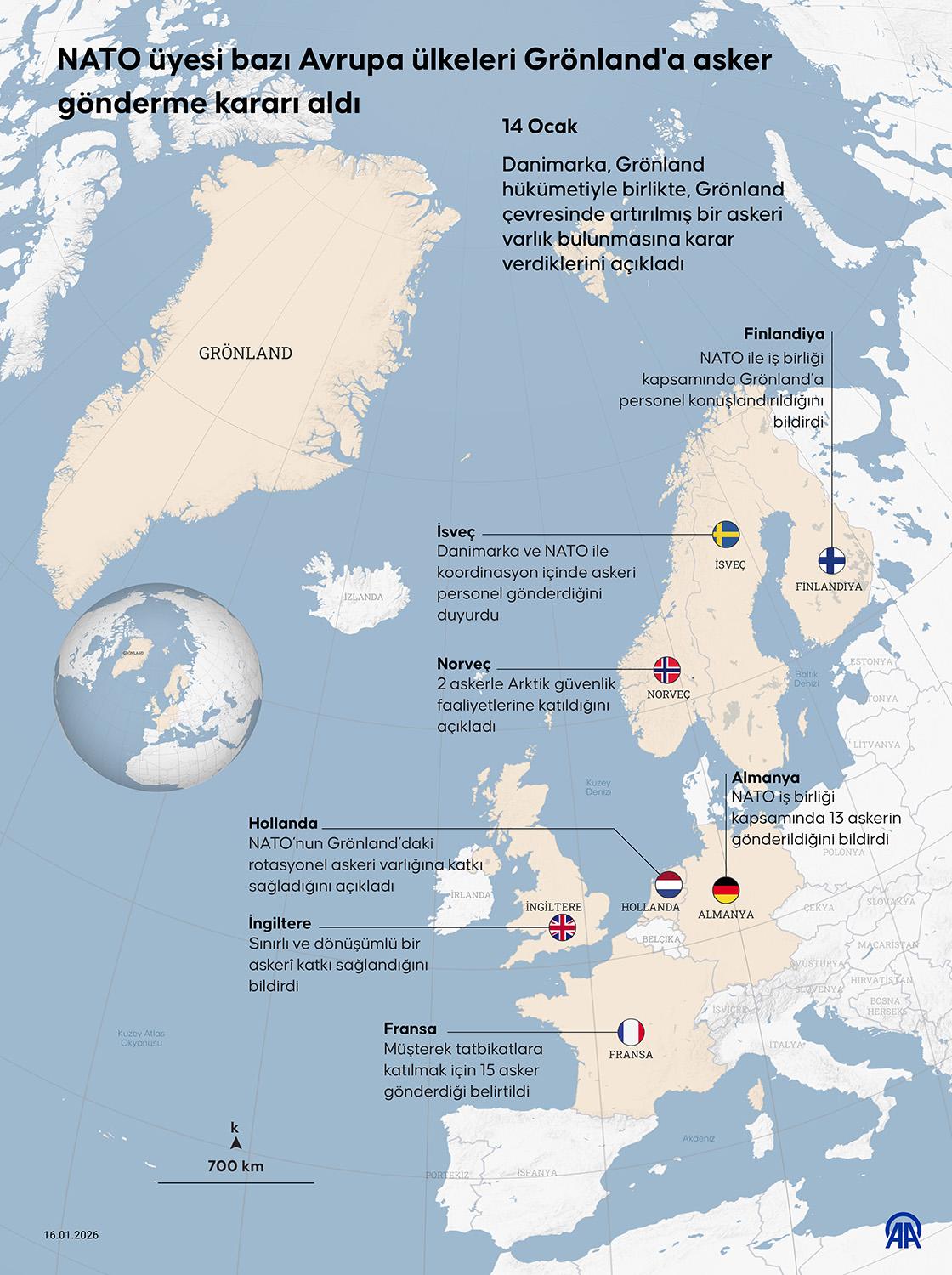
Infographic on countries that decided to send troops to Greenland. - (Anadolu Agency)
The exercise has been organized under NATO cooperation led by Denmark and is described as an activity aimed at testing NATO’s “deterrence and readiness capacity” in the Arctic region. The military elements participating in the mission have operated in cooperation with each other within the framework of NATO coordination activities in the region for the sake of European-Atlantic security. The Danish Ministry of Defence announced that as of 15 January, the military presence around Greenland will be increased on a rotational basis.
On 16 January 2026, at a weekly press briefing in Moscow, Russian Foreign Ministry Spokesperson Maria Zakharova made statements regarding military activity in the Arctic and the debates over Greenland. Zakharova declared that Russia will respond to any attempts to ignore its interests, saying, “Efforts to disregard Russian interests in the Arctic, particularly in the area of security, will not go unanswered. These will have broad-reaching consequences.”
Zakharova noted that Russia is closely monitoring US President Donald Trump’s plans regarding Greenland and stated, “Any dispute concerning this region must be resolved through negotiations in accordance with international law and with due consideration for the interests of the local population.” She also remarked, “The flaws of Copenhagen’s long-standing ally, the United States, bowing to pressure are now glaringly obvious.”
Zakharova denied allegations that Russia and China have any military plans targeting Greenland. The spokesperson stated that such claims are “unfounded” and added, “Russia stands for the preservation of peace and stability in the Arctic region.” Zakharova asserted that NATO’s actions have directly increased tensions in the region, saying, “These actions relate to the display of a colonialist approach toward the region, its militarization and its transformation into a theater of geopolitical competition.”
The spokesperson for the Russian Ministry of Foreign Affairs emphasized Russia’s determination to “protect the natural environment of the Arctic, preserve its cultural heritage, and safeguard the traditional ways of life of indigenous peoples.” Zaharova stated, “We will continue to firmly defend our position aimed at ensuring sustainable socio-economic development in this region.”
A delegation of U.S. senators met with representatives of the Danish business community in Copenhagen on January 16, 2026. In the morning, the delegation left the Danish Parliament building (Christiansborg) and proceeded to the headquarters of the Confederation of Danish Industry, where they held a working lunch with business leaders. The agenda of the meeting included economic relations between the two countries and international cooperation regarding Greenland.
U.S. Senator Dick Durbin (Illinois), in remarks prior to the meeting, said, “We have been friends and allies with Denmark and Greenland for decades. We wish to demonstrate our gratitude to them.” Durbin also noted that recent statements by U.S. President Donald Trump “did not reflect the sentiments of the American people.” Durbin added, “President Donald Trump’s recent remarks do not align with the feelings and beliefs of the American public.”
Before the meeting, Søren Gade, President of the Danish Parliament and former Minister of Defense, responded on the social media platform Facebook to the U.S. administration’s stance on Greenland. Gade stated, “I never thought I would ever speak critically about the United States. But now I can no longer remain silent if I am to look Danish veterans in the eye.” In his post, Gade also characterized the U.S. administration’s rhetoric as “inappropriate.”
On the same day, a statement from the White House declared, “The deployment of European alliances to Greenland will not affect Trump’s plans to take control of the territory.”
U.S. President Donald Trump announced on January 17 that customs tariffs would be imposed on eight European countries. Under this decision, goods imported from Denmark, Norway, Sweden, France, Germany, the Netherlands, Finland, and the United Kingdom would be subject to a 10 percent tariff starting February 1, 2026, with the rate increasing to 25 percent on June 1, 2026. Trump stated that these tariffs would remain in place until an agreement is reached on the sale of Greenland to the United States. This decision has been transformed into a legal and commercial pressure tool amid disagreements over Greenland’s status and sovereignty.
According to information reported by Anadolu Agency, Greenland’s Prime Minister Jens-Frederik Nielsen commented on the U.S. customs tariff decision. Nielsen indicated that the decision did not alter the current political trajectory and should be viewed as part of the broader discussion regarding Greenland’s right to self-determination.
European Union (EU) member states convened in response to the U.S. threat of customs tariffs on Greenland and decided to hold an emergency summit. According to an agreement reached by EU diplomats on January 18, EU leaders evaluated options to counter U.S. tariffs and worked on potential retaliatory measures if necessary. It was also reported that the European Parliament considered the possibility of suspending the implementation of its trade agreement with the United States.
In another development reflecting European solidarity, it was noted that Greenland welcomed the European response. According to Reuters, the Greenlandic government appreciated the support European countries extended to sovereignty claims, particularly Denmark’s continued backing of its sovereignty.
U.S. President Trump’s threats linking customs tariffs to Greenland triggered declines in European stock markets. The pan-European STOXX 600 index recorded a 1.2 percent drop on January 19, marking its steepest daily decline in two months. This development prompted investors to shift toward safe-haven assets amid growing uncertainty regarding trade policies. A corresponding reaction was observed in foreign exchange markets: while the U.S. dollar depreciated, safe-haven currencies such as the euro, yen, and Swiss franc gained value.
It was reported that European and NATO leaders, including European Commission President Ursula von der Leyen, held consultations regarding Greenland. In this context, the Prime Minister of the United Kingdom conducted phone talks with Germany, France, and Italy, reaching consensus on sustaining European solidarity and defending sovereignty interests. Furthermore, a commitment to cooperation was made to address the geopolitical challenges arising from the customs tariffs.
As a consequence of the Greenland crisis, public opinion and leaders in both Denmark and Greenland have opposed any notion or initiative to have Greenland purchased by the United States. It was reported that European governments issued strong criticisms of Trump’s demands, with countries such as the United Kingdom labeling Trump’s tariff approach as “wrong.” These developments have fueled growing debates on Greenland’s geopolitical and economic significance on the international stage.
As part of military activities related to Greenland, North American Aerospace Defense Command (NORAD) announced that U.S. aircraft would be deployed to Greenland as part of “long-planned routine operations.”
NORAD stated that U.S. aircraft would arrive at Pituffik Space Base in Greenland. The statement clarified that this deployment was part of previously planned routine operations under the defense cooperation framework between the United States, Canada, and Denmark.
It was emphasized that the deployment was conducted in coordination with Denmark, that all involved units operated within the framework of required diplomatic permissions, and that Greenlandic authorities had been informed of the planned operations. The aircraft were noted to be supporting routine operations aimed at defending North America.
U.S. President Donald Trump asserted that Greenland is essential to U.S. national security and holds critical importance within the defense architecture known as the “Golden Dome.” Following meetings in Washington involving the foreign ministers of the United States, Denmark, and Greenland, it was stated that fundamental disagreements persist between the parties, and that the U.S. approach toward Greenland is being closely watched by the international public.
On January 20, 2026, U.S. President Donald Trump shared a visual on his social media account based on a photograph taken during a prior meeting in the Oval Office with European leaders. In the post, digital editing was applied to the image to display a map showing Canada, Venezuela, and Greenland as part of U.S. territory.
In the image, the map superimposed in the background of the Oval Office scene depicted the three regions as being within U.S. borders. The post was interpreted in connection with Trump’s previous statements regarding Greenland.
On the same day, Danish Prime Minister Mette Frederiksen, in a statement in the capital Copenhagen, declared that Denmark would not refrain from responding with similar force if the United States were to use military power against Greenland. Frederiksen noted that they were closely monitoring President Trump’s statements about “seizing” Greenland.
Frederiksen pointed out that Trump’s remarks did not rule out the use of military force and stated that Denmark’s stance was a natural consequence of the U.S. President’s rhetoric and actions. She also confirmed that military training activities in Greenland had been increased and that these efforts were part of the Arctic Resilience Operation conducted under NATO auspices.
In this context, it was recalled that Greenland, an autonomous territory within the Kingdom of Denmark, had previously rejected U.S. approaches that included the transfer of sovereignty. Denmark, alongside its allies, has called for increased military cooperation in the region, with several European countries announcing they would send small military units and officers to Greenland.
In response, Trump argued that world peace was at risk due to the Greenland dispute and announced that customs tariffs would be imposed on Denmark, Norway, Sweden, France, Germany, the United Kingdom, the Netherlands, and Finland for opposing the U.S. acquisition of Greenland. According to the announcement, a 10 percent tariff would take effect on February 1, rising to 25 percent after June 1.
On January 21, 2026, Canadian Prime Minister Mark Carney, in remarks at the World Economic Forum meeting in Davos, Switzerland, stated that Canada stands with Greenland and Denmark on the issue of Arctic sovereignty. Carney affirmed support for Greenland’s right to determine its own future.
Carney emphasized that NATO’s support for Article 5 remains strong and stated that Canada is working alongside its NATO allies to ensure the security of the alliance’s northern and western regions. Carney expressed opposition to Canada’s tariffs related to Greenland and called for diplomatic talks aimed at ensuring security and prosperity in the region.
In his speech, Carney argued that major powers are using economic integration as a tool of pressure through arms and tariffs, and asserted that middle-sized countries must act together.
On the same day, it was reported that France called for a NATO exercise to be held in Greenland. A statement from the Élysée Palace confirmed that France has requested a NATO exercise in Greenland and expressed its readiness to contribute to such an exercise.
Close sources to French President Emmanuel Macron indicated that this request is based on similar grounds as Denmark’s justification for participating in military exercises in Greenland. The sources noted that France aims to highlight the seriousness of the security situation in the Arctic region and to send a message to the U.S. administration through this initiative.
It was stated that several European countries, including France, had deployed troops to the region last week to participate in joint military exercises in Greenland, with the Paris administration sending approximately 15 soldiers under this initiative.
On 5 January 2026, the United States President Donald Trump stated that Greenland holds essential strategic importance for U.S. national security. Trump emphasized that Greenland’s location in the Arctic region, its role as a geopolitical transit point between the North Atlantic and North America, and its significance for regional military infrastructure place it firmly within the United States’ direct area of interest. The statement indicated that various possibilities regarding Greenland’s future were being considered, and it included declarations that the United States would not retreat on this issue.
Later the same day, Greenland’s Prime Minister Jens-Frederik Nielsen issued a public statement in response to Trump’s remarks. Nielsen affirmed that Greenland is not for sale and will not accept becoming part of another state. He stressed that only the people of Greenland have the right to determine its future and rejected any rhetoric involving external pressure or threats. The Greenlandic government underscored that its status must be determined within the framework of international law and existing constitutional arrangements.
U.S. Statements on Greenland (BBC NEWS)
On 6 January 2026, the White House Press Office stated that the U.S. administration is evaluating “all options” regarding Greenland. The statement specified that these options include diplomatic initiatives, political arrangements, and military measures. White House officials noted that the use of the U.S. military remains a possibility within the bounds of constitutional authority. This statement followed Trump’s remarks from the previous day.
According to a report by Reuters on 6 January 2026, the Trump administration has explored various pathways toward incorporating Greenland into the United States. The assessment indicated that the use of military force remains among the possible options and has not been entirely ruled out. Reuters’ analysis linked this approach to the United States’ broader security planning in the Arctic region.
U.S. President Donald Trump (Anadolu Ajansı)
On the same day, the Denmark government issued an official response to Trump’s statements regarding Greenland. Danish Prime Minister Mette Frederiksen stated that threats to the territorial integrity of a NATO member state are unacceptable. Danish officials emphasized that Greenland is an autonomous territory within the Kingdom of Denmark, that defense and foreign policy fall under Denmark’s jurisdiction, and that this status cannot be altered by unilateral declarations.
On 6 January 2026, Germany, France, Italy, Poland, Spain, the United Kingdom, and Denmark issued a joint statement on Greenland. The statement affirmed that sovereignty, territorial integrity, and the inviolability of borders are fundamental principles of international law. It emphasized that only Denmark and the people of Greenland have the right to determine Greenland’s future and stressed that Arctic security must be ensured through cooperation among NATO allies.
Reactions from Denmark and Greenland to Trump’s Statements (Guardian)
On 7 January 2026, several European countries issued statements of support for Denmark following Trump’s remarks on Greenland. These messages affirmed support for Denmark’s sovereign rights and Greenland’s current status. Statements from European capitals emphasized that any coercive action is unacceptable and that the issue must be addressed through diplomatic channels.
On 7 January 2026, the U.S. administration continued to assert that the military option has not been entirely ruled out regarding Greenland. Official statements reaffirmed that the United States will act in accordance with its national security interests and noted that Washington’s stance had not changed despite objections from European countries. This development has generated new debate within U.S.-European relations and NATO’s internal balance.
According to a report by The New York Times (NYT), the 1951 Agreement on the Defense of Greenland, signed between the United States and Denmark, grants the U.S. administration the authority to establish military bases across the territory, deploy personnel, and control air and maritime traffic. The agreement is said to provide the United States with broad authority to construct, operate, and maintain military facilities in Greenland.
The agreement was updated in 2004 to recognize Greenland’s semi-autonomous administration and to require consultation with Denmark and Greenland prior to “significant changes” in U.S. military activities. Mikkel Runge Olesen, a researcher at the Danish Institute of International Studies in Copenhagen, stated, “The United States can move so freely in Greenland that it can almost do anything it wants.”
U.S. Vice President JD Vance stated that European allies must take President Donald Trump’s statements on Greenland seriously, saying, “Our expectation from our European friends is that they take the security of this landmass more seriously, otherwise the United States will be compelled to act on this issue.”
In response to questions about the future of U.S. policy toward Greenland, Vance referenced Trump’s statements, saying, “My advice to European leaders is to take the U.S. President seriously. Our expectation from our European friends is that they take the security of this landmass more seriously, otherwise the United States will be compelled to act on this issue.”
Vance, referencing Trump’s remarks on Greenland, stated that “Greenland is critically important to both America’s and the world’s missile defense.”
U.S. President Donald Trump stated that Europe and the United States must “defend” Greenland for their national security, adding, “We cannot allow China or Russia to occupy Greenland.” Trump reiterated that his position on Greenland has not changed and that the United States wants to “own” it, defending this stance as an act of goodwill toward European nations.
Trump declared, “We do not want Russia or China to go to Greenland. If we do not take control of it, Russia or China will become your neighbor. That will not happen.” He emphasized that the United States is determined on this issue.
U.S. President Trump added, “We cannot allow China or Russia to occupy Greenland. We also cannot allow China or Russia to occupy Venezuela. If we had not acted as we did, China or Russia would be in Venezuela.” He noted his desire to reach an agreement with Denmark on Greenland but warned that if no agreement is reached, the United States is prepared to use “the hard way.”
According to reports published on 11 January 2026, U.S. President Donald Trump instructed special operations commanders to prepare a military plan for the takeover of Greenland. These allegations were based on reports by the British newspaper Daily Mail, citing sources close to the matter.
In the report, it was claimed that close circles around Trump were emboldened by the prospect of a U.S. military intervention targeting Venezuela’s President Nicolas Maduro and his spouse, and that there was a push to take control of Greenland before Russia or China could act.
It was alleged that this directive was communicated to the U.S. Joint Special Operations Command (JSOC). However, senior military officials reportedly opposed the plan, arguing that such an operation would be illegal and would fail to gain the support of the U.S. Congress.
Same reports suggested that military officials attempted to divert Trump’s attention to other issues by bringing up less controversial topics such as countering Russia’s “ghost fleet” or military options against Iran.
It was recalled that in previous statements, Trump had said, “We do not want Russia or China to go to Greenland. If we do not take it, Russia or China will be your neighbor.”
It is known that Greenland, an autonomous territory of Denmark, has previously rejected U.S. approaches that included proposals for transferring sovereignty. On January 5, Mette Frederiksen stated in a public remark that if the United States were to make a military attack on a NATO ally, the alliance would come to an end, and she strongly criticized Trump’s national security rhetoric regarding Greenland.
According to reports published on January 12, 2026, the United Kingdom has begun developing plans to deploy troops to Greenland. The plan is said to aim both at protecting Greenland against the growing presence of China and Russia and at deterring the United States, which is alleged to seek to seize the territory.
The British newspaper The Telegraph reported that the plan is being discussed with European allies. It was stated that the United Kingdom is in contact with France and Germany on the issue of Greenland’s security. The report noted that British military officials have held meetings with their German and French counterparts and are conducting preparatory work for a possible military mission in Greenland. Initial plans consider the deployment of British troops alongside warships and air assets to the island.
The planned mission is expected to be conducted under the NATO umbrella and is described as a distinct operation separate from existing missions in the Baltic states and Poland. British officials stated they are already preparing for Arctic security. An unnamed government official speaking to the newspaper said Prime Minister Keir Starmer takes the threats from Russia and China seriously and believes concrete action is necessary. Another official stated that the United Kingdom agrees with U.S. President Trump’s view that NATO’s Atlantic security must be strengthened in response to Russia’s increasing activities in the North Atlantic. The British Foreign Office also confirmed in its statement that the United Kingdom is determined to work with its allies to defend the Arctic under NATO.
On January 12, 2026, Republican member of the U.S. House of Representatives Randy Fine introduced a bill titled “Greenland Annexation and Statehood Act.” The bill proposes that Greenland voluntarily join the United States as the 51st state.
In his written statement, Fine stated that the bill grants the Donald Trump administration the authority to take necessary steps toward Greenland’s accession to the United States. The statement emphasized that Greenland holds a strategic position for national security and is critically important due to its control over Arctic sea routes and defense infrastructure. No official schedule has been released regarding whether the bill will be considered by the full House of Representatives.
On the same day, it was recalled that Greenland, as an autonomous territory of Denmark, has previously rejected similar U.S. approaches involving sovereignty transfers. Mette Frederiksen, in her January 5 statement, warned that any military intervention against a NATO ally would have serious consequences and criticized U.S. rhetoric on Greenland.
On January 12, 2026, Jose Manuel Albares commented on the United States’ possible plans regarding Greenland. In a statement made in Madrid, Albares said that if a situation arises that threatens NATO security in the Arctic region or in Greenland, security measures could be strengthened within the NATO framework.
The statement indicated that if Denmark’s security within the European Union and NATO is deemed insufficient, allies could jointly analyze the situation and enhance security in line with shared interests. Albares did not treat a U.S. military intervention in Greenland as a likely scenario but stated that NATO mechanisms could be activated in response to potential threats.
In the same remarks, Albares emphasized that the European Union must adopt a more active stance in the face of international crises and stressed the importance of Europe’s collective capacity to respond to threats to sovereignty.
On January 13, 2026, the European Union Commission publicly declared its full solidarity with Greenland amid rising international debate over its status. EU Commission spokesperson Anitta Hipper responded to journalists’ questions at a daily press briefing in Brussels, emphasizing that any approach to Greenland’s sovereignty is directly linked to the EU’s fundamental principles.
Hipper stated that he did not wish to delve into the legal details regarding Greenland’s protection under European Union agreements; however, he affirmed that Greenland is a territory belonging to its own people and that the EU stands in full solidarity with Greenland in this context. The statement particularly emphasized the principle that “no nation’s security can be achieved at the expense of another’s sovereignty,” and noted that this principle has long been valid for countries with longstanding alliance relationships.
The European Commission spokesperson affirmed that the United States of America remains an indispensable partner for the European Union; however, he underscored that sovereignty and principles of international law must be upheld independently of alliance relationships. These remarks followed previous statements by U.S. President Donald Trump regarding Greenland, which emphasized ownership.
Trump argued that if the United States does not control Greenland, Russia or China could increase their influence in the region; he contended that military presence alone is insufficient and that ownership is also necessary. He further pointed out that Chinese and Russian submarines and warships are operating near Greenland and declared that such activities would not be tolerated. Regarding questions about whether Trump’s approach might undermine unity and solidarity within NATO, it was reported that the United States responded by asserting that it is less dependent on its allies than they are on it.
Greenland, as an autonomous territory under Denmark, has explicitly rejected previous approaches from the United States that implied a transfer of sovereignty.
On January 14, 2026, Greenland’s Minister for Industry, Raw Materials, Mining, Energy, Law Enforcement, and Equality, Naaja Nathanielsen, delivered comprehensive remarks in London on the future of Greenland. In her assessment to the press following a meeting of the All-Party Parliamentary Group on Greenland within the UK Parliament, Nathanielsen stated that U.S. rhetoric about annexing or purchasing Greenland had generated serious concern among the Greenlandic population.
Nathanielsen said that the issue has become central to daily life in Greenland, with people struggling to sleep due to anxiety about the future. At the political level, she emphasized that all parties share a clear position: Greenlanders have no intention of becoming American, do not see themselves as Americans, and are content to remain part of the Kingdom of Denmark.
Nathanielsen noted that U.S. statements have caused disappointment from the perspective of an alliance relationship, yet she characterized the discussions of annexation or purchase as “unwarranted.” At the same time, she emphasized that Greenland remains open to U.S. mining companies and investors, and affirmed that U.S. concerns regarding national security and access to subterranean resources are open to negotiation.
Nathanielsen stated that Greenland does not wish to see itself as being in conflict with the United States and will continue to pursue peaceful solutions. Referring to U.S. President Trump’s comments on Russian and Chinese activities in the Arctic, she noted that Russia is an Arctic coastal state and that China has long shown interest in the region; however, she stated that no direct military or economic pressure has been detected against Greenland.
In her assessment of a potential U.S. occupation scenario, Nathanielsen stated that such an event would fundamentally shake the rules-based international order, emphasizing that an attack by one NATO member state on another would constitute an attack on all allies. She asserted that in the event of occupation, international law and existing agreements would lose their validity, leading to negative and shameful consequences for all parties involved. Finally, Nathanielsen clarified that Greenlanders are not seeking independence from Denmark and have no principled objection to an increased presence of allied military forces on the island under the NATO framework. She recalled that Greenland has previously hosted a more substantial military presence than today and noted that this is not a foreign phenomenon to the local population.
On February 6, 2026, France announced its decision to open a consulate in Nuuk, the capital of Greenland. French Minister for Foreign Affairs, Jean-Noël Barrot, stated on the RTL radio program that Greenland, due to its energy resources and strategic location, has become a focal point for global powers. Barrot affirmed that France aims to strengthen its presence in Greenland across political, economic, and diplomatic dimensions, and emphasized that the opening of the consulate in Nuuk is a concrete manifestation of this approach.
Jean-Noël Barrot noted that the decision to open the consulate is part of a diplomatic plan publicly announced by Emmanuel Macron during his visit to Greenland the previous year. During that visit, France had declared its intention to enhance its institutional engagement with the Arctic region.
The opening of the consulate in Nuuk places France among the countries with official diplomatic representation in Greenland. This step is regarded as significant for expanding France’s diplomatic engagement in the Arctic and enabling direct monitoring of developments in Greenland within the framework of its Arctic policy.
On January 14, 2026, the Danish Ministry of Defence announced in a written statement that it had decided to increase its military presence in Greenland. The statement drew attention to growing security concerns in the Arctic region and stated: “The Government of Greenland and the Danish Ministry of Defence have decided to increase joint exercises with NATO allies in Greenland. This means that from today, our military presence in Greenland and its surrounding areas will be enhanced.” The ministry indicated that the decision aims to strengthen defense cooperation within the NATO framework. It further stated that in the coming period, there will be an increase in aircraft, ships, and troop numbers around Greenland.
Defence Minister Troels Lund Poulsen, when asked about the possibility of a U.S. military intervention in Greenland, described it as “entirely hypothetical.” In his assessment in Copenhagen, he said: “I view any potential U.S. attack on Greenland as a completely hypothetical scenario.”
Swedish Prime Minister Ulf Kristersson, in a statement made on the U.S.-based X social media platform, said: “Swedish Armed Forces officers are traveling to Greenland today.” Kristersson noted that his country supports Denmark’s decision to conduct exercises in Greenland and stated that “the steps to be taken within the framework of the exercise will be prepared jointly.”
Greenland, 16 January 2026 – (Anadolu Agency)
The German Ministry of Defense announced on 14 January 2026 that it would participate in multinational reconnaissance operations in Greenland at Denmark’s invitation. The statement indicated that “Germany will join other European countries in reconnaissance operations in Greenland from 15 to 17 January.”
The ministry emphasized that Germany’s aim is to support Denmark’s efforts to enhance security in the region and noted that military contributions such as maritime surveillance capabilities would be examined. Germany has deployed a 13-member reconnaissance team to Nuuk, Greenland, using an A400M transport aircraft. It was stated that the reconnaissance mission would be conducted alongside representatives from other European countries.
Dutch Defense Minister Ruben Brekelmans, in a written statement on 15 January 2026, announced that the Netherlands would participate in multinational reconnaissance operations aimed at enhancing security in the Arctic region. Brekelmans stated: “Therefore, the Netherlands will conduct a joint reconnaissance mission in Greenland with other NATO allies for a military exercise in the Arctic region. Denmark will lead the reconnaissance.”
It was specified that the Netherlands would contribute one soldier to the reconnaissance mission, and the purpose of the mission was emphasized as identifying options for a joint exercise in the Arctic region. Brekelmans said: “Following the reconnaissance, the exercise will be further detailed and planned.”
Additionally, Brekelmans indicated that this initiative could be the next step in a broader mission under the NATO framework and noted that the matter would be addressed within NATO in the coming period.
French President Emmanuel Macron, in a statement on 15 January 2026, announced that France had sent military personnel to participate in joint exercises in Greenland. In a post on the U.S.-based X social media platform, Macron said: “At Denmark’s request, I have decided that France will participate in the joint exercises organized by Denmark in Greenland under Operation Arctic Endurance.”
Macron stated in his remarks that the first French military units are already en route to the region and that additional units will arrive in the coming days. French Chief of the General Staff Fabien Mandon, in a statement on the same platform, said: “French military personnel are heading to Greenland to join exercises organized by Denmark with our partners.”
According to information from close sources to French Defense Minister Catherine Vautrin, France has sent approximately 15 soldiers to Greenland. These personnel are expected to participate in the joint mission, which will last until 17 January 2026. French media reported that the mission is being conducted under the framework of “Operation Arctic Endurance” and is led by Denmark. The purpose of the exercise is stated as enhancing coordination and security capacity among NATO allies in the Arctic region.
Estonia, the Netherlands, and Finland, in statements made on 15 January 2026, declared their readiness to support the European military exercise scheduled in Greenland. Estonian Foreign Minister Margus Tsahkna, in a post on X, stated that his country has contributed to planning joint exercises with other European nations, saying: “Estonia is contributing to the planning process of a joint European military exercise in Greenland and is prepared to deploy troops if requested.”
Dutch Defense Minister Ruben Brekelmans, in a statement on the same day, affirmed that the Netherlands would participate in NATO-led activities aimed at enhancing security in the Arctic region. In a post on X, Brekelmans said: “The Netherlands is conducting a joint reconnaissance mission in Greenland under Denmark’s leadership alongside other NATO partners. This reconnaissance is part of the preparatory phase for a military exercise in the Arctic region.”
Finland Ministry of Defence has announced that it will send two military liaison officers to Greenland at Denmark’s request. In its written statement, the ministry stated, “Strengthening security in the Arctic region requires increased efforts from the Alliance.”
On 15 January 2026 in Washington, a meeting on Greenland was held between US Vice President JD Vance and Danish officials. White House Press Secretary Karoline Leavitt described the talks as “productive” in a subsequent press briefing.
Leavitt, referring to President Donald Trump’s policy toward Greenland, said, “Trump has clearly stated his priority of acquiring Greenland, and the president believes this is the most appropriate step for our national security interests.”
Leavitt reported that during the meeting, both sides agreed to establish a working group to conduct technical discussions on the potential purchase of Greenland. Leavitt stated, “The parties agreed to establish a working group to continue technical discussions on the acquisition of Greenland. These discussions are scheduled to take place every two to three weeks.”
Following the meeting, Danish Foreign Minister Lars Løkke Rasmussen stated in a press statement that “fundamental disagreements persist.” Rasmussen said, “We have been unable to change the American position. The president’s desire to assert control over Greenland is clearly evident.” He added, “Any disregard for the territorial integrity of the Kingdom of Denmark and the right of the Greenlandic people to determine their own destiny is of course completely unacceptable.”
Leavitt emphasized the US administration’s determination to continue this process, stating, “This is a dialogue that the administration will continue with the Danes and the respected Greenlandic delegation.”
As of 15 January 2026, military units from European countries have arrived in Greenland. Personnel from France, Germany, Norway and Sweden have relocated to the town of Nuuk under Denmark’s coordination as part of a joint mission. France has deployed 15 soldiers, and Germany has sent 13 soldiers. Norway and Sweden have also participated in the operation. The mission has been described as a “regional awareness exercise” and included the symbolic raising of the European Union flag. French officials confirmed that the soldiers sent from their country are attached to a mountain infantry unit.
Swedish Prime Minister Ulf Kristersson stated that Swedish Armed Forces officers were sent to Greenland at Denmark’s request. It was indicated that Swedish officers will continue preparations for “Operation Arctic Endurance,” a joint exercise to be conducted with other European countries. The Norwegian Ministry of Defence confirmed that two military personnel have been deployed to Greenland. The Dutch Ministry of Defence also announced that one naval officer will participate in the same exercise. The participating countries include France, Germany, Sweden, Norway, Finland, the Netherlands and the United Kingdom.
Infographic on countries that decided to send troops to Greenland. – (Anadolu Agency)
The exercise has been organized under Danish leadership and NATO cooperation and is defined as an activity aimed at testing NATO’s “deterrence and readiness capacity” in the Arctic region. The military elements from participating countries have operated in cooperation within the framework of NATO coordination activities in the region for European-Atlantic security. The Danish Ministry of Defence announced that as of 15 January, the military presence around Greenland will be increased on a rotational basis.
On 16 January 2026, at a weekly press briefing in Moscow, Russian Foreign Ministry Spokesperson Maria Zakharova made statements regarding military activity in the Arctic and the debate over Greenland. Zakharova stated that Russia will respond to any attempts to ignore its interests, saying, “Efforts to disregard Russian interests in the Arctic, particularly in the field of security, will not go unanswered. These will have broad-ranging consequences.”
Zakharova said Russia is closely monitoring US President Donald Trump’s plans regarding Greenland and added, “Any dispute concerning this region must be resolved through negotiations in accordance with international law and with due regard for the interests of the local population.” She also remarked, “The flaws of Copenhagen’s long-standing ally, the United States, bowing to pressure are now clearly evident.”
Zakharova denied allegations that Russia and China have any military plans targeting Greenland. The spokesperson stated that such claims are “unfounded” and added, “Russia stands for the preservation of peace and stability in the Arctic region.” Zakharova asserted that NATO’s actions are directly increasing tensions in the region, saying, “These actions relate to the display of a colonial approach toward the region, its militarization and its transformation into a theatre of geopolitical competition.”
The spokesperson for the Russian Ministry of Foreign Affairs emphasized Russia’s determination to “protect the natural environment of the Arctic, preserve its cultural heritage, and safeguard the traditional ways of life of indigenous peoples.” Zaharova stated, “We will continue to firmly defend our position aimed at ensuring sustainable socio-economic development in this region.”
A delegation of U.S. senators met with representatives of the Danish business community in Copenhagen on January 16, 2026. In the morning, the delegation left the Danish Parliament building (Christiansborg) and proceeded to the headquarters of the Confederation of Danish Industry, where they held a working lunch with business leaders. The agenda of the meeting included economic relations between the two countries and international cooperation on Greenland.
U.S. Senator Dick Durbin (Illinois), in remarks prior to the meeting, said, “We have been friends and allies with Denmark and Greenland for decades. We wish to demonstrate our gratitude to them.” Durbin also noted that recent statements by U.S. President Donald Trump “did not align with the sentiments of the American people.” Durbin added, “President Donald Trump’s recent remarks do not reflect the feelings and beliefs of the American public.”
Before the meeting, Søren Gade, President of the Danish Parliament and former Minister of Defense, responded on the social media platform Facebook to the U.S. administration’s stance on Greenland. Gade stated, “I never thought I would ever speak critically about the United States. But now I can no longer remain silent if I am to look Danish veterans in the eye.” In the same post, Gade characterized the U.S. administration’s rhetoric as “inappropriate.”
On the same day, a statement from the White House declared, “The deployment of European Union entities to Greenland will not affect Trump’s plans to take control of the territory.”
U.S. President Donald Trump announced on January 17 that customs tariffs would be imposed on eight European countries. Under this decision, goods imported from Denmark, Norway, Sweden, France, Germany, the Netherlands, Finland, and the United Kingdom would be subject to a 10 percent tariff starting February 1, 2026, with the rate increasing to 25 percent on June 1, 2026. Trump stated that these tariffs would remain in place until an agreement is reached on the sale of Greenland to the United States. This decision has been transformed into a legal and commercial pressure tool within the context of disagreements over Greenland’s status and sovereignty.
According to information reported by the Anadolu Agency, Greenland’s Prime Minister Jens-Frederik Nielsen commented on the U.S. customs tariff decision. Nielsen stated that the decision did not alter the current political trajectory and should be viewed as part of broader discussions concerning Greenland’s right to self-determination.
European Union (EU) member states convened in response to the U.S. threat of customs tariffs on Greenland and decided to organize an emergency summit. According to an agreement reached by EU diplomats on January 18, EU leaders evaluated options to counter U.S. tariffs and worked on potential retaliatory measures if necessary. It was also reported that the European Parliament may consider suspending the implementation of its trade agreement with the United States.
In another development reflecting European solidarity, it was noted that Greenland welcomed the European response. According to Reuters, the Greenlandic government appreciated the support from European countries for sovereignty, particularly Denmark’s continued backing of its sovereignty claims.
U.S. President Trump’s threats linking customs tariffs to Greenland triggered declines in European stock markets. The Pan-European STOXX 600 index recorded a nearly 1.2 percent drop on January 19, marking its steepest daily decline in two months. This development led investors to shift toward safe-haven assets amid growing uncertainty regarding trade policies. A similar reaction was observed in foreign exchange markets: while the U.S. dollar depreciated, safe-haven currencies such as the euro, yen, and Swiss franc gained value.
It was reported that European and NATO leaders, including European Commission President Ursula von der Leyen, held consultations regarding Greenland. In this context, the Prime Minister of the United Kingdom conducted phone talks with Germany, France, and Italy, achieving consensus on sustaining European solidarity and protecting sovereignty interests. Furthermore, a commitment to cooperate in addressing geopolitical challenges arising from the customs tariffs was made.
As a consequence of the Greenland crisis, public opinion and leaders in both Denmark and Greenland have opposed any notion or initiative to have Greenland purchased by the United States. It was reported that European governments issued strong criticism of Trump’s demands, with countries such as the United Kingdom labeling Trump’s tariff approach as “wrong.” These developments have fueled growing debates on Greenland’s geopolitical and economic significance on the international stage.
As part of military activities concerning Greenland, the North American Aerospace Defense Command (NORAD) announced that U.S. aircraft would be deployed to Greenland as part of “long-planned routine operations.”
NORAD stated that U.S. aircraft would arrive at the Pituffik Space Base in Greenland. The statement clarified that this deployment was part of previously planned routine activities under the defense cooperation framework between the United States, Canada, and Denmark.
It was emphasized that the deployment was conducted in coordination with Denmark, that all personnel involved operated within the framework of required diplomatic authorizations, and that Greenland authorities had been informed of the planned operations. The aircraft were noted to be supporting routine operations aimed at defending North America.
U.S. President Donald Trump asserted that Greenland is essential for U.S. national security and holds critical importance within the defense architecture known as the “Golden Dome.” Following meetings in Washington involving the foreign ministers of the United States, Denmark, and Greenland, it was stated that fundamental disagreements persist between the parties, and that the U.S. approach toward Greenland is being closely monitored by the international public.
On January 20, 2026, U.S. President Donald Trump shared a visual on his social media account based on a photograph taken during a prior meeting in the Oval Office with European leaders. In the post, a digitally altered map was superimposed over the background of the photograph, depicting Canada, Venezuela, and Greenland as part of U.S. territory.
In the image, the three regions mentioned appeared within the borders of the United States on the map added behind Trump’s meeting with European leaders. The post was interpreted in connection with Trump’s previous statements regarding Greenland.
On the same day, Danish Prime Minister Mette Frederiksen, in a statement in the capital Copenhagen, declared that Denmark would not refrain from responding with similar measures if the United States were to use military force against Greenland. Frederiksen noted that they were closely monitoring President Trump’s statements regarding “seizing” Greenland.
Frederiksen pointed out that Trump’s remarks did not rule out the use of military force and stated that Denmark’s stance was a natural consequence of the U.S. President’s words and actions. She also confirmed that military training activities in Greenland had been increased and that these activities were part of the NATO-led Arctic Resilience Operation.
It was recalled that Greenland, an autonomous territory of the Kingdom of Denmark, had previously rejected approaches from the United States that included proposals for the transfer of sovereignty. Denmark, alongside its allies, has called for increased military cooperation in the region, with several European countries announcing they would send small military units and officers to Greenland.
In response, Trump argued that world peace was at risk due to opposition to the U.S. acquisition of Greenland and announced that customs tariffs of 10 percent would be imposed on Denmark, Norway, Sweden, France, Germany, the United Kingdom, the Netherlands, and Finland starting February 1, increasing to 25 percent after June 1.
On January 21, 2026, Canadian Prime Minister Mark Carney, during a speech at the World Economic Forum in Davos, Switzerland, declared that Canada stood with Greenland and Denmark on the issue of Arctic sovereignty. Carney affirmed support for Greenland’s right to determine its own future.
Carney emphasized that NATO’s support for Article 5 remains ongoing and stated that Canada is working alongside its NATO allies to ensure the security of the alliance’s northern and western regions. Carney opposed Canada’s imposition of tariffs in the context of the Greenland issue and called for diplomatic talks aimed at ensuring security and prosperity in the region.
In his speech, Carney argued that major powers are using economic integration as a tool of pressure through arms and tariffs, and asserted that middle-sized countries must act in unison.
On the same day, it was reported that France has called for a NATO exercise to be held in Greenland. A statement from the Élysée Palace confirmed that France has requested a NATO exercise in Greenland and expressed its readiness to contribute to such an exercise.
Sources close to French President Emmanuel Macron indicated that this request is based on similar grounds as Denmark’s justification for participating in military exercises in Greenland. The sources highlighted the seriousness of the security situation in the Arctic region and stated that France aims to send a message to the U.S. administration through this initiative.
It was noted that several European countries, including France, have deployed troops to the region last week to participate in joint military exercises in Greenland, with the Paris administration sending approximately 15 soldiers under this initiative.
Al Jazeera. "European Troops Arrive in Greenland as Talks with US Hit Wall over Future." Accessed January 16, 2026. https://www.aljazeera.com/news/2026/1/15/european-troops-arrive-in-greenland-as-talks-with-us-hit-wall-over-future
Al Jazeera. “US Says Military ‘Always an Option’ in Greenland as Europe Rejects Threats.” Accessed January 7, 2026. https://www.aljazeera.com/news/2026/1/7/us-says-military-always-an-option-in-greenland-as-europe-rejects-threats
Anadolu Ajansı. "ABD uçaklarının ‘rutin faaliyetler’ kapsamında Grönland’da konuşlandırılacağı bildirildi." Accessed January 20, 2026. https://www.aa.com.tr/tr/dunya/abd-ucaklarinin-rutin-faaliyetler-kapsaminda-gronlandda-konuslandirilacagi-bildirildi/3804618
Anadolu Ajansı. "Avrupa Ülkelerinden Trump’ın Grönland Açıklaması Sonrası Danimarka’ya Destek Mesajları." Accessed January 7, 2026. https://www.aa.com.tr/tr/dunya/avrupa-ulkelerinden-trumpin-gronland-aciklamasi-sonrasi-danimarkaya-destek-mesajlari/3790183
Anadolu Ajansı. "Avrupa’nın 7 Ülkesinden Grönland’a İlişkin Ortak Açıklama." Accessed January 7, 2026. https://www.aa.com.tr/tr/dunya/avrupanin-7-ulkesinden-gronlanda-iliskin-ortak-aciklama/3791325
Anadolu Ajansı. "Fransa, Müşterek Tatbikatlara Katılmak İçin Grönland’a Asker Gönderdi." Accessed January 16, 2026. https://www.aa.com.tr/tr/dunya/fransa-musterek-tatbikatlara-katilmak-icin-gronlanda-asker-gonderdi/3800011
Anadolu Ajansı. "Grönlandlı Bakan Nathanielsen: Amerikalı olmaya hiç niyetimiz yok." Accessed January 14, 2026.
Anadolu Ajansı. "Rusya: Arktik’te Çıkarlarımızı Görmezden Gelme Yönündeki Girişimlere Karşılık Verilecek." Accessed January 16, 2026. https://www.aa.com.tr/tr/dunya/rusya-arktikte-cikarlarimizi-gormezden-gelme-yonundeki-girisimlere-karsilik-verilecek/3800800
Anadolu Ajansı. "Trump’ın, Grönland’ın ele geçirilmesi için askeri plan hazırlanması talimatı verdiği iddiası." Accessed January 12, 2026.
Anadolu Ajansı. "White House Says Meeting with Danish Officials over Greenland Was Productive." Accessed January 16, 2026. https://www.aa.com.tr/en/americas/white-house-says-meeting-with-danish-officials-over-greenland-was-productive/3800765
Anadolu Ajansı. "İngiltere, Rusya, Çin ve ABD’ye karşı Grönland’a asker gönderme planı üzerinde çalışıyor." Accessed January 12, 2026.
Anadolu Ajansı. "İspanya: Gerekirse NATO, Grönland'ın güvenliğini artırabilir." Accessed January 13, 2026.
Anadolu Ajansı. “ABD Başkanı Trump: Çin veya Rusya'nın Grönland'ı işgal etmesine izin veremeyiz.” Accessed January 10, 2026.
Anadolu Ajansı. “Almanya, Grönland’a Keşif Çalışmaları İçin Asker Gönderecek.” Accessed January 16, 2026. https://www.aa.com.tr/tr/dunya/almanya-gronland-a-kesif-calismalari-icin-asker-gonderecek/3799606
Anadolu Ajansı. “Beyaz Saray: ABD ile Danimarka, Grönland’ın Satın Alınması Konusunda Teknik Görüşmelere Başlayacak.” Accessed January 16, 2026. https://www.aa.com.tr/tr/dunya/beyaz-saray-abd-ile-danimarka-gronlandin-satin-alinmasi-konusunda-teknik-gorusmelere-baslayacak/3800735
Anadolu Ajansı. “Danimarka, Grönland’daki Askeri Varlığını Artıracağını Duyurdu.” Accessed January 16, 2026. https://www.aa.com.tr/tr/dunya/danimarka-gronlanddaki-askeri-varligini-artiracagini-duyurdu/3799380
Anadolu Ajansı. “Estonia, Netherlands, Finland Say They Are Ready to Support European Military Exercise in Greenland.” Accessed January 16, 2026. https://www.aa.com.tr/en/americas/estonia-netherlands-finland-say-they-are-ready-to-support-european-military-exercise-in-greenland/3800564
Anadolu Ajansı. “Hollanda, Grönland’da Yürütülecek Çok Uluslu Keşif Çalışmalarına Katılacak.” Accessed January 16, 2026. https://www.aa.com.tr/tr/dunya/hollanda-gronland-da-yurutulecek-cok-uluslu-kesif-calismalarina-katilacak/3800476
Anadolu Ajansı. “NYT: Soğuk Savaş Dönemindeki Anlaşma, ABD’ye Grönland’da Geniş Askeri Hareket Alanı Sağlıyor.” Anadolu Ajansı, January 8, 2026. Accessed January 8, 2026. https://www.aa.com.tr/tr/dunya/nyt-soguk-savas-donemindeki-anlasma-abdye-gronlandda-genis-askeri-hareket-alani-sagliyor/3793476.
Anadolu Ajansı. “US Delegation Arrives in Copenhagen as Row over Greenland Escalates.” Accessed January 16, 2026. https://www.aa.com.tr/en/americas/us-delegation-arrives-in-copenhagen-as-row-over-greenland-escalates/3801401
BBC News. "Trump ‘considering using military’ to take Greenland says White House | BBC News." Accessed January 7, 2026. https://www.youtube.com/watch?v=u-8dZ-K62Fs
BBC News. “'We need Greenland': Trump repeats threat to annex Danish territory.” Accessed January 7, 2026. https://www.bbc.com/news/articles/c4g0zg974v1o
BBC News. “European military personnel arrive in Greenland as Trump says US needs island.” BBC News. Accessed January 16, 2026. https://www.bbc.com/news/articles/cd0ydjvxpejo
BBC News. “US Congress members visit Denmark as Trump's pressure on Greenland rises.” BBC News. Accessed January 16, 2026. https://www.bbc.com/news/articles/c9qpy952xvno
BBC News. “US discussing options to acquire Greenland, including use of military, says White House." Accessed January 7, 2026. https://www.bbc.com/news/articles/cwyg1jg8xkmo
CNN. "European nations send additional troops to Greenland as US annexation threats escalate." Accessed January 16, 2026. https://edition.cnn.com/2026/01/15/world/europe-troops-greenland-trump-nato-intl-hnk
Euronews Türkçe. "Trump’ın Son Tehdidinin Ardından Grönland Başbakanı: Yeter!" Accessed January 7, 2026. https://tr.euronews.com/2026/01/05/trumpin-son-tehdidinin-ardindan-gronland-basbakani-yeter
France 24. "France to open consulate in Greenland in a ‘political signal’ amid Trump threats." Accessed January 14, 2026.
Reuters. "Trump vows tariffs on eight European nations over Greenland." Accessed January 20, 2026. https://www.reuters.com/world/europe/trump-vows-tariffs-eight-european-nations-over-greenland-2026-01-17/
Reuters. "Trump’s Greenland threat puts Europe Inc back in tariff crosshairs." Accessed January 20, 2026. https://www.reuters.com/business/trumps-greenland-threat-puts-europe-inc-back-tariff-crosshairs-2026-01-19/
Reuters. “Trump discussing how to acquire Greenland, US military always an option, White House says.” Accessed January 8, 2026. https://www.reuters.com/world/trump-advisers-discussing-options-acquiring-greenland-us-military-is-always-an-2026-01-06/
TRT Haber. “Beyaz Saray: ABD Grönland’a Sahip Olmak İçin Tüm Seçenekleri Değerlendiriyor.” Accessed January 7, 2026. https://www.trthaber.com/haber/dunya/beyaz-saray-abd-gronlanda-sahip-olmak-icin-tum-secenekleri-degerlendiriyor-930771.html
The Guardian. "Denmark, Greenland push back on Trump remarks, say Greenland not for conquest." Accessed January 7, 2026. https://www.youtube.com/watch?v=2EwL2Vn-TsM
On 21 January 2026, USA President Donald Trump held discussions with NATO Secretary General Mark Rutte in Davos, resulting in a dialogue concerning Greenland and the Arctic region. Following the meeting, Trump announced the establishment of a “framework agreement” regarding the future of Greenland and the Arctic region. It was stated that if implemented, this framework would constitute a comprehensive arrangement for the United States and NATO countries.
Trump announced that customs tariffs scheduled to take effect on 1 February 2026 against certain European countries over the Greenland issue had been suspended. The statements indicated that the process would be led by U.S. Vice President JD Vance, U.S. Secretary of State Marco Rubio, and U.S. Special Representative Steve Witkoff. Additionally, it was announced that further negotiations would be conducted regarding the defense system known as the “Golden Dome.”
On 21 January, Trump delivered a comprehensive speech at the 56th World Economic Forum Annual Meeting in Davos, Switzerland. In his address, he emphasized that Greenland holds strategic importance for U.S. national security. Recalling the United States’ historical acquisitions of various territories, Trump stated he had called for urgent negotiations with Denmark toward the purchase of Greenland.
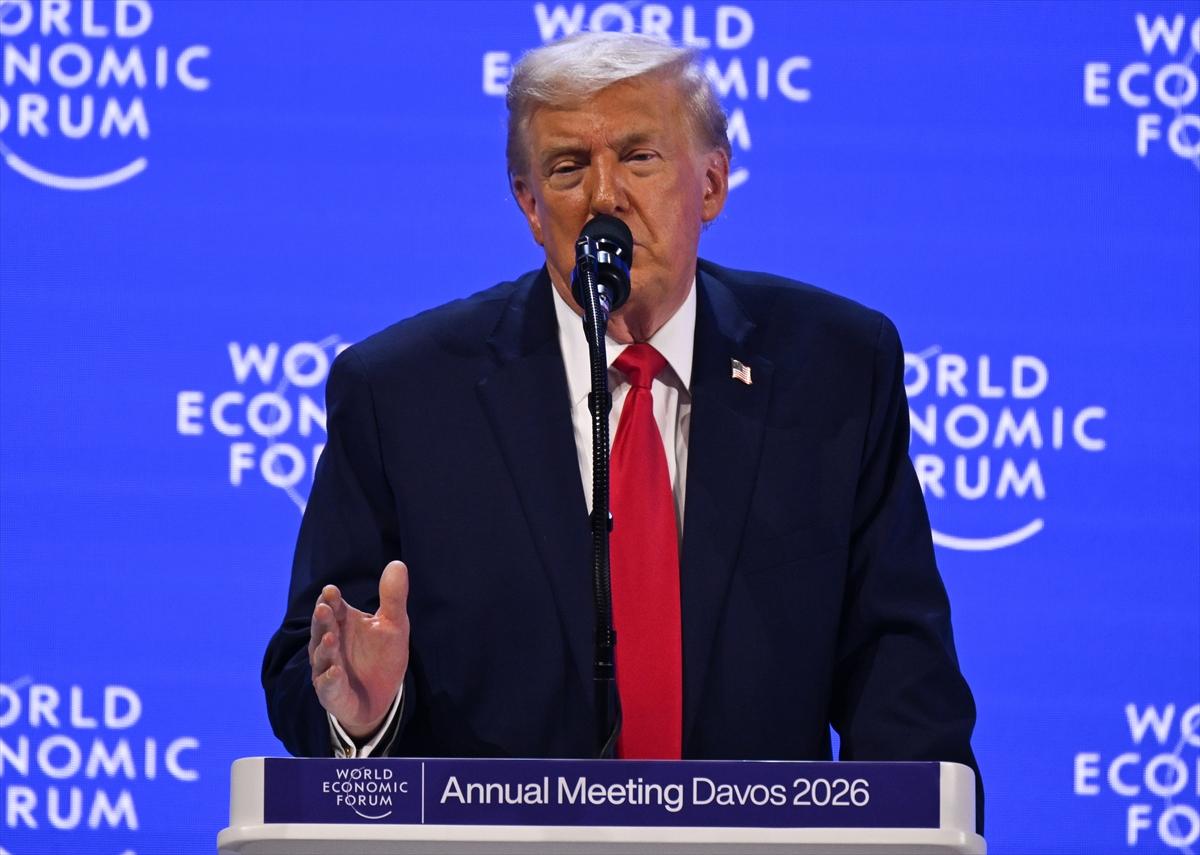
Trump’s Davos Speech. 21 January 2026 (Anadolu Ajansı)
The U.S. President clearly stated he was not considering the use of military force and underscored that coercion was not on the agenda. However, he noted that the Arctic region could play a central role in potential future conflicts and is a critical geography for missile defense planning. He assessed that Greenland’s transfer to the United States would not harm NATO but rather strengthen the alliance.
On 21 January, the Greenland government announced the preparation of an informational brochure on crisis preparedness. At a press conference held in the capital Nuuk, Greenland Minister of Fisheries, Hunting, Agriculture, Self-Sufficiency and Environment Peter Borg and Minister of Social Affairs, Housing, Infrastructure and Regional Affairs Aqqaluaq Egede made statements.
The brochure emphasized the importance of individual and societal preparedness against potential crises caused by prolonged power outages, natural disasters, supply chain disruptions, and international tensions. It stated that households must maintain basic supplies such as water, food, blankets, first-aid materials, and heating equipment. The statements also stressed the need for efforts to prevent military intervention.
On the same day, Trump responded to questions from journalists following his meeting with Egyptian President Abdulfettah es-Sisi in Davos. In response to a question regarding Greenland, he stated that the military option was not on the agenda and that he did not believe such an option would be necessary. Trump expressed confidence that Denmark was best positioned to make the appropriate decision on the matter.
On 22 January 2026, Trump answered questions from journalists following his Davos talks. Highlighting the long-term nature of the framework agreement reached with NATO on Greenland, Trump described its duration as “infinite.” It was stated that this framework was to be regarded as a final and permanent arrangement.
Trump did not clarify the details of Greenland’s status under the agreement but reiterated the decision to suspend the previously announced customs tariffs. The tariffs in question were noted to apply to Denmark, Norway, Sweden, France, Germany, the United Kingdom, the Netherlands, and Finland.
On 22 January, Danish Foreign Minister Lars Lokke Rasmussen stated that the notion of the United States acquiring Greenland was not under consideration and declared this issue a “red line” for Denmark. Rasmussen affirmed that NATO Secretary General Rutte had not negotiated on behalf of Denmark or Greenland but acknowledged the importance of his contributions to Arctic security.
On the same day, Danish Prime Minister Mette Frederiksen issued a written statement. The statement indicated openness to negotiations in areas such as politics, investment, security, and economics, but firmly stated that sovereignty was non-negotiable. Frederiksen emphasized that Arctic security was a matter of concern to NATO and affirmed Denmark’s readiness to cooperate with allies provided respect for its territorial integrity.
Danish Defense Minister Troels Lund Poulsen, in his statement, affirmed that sovereignty over any part of the kingdom would not be transferred. It was also reported that Greenland’s Foreign Minister Vivian Motzfeldt participated in the talks.
On 22 January 2026, leaders of the European Union convened in Brussels for an extraordinary summit in response to U.S. President Trump’s statements regarding Greenland and his threats of customs tariffs against European countries. The summit was attended by the heads of state or government of all 27 EU member states and chaired by EU Council President Antonio Costa.
Before the summit, EU High Representative for Foreign Affairs and Security Policy Kaja Kallas told the press that the main agenda item was transatlantic relations. Kallas noted that 2026 had begun amid an unpredictable international environment and that the Russia-Ukraine war remained a fundamental challenge to European security. She emphasized that disagreements between Europe and the United States only strengthened adversarial actors and stated that Russia and China benefited from the weakening of transatlantic ties.
In the same statements, alongside addressing threats concerning Greenland, the EU’s participation in the Peace Council established for Gaza was also raised. Kallas stated that this body must align with the framework and limited duration outlined in United Nations Security Council resolutions.
On 23 January 2026, U.S. President Trump made statements to journalists aboard his aircraft during his return flight from Davos to Washington. Trump stated that the framework agreement on Greenland reached with NATO was “indefinite” and that the United States could “do as it wished” regarding the island. These remarks implied a broad operational scope, including potential military activities.
Trump indicated that cooperation with NATO would be pursued in activities conducted in Greenland and that, aside from costly projects, primary investment would be directed toward the defense system known as the “Golden Dome.” Regarding Denmark’s approach to this process, he stated that assessments would be shared within two weeks.
On the same day, in Stockholm, Sweden’s capital, Lars Løkke Rasmussen met with Swedish Foreign Minister Maria Malmer Stenergard. In statements following the meeting, Rasmussen welcomed Trump’s decision to abandon his threat of new customs tariffs on Europe and viewed his constructive talks with NATO Secretary General on Greenland as a positive development.
Rasmussen expressed cautious optimism regarding U.S. intentions on Greenland and emphasized the necessity of establishing a healthy dialogue among Denmark, Greenland, and the United States. Swedish Foreign Minister Stenergard criticized Trump’s statements on Greenland but stressed that U.S.-Sweden relations must be viewed from a long-term perspective. She affirmed that the United States remains a vital ally to both Sweden and Denmark and that preserving transatlantic cooperation is of vital importance.
Danish Prime Minister Mette Frederiksen visited Nuuk, the capital of Greenland, where she met with Greenlandic leaders. During her visit, Frederiksen held talks with Greenlandic Prime Minister Jens-Frederik Nielsen. Following the meeting, both sides made statements to the press. Nielsen affirmed that Denmark and Greenland were acting in coordination.
In her press statement, Frederiksen acknowledged that relations with the United States remained in a difficult phase but indicated that a new diplomatic path could be explored. She emphasized that the purpose of her visit was to demonstrate Denmark’s support for Greenland. Frederiksen drew attention to the hardship faced by the Greenlandic people, affirmed Denmark’s unconditional support for Greenland, and stated that Europe stood alongside Greenland.
On 24 January 2026, the U.S. Department of Defense (Pentagon) released the 2026 National Defense Strategy document. The document defined “defense of the homeland” as the primary priority. It stated that U.S. interests in the Western Hemisphere would be actively defended, listing the Panama Canal, the Gulf of Mexico, and Greenland as critical regions requiring assured strategic access. With this document, Greenland was formally identified as one of the explicit strategic reference points in U.S. defense planning.
On 25 January 2026, statements from Reuters reported assessments by the Danish government and NATO officials regarding Arctic security. Danish Prime Minister Mette Frederiksen stated that Greenland’s affiliation with the Kingdom of Denmark was not open to debate; however, due to increased military activity in the Arctic region, she stressed the need to strengthen defense and surveillance operations. The same statements indicated that NATO was working to enhance security coordination in the region.
On 26 January 2026, Mark Rutte provided assessments regarding his meeting with U.S. President Donald Trump. Rutte clarified that Greenland’s affiliation with Denmark or its status was not discussed during the meeting. He stated that NATO’s focus was on strengthening collective defense capabilities in the Arctic and enhancing military coordination among allies. Rutte also noted that NATO member states were closely monitoring the security environment in the Arctic region.
On 27 January 2026, military presence in Nuuk, the capital of Greenland, was increased. Danish Armed Forces personnel were deployed off the coast of Nuuk Port, and it was reported that a second warship had arrived at the port in addition to the vessel already stationed there. The vessels P570 and P571 were confirmed to be stationed at the port, with security and control checkpoints established at the harbor entrance and military personnel continuing their watch duties. This military deployment followed recent international statements and defense documents highlighting Greenland’s strategic location.

U.S. President Donald Trump appointed a special envoy to Greenland on 22 December 2025, emphasizing its importance to U.S. national security. This move by Washington drew criticism from the European Union and Denmark, bringing the status of Greenland and Arctic security back onto the international agenda.
No Discussion Added Yet
Start discussion for "The United States' Policy and Diplomatic Initiatives Toward Greenland (2025)" article
December 23, 2025
U.S. Statements Regarding Greenland in 2026 and International Reactions
December 23, 2025
Denmark Government’s Official Position
December 23, 2025
NYT Allegation Regarding U.S. Military Operational Capacity in Greenland
December 23, 2025
U.S. Vice President Vance’s Statement on Europe and Greenland (January 8)
December 23, 2025
Trump’s Statement on Russia and China in Relation to Greenland (January 10)
December 23, 2025
Allegations of U.S. Military Plan for Greenland (January 11)
December 23, 2025
United Kingdom’s Plans to Deploy Troops to Greenland (January 12)
December 23, 2025
January 13, 2026 – European Union Reaffirms Support for Greenland
December 23, 2025
January 14, 2026 – Statements by Greenlandic Minister Naaja Nathanielsen
December 23, 2025
France’s Decision to Open a Consulate in Greenland (January 14)
December 23, 2025
Denmark’s Decision to Increase Its Military Presence in Greenland (January 14, 2026)
December 23, 2025
Participation of Germany and the Netherlands in the Reconnaissance Mission (14–15 January 2026)
December 23, 2025
“Operation Arctic Endurance” and European Participation (15 January 2026)
December 23, 2025
US–Denmark–Greenland Talks and White House Statements (15 January 2026)
December 23, 2025
European Military Forces Arrive in Greenland (15 January 2026)
December 23, 2025
Russia’s Response to the Arctic Issue (16 January 2026)
December 23, 2025
U.S. Delegation Meetings in Copenhagen (January 16, 2026)
December 23, 2025
U.S. Customs Tariff Decisions and Diplomatic Implications
December 23, 2025
Impact on Markets and Trade
December 23, 2025
NATO and European Leader Consultations
December 23, 2025
Deployment of U.S. Aircraft to Greenland (January 20)
December 23, 2025
January 20, 2026: U.S. President Donald Trump’s Social Media Post
December 23, 2025
Denmark’s Statement on the Use of Military Force (January 20)
December 23, 2025
January 21, 2026: Canada’s Support for Greenland and Denmark
December 23, 2025
January 21, 2026: France’s Call for a NATO Exercise
January 7, 2026
U.S. Statements Regarding Greenland in 2026 and International Reactions
January 7, 2026
Denmark Government’s Official Position
January 7, 2026
NYT Claim on U.S. Military Operational Capacity in Greenland
January 7, 2026
U.S. Vice President Vance’s Statement on Europe and Greenland (8 January)
January 7, 2026
Trump’s Statement on Russia and China in Relation to Greenland (10 January)
January 7, 2026
Allegations of U.S. Military Plan for Greenland (11 January)
January 7, 2026
United Kingdom’s Plans to Deploy Troops to Greenland (January 12)
January 7, 2026
European Union Reaffirms Support for Greenland (January 13, 2026)
January 7, 2026
January 14, 2026 – Statements by Greenlandic Minister Naaja Nathanielsen
January 7, 2026
France’s Decision to Open a Consulate in Greenland (January 14)
January 7, 2026
Denmark’s Decision to Increase Its Military Presence in Greenland (January 14, 2026)
January 7, 2026
Germany and the Netherlands Join Reconnaissance Mission (14–15 January 2026)
January 7, 2026
“Operation Arctic Endurance” and European Participation (15 January 2026)
January 7, 2026
US–Denmark–Greenland Talks and White House Statements (15 January 2026)
January 7, 2026
European Military Forces Arrive in Greenland (15 January 2026)
January 7, 2026
Russia’s Response on the Arctic (16 January 2026)
January 7, 2026
U.S. Delegation Meetings in Copenhagen (January 16, 2026)
January 7, 2026
U.S. Customs Tariff Decisions and Diplomatic Implications
January 7, 2026
Impacts on Markets and Trade
January 7, 2026
NATO and European Leader Consultations
January 7, 2026
Deployment of U.S. Aircraft to Greenland (January 20)
January 7, 2026
January 20, 2026: U.S. President Donald Trump’s Social Media Post
January 7, 2026
Denmark’s Statement on the Use of Military Force (January 20)
January 7, 2026
January 21, 2026: Canada’s Support for Greenland and Denmark
January 7, 2026
21 January 2026: France’s Call for a NATO Exercise
January 22, 2026
Davos Talks and Framework Agreement Statement with NATO
January 22, 2026
World Economic Forum Speech and Position on Greenland
January 22, 2026
Greenland Government’s Crisis Preparedness Measures
January 22, 2026
Statements on Military Options
January 22, 2026
Statements on the Duration of the Framework Agreement
January 22, 2026
Denmark’s Responses and Emphasis on the “Red Line”
January 22, 2026
22 January 2026: EU Leaders’ Extraordinary Greenland Summit
January 22, 2026
23 January 2026: Trump’s “Indefinite Agreement” Statement
January 22, 2026
Diplomatic Responses from Nordic Countries (23 January 2026)
January 22, 2026
Danish Prime Minister Mette Frederiksen’s Visit to Nuuk (23 January)
January 22, 2026
U.S. National Defense Strategy Document 2026 (24 January)
January 22, 2026
Denmark and NATO’s Emphasis on Arctic Security (25 January)
January 22, 2026
NATO Secretary General Mark Rutte’s Statements (26 January)
January 22, 2026
Deployment of Second Warship at Nuuk Port (27 January)