


What is a chemical reaction?
A chemical reaction is a significant change that occurs within the structure of substances. The atoms that make up a substance combine in different ways, bonds break, and new bonds form. As a result of this process, new substances that did not exist initially are produced. For example, hydrogen and oxygen combine to form water. This illustrates how chemical reactions produce substances with new properties through the rearrangement of atoms.

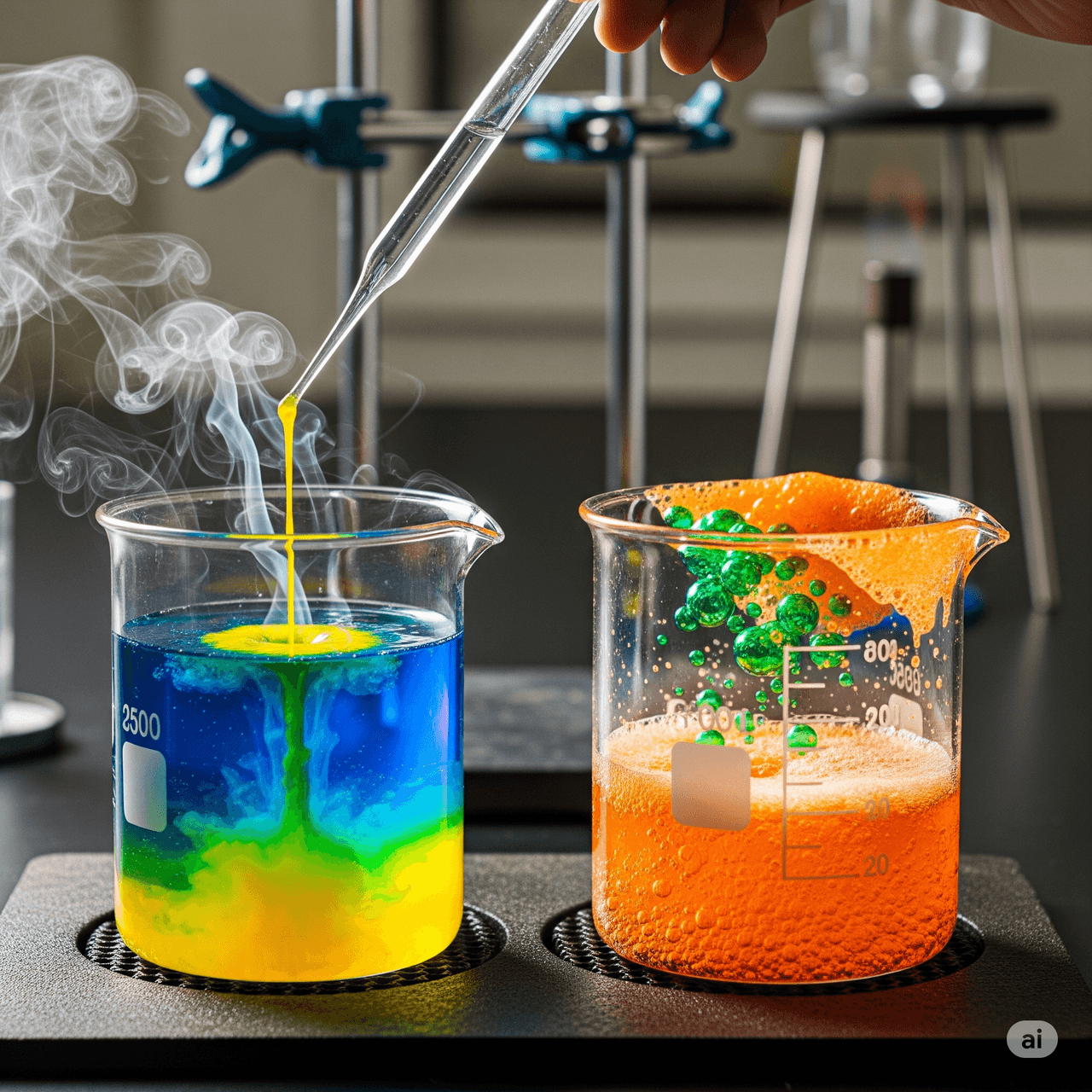
(Generated by artificial intelligence.)
How Does It Occur?
During a reaction, atoms are neither destroyed nor lost. They simply recombine in different arrangements. Therefore, in a chemical reaction, the total mass of the reactants equals the total mass of the products. This is known as the law of conservation of mass. For instance, when wood burns, ash gases and heat are produced, but the total mass remains unchanged. This demonstrates that chemical processes follow unchanging natural laws.
The Role of Energy
Energy is crucial for chemical reactions to occur. Some reactions release energy and are called exothermic reactions. For example, when a candle burns, both light and heat energy are released. Other reactions require energy input and are called endothermic reactions. Plants performing photosynthesis by using sunlight is an example of this. Energy is one of the most fundamental factors determining the rate and direction of chemical processes.
Classes of Chemical Reactions
Chemical reactions are classified into different types. Combustion, combination, decomposition, displacement, and acid–base reactions are among the best-known examples. For instance, the electrolysis of water is a decomposition reaction. The mixing of vinegar with carbonate is an acid–base reaction. These classifications help us understand different phenomena more easily.

(Generated by artificial intelligence.)
Reactions in Daily Life
Chemical reactions are present everywhere in life. The rusting of iron over time, bread baking in an oven, the use of oxygen during breathing, and the digestion of food in the stomach are all chemical processes. These examples show that reactions do not occur only in laboratories but continue constantly throughout nature and life. Thus, children can use their knowledge of chemistry to understand events around them.
Importance for Children
Learning about chemical reactions helps children better understand nature. Even the most basic needs of daily life—drinking water, eating food, and breathing—are dependent on chemical processes. Therefore, chemistry is not only found in textbooks but is present in every moment of life. Children who learn how reactions work develop scientific thinking skills and gain a better ability to explain the phenomena they observe in their environment.
Note: Please conduct experiments like this either with the supervision of an expert or under the guidance of a family member.